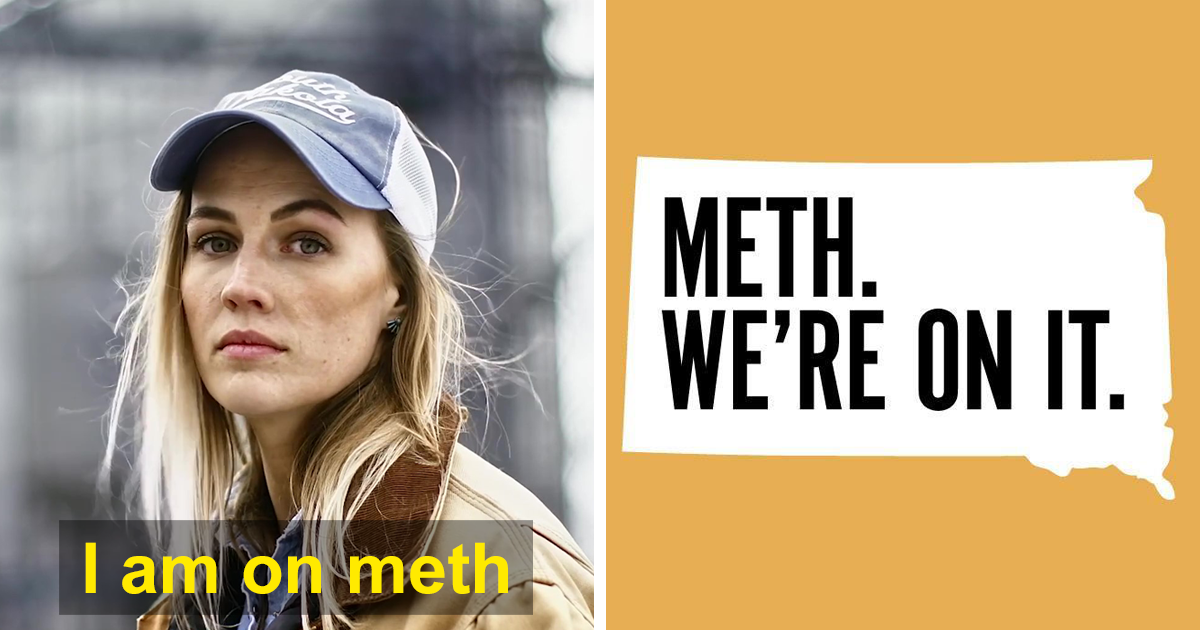
There are bad slogans, there are confusing slogans, and then there is Meth. We’re On It. That one didn’t just walk into the national conversation. It kicked the door open, waved awkwardly, and somehow introduced an entire state like it was making a group confession.
When South Dakota rolled out the campaign in 2019, the internet reacted exactly the way the internet reacts when handed a phrase that sounds like a public-health message and a self-own at the same time. Memes flew. Late-night jokes practically wrote themselves. Marketing people winced so hard they may have needed ice packs. And yet the story was never just about a clunky slogan. Behind the accidental comedy was a very real meth problem, a serious policy debate, and a bigger question that still matters today: if a campaign grabs attention but mangles its message, is that a success or a very expensive faceplant?
This is what made the South Dakota anti-meth campaign so fascinating. It was part cautionary tale, part public-health experiment, part internet circus. And depending on where you stood, it was either a bold attempt to force people to talk about addiction or proof that awareness campaigns can drift into parody when they confuse shock value with clarity.
How South Dakota ended up with America’s most accidentally hilarious slogan
The campaign launched under Governor Kristi Noem as part of a statewide effort to tackle what officials described as a growing methamphetamine crisis. The state said meth was straining families, filling jails, crowding court systems, and stretching treatment capacity. The broader campaign budget was close to $1.4 million, and about $449,000 of that went to the Minneapolis-based agency that developed the slogan and creative materials.
That money bought more than one line. The state rolled out a full awareness package: television ads, public service announcements, billboards, posters, radio spots, digital content, and a website designed to point people toward prevention, treatment, and recovery resources. In other words, this was not a random billboard that escaped a brainstorming session. It was a fully funded, carefully launched public campaign.
Its core idea was that meth was not just “somebody else’s problem.” The line was supposed to mean that everyone in South Dakota needed to get on the issue. State officials said they wanted a slogan that was provocative enough to cut through the noise. They did not want another forgettable anti-drug campaign full of gloomy stock photos and generic warnings. Mission accomplished, at least on the “not forgettable” part.
The problem was that the slogan’s intended meaning and its obvious meaning got into a fistfight in public. When people saw “Meth. We’re On It.” next to images of ordinary South Dakotans, many read it less as “we are addressing the problem” and more as “hello, yes, everyone here uses meth.” That is not ideal messaging. That is a branding boomerang.
The real meth crisis behind the punch line
For all the mockery, the state was not inventing the crisis. South Dakota officials pointed to alarming indicators. They said treatment demand had surged in recent years, youth meth exposure was higher than the national average, and meth was deeply entangled with the criminal-justice system. Reports at the time cited a 200% increase in people seeking treatment for meth-related addiction from 2014 to 2018. Officials and news coverage also highlighted that South Dakota youth, especially those in the 12-to-17 range, reported meth use at rates roughly double the national average.
That is the part of the story people often forget because the slogan was so absurdly memeable. Meth was not a niche issue in South Dakota. Coverage at the time described it as a statewide problem touching schools, homes, rural communities, and the courts. One widely cited figure said methamphetamine was tied to roughly 83% of controlled-substance court admissions in the state during 2019. Another statistic shared during the rollout said thousands of arrests were connected to meth, while overdose deaths and treatment strain added urgency.
So yes, the campaign sounded like a joke. But the problem behind it was not one. That contrast is what gave the whole episode its weird power. The internet wanted to laugh, while public-health officials wanted people to pay attention. Both impulses showed up at once, and neither completely canceled out the other.
Why the slogan exploded online
The campaign went viral because it broke a basic rule of mass communication: if your audience can misunderstand you in one second, they probably will. And if that misunderstanding is funnier than your actual message, you have basically handed social media a loaded confetti cannon.
People did not need a decoder ring to make jokes about “I’m on meth” posters featuring teachers, parents, farmers, football players, and coffee-shop customers. The phrase was short, blunt, and catastrophically easy to remix. It sounded like a confession, not a call to action. The internet, being the internet, treated it like a gift basket.
That made the campaign a master class in the difference between attention and comprehension. Plenty of people saw it. Plenty of people repeated it. But repeating a slogan is not the same as understanding it. A public-health campaign can be famous and still be muddy. In fact, that was the whole problem here: the slogan was incredibly efficient at getting noticed and weirdly inefficient at making sense.
From a pure marketing standpoint, it was almost too clever for its own good. The line relied on a double meaning, but only one of those meanings landed instantly. Unfortunately for South Dakota, the wrong one was funnier, faster, and much more portable online.
The state’s defense: awkward, yes, but unforgettable
State officials did not retreat. In fact, they leaned in. Governor Noem argued that the backlash proved the campaign was working because it got people talking about meth. That was not an unreasonable defense on its face. Awareness campaigns often struggle to break through public numbness, especially when audiences feel they have seen every warning label already. If people were suddenly discussing meth, then one could argue the campaign had at least opened the door.
Supporters also said the campaign tried to do something other anti-drug messages often fail to do: widen the frame. Instead of presenting meth addiction as a problem belonging to some distant, stigmatized “other,” the campaign tried to tell South Dakotans that addiction affects entire communities. Parents, teachers, coworkers, law enforcement, neighbors, and friends all have a role in prevention, intervention, and recovery. That idea itself was not foolish. In fact, it was arguably the campaign’s strongest concept.
And later campaign-side case studies boasted that the rollout generated massive attention, huge media impressions, and extraordinary social chatter. In a narrow awareness sense, the campaign undeniably traveled. It did not disappear into the background. It grabbed the country by the collar and made itself impossible to ignore.
But public-health communication is not a talent show. Being impossible to ignore is only useful if people leave with the right message. Otherwise, you are not educating the public; you are just setting taxpayer money on fire in a very visible way.
Critics said the campaign confused branding with policy
That was the main criticism from opponents: even if the slogan got attention, awareness alone does not solve addiction. Civil-liberties advocates and policy critics argued that South Dakota’s response to meth leaned too heavily on arrests, incarceration, and tough-on-crime politics while not doing enough to address treatment access, long-term recovery, and structural causes. To them, the campaign looked like a glossy wrapper on a harder and messier policy problem.
Some critics also questioned the optics of paying an out-of-state ad firm to create a slogan that quickly became a national joke. Others argued that a campaign about addiction should be clearer, more compassionate, and less vulnerable to accidental mockery. When a message about a deadly drug gets turned into a punch line, the concern is not just embarrassment. The concern is whether people struggling with addiction feel seen at all.
That is a fair point. Public-health messaging lives in a tricky space. It has to be visible without being exploitative, memorable without being careless, and emotionally powerful without reducing real human suffering to a catchphrase. South Dakota tried to be edgy and communal at the same time. The result was a slogan that was communal in theory and deeply chaotic in practice.
Did the campaign work, or did it just go viral?
This is where the story gets a little slippery. If the question is whether the campaign generated awareness, the answer is yes. Absolutely. Wildly. There was more attention on South Dakota’s meth campaign than most state public-service ads could dream of. The rollout earned national coverage, social media momentum, and enough conversation to dominate headlines for days.
If the question is whether the campaign changed behavior, reduced meth use, or dramatically improved outcomes on its own, the case is much harder to prove. Awareness is measurable in impressions, mentions, clicks, and chatter. Recovery is harder. Prevention is harder. Long-term behavior change is hardest of all.
That distinction matters. A campaign can “work” in the narrow sense that people saw it and discussed it. But the public usually hears the word worked and thinks it means fewer addictions, fewer overdoses, stronger treatment uptake, healthier families, and safer communities. Those are much bigger claims. And based on the public evidence available from the rollout period, it is easier to say the campaign succeeded as a conversation starter than as a clearly proven fix.
In plain English: it won the battle for attention, but the war against meth was always going to require much more than a slogan with the subtlety of a brick through a window.
What this episode says about modern public-health marketing
The South Dakota campaign became a small classic in communications circles because it exposed a modern dilemma. In the internet era, boring messages vanish. But messages designed for maximum shock can mutate into comedy before their serious point arrives. That is especially dangerous when the topic is addiction, because addiction already carries stigma, shame, and misunderstanding.
The campaign also showed that virality is not neutral. People often say, “Well, at least everyone’s talking about it,” as if attention automatically counts as progress. Sometimes it does. Sometimes it just creates noise. In this case, the campaign managed to raise awareness and raise eyebrows at the exact same time. That is not nothing, but it is not the same thing as building trust.
If there is a lesson here for future public-health campaigns, it is probably this: be bold, but do not make the audience solve a riddle. Clarity matters. So does dignity. A strong campaign can be emotionally sharp without sounding like it lost a bet.
South Dakota wanted a line that felt urgent, local, and impossible to ignore. It got all three. It just also got a fourth thing nobody wants in government communications: a slogan that looked like it belonged on a parody T-shirt.
Additional perspectives and experiences related to the campaign
To understand why this campaign still gets talked about, it helps to think about the experience of encountering it from different angles. For people outside South Dakota, the first experience was usually laughter. They saw the slogan, read it literally, and assumed the whole state had accidentally hired a copywriter from a sitcom. It was the kind of message that made people stop scrolling, blink twice, and send it to a friend with some version of, “You cannot be serious.”
But for many South Dakotans, the experience was probably more complicated than a punch line. Imagine living in a place where meth really is affecting schools, courtrooms, treatment centers, and family life, and then watching your state become nationally famous for a slogan that sounds like a collective confession. That has to be a strange emotional cocktail: embarrassment, defensiveness, frustration, and maybe a little grim agreement that yes, the problem really is serious, even if the wording landed like a banana peel.
For families dealing with addiction, the campaign likely felt even more layered. On one hand, there may have been some relief in seeing the state admit that meth was not confined to stereotypes or hidden corners. The campaign’s underlying point was that addiction touches whole communities, not just the people who use the drug. That message can matter. It tells parents, siblings, spouses, teachers, and neighbors that they are not imagining the scale of the problem.
On the other hand, the rollout may also have felt awkwardly impersonal. Addiction is already humiliating for many people. Recovery is often fragile. If the first thing a campaign does is become a meme, some people will inevitably wonder whether the public is laughing at the slogan, the government, or the crisis itself. Those are very different targets, but in real life they can blur together fast.
There is also the experience of the professionals in the middle: counselors, prevention workers, teachers, social workers, and law-enforcement officers. For them, the slogan probably mattered less than whether it actually moved people toward treatment, school-based prevention, or community support. A flashy awareness campaign can create a short-term spike in attention, but it also raises expectations. If people are suddenly looking for help, the system has to be ready. If it is not, awareness starts to feel like theater.
Then there is the marketing lesson, which still fascinates people because it was so public and so weird. The campaign showed what happens when a message is optimized for disruption without being fully protected against misreading. In a conference room, the line may have sounded provocative, modern, and broad-based. In the real world, it landed in the exact environment where ambiguity goes to get roasted alive.
That is why the campaign remains memorable. It was not just a failed joke or a successful stunt. It was a collision between genuine public concern and internet-era message distortion. The lived experience of that collision was messy. People laughed, people argued, people rolled their eyes, and some people likely found resources because they looked the campaign up after the headlines. That mix is what made the whole saga feel so American: serious problem, strange branding, endless debate, and a national audience ready to turn policy into a meme before lunch.
Conclusion
South Dakota’s anti-meth campaign remains one of the most unforgettable public-health rollouts in recent memory, not because it was elegant, but because it was impossible to look away from. The state spent about $449,000 on a slogan that sounded like a confession, launched it into a meth crisis that was very real, and then watched the country turn it into a punch line within hours. That does not make the campaign meaningless. It makes it revealing.
The whole saga exposed a basic truth about public messaging: attention is powerful, but clarity is priceless. South Dakota succeeded in making people talk about meth. What it did not fully do was control how they talked about it. And that gap between intention and interpretation is where the campaign will live foreverhalf warning, half meme, all case study.