Could a routine mammogram do double duty for women’s health? That question is getting louder as researchers explore whether machine learning can analyze mammogram images not only for breast cancer signs, but also for clues about future heart disease risk. It sounds a little like asking your refrigerator to do your taxes, but in medicine, images often contain more information than humans can easily see at first glance.
Harvard Health recently highlighted research suggesting that a deep machine learning tool may help estimate a woman’s 10-year risk of major cardiovascular problems using routine mammogram images plus age. The idea is not that mammograms diagnose heart disease. They do not. Instead, the images may reveal patterns such as breast arterial calcification, breast density, and other subtle features that correlate with cardiovascular risk. In plain English: a scan already used for breast cancer screening may also contain useful heart-health signals hiding in the background.
This matters because heart disease remains the leading cause of death among women in the United States, yet many women still think of it as a “men’s problem.” That outdated myth needs to retire immediately, preferably somewhere with no Wi-Fi. Women can develop coronary artery disease, heart failure, stroke, high blood pressure, and other cardiovascular conditions, sometimes with symptoms that are easy to overlook or misread. If artificial intelligence can help identify risk earlier, mammograms may become part of a broader prevention conversation.
What Did the Machine Learning Mammogram Study Find?
The study summarized by Harvard Health examined data from more than 49,000 women who had undergone routine mammography. Researchers used a deep learning model to analyze mammogram features and age, then compared the tool’s ability to predict major cardiovascular events over time with commonly used heart disease risk calculators. The outcomes included first heart attack, stroke, coronary artery disease, and heart failure.
Over a median follow-up of nearly nine years, thousands of participants experienced a first major cardiovascular event. The machine learning model performed about as well as established risk prediction methods that typically require clinical information such as blood pressure, cholesterol levels, diabetes status, smoking history, and medication use. That is what makes the finding so interesting: the algorithm used information already captured during breast cancer screening, plus age.
To be clear, this does not mean your next mammogram will automatically come with a crystal ball, a confetti cannon, and a personalized heart plan. The research is promising, but it is still part of an evolving field. Before these tools become routine clinical practice, they need validation across diverse populations, clear reporting standards, patient-friendly explanations, and guidance on what doctors should do with the results.
How Can a Mammogram Show Clues About Heart Disease?
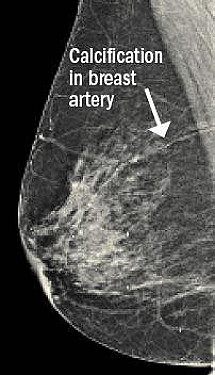
A mammogram is an X-ray image of breast tissue. Its main job is to detect early signs of breast cancer, but it may also show calcium deposits in the arteries of the breast. This is called breast arterial calcification, or BAC. On mammograms, calcifications can appear as bright white lines or spots. Some breast calcifications are related to benign breast changes or, less commonly, cancer-related concerns. Breast arterial calcification is different because it forms in blood vessel walls.
BAC is not the same thing as coronary artery calcification, which occurs in the arteries that supply blood to the heart. However, research has linked BAC with higher risk of cardiovascular disease in some women. Think of it as a smoke alarm in another room: it does not prove there is a fire in the kitchen, but it tells you to look more carefully.
Machine learning takes this a step further. Instead of relying only on whether a radiologist notes visible breast arterial calcification, an algorithm can scan the entire image for many patterns at once. It may evaluate vessel calcification, tissue density, image texture, and other features that are difficult to summarize with the human eye. This is where artificial intelligence becomes useful: not because it is “smarter” than doctors, but because it can process huge numbers of image details consistently and quickly.
Why Women’s Heart Disease Risk Is Often Missed
Cardiovascular disease in women has been underrecognized for decades. Many people know mammograms are important, but fewer understand that blood pressure checks, cholesterol testing, diabetes screening, sleep quality, smoking status, physical activity, and family history are also part of women’s long-term health protection.
Women may also experience heart disease symptoms differently. Chest pressure can happen, but so can shortness of breath, nausea, back pain, jaw pain, unusual fatigue, indigestion-like discomfort, dizziness, or a sense that something is simply “off.” Unfortunately, “something feels off” is not always treated with the urgency it deserves, especially when life is busy and everyone expects women to keep functioning like a fully charged phone.
Traditional heart risk calculators are useful, but they are not perfect. Some tools were historically developed from populations that did not fully represent women or diverse racial and ethnic groups. Younger women may also be labeled low risk because age weighs heavily in many calculators, even when they have important warning signs such as high blood pressure, diabetes, pregnancy-related complications, early menopause, autoimmune disease, or a strong family history of premature heart disease.
What Makes Machine Learning Different?
Machine learning is a form of artificial intelligence that learns patterns from data. In medical imaging, deep learning models can be trained on large collections of images linked to health outcomes. If thousands of mammograms are connected with years of follow-up data, an algorithm can learn which visual patterns tend to appear in women who later develop cardiovascular events.
The model does not “understand” heart disease the way a cardiologist does. It identifies statistical relationships. That distinction is important. A machine learning prediction should not replace a medical evaluation, but it may help flag patients who deserve closer attention.
A Simple Example
Imagine two women, both age 58, both with mammograms that show no cancer. One mammogram shows no obvious vascular calcification, while the other shows breast arterial calcification and other image patterns associated with higher cardiovascular risk. If an AI model can identify that second woman as needing a heart-health conversation, it may prompt earlier blood pressure treatment, cholesterol testing, lifestyle support, or a referral for additional risk assessment.
That early nudge could be valuable. Heart disease prevention works best before the emergency happens. No one wants their first “cardiology appointment” to begin with flashing ambulance lights.
What Is Breast Arterial Calcification?
Breast arterial calcification is calcium buildup in the middle layer of breast artery walls. It is usually not considered a sign of breast cancer. It is more common with aging and has been associated with conditions such as high blood pressure, diabetes, chronic kidney disease, and inflammation. Researchers are especially interested in BAC because it may reveal vascular aging in women.
Several studies have found that women with BAC may have higher rates of heart disease, stroke, heart failure, or other cardiovascular outcomes compared with women without BAC. The strength of the relationship varies among studies, and BAC is not currently treated as a stand-alone diagnosis. Still, it may be a useful signal when combined with traditional risk factors.
The American College of Cardiology has noted that finding BAC does not mean a woman currently has heart disease. Instead, it may indicate increased risk over time. That difference matters. A risk marker is not a verdict. It is a reason to ask better questions.
Could Mammograms Become a “Two-for-One” Screening Tool?
The most exciting possibility is efficiency. Millions of women already receive mammograms as part of breast cancer screening. If the same images can help identify cardiovascular risk without extra radiation, extra imaging time, or a separate appointment, the public health potential is significant.
This does not mean mammograms should be ordered for heart disease screening alone. Mammography remains a breast cancer screening tool. But when a woman is already getting a mammogram, it may make sense to extract more useful health information from the image if the science supports it and the clinical workflow is ready.
Doctors call this “opportunistic screening.” In normal-person language, it means: “Since we already have the image, can we learn something else useful from it?” That idea is gaining traction in many areas of medical imaging, from detecting bone density clues on CT scans to identifying coronary calcium on scans performed for other reasons.
What Should Patients Do If Their Mammogram Mentions Calcification?
If your mammogram report mentions breast arterial calcification, do not panic. Also, do not ignore it. The smart move is to bring the report to your primary care doctor, gynecologist, or cardiologist and ask whether it changes your cardiovascular risk assessment.
Your clinician may review your blood pressure, cholesterol numbers, A1C or blood sugar, family history, smoking history, kidney function, weight, physical activity, menopause history, pregnancy complications, and medications. Depending on your overall risk, they may recommend lifestyle changes, more frequent monitoring, statin therapy, blood pressure treatment, or additional testing such as a coronary artery calcium scan.
One key point: BAC findings are not always routinely reported. Some radiologists mention them; others may not. Reporting standards are still evolving. As machine learning tools become more available, healthcare systems will need to decide how to present results in a way that is accurate, understandable, and actionable.
What Are the Limitations of AI Mammogram Heart Prediction?
Machine learning in medicine can be powerful, but it is not magic. Algorithms depend on the data used to train them. If a model is developed mainly from one country, healthcare system, age group, or imaging technology, it may not perform equally well everywhere. That is why validation in diverse populations is essential.
Another challenge is clinical action. Suppose an AI tool labels a woman as higher risk. What exactly should happen next? Should she receive a cholesterol test? A coronary calcium scan? A cardiology referral? A lifestyle program? Medication? The answer depends on the full clinical picture. Without clear guidelines, AI risk scores can create confusion instead of clarity.
There are also concerns about anxiety and overtesting. A risk alert can motivate healthy change, but it can also scare people. Good communication is crucial. Patients need to understand that risk prediction is not diagnosis, and a higher-risk result does not mean a heart attack is waiting around the corner wearing sunglasses.
Heart Disease Prevention Still Starts With the Basics
Even the most sophisticated AI tool cannot replace the fundamentals of heart health. The core prevention steps remain refreshingly low-tech: know your blood pressure, understand your cholesterol, avoid tobacco, move your body, eat more fiber-rich foods, manage blood sugar, prioritize sleep, reduce excess alcohol, and work with your clinician on weight, stress, and medication decisions when needed.
The American Heart Association’s prevention framework emphasizes habits such as eating better, being active, quitting tobacco, getting healthy sleep, managing weight, controlling cholesterol, managing blood sugar, and managing blood pressure. These habits are not trendy, but they are powerful. They are also cheaper than waiting for a crisis.
Questions to Ask Your Doctor
- Did my mammogram report mention breast arterial calcification?
- Do I need a heart disease risk assessment?
- What are my most recent blood pressure, cholesterol, and blood sugar numbers?
- Do my pregnancy history, menopause timing, autoimmune conditions, or family history affect my risk?
- Would additional testing, such as coronary artery calcium scoring, be appropriate for me?
- What lifestyle changes would make the biggest difference for my personal risk profile?
How This Research Could Change Preventive Care
If future studies confirm that machine learning mammogram analysis reliably predicts cardiovascular risk, preventive care for women could become more integrated. Instead of treating breast screening and heart screening as completely separate lanes, healthcare teams could use one appointment to open two important conversations.
For health systems, this could improve risk detection without requiring every patient to schedule another visit. For clinicians, it could provide a visual risk marker that encourages action. For patients, it could make heart disease prevention feel more concrete. Many people struggle to respond to abstract risk percentages, but seeing evidence of vascular calcification on an image may feel more immediate.
Still, implementation must be thoughtful. AI tools should be transparent, tested for bias, integrated into electronic health records carefully, and paired with clinical guidance. Patients should not receive alarming messages without context. Doctors should not receive alerts without time or resources to act on them. Technology is useful only when it improves care, not when it adds another blinking box to an already crowded screen.
Real-Life Experiences and Practical Reflections
To understand why this topic matters, imagine the experience of a woman named Karen, a composite example based on common clinical scenarios. Karen is 61, busy, and generally healthy. She gets her mammogram every two years, but she has not had a full heart-health check in a while because, like many people, she feels fine. Her mammogram shows no breast cancer, which is wonderful news. But the report also mentions breast arterial calcification. At first, Karen is confused. “Wait, I came here for breast screening. Why are we talking about arteries?”
That moment could become a turning point. Karen brings the report to her primary care doctor. They review her blood pressure, which has been creeping upward. Her LDL cholesterol is higher than ideal, and her father had a heart attack in his early 60s. None of these facts alone felt urgent to Karen before. Together, they create a clearer picture. Her doctor recommends a structured plan: more consistent exercise, a Mediterranean-style eating pattern, home blood pressure tracking, repeat labs, and a discussion about cholesterol-lowering medication. The mammogram did not diagnose heart disease, but it helped start a conversation Karen might otherwise have delayed.
Now consider another composite example: Denise, age 47, who has a normal mammogram and no obvious breast arterial calcification, but she has diabetes and high blood pressure. A low-risk mammogram-based AI result would not mean she can ignore those conditions. This is where patient education becomes essential. AI image analysis may add information, but it does not erase traditional risk factors. Denise still needs evidence-based prevention, medication adherence, nutrition support, and regular follow-up.
In clinical practice, the best use of mammogram-based heart prediction may be as a conversation starter rather than a final answer. Many women are excellent at scheduling screenings for others, remembering appointments, managing family logistics, and somehow knowing where the missing charger is. But their own heart health can slide to the bottom of the list. A mammogram report that includes cardiovascular risk clues could help move prevention back up the priority ladder.
There is also an emotional side. Some patients may feel anxious when an unexpected finding appears on a report. Others may feel grateful for early warning. The difference often comes down to explanation. A helpful clinician might say, “This does not mean you have heart disease today. It means we should look at your overall risk and make sure we are not missing an opportunity to prevent problems later.” That kind of language is calm, accurate, and empowering.
For healthcare teams, experience will matter too. Radiologists, primary care doctors, cardiologists, and gynecologists will need shared workflows. If BAC is reported, who follows up? If AI assigns a risk category, where does it appear? What message does the patient receive? Who explains it? These details may sound boring, but they are the plumbing of good healthcare. And as anyone who has ever had actual plumbing trouble knows, the boring parts matter a lot when they stop working.
The biggest lesson from this emerging field is not that machines are replacing clinicians. It is that familiar tests may have hidden value when interpreted with better tools. Mammograms already save lives through breast cancer detection. If machine learning can also help identify women who need earlier heart disease prevention, the same appointment could become even more powerful. That is not science fiction. It is the practical future of smarter, more connected preventive care.
Conclusion: A Promising Signal, Not a Stand-Alone Diagnosis
Machine learning used on mammograms may help predict heart disease by identifying image-based patterns linked to cardiovascular risk. The research highlighted by Harvard Health is promising because it suggests that routine mammography, combined with age and AI analysis, may perform similarly to traditional risk calculators in predicting major cardiovascular events.
But this technology should be viewed as an added tool, not a replacement for medical care. Women should continue recommended breast cancer screening and also stay proactive about heart health. If a mammogram report mentions breast arterial calcification, it is worth discussing with a clinician. If it does not, traditional risk factors still matter. Blood pressure, cholesterol, blood sugar, smoking, physical activity, sleep, family history, and menopause-related changes remain central pieces of the prevention puzzle.
The future may bring mammogram reports that offer more than breast cancer findings. With careful validation and smart clinical use, AI could help turn routine imaging into a wider window into women’s health. That is a big idea from a familiar testand a reminder that prevention often begins with noticing what was already there.
Note: This article is for educational purposes only and should not replace personalized medical advice from a qualified healthcare professional.