Note: This article is written in standard American English and is based on established astronomy information from reputable educational, scientific, and astronomy sources.
Introduction: The Moon Is Not Playing Hard to GetIt Has a Schedule
Few sights are as quietly dramatic as the Moon hanging in the sky, glowing like nature’s own night-light. But if you have ever looked up and wondered, “Is the Moon getting bigger or smaller?” you are not alone. Many people can spot a crescent, a half moon, or a full moon, but figuring out whether the Moon is waxing or waning can feel like decoding a celestial emoji.
The good news is that the Moon is surprisingly predictable. It follows a repeating cycle of phases as it orbits Earth. Once you understand a few simple clueswhere the light appears, what time the Moon rises, and how the phases move in orderyou can tell whether the Moon is waxing or waning without needing a telescope, astronomy degree, or dramatic wizard robe.
This guide explains how to identify a waxing Moon, how to recognize a waning Moon, and how to remember the difference using practical tricks. By the end, you will be able to look at the night sky and say, with calm confidence, “Ah yes, waxing gibbous,” which is also an excellent way to sound mysterious at a backyard barbecue.
What Does “Waxing” Mean?
In astronomy, waxing means the illuminated portion of the Moon that we see from Earth is increasing. In plain English, the Moon appears to be growing brighter and larger night after night.
The waxing phase begins just after the new moon, when the Moon is almost invisible from Earth. As the days pass, a thin crescent of light appears. That crescent grows into a half moon, then a larger gibbous shape, and finally becomes a full moon.
Simple Definition of a Waxing Moon
A waxing Moon is a Moon that is moving from new moon toward full moon. Its visible light is increasing.
Think of waxing like “building.” The Moon is building toward fullness. It starts as a tiny silver fingernail and gradually becomes a bright, round disk. Very productive behavior for a rock in space.
What Does “Waning” Mean?
Waning means the illuminated portion of the Moon that we see from Earth is decreasing. After the full moon, the bright disk begins to shrink night by night.
The waning phase begins just after the full moon. The Moon moves from full to waning gibbous, then to third quarter, then to waning crescent, and finally returns to new moon.
Simple Definition of a Waning Moon
A waning Moon is a Moon that is moving from full moon back toward new moon. Its visible light is decreasing.
Think of waning like “withdrawing.” The Moon is slowly dimming, trimming itself down until it disappears into the new moon phase and starts the whole cycle again.
The Moon Phase Cycle in Order
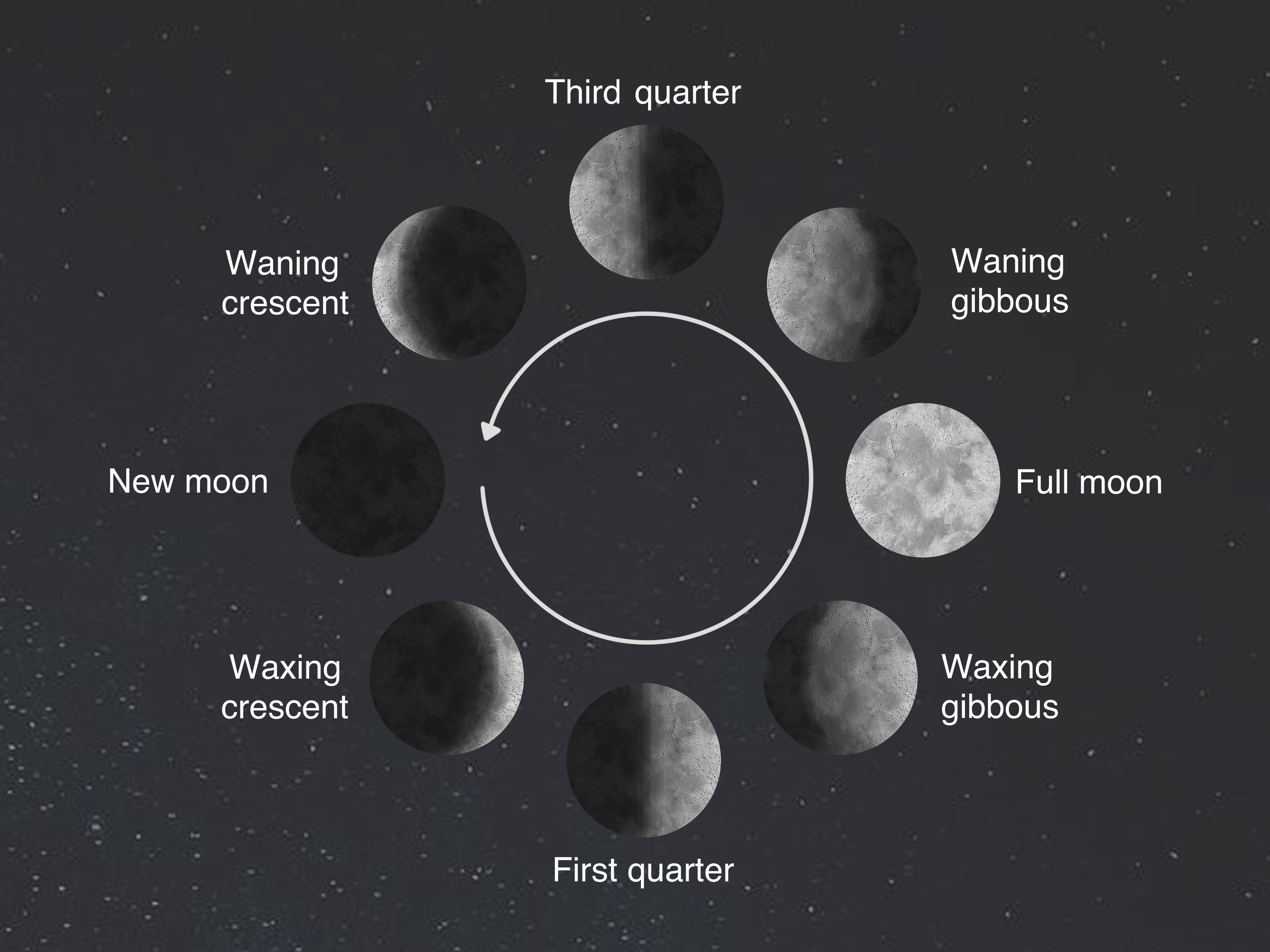
To tell whether the Moon is waxing or waning, it helps to know the complete order of the Moon phases. The lunar cycle takes about 29.5 days, which is why the Moon seems to change shape throughout the month.
The Eight Main Moon Phases
- New Moon: The Moon is between Earth and the Sun, and the side facing Earth is mostly dark.
- Waxing Crescent: A small sliver of light appears and grows larger.
- First Quarter: Half of the Moon’s visible face is illuminated, and the light is increasing.
- Waxing Gibbous: More than half of the Moon is illuminated, but it is not yet full.
- Full Moon: The entire visible face of the Moon is illuminated.
- Waning Gibbous: The Moon is still mostly bright, but the light is decreasing.
- Third Quarter: Half of the Moon’s visible face is illuminated again, but now the light is shrinking.
- Waning Crescent: A thin crescent remains before the Moon becomes new again.
The key is this: waxing happens before the full moon, and waning happens after the full moon. If the Moon is on its way to becoming full, it is waxing. If it has already passed full and is losing light, it is waning.
The Easiest Way to Tell: Look at the Lit Side
For observers in the Northern Hemisphere, including most of the United States, the easiest visual clue is the side of the Moon that is illuminated.
Northern Hemisphere Rule
If the right side of the Moon is lit, the Moon is usually waxing. If the left side of the Moon is lit, the Moon is usually waning.
Here is the quick version:
- Right side bright: Waxing Moon
- Left side bright: Waning Moon
This rule works well for people in the Northern Hemisphere. A waxing crescent looks like a curved sliver of light on the right side. A waning crescent looks like a curved sliver of light on the left side.
Southern Hemisphere Rule
In the Southern Hemisphere, the pattern appears reversed. If the left side is illuminated, the Moon is generally waxing. If the right side is illuminated, it is generally waning.
This happens because people in different hemispheres view the Moon from different orientations. The Moon itself has not changed its mind; your viewpoint has.
Use the “D, O, C” TrickCarefully
Some skywatchers use the letters D, O, C to remember moon phases. In the Northern Hemisphere, a waxing Moon may resemble the curved side of a capital “D,” a full moon resembles an “O,” and a waning Moon may resemble a “C.”
So the pattern can look like this:
- D shape: Waxing
- O shape: Full
- C shape: Waning
This memory trick is handy, but it is not universal. In the Southern Hemisphere, the visual pattern is flipped. Also, the Moon may appear tilted depending on your location, the season, and the time of night. Use this trick as a friendly helper, not as a sacred moon law carved into a space tablet.
Check the Time the Moon Rises
Another way to tell whether the Moon is waxing or waning is to pay attention to when it appears in the sky. Moonrise times shift later each day as the Moon moves through its orbit around Earth.
Waxing Moon Timing
A waxing Moon is usually visible in the afternoon or evening. A waxing crescent may appear low in the western sky shortly after sunset. A first quarter Moon often rises around midday and is visible during the evening. A waxing gibbous Moon rises in the afternoon and shines brightly into the night.
Waning Moon Timing
A waning Moon is more likely to be visible late at night, after midnight, or in the morning sky. A waning gibbous Moon rises after sunset and remains visible into the morning. A third quarter Moon often rises around midnight. A waning crescent appears before sunrise, glowing quietly while many people are still arguing with their alarm clocks.
Here is a simple guide:
- Visible after sunset in the evening: Often waxing
- Visible after midnight or before sunrise: Often waning
This method is especially useful when the Moon looks close to half full and you are not sure which side is brighter.
Waxing Crescent vs. Waning Crescent
A crescent Moon is one of the easiest phases to recognize, but it can still raise the big question: is it waxing or waning?
Waxing Crescent
A waxing crescent appears shortly after the new moon. It is a thin sliver of light that grows larger each night. In the Northern Hemisphere, it is usually lit on the right side and appears in the western sky after sunset.
Example: You step outside after dinner and see a delicate crescent low in the sky. If you are in the United States and the right side is glowing, you are likely looking at a waxing crescent.
Waning Crescent
A waning crescent appears near the end of the lunar cycle. It is also thin, but it is shrinking night by night. In the Northern Hemisphere, it is usually lit on the left side and appears in the eastern sky before sunrise.
Example: You wake up early, stumble toward the coffee maker, and notice a slim crescent in the dawn sky. If its left side is glowing, it is probably a waning crescent.
Waxing Gibbous vs. Waning Gibbous
A gibbous Moon is more than half illuminated but not completely full. The word “gibbous” sounds like a minor goblin from a fantasy novel, but it simply means rounded or bulging.
Waxing Gibbous
A waxing gibbous Moon appears after first quarter and before full moon. It grows larger each night. In the Northern Hemisphere, the right side is usually bright, and the shadow is on the left.
This phase is bright enough to light up the landscape and is often visible in the evening. If the Moon looks almost full but not quite there yet, and it is getting brighter night after night, it is waxing gibbous.
Waning Gibbous
A waning gibbous Moon appears after the full moon and before third quarter. It is still very bright, but the illuminated area is shrinking. In the Northern Hemisphere, the left side is usually bright, and the shadow begins to appear on the right.
If the Moon looks like someone took a small bite out of the right side after full moon, it is likely waning gibbous. Do not blame the bite on space mice. The Moon is simply moving along its orbit.
Why the Moon Appears to Change Shape
The Moon does not actually change shape. It remains a roughly spherical object orbiting Earth. The changing phases happen because the Sun always illuminates half of the Moon, but from Earth we see different portions of that sunlit half as the Moon moves around us.
At new moon, the lit half faces mostly away from Earth. At full moon, the lit half faces us. Between those points, we see partial views of the illuminated side, creating crescents, quarters, and gibbous shapes.
One common misconception is that Moon phases are caused by Earth’s shadow. That is not true in normal monthly phases. Earth’s shadow causes a lunar eclipse, which only happens under special alignment during a full moon. Regular Moon phases are caused by geometry: the changing positions of the Sun, Earth, and Moon.
First Quarter and Third Quarter: Why “Half Moon” Can Be Confusing
Many people call the first quarter and third quarter phases “half moons” because half of the Moon’s visible disk appears illuminated. That description is visually understandable, but astronomically the terms first quarter and third quarter refer to where the Moon is in its orbit.
First Quarter Moon
The first quarter Moon occurs when the Moon is one quarter of the way through its cycle from new moon to new moon. In the Northern Hemisphere, the right half is usually illuminated. This phase is waxing because the visible light is increasing.
Third Quarter Moon
The third quarter Moon, also called the last quarter Moon, occurs after the full moon. In the Northern Hemisphere, the left half is usually illuminated. This phase is waning because the visible light is decreasing.
So when you see a “half moon,” do not stop there. Ask: which half is lit? If you are in the Northern Hemisphere and the right half is lit, it is first quarter and waxing. If the left half is lit, it is third quarter and waning.
Quick Field Guide: Is the Moon Waxing or Waning?
Use this quick checklist when you are outside looking at the Moon:
Step 1: Look at the Bright Side
In the Northern Hemisphere, right-side light usually means waxing. Left-side light usually means waning.
Step 2: Think About the Time
If you see the Moon in the evening after sunset, it is often waxing. If you see it late at night or early in the morning, it is often waning.
Step 3: Compare It With Yesterday
If the Moon looks larger than it did the night before, it is waxing. If it looks smaller, it is waning. This is one of the most reliable methods if you observe the Moon over several nights.
Step 4: Know Where It Is in the Cycle
Before full moon, the Moon is waxing. After full moon, the Moon is waning. A moon phase calendar or astronomy app can help confirm what you see.
Common Mistakes When Identifying Waxing and Waning Moons
Mistake 1: Thinking the Moon Makes Its Own Light
The Moon does not produce light. It reflects sunlight. The glowing part you see is the portion of the Moon’s sunlit half visible from Earth.
Mistake 2: Assuming Earth’s Shadow Causes Every Phase
Earth’s shadow is involved in lunar eclipses, not ordinary Moon phases. Monthly phases happen because of the Moon’s orbit and the changing angle between the Sun, Earth, and Moon.
Mistake 3: Forgetting Your Hemisphere
The right-side-left-side rule depends on where you are. In the Northern Hemisphere, right is generally waxing and left is waning. In the Southern Hemisphere, the pattern appears reversed.
Mistake 4: Calling Every Half Moon the Same Thing
A first quarter Moon and third quarter Moon both look half illuminated, but one is waxing and the other is waning. The difference is whether the Moon is moving toward full or back toward new.
Why Knowing Waxing and Waning Matters
Learning to identify the Moon’s phase is more than a fun skywatching trick. It helps you understand time, nature, tides, calendars, and cultural traditions. Farmers, sailors, photographers, hikers, anglers, and night-sky enthusiasts have long paid attention to the Moon’s changing light.
A bright waxing gibbous or full moon can make nighttime landscapes easier to see. A dark new moon period is better for stargazing because moonlight does not wash out faint stars. Photographers often plan moonrise shots around full or nearly full moons. Gardeners who follow traditional lunar planting calendars also pay attention to waxing and waning periods, even though scientific support for some gardening claims varies.
In daily life, knowing the Moon phase can simply make you more connected to the sky. It turns a casual glance upward into a small moment of understanding. And honestly, anything that makes us look up from our screens for a minute deserves applause.
Personal Experiences and Practical Observations: Learning the Moon’s Rhythm in Real Life
The easiest way to master the difference between a waxing and waning Moon is not to memorize a chart once and hope your brain behaves. The better method is to observe the Moon for several evenings in a row. Think of it as a calm, low-cost science project with excellent lighting.
Start just after a new moon. Go outside shortly after sunset and look toward the western sky. At first, you may see only a very thin crescent. It can look delicate, almost like someone clipped a glowing toenail from the heavens and politely placed it above the horizon. In the Northern Hemisphere, that thin crescent will usually be lit on the right side. Over the next few nights, watch how the crescent grows thicker. That is waxing in action.
By the time the Moon reaches first quarter, the right half will appear illuminated. This is a satisfying phase because it is obvious and easy to identify. The Moon looks like a clean half-circle, and because it is visible in the evening, it is convenient for casual observation. You do not have to wake up before dawn or explain to your neighbors why you are standing outside in slippers whispering, “Show me your phase.”
As the Moon continues to wax, it becomes gibbous. This stage can feel tricky because the Moon may look almost full for several nights. One useful habit is to notice which side still has shadow. Before the full moon, the shadow is usually on the left side in the Northern Hemisphere. The bright area is still expanding, even if the difference from one night to the next is subtle.
After the full moon, the pattern changes. The Moon begins waning, and the shadow appears on the right side. At first, the difference may be hard to spot because a waning gibbous Moon remains very bright. But if you compare it with the previous night, you will notice that the illuminated portion is shrinking. This is the phase that often surprises people because the Moon rises later and may still be visible in the morning.
One of the best real-world tricks is to pair Moon observation with your routine. If you take an evening walk, check the Moon at the same time each night. If you wake up early, look for the waning crescent before sunrise. If you commute, notice whether the Moon appears in the morning sky. Over time, the Moon stops being a random glowing object and starts feeling like a familiar clock.
You can also take photos with your phone each night. They do not need to be professional. The goal is comparison, not gallery fame. Save the images in a folder and look at them in order. You will see the Moon grow from crescent to full, then shrink from full back to crescent. This visual record makes waxing and waning much easier to understand.
Another useful experience is observing the Moon from different locations. In a city, buildings may block the horizon, making crescent moons harder to spot. In a rural area or open park, you may see the Moon earlier after sunset or lower before sunrise. Weather also plays a role. Clouds can hide several nights of progress, which is rude but common.
Eventually, you will develop a natural sense for the cycle. You will see a right-lit crescent in the evening and instantly know it is waxing. You will see a left-lit crescent before dawn and know it is waning. That moment feels small but rewarding, like learning a secret handshake with the universe.
The Moon has been repeating this pattern for billions of years. Learning to read it connects you with ancient skywatchers, modern astronomers, and anyone who has ever paused under a quiet night sky and wondered what the Moon was up to. As it turns out, the Moon is not being mysterious. It is just very consistentand perhaps a little dramatic about lighting.
Conclusion: The Moon’s Clues Are Written in Light
Knowing how to tell whether the Moon is waxing or waning is easier once you understand the basic pattern. A waxing Moon is growing brighter and moving toward full. A waning Moon is shrinking and moving back toward new. In the Northern Hemisphere, a right-lit Moon is generally waxing, while a left-lit Moon is generally waning. Evening moons are often waxing; late-night and morning moons are often waning.
The next time you see the Moon, take a moment to notice its shape, its bright side, and the time of day. With a little practice, you will be able to identify the phase quickly and confidently. The Moon may be 238,000 miles away, but it is kind enough to leave clues in plain sight.