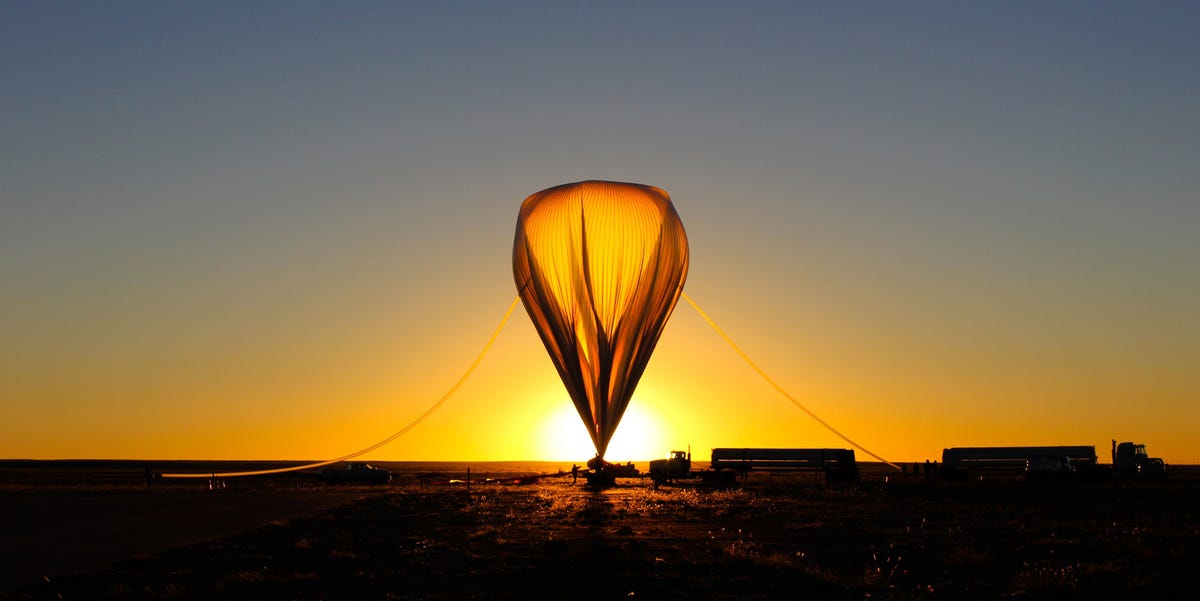
When a Chinese surveillance balloon drifted across the United States in early 2023, Americans discovered that the sky could host something stranger than delayed flights, weather fronts, and airline passengers fighting over armrests. The enormous balloon became a diplomatic crisis, a national-security spectacle, and eventually the target of an F-22 firing an AIM-9X Sidewinder off the South Carolina coast. Yet behind the headlines was an awkward strategic truth: the United States has also spent years developing high-altitude balloons for surveillance, communications, military experimentation, and missile tracking.
Modern military balloons are not simply oversized party decorations with cameras taped underneath. Some are sophisticated near-space platforms equipped with autonomous navigation, artificial intelligence, radar, electro-optical sensors, communications gear, or electronic-intelligence payloads. They can remain above a region far longer than most aircraft, cost less than satellites, and carry equipment that can be recovered, upgraded, and flown again.
That combination explains why spy balloons may become an increasingly important secret weapon of the United States. “Secret weapon,” however, does not necessarily mean a balloon dropping bombs while playing ominous movie music. Its real value lies in quietly watching, connecting, detecting, and helping other weapons reach the correct target.
Why the United States Is Looking Up Again
Military planners have traditionally divided the sky into familiar layers. Aircraft operate in the atmosphere, satellites orbit far above it, and the space between them receives considerably less public attention. The stratosphere occupies part of that overlooked territory, beginning roughly 4 to 12 miles above Earth, depending on latitude and season, and extending to around 31 miles. At these heights, high-altitude platforms can fly above most weather and commercial aviation while remaining much closer to the ground than satellites.
This region is sometimes described as “near space.” It offers a useful middle ground: high enough to observe enormous areas, low enough for detailed sensing and comparatively fast communications. Satellites provide extraordinary coverage, but they are expensive, follow orbital paths, and can take years to design and launch. Military aircraft are maneuverable, but they require fuel, maintenance, aircrews or complex autonomous systems, and access to contested airspace.
A stratospheric balloon can potentially stay aloft for days, weeks, or even months. NASA describes scientific balloons as low-cost, stable platforms for carrying technology and research payloads in the stratosphere. Long-duration systems can communicate through satellites, receive commands, and remain airborne for weeks or longer. Although NASA’s missions are scientific rather than military, the same basic engineering advantages attract defense planners.
COLD STAR and the Rise of the American Spy Balloon
One of the most intriguing publicly reported U.S. efforts is COLD STAR, an acronym for Covert Long-Dwell Stratospheric Architecture. Reporting based on Pentagon budget material described the program as an attempt to develop balloons with autonomous navigation, high-fidelity sensors, onboard artificial intelligence, and the ability to remain above an area for long periods. The program was initially associated with efforts to identify drug-trafficking activity before its technology moved toward broader military applications.
The word “covert” deserves careful handling. Publicly available information about COLD STAR is limited, and much of the operational picture remains classified. There is no reliable public catalog showing where every American military balloon is flying, what each one carries, or whether current versions match previously disclosed prototypes. That uncertainty is not a bug from the Pentagon’s perspective. A surveillance platform loses some charm when everyone receives its flight plan and sensor manual.
Another major research effort, DARPA’s Adaptable Lighter Than Air program, focused on developing high-altitude balloons capable of traveling long distances while using atmospheric winds for navigation. Rather than fighting the wind like an airplane, a smart balloon can change altitude, search for wind layers moving in a desired direction, and ride those currents toward its destination. It is less like steering a car and more like playing three-dimensional chess with the atmosphere.
Commercial companies have also developed stratospheric platforms designed to fill the capability gap between aircraft and satellites. Aerostar, a prominent U.S. balloon manufacturer, promotes high-altitude systems for communications, sensing, scientific work, and other near-space missions. Such private-sector expertise gives the military access to technologies that have already benefited from commercial telecommunications and atmospheric research.
What American Military Balloons Can Actually Do
Persistent Intelligence and Surveillance
The most obvious mission is intelligence, surveillance, and reconnaissance, usually shortened to ISR. A balloon carrying optical cameras, infrared sensors, radar, or signals-intelligence equipment could observe roads, ports, airfields, missile sites, ships, and military formations over extended periods.
Persistence is the crucial advantage. A satellite may pass over a target and then disappear beyond the horizon. An aircraft may remain nearby for hours before returning for fuel. A balloon positioned in a favorable area can keep watching. This enables analysts to study patterns rather than isolated snapshots: when vehicles arrive, which communications systems become active, how frequently units move, and whether a facility is preparing for an operation.
The U.S. Army has continued exploring high-altitude platforms for deep sensing, communications, electronic intelligence, and long-range targeting. Publicly discussed efforts such as High-Altitude Platform–Deep Sensing and HELIOS have examined balloons, solar-powered aircraft, and other platforms capable of carrying small sensors above contested regions. Army officials have emphasized the attraction of inexpensive, proliferated systems that provide over-the-horizon awareness.
Tracking Hypersonic and Cruise Missiles
Hypersonic weapons present a difficult tracking problem because they can travel at more than five times the speed of sound and maneuver within the atmosphere. Traditional ground-based radars may lose sight of low-flying or maneuvering targets because of Earth’s curvature and terrain. Satellites can help provide broader coverage, but an effective defense requires multiple sensors maintaining continuous custody of a target.
High-altitude balloons could strengthen this layered network by carrying infrared detectors or radar systems closer to likely flight paths. They would not replace satellites, aircraft, ships, or ground stations. Instead, they could fill gaps and pass targeting-quality information through a military command network. Missile-defense analysts have repeatedly emphasized that tracking advanced threats requires persistent, high-fidelity sensing across several domains.
The United States has experimented with balloon-supported radar before. The Army’s JLENS system used tethered aerostats to provide long-range surveillance and help detect cruise missiles and other airborne targets. The program suffered technical, financial, and public-relations problems, especially after one aerostat broke free in 2015 and dragged its tether across Pennsylvania. Nevertheless, the underlying conceptraising a sensor high enough to see beyond the normal radar horizonremains strategically attractive.
Communications Above a Contested Battlefield
Modern forces depend on data. Soldiers, ships, aircraft, drones, sensors, and commanders must exchange information even when satellites are jammed, ground towers are destroyed, or mountainous terrain blocks radio signals.
A balloon carrying communications equipment could serve as a high-altitude relay station. From its elevated position, it could connect units separated by hundreds of miles, forward sensor data, support navigation, or provide an emergency network after an attack. Because balloons can carry modular payloads, the same basic platform might be configured for communications during one mission and surveillance during another.
This capability is especially relevant in the Pacific, where military operations may span enormous distances between islands, ships, aircraft, and dispersed ground units. A network of relatively inexpensive balloons could create temporary communications coverage without waiting for new towers or relying entirely on vulnerable satellites.
Supporting the Sensor-to-Shooter Chain
Military discussions often refer to the “sensor-to-shooter” chain: one system detects a target, another identifies and tracks it, a command network decides what to do, and a weapon receives the targeting data. The balloon may never fire anything itself. Its job is to ensure that something else can.
High-altitude platforms have already appeared in exercises involving targeting and long-range fires. RAND research discussing U.S. and allied training noted experiments in which stratospheric balloons supplied weather and targeting information to artillery units. This illustrates how a quiet platform overhead can contribute directly to decisions on the ground.
In practical terms, the balloon is less a futuristic bomber and more an airborne nervous system. It sees, listens, transmits, and helps coordinate. That may sound less dramatic than launching a missile, but accurate information often determines whether a missile is useful or merely an extremely expensive way to rearrange empty dirt.
Why Balloons Can Beat Satellites and Drones
Lower Costs and Faster Development
Balloons are not cheap in the same sense as a grocery-store helium balloon, but they can be dramatically less expensive than building and launching a military satellite. NASA notes that balloon payloads can be developed quickly, carry heavy instruments, and sometimes be recovered for reuse. Reusable sensors allow engineers to repair hardware, install new software, or test a different payload without constructing an entirely new spacecraft.
This matters during a crisis. If the military identifies a new sensing requirement, a balloon system might be modified and deployed much faster than a satellite constellation. Faster experimentation also encourages calculated risk. Losing one lower-cost platform hurts less than losing a billion-dollar orbital asset.
Long Endurance
High-altitude aircraft such as the RQ-4 Global Hawk can remain airborne for extended missions, but they still consume fuel and require sophisticated maintenance. Solar-powered balloons can potentially remain aloft much longer because they have fewer moving parts and use atmospheric currents for much of their movement.
Long endurance supports what military planners call persistence. A balloon can remain close enough to repeatedly observe the same region, potentially offering the continuous coverage needed to track mobile missile launchers, ships, supply routes, or changing electronic emissions.
Small Signatures
Balloons can be difficult to detect because they may have limited radar and infrared signatures. They lack hot jet engines, and much of their structure can be made from nonmetallic materials. Their slow movement may also cause older radar systems or filtering software to classify them as harmless clutter rather than military aircraft.
The 2023 Chinese balloon episode demonstrated how detection settings matter. After the incident, U.S. officials acknowledged that radar filters had been adjusted to improve the detection of slow-moving high-altitude objects. This produced more potential contacts and contributed to the shootdowns of three additional objects that officials later assessed were probably connected to benign research or recreation.
The Serious Weaknesses of Spy Balloons
Balloons are useful, not magical. Their greatest strengthriding the atmosphereis also a major weakness. Winds change. Forecasts contain uncertainty. A balloon may maneuver by adjusting altitude, but it cannot always fly directly against powerful currents. Precision navigation has improved, yet controlling a balloon remains more complicated than ordering it to “turn left after the cloud.”
Weather, temperature, ultraviolet radiation, envelope leakage, icing, and payload weight can all affect performance. Communications may be jammed, navigation signals spoofed, and sensors deceived. A balloon that loses control can drift into restricted or foreign airspace, creating diplomatic consequences far larger than the platform’s financial value.
Survivability is another concern. Balloons may be difficult to detect, but once located, they are not built to dogfight. The Chinese platform destroyed in February 2023 was flying around 60,000 feet, requiring specialized aircraft and weapons, but the successful interception proved that high altitude does not equal immunity. The operation involved F-22s, support aircraft, tankers, intelligence platforms, naval recovery forces, and carefully cleared airspace. Shooting down a balloon can be complicated, but it is certainly possible.
There is also the privacy issue. Tests of wide-area balloon surveillance over parts of the American Midwest raised questions about how imagery would be collected, stored, and used. A platform capable of monitoring suspected traffickers or military movements can also observe ordinary citizens. Any domestic use therefore requires clear rules, oversight, retention limits, and safeguards against turning the sky into an endless warrantless security camera.
How the Chinese Balloon Incident Changed the Conversation
The 2023 incident did more than create memes and inspire people to point hunting rifles at an object roughly ten miles above them. It forced the United States to examine gaps in its awareness of high-altitude airspace.
The Pentagon said the Chinese balloon belonged to a broader surveillance program linked to China’s military and that similar systems had operated over numerous countries. China maintained that the aircraft was a civilian research balloon blown off course. U.S. officials tracked it across North America, protected sensitive information, collected intelligence about the platform, shot it down over water, and recovered debris for analysis.
For American planners, the event highlighted two sides of the same technology. Foreign balloons can threaten national security, while domestic balloons can provide valuable intelligence. The lesson was not that balloons had suddenly been invented. It was that a technology associated with the nineteenth century had quietly acquired twenty-first-century sensors, navigation software, solar power, and artificial intelligence.
Experience-Based Lessons From the New Balloon Era
Experiences from scientific balloon teams, military exercises, air-defense operators, and public incidents reveal that successful balloon missions depend less on the glamorous payload brochure and more on preparation. Launch crews must study atmospheric conditions at multiple altitudes, predict possible flight corridors, coordinate airspace access, maintain communications, and prepare recovery plans. A balloon may look peacefully uncomplicated from the ground, but operating one can involve meteorologists, engineers, pilots, intelligence specialists, regulators, and recovery crews spread across several states or countries.
Scientific missions provide an especially useful lesson in patience. NASA balloon teams often spend months preparing an instrument, only to delay launch because winds are wrong. Once airborne, the platform may travel thousands of miles. Teams monitor pressure, altitude, temperature, battery performance, communications, and payload health while constantly updating the predicted landing area. That operational experience translates naturally to military missions, where reliability and control matter just as much as sensor quality.
Another lesson is that recovery cannot be treated as an afterthought. Sensors may contain classified technology, stored intelligence, or expensive components. Mission planners must determine where a platform can safely descend and how rapidly a team can reach it. Researchers have demonstrated parachute systems capable of releasing data capsules from stratospheric balloons and guiding recovery teams toward predicted landing zones. For a military platform, similar techniques could prevent sensitive equipment from falling into the wrong hands.
Air-defense crews learned a different lesson during the Chinese balloon incident: identifying an object is often harder than detecting it. Radar operators must distinguish among surveillance systems, weather balloons, research aircraft, hobby projects, debris, and sensor errors. Adjusting radar sensitivity may reveal more objects, but it can also create an avalanche of ambiguous contacts. More detection does not automatically produce more understanding.
The shootdown itself demonstrated the importance of restraint. Destroying a balloon over populated territory could scatter heavy payload components across a wide area. U.S. officials therefore waited until the Chinese balloon reached the Atlantic, where fighters could engage it with less danger to people on the ground. The delay became politically controversial, yet it reflected a real operational tradeoff between ending the surveillance mission quickly and avoiding civilian casualties.
Military exercises have also shown that balloons are most effective when integrated into a larger system. A sensor collecting perfect imagery is useless if its data cannot reach analysts. A radar track has little combat value if the command network cannot pass it to an interceptor or artillery unit. Balloon projects must therefore be designed around communications, data standards, cybersecurity, and command proceduresnot merely around altitude records.
Operators must also plan for electronic warfare. An adversary may jam the balloon’s communications, interfere with satellite navigation, attack its ground station, or feed false signals into its sensors. Autonomous software can help a platform continue operating when links are disrupted, but autonomy introduces its own risks. The system must know when to change altitude, when to preserve power, when to stop collecting, and when to terminate the flight without producing an international incident.
Finally, experience suggests that balloons work best as expendable or semi-expendable members of a larger network. A single exquisite platform becomes a tempting target and a possible single point of failure. A distributed group of cheaper balloons can provide overlapping coverage, replace losses, and force an adversary to spend expensive missiles or aircraft on comparatively inexpensive targets.
This cost imbalance may become one of the balloon’s greatest strategic advantages. Even when a balloon is detected, the opponent must decide whether it is important enough to destroy, harmless enough to ignore, or deceptive enough to conceal another operation. Every response consumes attention, radar capacity, flight hours, weapons, and decision-making time.
Conclusion: An Old Idea Finds a New Mission
Spy balloons are unlikely to replace satellites, stealth aircraft, drones, ground radar, or reconnaissance ships. Their future lies in complementing those systems. They can provide persistent surveillance, relay communications, detect missiles, support targeting, and restore coverage when more expensive assets are unavailable or under attack.
The United States is interested in these platforms because modern warfare depends on seeing first, understanding faster, and sharing data before an adversary can react. A balloon carrying the right sensors may deliver all three capabilities while costing a fraction of a satellite or high-end aircraft.
The technology still faces serious problems involving navigation, weather, survivability, airspace safety, privacy, cybersecurity, and diplomacy. Publicly known American programs also reveal only part of the picture; many details remain classified, experimental, or commercially sensitive.
Still, the strategic logic is compelling. The next revolution in surveillance may not roar down a runway or rise on a column of rocket fire. It may drift almost silently through the stratosphere, carrying cameras, radar, radios, and artificial intelligence beneath a thin envelope of gas. The future of military technology, it turns out, sometimes looks suspiciously like something a child would ask to hold at a birthday party.
Research note: This analysis synthesizes publicly available information from the U.S. Department of Defense, DARPA, NASA, NOAA, GAO, RAND Corporation, CSIS, Air & Space Forces Magazine, Breaking Defense, Popular Mechanics, Associated Press, Aerostar, and related American aerospace research. Operational capabilities and program status may differ from public reporting because significant portions of military balloon development remain classified.