Surface area sounds like one of those math terms that wears a tiny bow tie and refuses to relax. But the idea is refreshingly practical: it tells you how much outside space a three-dimensional object has. If you are wrapping a gift box, painting a bedroom wall, covering a soup can with a label, frosting a cake, or figuring out how much cardboard is needed for packaging, you are already thinking about surface area. Congratulationsyou have been doing geometry in the wild.
In simple terms, surface area is the total area of all the surfaces on a 3D shape. Unlike volume, which measures how much space is inside an object, surface area measures the outside. Think of volume as the amount of popcorn a box can hold, while surface area is how much wrapping paper it takes to cover the box. One fills the object; the other dresses it up for the party.
This guide explains 7 ways to find surface area, using clear formulas, real examples, and friendly explanations. Whether you are working with cubes, rectangular prisms, cylinders, cones, pyramids, spheres, or composite solids, the goal is the same: identify the surfaces, calculate each area, and add them together without panicking dramatically into your notebook.
What Is Surface Area?
Surface area is the sum of the areas of every outer face or curved surface of a solid figure. It is always measured in square units, such as square inches, square feet, square centimeters, or square meters. That “square” part matters because you are measuring a flat covering, even when the object itself is three-dimensional.
For example, a cube has six square faces. To find its surface area, you find the area of one face and multiply by six. A cylinder is a little trickier because it has two flat circular bases and one curved side. A sphere is trickier still because it has no flat faces at all, yet it still has an outside surface. Geometry likes to keep us humble.
Why Learning Surface Area Matters
Surface area is not just a school worksheet topic. It appears in construction, packaging design, manufacturing, painting, architecture, shipping, science, medicine, and even cooking. A baker estimating icing for a cake, a contractor buying siding, and a designer creating a product box all need surface area. The formulas may look abstract at first, but they are basically shortcuts for solving everyday “how much material do I need?” problems.
Below are seven practical ways to find surface area, moving from the easiest visual method to formulas for common 3D shapes.
1. Use a Net to Unfold the Shape
One of the best ways to understand surface area is to imagine unfolding a 3D object into a flat pattern called a net. A net shows every face of a solid as a two-dimensional shape. Once the object is unfolded, you can find the area of each piece and add them together.
How it works
Suppose you have a rectangular box. If you cut along the edges and lay it flat, you will see six rectangles: front, back, top, bottom, left side, and right side. The surface area is the total area of those six rectangles.
This method is especially helpful for beginners because it makes surface area visible. Instead of memorizing a formula first, you see where the formula comes from. It is also useful for irregular shapes made from flat faces.
Example
Imagine a box with a length of 8 inches, width of 3 inches, and height of 4 inches. Its faces come in pairs:
- Top and bottom: 8 × 3 = 24 square inches each
- Front and back: 8 × 4 = 32 square inches each
- Left and right sides: 3 × 4 = 12 square inches each
Add them together: 24 + 24 + 32 + 32 + 12 + 12 = 136 square inches.
The net method is the “show your work” superstar of surface area. It makes mistakes easier to catch because every face is accounted for.
2. Find the Surface Area of a Cube
A cube is the friendly golden retriever of 3D geometry. Every edge has the same length, and every face is an identical square. Because a cube has six congruent square faces, its surface area formula is simple:
Surface Area of a Cube = 6s²
In this formula, s is the length of one side.
Example
If each side of a cube is 5 inches long, the area of one square face is:
5 × 5 = 25 square inches
Since the cube has six faces:
6 × 25 = 150 square inches
So, the surface area of the cube is 150 square inches.
When to use this method
Use the cube formula when all sides are equal. Common examples include dice, cube-shaped boxes, building blocks, and certain storage containers. If the object has equal length, width, and height, you are probably looking at a cube. If not, move to the rectangular prism formula before geometry gives you a side-eye.
3. Find the Surface Area of a Rectangular Prism
A rectangular prism is a box shape with six rectangular faces. Unlike a cube, its length, width, and height may all be different. Shoeboxes, cereal boxes, shipping boxes, bricks, and many rooms are rectangular prisms.
The formula is:
Surface Area of a Rectangular Prism = 2lw + 2lh + 2wh
Here, l means length, w means width, and h means height.
Example
Suppose a rectangular prism has a length of 10 feet, width of 4 feet, and height of 6 feet.
- 2lw = 2(10 × 4) = 80
- 2lh = 2(10 × 6) = 120
- 2wh = 2(4 × 6) = 48
Add them:
80 + 120 + 48 = 248 square feet
This formula is really just the net method in a shorter outfit. It calculates each pair of matching faces and adds them together.
Real-life use
If you are painting a rectangular room, wrapping a box, or covering a storage container, this formula helps estimate material. Just remember: if one side is open, such as a box without a lid, subtract the missing face.
4. Find the Surface Area of a Prism
A prism is a solid with two matching bases and flat side faces. The bases can be triangles, rectangles, pentagons, hexagons, or other polygons. A rectangular prism is one kind of prism, but the general prism formula works for many shapes.
The formula for a right prism is:
Surface Area of a Prism = 2B + Ph
In this formula, B is the area of one base, P is the perimeter of the base, and h is the height of the prism.
Why this formula works
The term 2B covers the two matching bases. The term Ph covers the side faces, also called the lateral area. If you imagine wrapping a strip around the sides of a prism, the length of that strip is the perimeter of the base, and the height is the height of the prism.
Example: triangular prism
Suppose a triangular prism has a triangular base with an area of 12 square inches, a base perimeter of 18 inches, and a prism height of 7 inches.
Surface Area = 2B + Ph
Surface Area = 2(12) + 18(7)
Surface Area = 24 + 126 = 150 square inches
This formula is powerful because it works for many prisms. Once you know the base area, base perimeter, and height, the surface area becomes much easier to find.
5. Find the Surface Area of a Cylinder
A cylinder has two circular bases and one curved surface. Soda cans, soup cans, water tanks, and paper towel rolls are classic examples. The total surface area includes both circles and the curved side.
The formula is:
Surface Area of a Cylinder = 2πr² + 2πrh
Here, r is the radius of the circular base, and h is the height.
Breaking down the formula
The first part, 2πr², finds the area of the two circular bases. The second part, 2πrh, finds the curved side. If you peel the label off a can and lay it flat, it forms a rectangle. The width of that rectangle is the circumference of the circle, and the height is the height of the cylinder.
Example
A cylinder has a radius of 3 inches and a height of 8 inches.
Surface Area = 2π(3²) + 2π(3)(8)
Surface Area = 18π + 48π = 66π
Using π ≈ 3.14:
66 × 3.14 = 207.24 square inches
If the cylinder has no top, such as an open can or bucket, subtract one circular base. If it has no top and no bottom, use only the lateral surface area: 2πrh.
6. Find the Surface Area of a Cone or Pyramid
Cones and pyramids come to a point, which makes them look a little dramatic, like geometry objects preparing for a royal entrance. Their surface area includes a base plus slanted side surfaces.
Surface area of a cone
A cone has one circular base and one curved surface. The formula is:
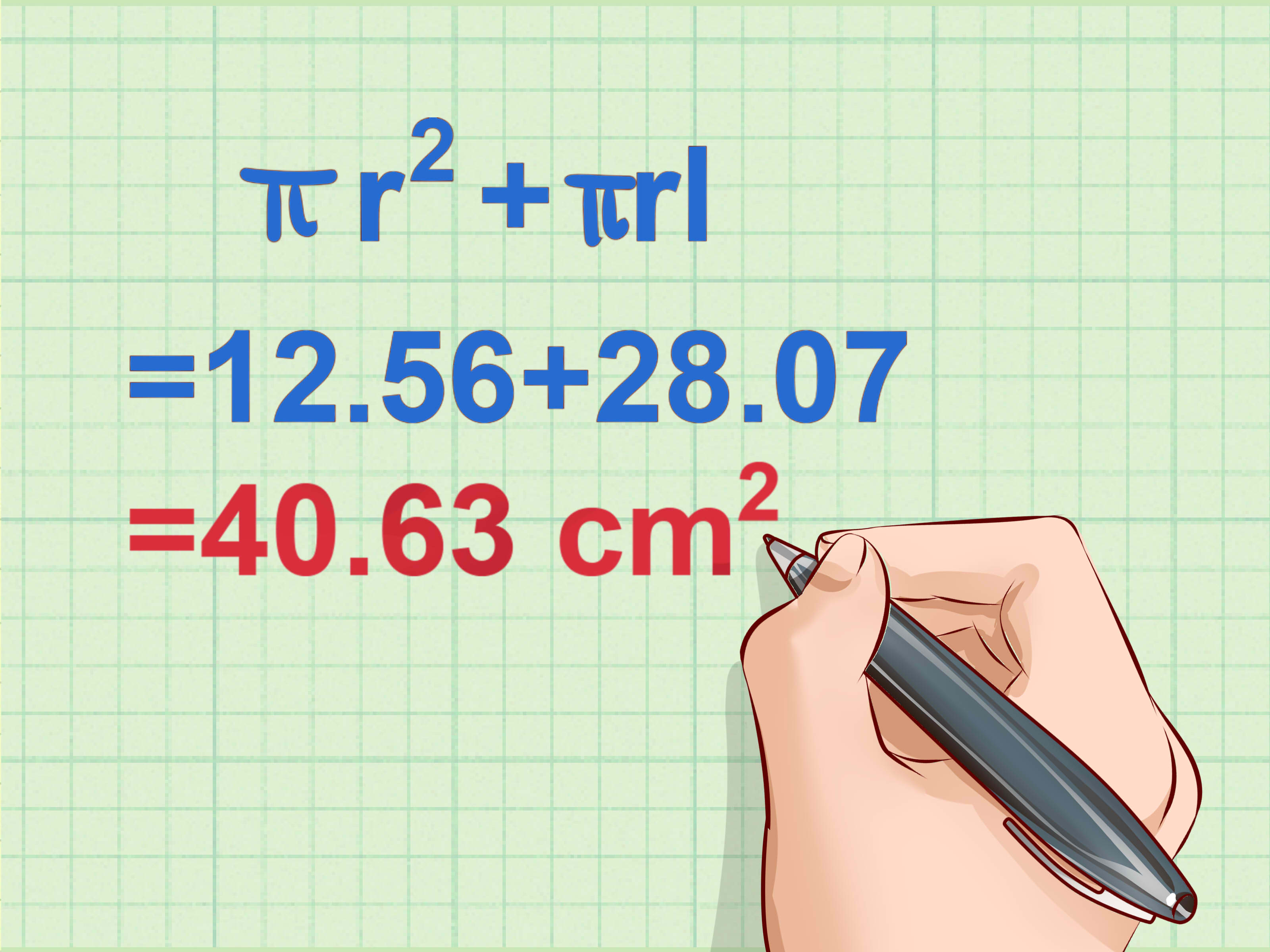
Surface Area of a Cone = πr² + πrl
Here, r is the radius, and l is the slant height. The slant height is the distance from the edge of the base to the tip of the cone along the outside surface.
Example
A cone has a radius of 4 centimeters and a slant height of 9 centimeters.
Surface Area = π(4²) + π(4)(9)
Surface Area = 16π + 36π = 52π
Using π ≈ 3.14:
52 × 3.14 = 163.28 square centimeters
Surface area of a pyramid
A pyramid has one polygon base and triangular side faces. For a regular pyramid, where the base is a regular polygon and the triangular faces match, the formula is:
Surface Area of a Pyramid = B + 1/2Pl
In this formula, B is the base area, P is the base perimeter, and l is the slant height.
Example
A square pyramid has a base area of 36 square feet, a base perimeter of 24 feet, and a slant height of 5 feet.
Surface Area = 36 + 1/2(24)(5)
Surface Area = 36 + 60 = 96 square feet
Cones and pyramids both require careful attention to slant height. Do not confuse slant height with vertical height. They are cousins, not twins.
7. Find the Surface Area of a Sphere or Composite Solid
A sphere is a perfectly round 3D shape, like a basketball, globe, or orange. It has no edges, vertices, or flat faces. Its surface area formula is beautifully compact:
Surface Area of a Sphere = 4πr²
Here, r is the radius.
Example
A sphere has a radius of 6 inches.
Surface Area = 4π(6²)
Surface Area = 4π(36) = 144π
Using π ≈ 3.14:
144 × 3.14 = 452.16 square inches
What about a hemisphere?
A hemisphere is half of a sphere. If you need only the curved surface area, use 2πr². If you need the total surface area, including the flat circular base, use 3πr².
Composite solids
A composite solid is made from two or more basic 3D shapes. For example, an ice cream cone is a cone plus a hemisphere. A house model may combine a rectangular prism and a triangular prism. To find surface area, break the figure into familiar pieces, calculate only the exposed surfaces, and add them together.
The key phrase is exposed surfaces. If two shapes are joined together, the touching faces are not part of the outside surface. Do not count hidden areas unless you enjoy giving your answer extra square units for no reason.
Common Surface Area Mistakes to Avoid
Mixing up surface area and volume
Surface area uses square units. Volume uses cubic units. If your answer for surface area is in cubic inches, something has gone sideways.
Forgetting hidden faces
When working with composite solids, only count the outside. Any face glued, stacked, or joined against another surface should usually be excluded.
Using diameter instead of radius
Circle-based formulas usually use radius, not diameter. If a problem gives you the diameter, divide it by 2 before plugging it into formulas for cylinders, cones, and spheres.
Confusing height and slant height
For cones and pyramids, surface area often uses slant height, not vertical height. The slant height runs along the outside face. The vertical height runs straight down through the center.
Quick Surface Area Formula Chart
| Shape | Surface Area Formula | Best Use |
|---|---|---|
| Cube | 6s² | All edges are equal |
| Rectangular Prism | 2lw + 2lh + 2wh | Box-shaped objects |
| Right Prism | 2B + Ph | Prisms with polygon bases |
| Cylinder | 2πr² + 2πrh | Cans, tubes, tanks |
| Cone | πr² + πrl | Cones with circular bases |
| Pyramid | B + 1/2Pl | Regular pyramids |
| Sphere | 4πr² | Round objects |
Experiences and Practical Lessons from Finding Surface Area
One of the most useful experiences related to finding surface area comes from everyday projects. Imagine trying to repaint a room. At first, it seems simple: buy paint, open the can, become a home improvement legend. Then reality enters wearing work boots. You need to know how much wall space you are covering. That means measuring the length and height of each wall, subtracting doors and windows, and adding the remaining areas. Suddenly, surface area is not just a math problemit is the difference between buying the right amount of paint and making three emergency trips to the hardware store while wearing paint-speckled sweatpants.
Gift wrapping is another surprisingly good teacher. A rectangular box may look innocent, but if you cut the wrapping paper too small, the corners will expose themselves like tiny cardboard secrets. By thinking about the surface area of the box, you can estimate how much paper is needed to cover every side. The same logic applies to packaging design. Companies need to know how much cardboard, plastic, or label material each product requires. A small miscalculation repeated across thousands of items can waste a lot of money and material.
Cooking also offers surface area lessons. A cake with more exposed surface needs more frosting. A round cake, a sheet cake, and a tiered cake may use similar ingredients but require very different amounts of icing because their exposed surfaces are different. Even roasting vegetables involves surface area. Smaller pieces have more exposed surface compared with their volume, which helps them brown faster. Math quietly sneaks into the kitchen and pretends it is seasoning.
In science classes, surface area becomes even more interesting. For example, small particles can react faster than large chunks because more surface is exposed. This idea matters in chemistry, biology, medicine, and environmental science. In the human body, structures such as lungs and intestines have large surface areas to help exchange gases or absorb nutrients efficiently. So, surface area is not just about boxes and cans; it is connected to how living systems work.
Students often find surface area easier when they stop trying to memorize every formula as a separate monster. Most formulas come from the same basic idea: break the surface into simpler parts. A cylinder is two circles plus one curved rectangle. A prism is two bases plus side rectangles. A pyramid is a base plus triangles. Once that pattern clicks, surface area becomes less intimidating.
The best practical advice is to sketch the shape before calculating. Label every known measurement, mark the surfaces you need, and cross out surfaces that are hidden or missing. If the object is open at the top, do not include the top. If two solids are stuck together, do not count the surfaces where they touch. A simple drawing can prevent most errors before they happen.
Another helpful habit is estimating before solving. If your final answer is wildly larger or smaller than expected, check your units, radius, slant height, and whether you accidentally counted a face twice. Surface area rewards careful thinking more than speed. A neat setup usually beats a frantic formula sprint.
Conclusion
Learning 7 ways to find surface area gives you a flexible toolkit for solving geometry problems and real-world measurement tasks. Start with the basic idea: surface area is the total outside area of a 3D object. From there, choose the method that fits the shape. Use nets for visual understanding, the cube formula for equal sides, the rectangular prism formula for boxes, the prism formula for polygon-based solids, the cylinder formula for cans and tubes, cone and pyramid formulas for pointed shapes, and sphere formulas for round objects.
The more you practice, the more surface area feels like common sense with a calculator. Identify the shape, list the exposed surfaces, choose the right formula, use square units, and double-check whether any face is missing or hidden. Do that, and surface area becomes less like a math mystery and more like a practical measuring skill you can use everywhere.