Human history is filled with brilliant inventions: electric lights, vaccines, airplanes, smartphones, and coffee machines that prevent entire offices from collapsing before 9 a.m. Unfortunately, human history also contains diet water, banana protectors, drawers that cannot open, and doors that lead directly into walls.
The most useless things ever made are not always badly manufactured. Some are beautifully engineered, attractively packaged, and promoted by people wearing very expensive suits. Their main problem is simpler: nobody needed them. Others began with a reasonable purpose but were ruined by poor installation, confusing design, excessive technology, or a spectacular failure to observe how human beings actually behave.
This collection includes pointless inventions, failed consumer products, absurd architecture, unnecessary kitchen gadgets, and public-design disasters. Some were sincere commercial ideas. Others were deliberate jokes created to parody modern consumer culture. A few might even be useful in extremely specific circumstancesperhaps during a snowball emergency or a banana-protection crisis.
What Makes an Invention Truly Useless?
A useless product generally falls into one of four categories. It may solve a problem that does not exist, perform a simple task less efficiently than a human, fail at its only intended function, or add so much complexity that the original convenience disappears.
That distinction matters. A commercial failure is not automatically a useless invention. Some products arrive too early, cost too much, or teach designers lessons that later produce successful technologies. The funniest examples, however, provide no such defense. They simply stand before us like a staircase ending at a brick wall, silently asking, “Are you sure nobody checked the blueprint?”
63 Hilariously Useless Inventions and Design Failures
Architectural Ideas That Forgot Their Purpose
- A staircase ending at a wall: Perfect for people whose destination is disappointment.
- A second-story door without a landing: It offers fresh air, a view, and an immediate gravity lesson.
- A gate without a fence: Walk around it, unless you are committed to respecting symbolic security.
- A balcony with no door: A charming outdoor space accessible only to determined window climbers.
- A bench pressed against a fence: Technically seating, provided your legs can pass through solid metal.
- A blocked fire exit: An emergency feature transformed into an emergency obstacle.
- A handrail covering one step: Support arrives briefly, then abandons you when the stairs become interesting.
- A bicycle lane ending at a curb: City planning with a surprise obstacle course included.
- A parking space trapped behind pillars: Reserved for motorcycles, teleporting cars, or extremely optimistic drivers.
Signs and Labels That Explain Absolutely Nothing
- A “sign not in use” sign: It must remain in use to announce that it is not in use.
- A blank notice board: An official announcement confirming that officials have nothing to announce.
- Two arrows pointing to the same destination: Choose either direction and enjoy identical uncertainty.
- “Contains peanuts” printed on peanuts: Valuable information for shoppers who suspected the shells contained lasagna.
- A label stating that the battery was removed: Conveniently located where the missing battery makes that obvious.
- Subtitles reading “cries in Spanish”: Because apparently human sadness requires regional translation.
- A public-telephone sign without a telephone: A small monument to vanished technology and unanswered calls.
- An exit arrow pointing toward a locked door: Escape is available after finding someone with the key.
- A warning sign hidden behind an obstruction: The danger may be visible before the warning is.
Kitchen Gadgets for Problems Your Hands Already Solved
- Diet water: Ordinary zero-calorie water, now wearing athletic packaging and a confidence problem.
- A hard plastic banana case: Extra protection for fruit already shipped inside a custom biodegradable wrapper.
- Individually wrapped peeled fruit: Nature’s packaging removed and replaced with plasticprogress, apparently.
- An egg-cubing device: For anyone furious that hard-boiled eggs insist on being egg-shaped.
- A banana slicer: It completes in ten seconds what a knife does in eight.
- A multi-blade avocado tool: Useful until you remember that spoons and knives already live nearby.
- A dedicated strawberry huller: Another tiny object destined to disappear behind the utensil drawer.
- A plastic snowball maker: Ideal when touching snow would ruin the authentic snow experience.
- A single-hot-dog toaster: Countertop real estate surrendered to a machine with one highly specific ambition.
Single-use kitchen tools are not automatically worthless; some can help people with limited grip strength, mobility challenges, or repetitive cooking tasks. Their usefulness collapses when they occupy half a drawer to perform a job needed twice a year. Consumer-product testing similarly shows that specialized tools vary widely in whether they genuinely save time.
Technology That Added Complexity Instead of Convenience
- Juicero: A costly connected press for produce packets that people discovered could be squeezed by hand.
- TwitterPeek: A pocket device largely dedicated to reading one social network badly.
- Consumer Google Glass: Impressive technology burdened by price, unclear everyday value, and major privacy concerns.
- The CueCat scanner: A barcode reader that made visiting websites harder than typing their addresses.
- Microsoft Bob: A friendly virtual house that made basic computer tasks feel strangely complicated.
- Clippy: An animated paper clip famous for interrupting people who had not requested assistance.
- An 88-button television remote: A control panel apparently designed for launching satellites between commercials.
- A USB-powered pet rock: It consumes electricity while providing the complete functionality of a normal rock.
- A DVD rewinder: A joke product for customers emotionally attached to the inconveniences of VHS tapes.
Fashion and Beauty Products Nobody Was Waiting For
- Bic for Her pens: Regular pens marketed in stereotypical colors as though women required specialized ink.
- Harley-Davidson perfume: An attempt to translate motorcycles, leather, and open highways into personal fragrance.
- The Rejuvenique facial mask: An electrical beauty device that looked more frightening than rejuvenating.
- The Hawaii Chair: A motorized swiveling seat promising exercise while users remained seated.
- The Bumpit: A plastic insert created to give hair the architectural presence of a small hill.
- Venetian-blind sunglasses: Eyewear offering maximum celebrity appearance and questionable sun protection.
- Fake pockets: Decorative fabric openings that betray anyone attempting to store keys.
- AirPod chopsticks: A parody invention combining lunch with the possibility of dipping electronics in soy sauce.
- A dog Snuggie: A blanket with sleeves for an animal already wearing a permanent fur coat.
Home and Office Features That Accomplish Almost Nothing
- A drawer cut in half by a wall: Storage capacity measured in postage stamps.
- A drawer installed near the ceiling: Convenient for giants and hotel guests carrying ladders.
- A cabinet with no interior space: The appearance of storage without the burden of storing anything.
- A peephole in a transparent glass door: For a closer look at the person already clearly visible.
- Five sinks in a tiny restroom: Excellent hand-washing capacity paired with almost no standing room.
- A privacy door around the urinal but not the toilet: Confidentiality assigned to the wrong fixture.
- A camping light aimed at a glowing laptop: Additional illumination for the object already producing light.
- The useless box: Flip its switch and a mechanical arm emerges solely to switch itself off.
- A remote-control headband: Hands-free storage achieved by wearing household electronics on your forehead.
Commercial Products and Novelty Ideas That Lost the Plot
- Gerber Singles: Adult meals packaged in baby-food jars, making dinner resemble a personal regression.
- Green ketchup: Familiar flavor delivered in a color that made french fries look medically concerning.
- Smell-O-Vision: A movie system that attempted to add synchronized odors to theaters.
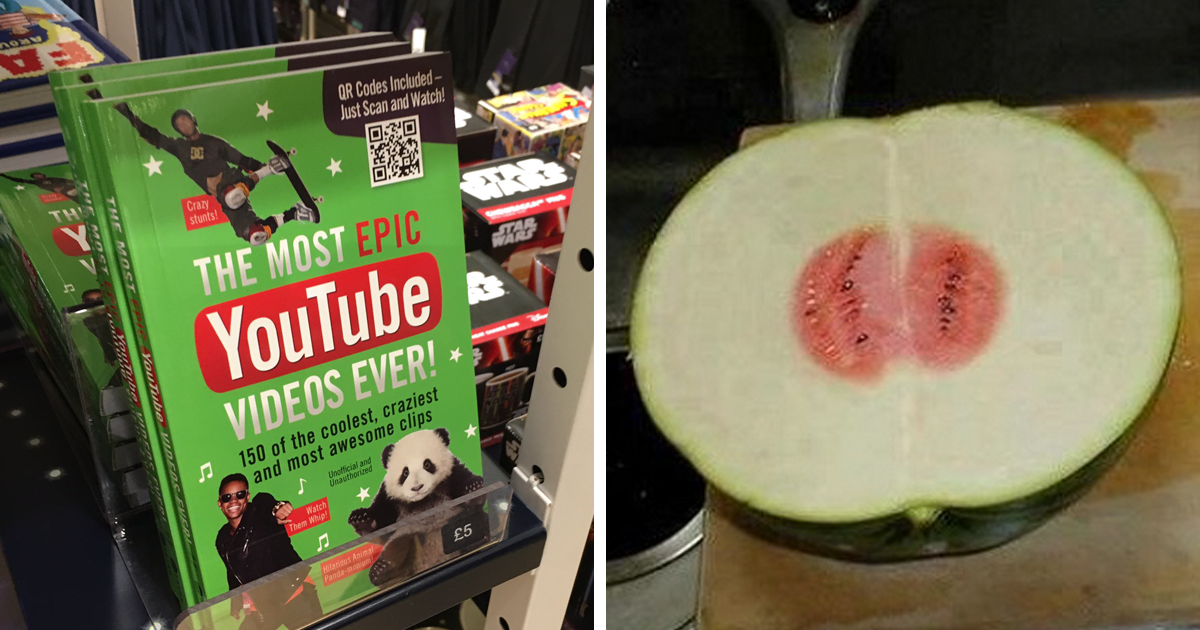
- A printed book about online videos: The speed and motion of the internet, converted into motionless paper.
- Inflatable IKEA furniture: Lightweight seating that reportedly struggled to remain where owners placed it.
- My Friend Cayla: An internet-connected doll criticized for privacy and security problems around children’s conversations.
- An automatic pet-petting machine: Technology replacing the easiest and most enjoyable part of owning an animal.
- A printed headlight sticker: It resembles a headlight perfectly, except for producing light.
- An escalator serving one tiny level change: Complex machinery boldly challenging the concept of taking two steps.
Why Do Pointless Products Keep Getting Made?
The first reason is marketing. A company rarely earns attention by announcing, “We made another normal spoon.” It can, however, generate headlines with a connected spoon that measures bite speed, sends statistics to an app, and requires a monthly firmware update. Novelty attracts curiosity even when it does not improve the experience.
Another cause is feature obsession. Designers and executives may continue adding functions because they can, not because customers asked for them. The resulting product becomes more expensive, harder to repair, and less intuitive than the object it replaces. In extreme cases, the supposed solution creates a second problem: accounts must be registered, batteries charged, subscriptions renewed, and software updated before the original task can begin.
Public-design failures often have a different origin. A building may be renovated in stages. A wall moves, a doorway closes, or a new railing is installed without removing the old one. The final result looks irrational because it reflects several disconnected decisions rather than one deliberate plan.
Failure is not entirely bad, however. Museums and design researchers preserve unsuccessful products because they reveal how innovation actually works. Not every strange idea deserves ridicule; some unsuccessful technologies introduce concepts that later become practical when costs fall or user habits change. The key question is whether an invention teaches a useful lessonor merely gives us a banana box that requires more storage space than the banana.
What Useless Products Teach Consumers
Before buying a clever gadget, ask three questions. How often will it be used? Does an object already owned perform the same task? Will the new product save more time than cleaning, charging, storing, or maintaining it requires?
This simple test eliminates much of the clutter sold through impulse advertisements. A product that saves five seconds but demands a dedicated drawer may not be convenient. A connected appliance that stops working when an app disappears may be less reliable than its ordinary predecessor. A novelty item may still provide entertainment, but it should be purchased as a jokenot mistaken for an essential tool.
Unnecessary electronics also have consequences beyond wasted money. Unwanted gadgets require materials, packaging, transportation, and eventual disposal. The Environmental Protection Agency recommends reducing consumption, reusing functional products, donating unwanted electronics, and using appropriate recycling options instead of treating every obsolete device like ordinary trash.
The Experience of Living With Useless Things
The typical experience begins with optimism. You see a gadget in an advertisement performing an ordinary task with cinematic elegance. A tomato is sliced without resistance. A drawer becomes magically organized. A smiling person completes breakfast without touching a knife, spoon, or apparently any object invented before last Thursday. The product costs only $19.99, although a second one is included for reasons nobody investigates carefully enough.
When the package arrives, the first surprise is its size. The device designed to save countertop space requires roughly the same territory as a small microwave. It contains seven plastic components, three blades, a cleaning brush, and an instruction manual warning against placing six of those components in the dishwasher. Assembly takes longer than the task it is supposed to simplify, but quitting now would mean admitting that the advertisement won.
The first attempt is rarely impressive. Food becomes trapped in a narrow compartment. The suction cup refuses to stick. A Bluetooth connection is required even though the product’s only job is heating water. You create an account, confirm an email address, download an update, and agree to a privacy policy long enough to qualify as an airport novel. By this point, a normal kettle would have boiled the water several times and possibly written a sincere apology.
Cleaning produces the decisive moment. A knife takes seconds to rinse. The specialized slicer has corners inaccessible to ordinary civilization. Tiny fragments remain lodged beneath moving parts, and the included brush disappears immediately. After one heroic use, the product enters its permanent habitat: the back of a cabinet beside the spiral vegetable cutter, novelty mug warmer, and electronic bottle opener that needs charging whenever a bottle actually appears.
Architectural uselessness creates a different experience because nobody can hide it in a drawer. A bench facing a wall, a blocked ramp, or a door opening onto empty air becomes a public puzzle. People stop, stare, take photographs, and invent explanations. Perhaps the staircase once led somewhere. Perhaps the gate awaits a future fence. Perhaps the designer was working from home and misunderstood several important measurements.
These objects are frustrating, but they are also memorable. A perfectly adequate cabinet is forgotten. A cabinet that opens to reveal a concrete wall becomes a story told for years. That is the strange value of useless design: it accidentally creates comedy, conversation, and a small feeling of superiority among everyone who notices the mistake.
There is also something reassuring about spectacularly unnecessary products. They prove that failure is not reserved for careless amateurs. Large corporations, experienced engineers, professional architects, and highly funded startups can all become so enchanted with an idea that they forget to ask whether anyone needs it. The lesson is not to stop experimenting. It is to test ideas against ordinary life before manufacturing a warehouse full of them.
The best response is therefore a mixture of amusement and caution. Laugh at the door leading nowhere. Appreciate the mechanical box devoted to turning itself off. Then look around your own home before purchasing another miraculous device. Somewhere in a kitchen drawer, a banana slicer may already be waiting to remind you that hands remain among humanity’s most versatile inventions.
Conclusion
The most useless things ever made reveal an important truth: creativity and practicality are not the same skill. An invention can be clever, attractive, technically impressive, and completely unnecessary. From pointless signs to overconnected appliances, these objects show what happens when novelty outruns common sense.
Still, useless inventions have a purpose of their own. They make people laugh, encourage better design, expose weak marketing assumptions, and remind consumers to question whether convenience is genuine. Sometimes failure even becomes the first rough draft of a future success. Other times, it becomes diet water.