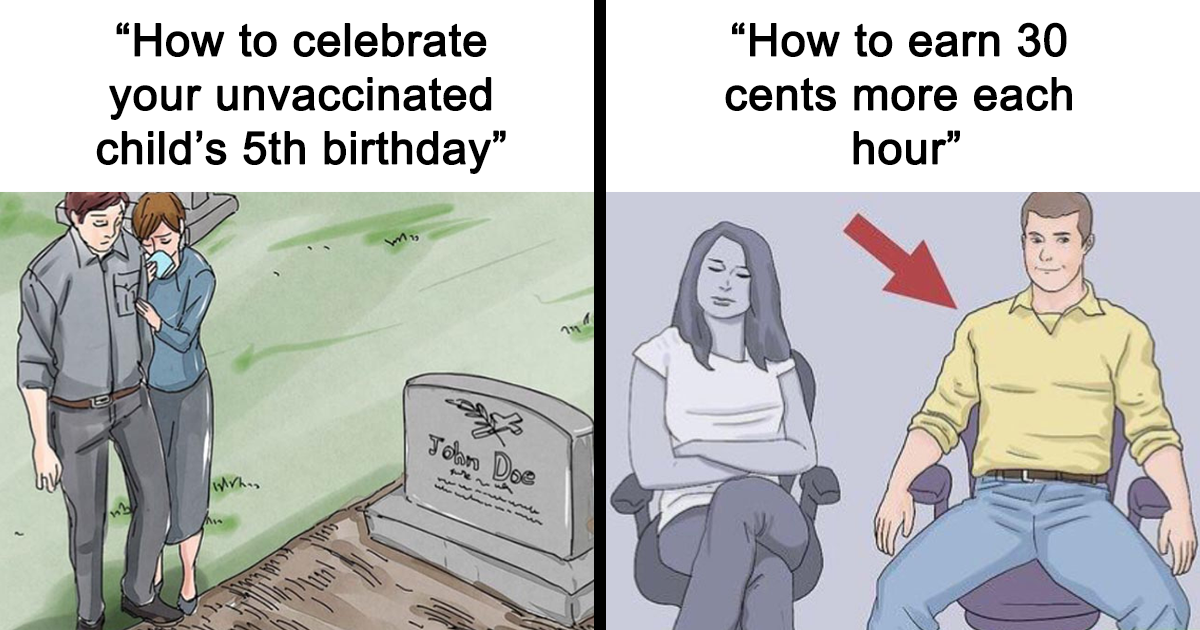
Note: The captions below are original, written in the spirit of out-of-context WikiHow image humor, and are not copied from existing meme posts.
There are many beautiful things on the internet: rescue dog videos, oddly satisfying cake frosting clips, and comment sections where people somehow agree with each other for twelve seconds. But few things capture the strange poetry of online comedy quite like out-of-context captions for WikiHow images.
WikiHow illustrations were created to be helpful. They show people folding shirts, fixing awkward conversations, escaping minor household disasters, and performing everyday tasks with the calm facial expression of someone who has accepted both enlightenment and unpaid parking tickets. Yet when those images are separated from their original article titles, something magical happens. Suddenly, a person holding a spoon is not preparing soup. They are negotiating with a tiny metal enemy. A cartoon man staring at a couch is not cleaning his living room. He is questioning every decision that led him to adulthood.
That is the charm of funny WikiHow captions: the joke lives in the gap between what the image was meant to explain and what the viewer imagines instead. It is visual comedy, internet absurdism, and group therapy for anyone who has ever looked at a stock-style illustration and thought, “This feels like a dream I had after eating gas station nachos.”
Why WikiHow Images Became Internet Comedy Gold
WikiHow’s illustration style is instantly recognizable. Clean lines, gentle colors, simple backgrounds, and characters who look deeply committed to solving problems no one has ever mentioned out loud. The drawings are meant to clarify step-by-step instructions, which is useful when you are learning how to clean a backpack, apologize properly, or identify a spider without turning into a human helicopter.
But the same clarity that makes the images educational also makes them hilarious when removed from context. Because the scenes are so specific, they invite misinterpretation. A person pointing at a banana could be teaching nutrition, practicing courtroom law, or accusing the fruit of emotional betrayal. That flexibility gives meme creators room to invent entirely new stories.
Out-of-context humor works because your brain tries to solve the puzzle. You see a serious-looking illustration and expect a serious explanation. Then the caption swerves into nonsense, drama, or painfully relatable everyday panic. The result is a tiny comedy explosion, usually followed by the phrase, “Why is this so accurate?”
What Makes a Great Out-Of-Context WikiHow Caption?
A strong caption does not simply describe the image. It reinterprets it. The best captions treat ordinary actions like epic disasters, emotional breakdowns, secret rituals, or workplace incidents that HR is absolutely not equipped to handle.
1. It creates a new story instantly
The viewer should understand the fake scenario in one quick punch. If a cartoon person is staring at a toaster, the caption might turn that toaster into a financial advisor, a romantic rival, or the only appliance that knows too much.
2. It exaggerates normal life
The funniest WikiHow memes often take a familiar feeling and make it ridiculous. Anxiety before sending an email becomes “Preparing to launch a sentence into the corporate ocean.”
3. It keeps the tone weirdly serious
Deadpan comedy works beautifully with instructional images. The calmer the picture looks, the funnier it is when the caption suggests complete emotional chaos.
4. It lets the image stay innocent
The image should not have to do all the work. The caption adds the absurdity, while the illustration remains politely confused.
50 Hilarious Out-Of-Context Captions For WikiHow Images
Here are 50 original caption ideas inspired by the classic out-of-context WikiHow image format. Imagine each one under a strangely specific tutorial drawing, and let your brain do the damage.
- How to smile after realizing the group project was never a group project.
- How to politely ask your houseplant why it has chosen violence.
- How to hold a spoon like you are about to make a life-changing announcement.
- How to pretend you understood the meeting after the word “synergy” appeared for the eighth time.
- How to check if your refrigerator is judging your midnight decisions.
- How to confront a chair that has been in your way since 2017.
- How to look busy while your computer installs an update from the Stone Age.
- How to forgive a printer without meaning it.
- How to explain to a banana that this is not personal.
- How to remain calm when your phone battery drops from 41% to 3% in one blink.
- How to enter a room and immediately forget why you were born.
- How to apologize to your laundry pile for ignoring its growth mindset.
- How to accept that the fitted sheet has defeated you again.
- How to identify the exact moment coffee becomes your legal guardian.
- How to discuss boundaries with a shopping cart that refuses to drive straight.
- How to pretend the smoke alarm is simply offering feedback.
- How to wave at someone who was actually waving at the person behind you.
- How to recover from saying “you too” to the movie theater employee.
- How to stare into a microwave like it contains tomorrow’s prophecy.
- How to make eye contact with your unfinished taxes and survive.
- How to hold a clipboard and instantly become suspiciously important.
- How to convince a zipper that cooperation is still an option.
- How to nod wisely while having no idea what a deductible is.
- How to stand near a grill and become everyone’s uncle.
- How to inspect a couch cushion for lost money and lost dreams.
- How to use a flashlight to investigate a noise you absolutely should ignore.
- How to tell your laptop fan it does not need to prepare for takeoff.
- How to open a snack bag quietly in a room full of professional listeners.
- How to act natural after walking into the wrong restroom.
- How to evaluate whether a Tupperware container is still part of society.
- How to reassure your dog that the vacuum is not a dragon, technically.
- How to read one email and require a three-day emotional recovery period.
- How to hold a tomato like it owes you an explanation.
- How to sit on the floor because adulthood has become too vertical.
- How to make a grocery list and still forget the one thing you entered the store for.
- How to become suspicious of a sock that returned without its partner.
- How to smile when the recipe says “easy” and then requests twelve bowls.
- How to answer “quick question” emails that are neither quick nor questions.
- How to look at your bank account and whisper, “Interesting creative choices.”
- How to give motivational advice to a dying phone charger.
- How to survive hearing your own voice in a recorded meeting.
- How to hold scissors with the confidence of a person about to ruin bangs.
- How to determine if the leftover rice is food or archaeology.
- How to react when autocorrect changes “meeting” to “meltdown.”
- How to look supportive while someone explains their dream in great detail.
- How to close every browser tab except the one carrying your entire personality.
- How to ask a suitcase why it gained weight on vacation.
- How to recognize that your “five-minute break” has become a documentary series.
- How to accept that the Wi-Fi router is now the emotional center of the home.
- How to walk away from a minor inconvenience like a wounded Victorian poet.
The Secret Sauce: Why These Captions Feel So Relatable
The most successful out-of-context WikiHow captions usually combine three ingredients: a normal object, an exaggerated emotional reaction, and a painfully familiar situation. The joke is rarely about the object itself. It is about the fact that modern life has trained us to have dramatic inner monologues about chargers, leftovers, printers, unread emails, and furniture corners that attack our shins with military precision.
That is why WikiHow image memes travel so well across the internet. You do not need deep lore. You do not need to know a character’s backstory, a television show, or a complicated fandom timeline. You only need to understand that someone in a softly shaded instructional drawing appears to be having a moment. The caption supplies the crisis, and your brain happily fills in the rest.
This is also why the format works across different platforms. A caption that makes sense on Reddit can also work on Facebook, Pinterest, Instagram, or a group chat named something like “Tax Documents” that has somehow become a meme warehouse. The humor is simple, visual, and instantly shareable.
How to Write Your Own Funny WikiHow-Style Captions
If you want to create your own captions, start by looking at the body language in the image. Is someone pointing? They might be accusing an appliance of betrayal. Is someone smiling too calmly? They might be hiding panic behind customer-service energy. Is someone holding an object with both hands? Congratulations, that object is now emotionally significant.
Use everyday anxiety
Emails, laundry, cooking, bills, phone batteries, awkward greetings, and mysterious household smells are excellent caption fuel. The more ordinary the problem, the funnier it becomes when treated like a national emergency.
Give objects personalities
Printers are stubborn. Suitcases are dramatic. Bananas are suspicious. Refrigerators are judgmental. Once you assign motives to objects, the caption basically writes itself.
Make the title sound instructional
Because WikiHow is built around “how to” language, the fake caption becomes funnier when it sounds like a real guide. “How to survive a spreadsheet with too many tabs” feels more authentic than “This spreadsheet is scary.”
Keep it short enough to punch
The best captions are usually one sentence. Long captions can work, but they need rhythm. A great out-of-context caption should land quickly, like a rubber chicken falling from a cabinet.
Why “Out Of Context” Humor Still Works Online
The internet loves context, but it also loves destroying context with confetti cannons. Out-of-context humor takes something designed for one purpose and gives it a completely different meaning. A serious image becomes silly. A harmless gesture becomes suspicious. A plain tutorial becomes an emotional thriller starring a spatula.
That mismatch is the engine of the joke. It creates surprise without requiring cruelty. In a web culture full of arguments, outrage, and comment wars over sandwich definitions, WikiHow-style memes are refreshing because they are mostly harmless nonsense. Nobody is the villain except maybe the printer, and frankly, the printer knows what it did.
There is also something oddly comforting about these memes. They remind us that everyone is confused by life’s small tasks sometimes. Everyone has burned toast, opened the wrong app, forgotten why they walked into a room, or stared at a household object like it had just delivered bad news. The captions simply make that shared confusion visible.
Experience: What Out-Of-Context WikiHow Captions Teach Us About Internet Humor
After spending enough time around out-of-context WikiHow captions, you begin to notice that they are not just random jokes. They are tiny examples of how people process daily absurdity. The images are clean, organized, and instructional. The captions are chaotic, emotional, and ridiculous. Together, they feel like modern life: a polished manual for a machine that is currently on fire.
One of the funniest experiences with this type of content is how quickly people add their own meanings. Show the same WikiHow-style image to ten friends, and you may get ten completely different captions. One person sees a man holding a glass and thinks, “How to toast at a wedding where you know too much.” Another sees, “How to drink water after Googling one symptom.” Someone else says, “How to hold your last shred of patience during a family game night.” None of them are wrong. That is the beauty of the format.
These captions also reveal how much humor depends on timing. A simple drawing can be mildly amusing, but the right caption turns it into a full story. The phrase “How to forgive a printer without meaning it” works because most people have personally experienced printer betrayal. The image does not need to show the printer. It only needs to show someone looking calm enough to be dangerous.
Another experience worth mentioning is how shareable these jokes are. Unlike complicated memes that require knowledge of a specific show, celebrity scandal, gaming update, or political moment, out-of-context WikiHow captions are easy to understand. A person holding a tomato like it committed fraud is funny almost immediately. The audience does not need a lecture. They only need eyes and a history of being mildly inconvenienced by produce.
There is also a creative lesson here for bloggers, social media managers, and humor writers. Specificity beats generality. “How to be awkward” is fine, but “How to recover from saying ‘you too’ to the movie theater employee” is better because it names a real social wound. The more precise the embarrassment, the more universal it becomes. Strangely, the internet connects most deeply through tiny humiliations.
Finally, these captions prove that clean humor does not have to be boring. You can make people laugh with a spoon, a suitcase, a couch cushion, or a banana under emotional investigation. You do not need shock value when you have contrast, timing, and a household object with suspicious energy. That is why WikiHow image captions have stayed funny for years. They turn instruction into imagination, confusion into comedy, and ordinary life into a tutorial nobody asked for but everyone understands.
Final Thoughts
Out-of-context captions for WikiHow images are funny because they turn helpful illustrations into tiny absurd dramas. They take the calmest drawings on the internet and give them the emotional stakes of a courtroom confession, a family group chat, or a microwave burrito spinning toward destiny.
Whether you enjoy darkly funny captions, wholesome nonsense, relatable office humor, or jokes about appliances with suspicious motives, the format has something for everyone. It is simple, flexible, and endlessly remixable. Best of all, it proves that even the most practical image can become comedy when the caption walks in wearing a fake mustache and carrying a clipboard.
So the next time you see a WikiHow-style illustration of someone calmly pointing at a sock, do not ask what the original article was about. Ask the more important question: what emotional crime did that sock commit?