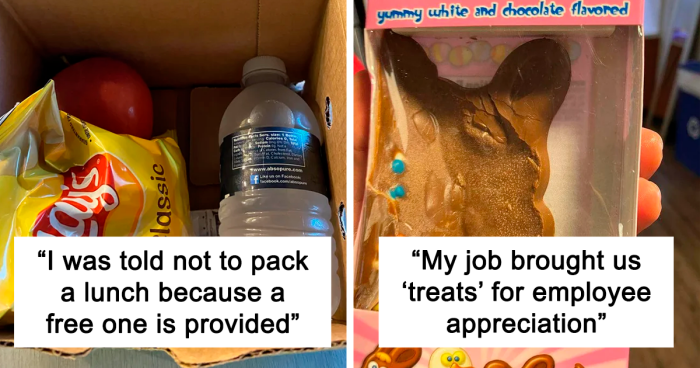
Some workplace perfinancial disaster, paid time off gives people room to recover, and flexible schedules help employees manage life beyond their laptops. Then there are the other “perks”the ones that arrive in a company-wide email decorated with confetti while everyone quietly wonders whether the confetti could have been exchanged for money.
Research consistently shows that workers care about compensation, useful benefits, flexibility, advancement, psychological safety, and meaningful recognition. In a Pew Research Center survey, only 30% of workers said they were highly satisfied with their pay, while just 26% felt similarly about promotion opportunities. Meanwhile, the Bureau of Labor Statistics treats health coverage, retirement plans, paid leave, and supplemental compensation as core parts of employee benefitsnot novelty mugs or permission to wear denim.
With that distinction established, let us salute 40 spectacular occasions when employers apparently opened the employee-appreciation budget, found fourteen dollars and a coupon, and decided to dream small.
Food-Based Perks That Somehow Made Everyone Hungrier
1. One Slice of Pizza After a Record-Breaking Quarter
The team generated millions in revenue, so management celebrated with three pizzas for 47 people. Employees were advised to take “reasonable portions,” transforming lunch into a competitive geometry examination.
2. A Candy Bar Instead of Holiday Pay
Working a holiday can mean missing family traditions, travel, and rest. Naturally, the ideal compensation is a miniature chocolate bar accompanied by a note reading, “You’re worth a million bucks.” Legally, however, the note cannot be deposited.
3. Free Coffee, Provided Employees Bring Everything
The break room technically offers free coffee. Workers merely need to supply the beans, filters, creamer, sugar, mugs, cleaning products, and emotional strength required to operate the machine.
4. A Fruit Basket for the Entire Department
Nothing says employee wellness like watching 30 adults negotiate ownership of two bananas, a bruised pear, and an apple that has apparently survived several corporate restructurings.
5. A Food Truck Employees Still Have to Pay For
Management proudly announces a “special employee lunch experience.” The experience consists of standing outside, buying a $17 sandwich, and eating it during the same 30-minute break as usual.
6. A Coupon for Five Percent Off the Company’s Products
Employees spend all day making or selling the product, then receive the privilege of purchasing it at nearly full retail price. The company calls this a discount. Accounting calls it customer acquisition.
7. A Single Donut Cut Into Pieces
One office allegedly needs neither a budget nor dignity when it possesses a knife. Slice one donut into eight segments, arrange them on a paper plate, and suddenly finance has invented fractional pastry ownership.
8. “Lunch and Learn” During the Employee’s Actual Lunch
The company provides a seminar but not necessarily food. Employees surrender their break to hear a presentation about productivity, time management, or the importance of taking regular breaks.
9. An Ice-Cream Party Scheduled After Everyone’s Shift
Attendance is described as voluntary, although managers take note of who leaves. Workers stay late without pay to demonstrate team spirit while eating a rapidly melting scoop under fluorescent lighting.
10. Leftovers From the Executive Meeting
Nothing builds loyalty like an email announcing that employees may collect half a turkey wrap and several abandoned pickle spears from Conference Room B before facilities throws them away.
Recognition Programs That Felt More Like Practical Jokes
11. Employee of the Month With No Reward
The winner receives additional responsibilities, a photograph near the copier, and the knowledge that their exceptional performance has earned them precisely the same paycheck.
12. A Certificate With the Employee’s Name Misspelled
A generic template becomes even more touching when nobody checks whether “Micheal,” “Sara,” or “Jhon” has been spelled correctly after seven years of service.
13. A Branded Pen for a Major Anniversary
Ten years of deadlines, emergencies, and institutional knowledge culminate in a plastic pen bearing the company logo. It stops working before the employee finishes updating their résumé.
14. Reward Points That Expire Before They Can Be Used
Employees accumulate points for excellent performance, only to discover that the catalog requires 12,000 points for a toaster and their entire annual achievement produced 340.
15. A Public Round of Applause Instead of a Raise
Applause is pleasant, but landlords continue to show an unreasonable preference for currency. Recognition matters most when it is timely, authentic, personalized, and connected to something employees value. Gallup found that workers receiving high-quality recognition were substantially less likely to leave over a two-year period.
16. A Gift Card That Creates a Tax Surprise
The employee receives a small gift card, celebrates briefly, and later discovers it listed as taxable compensation. The reward effectively arrives holding hands with paperwork.
17. A Trophy That Must Be Returned Next Month
The office’s highest performer is permitted temporary custody of a plastic trophy. It has previous winners’ names taped underneath and smells faintly of storage closet.
18. A Social-Media Shoutout the Employee Had to Write
Management asks the honored employee to draft their own appreciation post, provide a photograph, select hashtags, and send final copy for approval. Even gratitude has been delegated.
19. A New Job Title Without New Pay
Congratulationsyou are now “Senior Executive Lead Coordinator.” The work has expanded, the title requires two lines in an email signature, and the salary remains preserved in its original historical condition.
20. More Work as a Reward for Good Work
The most reliable employee finishes early, so management rewards them with tasks belonging to three slower colleagues. Excellence becomes a subscription service nobody remembers ordering.
Wellness Perks That Ignored the Cause of the Stress
21. A Meditation App for Employees Working 70 Hours
Rather than reducing impossible workloads, the employer provides a mindfulness subscription. Workers may now listen to ocean sounds while answering midnight emails.
22. A Stress Ball During Layoffs
A foam ball cannot repair job insecurity, but it can be squeezed while management explains that everyone must “do more with less.” Eventually, even the stress ball requests severance.
23. A Sleep Webinar Scheduled at 7 a.m.
The webinar teaches that adequate sleep improves health and performance. Attendance is mandatory, cameras must remain on, and anyone who yawns is clearly failing to engage.
24. A Wellness Challenge That Publicly Tracks Weight
Employees are invited to disclose personal measurements on a shared spreadsheet in exchange for the possibility of winning a water bottle. Privacy leaves the building before the first weigh-in.
25. A Mental Health Day With Mandatory Check-Ins
The company grants a day for recovery but schedules a morning status call, expects prompt Slack responses, and recommends using the afternoon to “get ahead for tomorrow.”
26. A Nap Pod Nobody Has Permission to Use
The futuristic nap pod appears prominently during office tours. Employees who attempt to enter it are reminded that sleeping during business hours may suggest a lack of commitment.
27. Discounted Gym Membership at an Impossible Location
The gym is 38 miles away, closes before the evening shift ends, and requires a 12-month contract. Nevertheless, it appears in recruitment materials beneath the phrase “We invest in you.”
28. A Mandatory Resilience Workshop
Employees are trained to become more resilient instead of the organization addressing understaffing, unpredictable scheduling, harassment, or chronic overtime. The leak remains; workers receive swimming lessons.
29. A Wellness Newsletter During a Benefits Cut
The email recommends fresh vegetables, preventive care, and stress reduction immediately after announcing higher deductibles. Healthy living apparently begins with pretending medical bills are imaginary.
30. A Breathing Exercise Before an Unpaid Shift Extension
Supervisors lead two minutes of controlled breathing, then announce that everyone must stay late. Inhale optimism, exhale labor-law questions.
Well-being cannot be reduced to an app, webinar, or bowl of aging fruit. In an American Psychological Association survey, 92% of workers said it was important to work for an organization that values emotional and psychological well-being. Research also associates genuine work-life support with better health, productivity, and retention. /section>
“Flexible” Benefits With an Impressive Number of Restrictions
31. Unlimited PTO That Nobody Can Get Approved
The policy is unlimited in the same way the sky is unlimited: beautiful to discuss, difficult to access, and controlled by forces beyond the employee’s authority.
32. Work From Anywhere, Except Anywhere Outside the Office
The job advertisement promises location flexibility. After hiring, employees learn that “anywhere” refers to any available desk between the lobby and the supply cabinet.
33. Flexible Hours Chosen Entirely by Management
Employees must remain flexible enough to open, close, cover weekends, change shifts without notice, and answer calls at home. The employer’s schedule, by contrast, is sacred.
34. An Unpaid Birthday Off
The company generously allows employees to celebrate by losing a day’s wages. Anyone unable to afford the perk may spend their birthday at work, where a group email awaits.
35. Early-Release Friday After Impossible Targets
Employees may leave at 3 p.m. if they complete an amount of work normally requiring two additional business days. Everyone departs at 7 p.m. feeling insufficiently festive.
36. Casual Friday With a Participation Fee
Workers pay for permission to wear jeans, often in the name of charity. The company receives cultural credit, the employee funds the initiative, and denim somehow becomes a payroll deduction.
37. A Premium Parking Spot for Remote Employees
The quarterly prize is a reserved parking space at an office the winner rarely visits. It is conveniently located beside the executive spaces and several hundred miles from the employee’s home.
38. Free Professional Training Completed Off the Clock
The employer advertises career development, then requires workers to finish mandatory courses during evenings or weekends. Growth is encouraged, provided it consumes no company time.
39. A Referral Bonus Payable After 18 Months
Employees recruit talented friends but receive the bonus only if both people remain through multiple reorganizations, a merger, two eclipses, and the return of a particular migratory bird.
40. A Suggestion Box That Leads Directly to Nowhere
Management requests honest feedback, ignores recurring concerns, and later announces a desk-decoration contest. Workers asked for fair staffing; they received an opportunity to make a cubicle look tropical.
Flexibility has measurable value when employees can actually use it. Mercer reported that 93% of surveyed employees would place at least some value on flexible working, while Pew found substantial dissatisfaction among workers lacking remote-work flexibility. Useful policies require trust, clear expectations, adequate staffing, and managers who do not punish people for using advertised benefits. /section>
Why Insulting Employee Perks Backfire
A small gesture is not automatically a bad gesture. Free coffee, occasional pizza, company merchandise, or team games can be enjoyable when they sit on top of competitive pay and humane working conditions. Trouble begins when employers use inexpensive extras to replace compensation, rest, staffing, respect, or career development.
Employees understand the difference between a bonus and a distraction. A snack cannot repair an unpredictable schedule. A branded hoodie cannot reduce a medical deductible. A mindfulness session cannot solve chronic understaffing. A certificate cannot compensate for years without advancement.
The most effective recognition also reflects what a particular employee values. Some people appreciate public praise; others prefer private thanks, development opportunities, additional time off, or a financial reward. Gallup’s research emphasizes timely, authentic feedback, while Workhuman recommends making recognition frequent, equitable, personalized, and integrated into everyday culture.
Core benefits carry practical value because they help people obtain healthcare, save for retirement, care for family members, and take time away from work. Indeed’s overview of employee benefits highlights these concrete functions, while BLS data show how access to healthcare, retirement plans, and sick leave differs sharply between full-time and part-time workers. /section>
What These “Perks” Feel Like in Real Workplace Experiences
The following scenarios are composites based on common workplace patterns rather than claims about one specific employer. They show why a perk that sounds harmless in a presentation can feel insulting when experienced from the other side of the conference table.
The Frontline Worker’s Experience
Imagine an employee who has covered multiple vacant positions for months. Their shifts change with little warning, paid sick leave is limited, and customers become angrier as staffing declines. Management eventually announces Employee Appreciation Week. On Monday, workers receive stickers. Tuesday brings a bowl of candy. Wednesday features a photograph with senior leaders who leave before the evening rush.
The employee is not offended because candy is inherently bad. They are offended because the celebration demonstrates that management recognizes morale is low but chooses not to address why. The sticker becomes a tiny adhesive monument to avoided responsibility.
The Office Employee’s Experience
Consider a salaried employee who regularly works late because two departing colleagues were never replaced. The company offers unlimited vacation, but every request triggers questions about deadlines, coverage, and commitment. Managers rarely take more than a long weekend, quietly establishing the real policy.
When the employee begins showing signs of burnout, HR sends a link to a meditation platform. The app recommends boundaries, sleep, and putting the phone away after work. Five minutes later, the employee receives a message from their manager marked urgent. The perk does not merely fail; it highlights the contradiction between the company’s language and behavior.
The Remote Worker’s Experience
A remote worker may receive perks designed almost entirely for headquarters: catered lunches, an on-site gym, commuter benefits, a game room, and happy hours beginning before the remote employee’s workday ends. Their own requests for a better chair, internet reimbursement, or flexible meeting hours are denied.
SHRM noted that organizations adapting perks for remote employees have used practical support such as meal stipends. The broader lesson is not that every benefit must be identical, but that benefits should offer comparable value to people working under different conditions.
The High Performer’s Experience
A strong performer is often rewarded with invisible labor. They train new hires, rescue late projects, document processes, and answer questions outside their role. During review season, the manager praises their dedication but explains that budgets are tight. A title change may be possible, although compensation is not.
Eventually, praise begins to sound less like recognition and more like advance notice of another assignment. Meaningful recognition should make good performance sustainable. When excellence only produces additional work, employees learn that appearing average may be the safest career strategy.
The Manager’s Experience
Not every foolish perk originates with an uncaring supervisor. Middle managers may receive tiny morale budgets while lacking authority to approve raises, increase staffing, or change benefits. They are instructed to improve engagement using games, themed meetings, and inexpensive rewards.
This places managers in an awkward position. They know the team needs structural support but are equipped with pizza coupons. Better organizations give managers enough authority, training, and resources to address root causes. Gallup has found that frequent, valuable feedback and recognition are associated with much stronger engagement, but authenticity disappears when managers are forced to perform gratitude without meaningful backing.
The Final Breaking Point
Insulting perks rarely cause resignation by themselves. The donut segment, stress ball, or misspelled certificate usually becomes symbolic of a longer pattern: low pay, weak communication, disrespect, blocked advancement, exhausting schedules, or benefits employees cannot use.
That is why the smallest gesture can produce the largest eye roll. Employees are not demanding that every appreciation event involve enormous bonuses. They are asking employers to understand the order of operations: provide fair compensation, safe conditions, manageable work, usable benefits, and respectful leadership first. Then bring out the pizza.