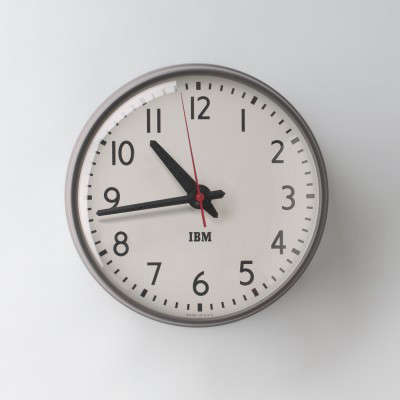
The 1960s IBM 13.5-inch Standard Issue Clock is the rare office object that can make a blank wall feel intelligent. With its high-contrast dial, deep steel case, domed glass, and no-nonsense industrial character, it recalls an era when schools, factories, churches, and corporate offices depended on synchronized clocks to keep entire buildings moving together. This guide explores the clock’s history, design, original electrical system, modern reissue, restoration considerations, collecting appeal, and the surprisingly emotional experience of living with one.
Why This Plain Gray Clock Became a Design Icon
At first glance, the 1960s IBM 13.5" Standard Issue Clock looks almost aggressively ordinary. It is round. It is gray. It has black numbers, dark hands, and a bright second hand. There are no walnut starbursts, brass sunrays, or little wooden birds popping out to announce lunch. Yet that restraint is precisely why the clock has endured.
Its face was designed to answer one question immediately: “What time is it?” The numerals are large enough to read across a classroom or warehouse floor. The pale dial and dark graphics create strong contrast. The substantial metal housing gives the clock a permanent, institutional presence. It does not decorate time; it reports time.
The familiar “1960s Standard Issue” name is now closely associated with the licensed Schoolhouse reproduction. Historically, IBM described clocks in its synchronized systems as indicator or secondary clocks, while collectors may also call them slave clocks. Schoolhouse states that the underlying IBM Indicator Clock design first appeared in 1947 and became especially common during the 1960s. That gives the clock a slightly complicated birth certificate: introduced before the decade, remembered because of the decade, and revived decades later for modern interiors.
IBM Was in the Time Business Before It Ruled Computing
The IBM name now brings to mind mainframes, punch cards, artificial intelligence, and perhaps a very serious person explaining cloud infrastructure. Long before all that, however, timekeeping was part of the company’s foundation.
One of IBM’s corporate ancestors was the International Time Recording Company, formed from businesses that developed mechanical systems for tracking employee attendance and work hours. These systems helped employers replace handwritten records with standardized time data. In 1911, International Time Recording joined other companies to form the Computing-Tabulating-Recording Company, which adopted the International Business Machines name in 1924.
IBM continued selling time recorders, master clocks, signal equipment, and related systems for decades. By the 1950s, however, data processing and electric typewriters had become far more important to the company. IBM’s own historical account says the Time Equipment Division represented less than three percent of gross revenue when it was sold to Simplex Time Recorder Company in 1958. The transaction explains why surviving clocks, replacement parts, and later examples can blur the line between IBM and Simplex manufacture.
A Useful Historical Nuance
Calling every round gray IBM clock a “1960s IBM clock” can be convenient, but it is not always precise. Some genuine IBM-branded clocks were produced in the 1940s or 1950s and remained installed well into the 1960s and beyond. Others were built after the time-equipment operation changed hands or contain Simplex-related components. A seller’s decade estimate should therefore be treated as a starting point, not a notarized fact delivered from the past by a man in a narrow tie.
The Design: Industrial Modernism Without the Speech
The clock’s appeal comes from disciplined proportions rather than ornament. The widely known reproduction measures 13.5 inches in diameter and projects approximately four inches from the wall. Its spun-steel case, textured gray finish, domed glass lens, and original-style dial graphics recreate the visual weight of the institutional clocks that inspired it. A red continuous-sweep second hand adds movement without making the clock look playful.
Readable Typography
The Arabic numerals are bold, simple, and evenly spaced. Their purpose is not to demonstrate typographic cleverness but to remain legible from a distance and at an angle. Minute marks form a clear perimeter, while the broad hour and minute hands are easy to distinguish visually. In a schoolroom, office, workshop, or warehouse, clarity matters more than decorative flourish.
A Case With Architectural Presence
Many inexpensive wall clocks sit almost flat against the wall and disappear from side view. The IBM clock does the opposite. Its deep case creates a visible profile, more like a small instrument enclosure than a printed dial in a plastic ring. The domed lens catches changing reflections, while the neutral gray housing works with brick, plaster, painted drywall, tile, wood paneling, and concrete.
How It Fits IBM’s Broader Design Culture
The clock’s original form predates some of IBM’s most famous design initiatives, so it should not automatically be credited to Eliot Noyes or Paul Rand. Still, its functional directness feels at home beside the comprehensive design program IBM developed under Thomas J. Watson Jr. Beginning in 1956, Noyes helped unify the company’s products, graphics, buildings, and public image around clarity, modern materials, and coherent visual thinking. The clock’s plainspoken utility belongs to that larger mid-century culture, even when direct authorship cannot be assigned.
How Original IBM Clock Systems Worked
A vintage IBM wall clock may look like a self-contained appliance, but many examples were designed as secondary clocks in a building-wide network. A central master clock kept the authoritative time and sent electrical impulses to remote clock movements. Schools used the same system to coordinate classroom clocks and bells. Factories could align break times and shift changes. Offices, hospitals, churches, and campuses gained one shared schedule rather than fifty clocks disagreeing like a committee.
Some systems advanced remote clocks with a low-voltage pulse, commonly around 24 volts, at regular intervals. Different mechanisms and generations used different correction methods, so an old movement should never be connected to household current merely because two wires are hanging from the back. Historical campus accounts describe IBM master clocks sending minute pulses to clocks throughout a building, and restoration discussions confirm that certain IBM and Simplex secondary models require a compatible controller or pulse driver.
Why a Vintage Clock May Appear Dead
A clock that does nothing when removed from a school wall may not be broken. It may simply be waiting for a master signal that no longer exists. This is one reason vintage examples are often advertised as untested. The original mechanism might be intact, electrically incomplete, modified, or frozen after decades of dust and dried lubricant.
The Modern Reissue Is Much Simpler
The Schoolhouse version replaced the building-control requirement with a battery-powered quartz movement. Published descriptions specify one C battery, a wall-mounting keyhole, and the same 13.5-inch diameter associated with the reissue. In practical terms, it preserves the visual theater while removing the need to install a master clock in the janitor’s office.
Original IBM Clock Versus Schoolhouse Reissue
Choosing between an original and a reproduction depends on whether you want historical machinery, dependable daily use, or a little of both.
What an Original Offers
An authentic vintage IBM clock carries real institutional history. Paint wear, small scratches, faded markings, and an old inventory number can connect it to a school, plant, or office where it once governed the day. Original hands, glass, faceplate, rear labels, wiring, and mechanism all add collector interest.
The trade-off is uncertainty. The clock may require specialist diagnosis, a pulse controller, careful rewiring, or a reversible movement conversion. Even when an original mechanism appears complete, that does not mean it is ready to plug into a household outlet.
What the Reissue Offers
The licensed reproduction delivers the recognizable silhouette with straightforward battery operation. Design publications noted its U.S.-made spun-steel case, domed glass, Portland assembly, and faithful face graphics. It is easier to hang, easier to maintain, and far less likely to turn a casual decorating project into an amateur electrical-engineering semester.
Neither Choice Is Automatically Better
A museum-minded collector may value an untouched, nonworking original more than a functioning conversion. A homeowner may reasonably prefer a reproduction that keeps accurate time and needs no custom electronics. A third owner may install a modern quartz movement in a damaged vintage shell. The best choice is the one that respects the object and fits its intended use.
How to Evaluate a Vintage IBM 13.5-Inch Clock
Before buying, request clear photographs of the dial, side profile, rear housing, labels, mounting points, mechanism, wiring, and lens edge. A front-only image can hide almost everything expensive.
Check the Dial and Branding
Look for consistent printing, correct spacing, age-appropriate wear, and any model number printed on or behind the dial. Model 95925 frequently appears in collector listings for approximately 13- to 13.5-inch IBM institutional clocks, but a model number alone does not prove an exact manufacturing year. Compare the complete construction rather than trusting one stamped number.
Inspect the Case and Lens
A dented steel case can often be tolerated aesthetically, especially if the clock is destined for an industrial interior. A cracked lens, severely rusted rim, missing hands, or damaged dial is more difficult to address. Confirm whether the lens is glass or a later replacement and whether the case has been repainted. Fresh paint is not necessarily bad, but it should not be advertised as untouched originality.
Ask What “Working” Means
For a secondary clock, “working” might mean the seller applied a proper pulse and watched the hand advance. It might also mean someone spun the hands manually and felt optimistic. Ask what power source or controller was used, whether the correction functions operate, and whether the movement has been converted.
Look for Missing Components
Hands, retaining nuts, lenses, rear covers, mounting brackets, and movement parts can be difficult to replace with period-correct pieces. A low purchase price becomes less attractive when the clock arrives as a circular metal scavenger hunt.
Restoration, Conversion, and Safety
Begin with documentation. Photograph every wire, terminal, screw, label, spacer, and hand position before disassembly. Do not clean the dial with ordinary household spray cleaner. Old printing can lift, smear, or stain. Remove loose dust gently with a soft brush and test any cleaning method in an inconspicuous area.
If originality matters, retain the old mechanism even when installing a reversible quartz conversion. Avoid drilling new holes when an adapter plate can use existing mounting points. Keep removed components together and label them clearly. Future collectors will thank you, perhaps silently, because clock collectors are usually busy listening for suspicious ticking.
Electrical work deserves caution. Vintage insulation may be brittle, original voltage requirements may be unclear, and a mechanism designed for control pulses is not equivalent to a standard 120-volt clock motor. A qualified clock repairer, electrician, or experienced impulse-clock specialist should inspect unfamiliar hardware. Preservation is admirable; preservation plus avoiding electrocution is even better.
Why Collectors Still Want the IBM Clock
The IBM Standard Issue Clock appeals to several groups at once. Industrial-design collectors appreciate its functional form. Technology enthusiasts enjoy owning an object linked to IBM’s precomputer history. Mid-century decorators value its proportions and muted finish. Former students and office workers respond to the clock’s familiarity, even when they cannot identify where they first encountered one.
It is also a recognizable object without being excessively flashy. An IBM clock can start a conversation, but it does not require an entire room to be designed around it. That balance makes it easier to live with than many novelty-heavy vintage pieces.
Condition, provenance, originality, model, and functionality all influence collector interest. A clock documented as coming from a notable school, factory, laboratory, or IBM facility may carry additional appeal. Nevertheless, buyers should be cautious about dramatic stories that arrive without photographs, inventory records, labels, or other evidence. “Found in an old building” is atmosphere, not provenance.
Where the IBM Standard Issue Clock Works Best
The clock is unusually adaptable because its visual language is neutral, graphic, and architectural. It can anchor a home office above a desk, add authenticity to a workshop, bring structure to a kitchen, or provide an industrial counterpoint in a warm living room.
In a mid-century modern room, it pairs naturally with molded plywood, steel shelving, teak, and restrained lighting. In a contemporary room, it offers texture and history without becoming costume décor. In a traditional space, the gray metal case can create productive tension beside painted millwork or antique furniture.
The clock works especially well where it has breathing room. A 13.5-inch object is large enough to command attention but small enough to avoid looking like the station clock at Grand Central. Mount it at a height and angle that preserve readability, and avoid positioning it directly opposite harsh windows if reflections on the domed glass will obscure the dial.
Experiences With the 1960s IBM 13.5" Standard Issue Clock
Living with this clock is different from owning a decorative wall object that gradually fades into the background. The IBM face keeps reintroducing itself. You notice it when entering the room, when waiting for coffee, when a meeting runs long, and when five minutes of focused work somehow turns into forty-two. Its readability is so immediate that checking the time becomes almost involuntary.
For many people, the strongest experience is recognition. The clock can trigger memories of fluorescent-lit classrooms, polished school hallways, factory break rooms, church basements, libraries, and offices with metal desks. Even someone who never saw an IBM-branded example may recognize the broader institutional clock type. That familiarity gives the object emotional weight. It feels less like a newly purchased accessory and more like something that has already occupied a corner of memory.
An original clock adds another layer. Handling the deep metal case makes its industrial purpose obvious. The housing is not pretending to be substantial; it is substantial. Turning it over may reveal labels, wiring, paint marks, mounting scars, or handwritten maintenance notes. Those details invite speculation. Which building did it serve? How many students watched its minute hand? How many employees waited for it to release them at five o’clock? A small chip in the paint can become more interesting than a flawless new finish.
The restoration experience ranges from satisfying to comically educational. A buyer may expect to replace a cord, only to discover a secondary movement that depends on low-voltage impulses from a vanished master system. Suddenly, the project includes controller research, wiring diagrams, voltage questions, and vocabulary nobody planned to learn on a Saturday. That complexity can be frustrating, but it also reveals what made institutional clocks remarkable: they were nodes in an early synchronized information network.
A quartz-converted vintage clock offers a compromise. It keeps the authentic shell, dial, lens, and hands while behaving like a normal household clock. Purists may prefer the original mechanism, but a reversible conversion allows the object to return to daily service. There is pleasure in seeing a once-silent artifact resume its job, even if a small battery now replaces an entire building’s timing infrastructure.
The modern reissue creates a calmer experience. Hang it, install the battery, set the hands, and continue with life. Its sweep second hand provides gentle motion rather than the emphatic minute jump of some impulse clocks. In a quiet office, that movement feels almost cinematic. In a kitchen, the large dial is useful from across the room. In a studio, it looks appropriately serious while quietly judging how long the “quick” project has taken.
Over time, the clock’s plainness becomes its charm. Trend-driven accessories often demand attention and then become tiring. The IBM clock does the opposite. Its shape, contrast, and materials are easy to understand on day one, but its historical associations deepen with ownership. It can be both tool and conversation piece, both corporate artifact and household companion. Most of all, it changes the atmosphere of a room without shouting. It simply hangs there, calmly announcing that time is passing and that the meeting probably should have ended ten minutes ago.
Conclusion
The 1960s IBM 13.5" Standard Issue Clock represents a type of design that modern products often imitate but rarely achieve: complete confidence without excess. Its bold dial, steel enclosure, domed lens, and institutional proportions were shaped by practical needs, yet those same qualities made it visually timeless.
Its story also reaches beyond style. IBM’s roots in time recording, the spread of synchronized master-clock networks, the 1958 sale of the Time Equipment Division, and the later Schoolhouse revival all sit behind this apparently simple object. Whether you choose an untouched secondary clock, a carefully converted vintage example, or a battery-powered reproduction, you are bringing home a small piece of American industrial historyone that still performs its original task every minute of the day.