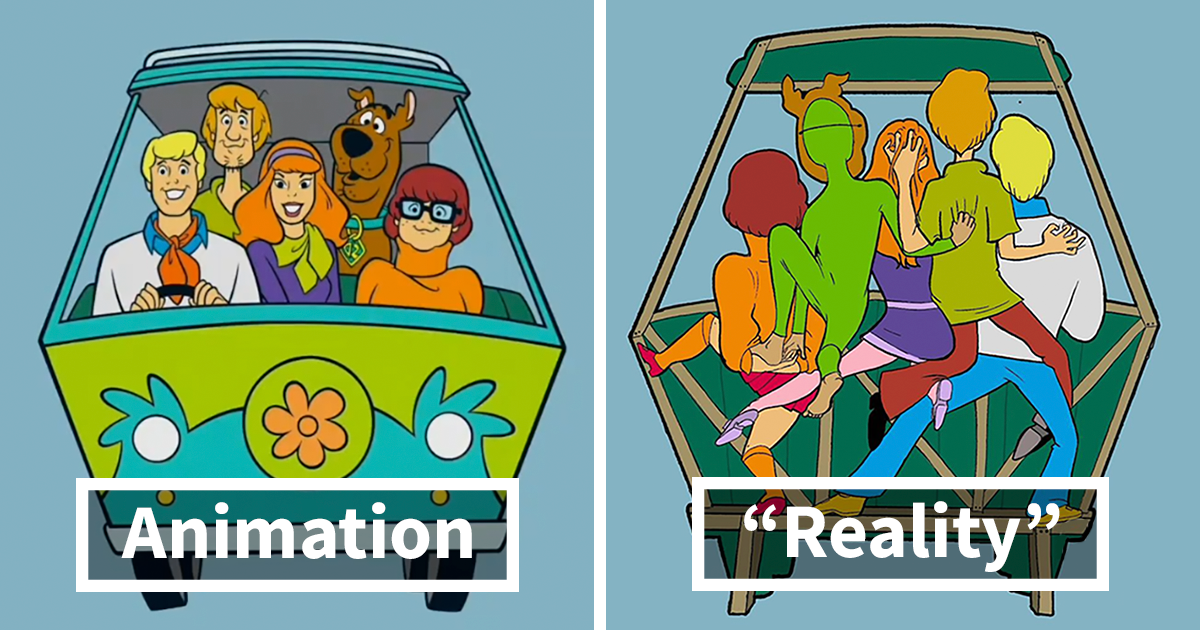
Animated movies have trained us to believe in perfect hair, flawless lighting, dramatic ocean waves, heroic poses, and characters who can sing on cliffs without once worrying about wind, gravity, or wardrobe malfunctions. Then along comes Indonesian digital artist Andhika Muksin with a mischievous question: what if those iconic animated scenes were not pure magic, but chaotic little film sets with green screens, props, exhausted actors, and one very patient crew member holding a cardboard prince?
That playful idea sits at the heart of “18 Behind-The-Scenes Pics Of Famous Scenes From Pop Culture Animations By Andhika Muksin,” a collection of fan-art edits that reimagines beloved scenes from Disney movies and classic cartoons as if they were filmed like live-action productions. Instead of treating animation as untouchable fantasy, Muksin opens a fake studio door and lets us peek behind the curtain. The result is funny, weirdly believable, and surprisingly clever.
His work does not mock animation so much as celebrate it. These edits are love letters wearing a fake mustache. They remind us that animated scenes feel magical because artists work very hard to hide the strings, layers, sketches, software, camera logic, acting choices, and production tricks that make them sing. Muksin simply imagines what would happen if those strings were suddenly visibleand, naturally, hilarious.
Who Is Andhika Muksin?
Andhika Muksin is an illustrator and digital collage artist based in Jakarta, Indonesia, known for reworking familiar pop culture characters into unexpected real-world situations. His art often focuses on Disney princesses, fairy-tale characters, and nostalgic cartoons, but his real subject is not just Disney. It is the gap between childhood fantasy and adult reality.
Before the behind-the-scenes animation series, Muksin gained attention for making Disney characters look more realistic and relatable. Instead of princesses waking up with perfect hair and impossible cheekbones, his versions might have bedhead, awkward camera angles, tired expressions, or the kind of facial reaction you make when your phone opens on selfie mode by accident. That is why his work spreads so easily online: it turns polished fantasy into something recognizably human.
His style blends several ingredients: digital collage, parody, visual humor, nostalgia, and a sharp understanding of how fans remember famous animated scenes. He does not need to explain every joke because the audience already knows the original moment. One edited frame is enough to make people say, “Oh no, I never thought about it that wayand now I cannot unsee it.”
What Makes The “Behind-The-Scenes” Concept So Funny?
The joke works because animation is not filmed in the same way live-action cinema is filmed. A cartoon character does not literally stand on a set, miss a mark, wear a wig, complain about lighting, or wait for someone to yell “cut.” Yet Muksin imagines exactly that. He treats animated characters like actors stuck inside a production day that has gone slightly off the rails.
That reversal creates instant comedy. A magical transformation becomes a practical effect. A dramatic underwater pose becomes an awkward studio setup. A heroic flight might depend on hidden wires, a platform, a green screen, or someone just out of frame doing far too much physical labor for the shot. It is animation magic translated into backstage inconvenience.
In the Bored Panda collection, viewers see characters and scenes from pop culture animations such as Scooby-Doo, Cinderella, The Powerpuff Girls, The Little Mermaid, Aladdin, and the Evil Queen from Snow White. The fun is not only in recognizing the characters. It is in seeing how Muksin re-stages the illusion: monsters become performers, princess moments become studio gags, and classic cartoon drama suddenly looks like a low-budget shoot with extremely committed actors.
The Art Of Dismantling Childhood Magic
Many people grew up treating animated films as emotional furniture. They were always there: on VHS tapes, weekend TV blocks, DVDs, streaming platforms, lunchboxes, pajamas, theme-park rides, and every family road trip where one song played 73 times because someone in the back seat had control of the soundtrack. Muksin understands that nostalgia is powerful because it feels personal.
His behind-the-scenes edits gently dismantle that nostalgia without destroying it. The magic is still there, but now it is wearing sneakers and standing in front of a green screen. This is why the work feels affectionate rather than cynical. He is not saying, “Your childhood was fake.” He is saying, “Your childhood was magical, but what if the production crew had to solve it with duct tape?”
That is a very adult kind of humor. As children, we accept the scene. As adults, we ask practical questions. How did Ariel’s hair stay perfect underwater? How did Cinderella’s dress survive all that rushing around? How did Aladdin’s flying carpet get such smooth aerial coverage? How many safety forms would be required for a villain to stand dramatically near lightning? Muksin turns those questions into pictures.
Why These Edits Connect With Animation Fans
One reason Muksin’s art resonates is that animation fans love details. They notice background jokes, Easter eggs, props, color palettes, character poses, and tiny visual references. A single still from a classic film can hold decades of audience memory. By editing these scenes, Muksin invites fans to revisit what they already know from a new angle.
Another reason is that the internet loves “what if” humor. What if princesses used social media? What if cartoon villains had office jobs? What if a perfect animated scene was actually filmed in the least glamorous way possible? Muksin’s behind-the-scenes series fits perfectly into that culture because it is easy to understand in seconds but still clever enough to reward a longer look.
The edits also work because they are visual essays disguised as jokes. They comment on the production language of modern entertainment: CGI, green screens, body doubles, props, stunt work, camera placement, lighting, and post-production. When he imagines a cartoon scene as a film set, he is pointing to the invisible labor behind every polished frameeven if the specific setup is fictional.
Real Animation Is Already Full Of Behind-The-Scenes Magic
The funniest part is that real animation production is already packed with behind-the-scenes wizardry. Walt Disney Animation Studios describes story as one of the first departments to visualize a film, with story artists thinking about emotion, expression, timing, staging, and framing. Layout artists then use characters, sets, props, and cameras to stage and shoot scenes shot by shot in the digital or animated space.
In other words, Muksin’s fake backstage world is not totally disconnected from reality. Animated films really do involve staging, camera logic, performance choices, lighting, production design, and technical problem-solving. The difference is that animators build those things frame by frame rather than pointing a camera at actors on a physical soundstage.
Disney history is especially rich with production innovation. The multiplane camera, developed at Walt Disney Studios and first used experimentally in The Old Mill in 1937, helped create a more convincing sense of depth in animated scenes. Later, digital tools pushed the art form further. Pixar’s history includes proprietary systems such as Marionette, known internally as Menv, and RenderMan, which helped shape computer animation workflows. Today, animation can involve modeling, rigging, simulation, lighting, rendering, and a small army of artists making sure a character’s eyebrow lands emotionally in the correct ZIP code.
Examples That Show Muksin’s Humor At Work
Scooby-Doo And The Fake Reality Of Monsters
Scooby-Doo is already built on the idea that scary things are not what they seem. Muksin’s behind-the-scenes treatment fits the franchise like a rubber monster mask. The humor lands because the show’s entire formula is about exposing illusions. A backstage version takes that logic one step further: not only is the monster fake in the story, but the scene itself becomes a fake production setup.
Cinderella And The Practical Problem Of Fairy-Tale Romance
Cinderella is one of the classic examples of polished animated fantasy. The dress, the ballroom, the prince, the midnight escapeit is all designed to feel elegant and effortless. Muksin’s style asks what might happen if that elegance depended on awkward props and crew tricks. Once you imagine a cardboard prince, a rushed set, or a production assistant managing royal sparkle, the fairy tale becomes instantly funnier.
The Little Mermaid And The Physics Of Being Dramatic Near Water
Ariel’s iconic imagery is beautiful because animation lets water, hair, light, and movement behave poetically. Reality is less cooperative. Real waves slap. Wet hair has opinions. Makeup quits. Rocks are not comfortable performance platforms. Muksin’s Mermaid-inspired humor often plays with that gap between cinematic fantasy and physical inconvenience.
Aladdin, The Genie, And The Green-Screen Joke
Aladdin gives Muksin a perfect playground because it includes transformation, flight, magical scale, and one of animation’s most expressive characters: the Genie. Imagining that magic as a live-action production invites jokes about blue makeup, green screens, tired actors, and effects that would definitely require a post-production team with coffee and a mild spiritual crisis.
The Powerpuff Girls And Cartoon Logic On A Film Set
The Powerpuff Girls has a visual language that is bold, graphic, and exaggerated. Putting that style into a behind-the-scenes context creates a funny collision between flat cartoon design and physical production logic. How do you film characters who are basically flying heads with tiny limbs and superhero confidence? Carefully, apparently.
Why The Series Is More Than A Meme
It would be easy to dismiss Muksin’s work as “just funny internet pictures,” but that undersells the craft. Good visual parody requires precision. The artist must understand the original image, identify what makes it iconic, preserve enough of it for recognition, and then alter it just enough to create a new meaning. Too little change, and it is merely a reference. Too much change, and the joke disappears.
Muksin’s best edits hit the sweet spot. They keep the emotional silhouette of the original scene while changing the production logic. That is why the audience laughs so quickly. The brain recognizes the famous moment, then immediately processes the absurd behind-the-scenes explanation. It is nostalgia plus surprise, which is basically rocket fuel for shareable content.
There is also a larger point about fan culture. Modern audiences do not only consume pop culture; they remix it, comment on it, meme it, rank it, cosplay it, parody it, and argue about it in comment sections with the intensity of medieval philosophers. Fan art has become one of the main ways people participate in the stories they love. Muksin’s art belongs to that participatory culture.
SEO Analysis: Why This Topic Performs Well Online
From an SEO perspective, “18 Behind-The-Scenes Pics Of Famous Scenes From Pop Culture Animations By Andhika Muksin” has several strong ingredients. It contains a number, a recognizable artist name, a pop culture hook, and a curiosity gap. Readers immediately understand that they will see a collection, but they also want to know which famous scenes were reimagined and how.
The topic naturally supports keywords such as Andhika Muksin, behind-the-scenes animation pics, Disney fan art, pop culture animations, funny cartoon edits, digital collage art, and famous animation scenes. More importantly, those keywords can be inserted naturally because they describe the subject directly. There is no need to stuff them into every paragraph like a suitcase before a budget flight.
Search users interested in this topic may come from several angles. Some are fans of Disney and classic cartoons. Some are looking for funny art. Some follow digital illustrators. Some are curious about how animation works. Others simply enjoy internet collections that make them laugh during lunch. A strong article should serve all of those readers by combining explanation, examples, context, and entertainment.
Experience Section: Watching These Edits Feels Like Sneaking Onto A Cartoon Set
Looking at Muksin’s behind-the-scenes animation edits feels a little like walking into a theater before the show begins and seeing the props scattered everywhere. The castle is plywood. The moon is a light. The ocean is a tarp. The dramatic villain cape is clipped to a folding chair. Somehow, knowing the trick does not ruin the magic. It makes the magic more enjoyable because you can appreciate both the illusion and the imagination behind the illusion.
That is the special pleasure of this series. It lets viewers be children and adults at the same time. The child recognizes the beloved scene and feels the old spark of wonder. The adult sees the joke and thinks, “Yes, honestly, that would probably take three crew members and a safety harness.” The humor lands because it respects both reactions.
There is also something comforting about seeing perfect characters placed in imperfect situations. Animated icons often seem untouchable. Their hair behaves. Their eyes sparkle. Their timing is flawless. Their emotional songs happen with orchestral support, which is deeply unfair to the rest of us trying to express feelings in a grocery store parking lot. Muksin brings those characters down to earth, not by making them less beloved, but by making them more relatable.
For artists, the series is a reminder that a great idea does not always need to be complicated. The concept is simple: take a famous animated scene and imagine the ridiculous production method behind it. But simplicity is not the same as ease. The execution requires timing, composition, reference knowledge, and a strong instinct for what viewers will recognize instantly. That is why the images feel effortless even though the thought process behind them is carefully tuned.
For animation fans, the edits create a fresh way to revisit familiar movies and cartoons. After seeing this type of work, it becomes hard not to imagine fake behind-the-scenes setups everywhere. A princess sings on a balcony, and suddenly you picture a tired crew member operating a wind machine. A villain transforms dramatically, and you wonder who handled the fog machine. A flying character soars across the sky, and your brain whispers, “Green screen. Definitely green screen.”
That lasting effect is what makes the series memorable. It changes how you look at pop culture scenes you already know. It adds a second layer of comedy without taking away the first layer of wonder. In a digital world flooded with quick jokes, Muksin’s work stands out because it is funny, affectionate, visually smart, and rooted in a genuine love of cartoons.
Conclusion
“18 Behind-The-Scenes Pics Of Famous Scenes From Pop Culture Animations By Andhika Muksin” succeeds because it understands the secret relationship between nostalgia and humor. We love animated classics because they feel magical, but we laugh when someone imagines the practical chaos required to make that magic happen. Muksin turns iconic scenes into fictional film sets, complete with invisible labor, awkward props, green-screen logic, and wonderfully silly explanations.
The result is more than a gallery of funny images. It is a playful analysis of how pop culture lives in our memories. It reminds us that beloved characters can survive a joke, that fan art can create new conversations around old favorites, and that sometimes the best way to honor childhood magic is to ask how many crew members it would take to fake a mermaid shot.
Note: This article is written as original editorial content based on real public information about Andhika Muksin’s fan art and animation production context. Before publishing with images, use properly licensed visuals, embedded posts with permission where applicable, or official artist-approved media.