Walk Hard: The Dewey Cox Story did nogenre’s dressing room, tried on every leather jacket, smashed the furniture, entered rehab, made a comeback, and somehow recorded an excellent soundtrack before breakfast.
Released in 2007, Jake Kasdan’s musical comedy follows fictional rock legend Dewey Cox through childhood tragedy, sudden fame, creative reinvention, drug addiction, romantic chaos, and enough historical encounters to make Forrest Gump request a fact-checker. John C. Reilly plays Dewey with complete sincerity, which is precisely why the nonsense works.
Behind the camera, the filmmakers approached this absurd biography with an almost unreasonable level of care. Actors learned instruments, professional songwriters created decades of fake hits, elaborate period sets were constructed, and Reilly promoted the film by touring as Dewey Cox. Here are 15 behind-the-scenes facts about Walk Hard: The Dewey Cox Story that reveal how an apparent spoof became one of the most carefully built cult comedies of its era.
Behind the Music, Mustaches, and Machetes
1. The Idea Came From a Genuine Love of Music Biopics
Director Jake Kasdan and producer Judd Apatow were not trying to destroy movies such as Ray and Walk the Line because they hated them. Kasdan was a devoted fan of rock-and-roll movies, while Apatow had a family connection to the recording business through his grandfather, record producer Bobby Shad.
Kasdan recognized that prestige music biographies had developed a familiar formula: childhood trauma, the discovery of talent, instant fame, drugs, broken marriages, rehab, redemption, and a triumphant final performance. He proposed making an enormous fictional biography containing every cliché at once. Apatow loved the idea, and the project reportedly moved toward Sony almost immediately. Dewey Cox was born faster than most real bands can agree on a drummer.
2. John C. Reilly Was Essentially the Only Choice for Dewey
The filmmakers needed someone who could carry a broad comedy while remaining believable during its serious musical passages. That combination dramatically shortened the candidate list.
Apatow had recently worked with John C. Reilly on Talladega Nights and already knew that the actor was a strong singer. Reilly also had extensive dramatic experience and could play ridiculous material without signaling that he was waiting for applause. According to Apatow, the production did not seriously consider anyone else. Reilly’s ability to treat Dewey as an emotionally real person became the movie’s secret weapon.
3. Reilly Became More Than the Lead Actor
Reilly did not arrive, memorize his dialogue, sing into a microphone, and return to a comfortable trailer filled with tasteful fruit. He became deeply involved in developing the character and the production.
He participated in songwriting, script discussions, musical decisions, and casting. That involvement helped unify Dewey’s many identities, from rebellious teenager to psychedelic studio obsessive to elderly entertainment icon. The character changes genres, hairstyles, wives, and recreational chemicals, yet Reilly gives him one recognizable emotional center.
4. One Adult Actor Played Dewey From His Teens to Old Age
Music biopics frequently ask viewers to accept an adult star as a teenager after applying a smaller jacket and an optimistic amount of hair gel. Walk Hard turns that convention into a running joke.
After the childhood sequence, Reilly plays Dewey from approximately age 14 through the character’s final years. The production makes little effort to hide the absurdity of a visibly adult man announcing that he is a young teenager. As the decades pass, wigs, makeup, glasses, facial hair, and increasingly elaborate costumes do the chronological heavy lifting.
Costume designer Debra McGuire estimated that Reilly went through about 120 wardrobe changes. Fittings were divided by musical period, with appropriate wigs and music used to help establish each version of Dewey. It was less like dressing one actor and more like preparing an entire Rock and Roll Hall of Fame exhibit that occasionally roller-skated away.
5. The Production Created an Entire Fictional Music Career
The filmmakers could have written four novelty songs, repeated the chorus a few times, and hoped nobody noticed. Instead, the music department built a catalog covering rockabilly, country, folk, protest music, psychedelic pop, disco, orchestral excess, and reflective late-career ballads.
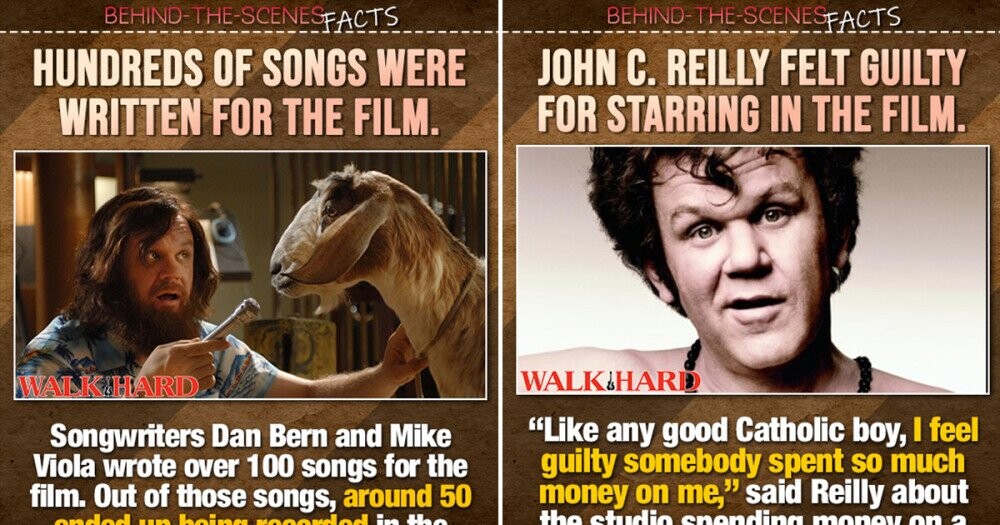
Reilly recalled that approximately 35 original songs were written within six months. Music producer Michael Andrews estimated that the team recorded roughly 45 to 50 tunes during the larger production process. Other accounts summarize the finished effort as about 40 tracks created over many months.
Reilly frequently worked on set during the day and recorded at night. The workload was exhausting, but the effort made Dewey sound like a musician with an actual career rather than an actor performing disposable comedy numbers.
6. Serious Songwriters Made the Fake Songs Sound Authentic
The soundtrack benefited from musicians who understood the styles being parodied. Michael Andrews supervised the musical operation, while contributors included Dan Bern, Mike Viola, Marshall Crenshaw, Van Dyke Parks, Charlie Wadhams, Benji Hughes, and others.
The writers were not simply adding funny lyrics to generic backing tracks. Each song needed to resemble a plausible recording from a particular period while remaining unmistakably Dewey Cox. Marshall Crenshaw helped write the title track, which sounds convincing enough to survive outside the film. Dan Bern and Mike Viola contributed several songs that balance musical craftsmanship with strategically foolish ideas.
This is why the soundtrack works as both comedy and music. Remove the jokes, and many tracks still contain strong melodies, polished arrangements, and committed performances.
7. Van Dyke Parks Helped Parody His Own Musical History
One of the movie’s most elaborate sequences sends up Brian Wilson’s ambitious studio experiments and the legendary sessions associated with the Beach Boys’ Smile era. To make the joke unusually accurate, the filmmakers hired Van Dyke Parks, who had actually collaborated with Wilson during that period.
Parks worked with Andrews on the psychedelic material and helped arrange the expanding wall of instruments, voices, brass, and unconventional sounds. The composition grew into an enormous production, even though only a relatively brief portion appears in the theatrical film.
In other words, the production hired a major figure from experimental pop history to assist with a joke about experimental pop history. That is commitment bordering on time-traveling mischief.
8. “Royal Jelly” Was Treated Like a Real Bob Dylan Performance
Dewey’s folk-protest period produces “Royal Jelly,” a magnificently opaque song inspired by mid-1960s Bob Dylan. Songwriter Dan Bern created several Dylan-style pieces in only a few days, allowing surreal images and disconnected metaphors to tumble over one another.
Reilly performed “Royal Jelly” live instead of merely lip-syncing. The sequence involved hundreds of extras, and his first rehearsal performance was reportedly so strong that the filmmakers regretted not having the cameras rolling. Reilly then performed it again.
He also added a shouted remark associated with Dylan’s famous 1966 concert confrontation. It is a tiny detail, but it demonstrates how much music history Reilly carried into the performance. He sings the absurd lyrics with so much conviction that the audience briefly considers whether the song might contain hidden wisdom. It does notbut it believes in itself.
9. Dewey’s Band Members Received Real Instrument Lessons
Tim Meadows, Chris Parnell, and Matt Besser could have waved their hands near instruments while the camera carefully avoided their fingers. Instead, music coaches helped them learn enough to make the band visually convincing.
The training included period-specific performance habits. The actors learned that musicians in different decades held, strummed, and played instruments differently. Parnell practiced on a bass with fret positions marked for guidance before being asked to use an upright bass for the early material. Besser worried about close-ups exposing his guitar technique, only to discover that many shots placed him safely in the distance.
The attention still matters. Even when viewers do not consciously notice accurate hand positions or era-appropriate movement, those details make the fictional band feel less like a costume party.
10. Jenna Fischer Got the Role Through Reilly’s Recommendation
Jenna Fischer had worked with Reilly on The Promotion when he suggested that she would be right for Darlene, Dewey’s musical partner and eventual wife. Fischer initially misunderstood which wife he meant.
After reading the script, she assumed she was being considered for Edith, Dewey’s exhausted first spouse, later played by Kristen Wiig. Fischer was surprised to learn that Reilly meant Darlene, the glamorous singer involved in the movie’s romantic duets and spectacularly unsubtle chemistry.
Reilly recognized that Fischer’s wholesome screen presence could make Darlene appealing while her comic timing kept the character from becoming a generic love interest. The result gave Fischer an opportunity to play a very different energy from Pam Beesly on The Office.
11. Kristen Wiig Was Cast After an Informal Creative Session
Kristen Wiig was emerging as one of Saturday Night Live’s brightest performers when she met with Reilly and the filmmakers. Rather than relying exclusively on a conventional audition, they invited her to explore the character with Reilly.
Her mysterious calm and ability to deliver emotional absurdity made her ideal for Edith. Wiig plays the long-suffering wife as if every impossible development is merely the next item on a household shopping list. Her increasingly enormous number of children becomes funnier because she refuses to behave as though she is standing inside a parody.
12. The Beatles Scene Assembled a Comedy Supergroup
During Dewey’s psychedelic journey, he meets the Beatles in India. Paul Rudd plays John Lennon, Jack Black becomes Paul McCartney, Jason Schwartzman portrays Ringo Starr, and Justin Long appears as George Harrison.
The scene intentionally avoids subtle impersonation. The actors use exaggerated accents, repeatedly identify one another by full name, and bicker like four men who learned British behavior from a stack of novelty tea towels.
The sequence mocks the way biopics introduce famous historical figures, often making characters announce names that everyone in the room would already know. It is one of the clearest examples of Walk Hard converting a storytelling shortcut into a complete comic set piece.
13. Real Rock Stars Were Eager to Join the Joke
The movie’s premise attracted musicians who immediately understood what Kasdan and Apatow were parodying. Jack White agreed to play Elvis Presley, delivering a physically aggressive interpretation that feels like Elvis has consumed three pots of coffee and declared war on personal space.
Reilly helped persuade White to accept the role because he viewed him as one of the few contemporary performers with comparable rock-star presence. Behind the scenes, White reportedly became fascinated by the production’s collection of vintage guitars.
Eddie Vedder also appears as himself, inducting Dewey into the Rock and Roll Hall of Fame. Apatow expanded Vedder’s speech after he arrived, turning a short appearance into an increasingly lengthy celebration of Dewey’s imaginary achievements. The presence of respected musicians strengthens the central joke: everyone behaves as though Dewey Cox genuinely belongs beside the legends.
14. One Nudity Gag Caused a Test-Screening Revolt
During a telephone conversation between Dewey and his wife, the camera gradually reveals that Dewey is surrounded by the aftermath of a chaotic party. A naked man eventually appears behind him, creating one of the movie’s most deliberately prolonged visual jokes.
The filmmakers experimented with numerous edits because the length of the reveal changed the audience’s reaction. At one test screening, the shot continued long enough to produce discomfort, silence, a shouted complaint, and an entire row of viewers leaving the theater.
Rather than treating that reaction as an automatic failure, the filmmakers considered the tension part of the gag. The scene also reflected Apatow’s interest in challenging Hollywood’s unequal treatment of male and female nudity. It may be the only studio comedy where audience walkouts effectively served as additional sound design.
15. Dewey Cox Went on Tour Before Becoming a Cult Hero
Because the 2007 writers’ strike disrupted television talk shows, the usual promotional machinery was limited. That was particularly damaging for a movie whose strange premise needed explanation. The studio responded with a more musical solution: send Dewey Cox on the road.
Reilly performed in character with the Hard Walkers during the seven-city Cox Across America tour. The musicians traveled by private jet and played the original songs for crowds that often had not yet seen the film. Instead of merely telling audiences that Reilly could sing, the campaign proved it onstage.
The strategy did not create an immediate box-office hit. Produced for a reported budget of approximately $35 million, Walk Hard earned about $18.3 million domestically and roughly $20.6 million worldwide. Its opening deeply disappointed the cast and filmmakers.
The story improved with time. Home viewing allowed audiences to absorb the dense jokes, quote the dialogue, and appreciate the soundtrack. Reilly received a Golden Globe nomination for his performance, while the title song received Golden Globe and later Grammy recognition. More importantly, the film developed a passionate following and became a reference point whenever a new music biopic repeated one of the conventions it had already mocked.
Why Walk Hard Became More Influential With Age
Walk Hard: The Dewey Cox Story endures because it understands the genre too well to settle for random mockery. Its jokes target specific storytelling habits: childhood incidents that explain an artist’s entire personality, songs written moments before recording, conveniently timed family confrontations, famous people introduced by full name, and decades represented by a new wig.
Yet the movie also respects music. Reilly never treats the performances as throwaway punch lines. The cast and crew constructed an emotional life for Dewey beneath the parody, allowing songs such as “Beautiful Ride” to become strangely moving. The audience laughs at the artificial biography while caring about the artificial musician.
That combination is difficult to reproduce. Too little sincerity would make the film a collection of sketches. Too much sincerity would turn Dewey into the exact prestige-movie hero being mocked. Kasdan, Apatow, Reilly, and the music team found a productive middle ground where every ridiculous event receives serious craftsmanship.
The Experience of Watching Walk Hard Today
Watching Walk Hard for the first time can be a slightly disorienting experience. The movie moves at the speed of a career-summary montage, introducing marriages, children, musical revolutions, addictions, reunions, and historical celebrities before viewers have fully processed the previous joke. That pace is intentional. It recreates the compression found in conventional music biographies, where 50 years can disappear between two meaningful glances.
The best first viewing usually happens with at least some familiarity with movies such as Walk the Line, Ray, La Bamba, Coal Miner’s Daughter, or The Doors. Knowledge of those films is not essential, but it reveals an additional layer of precision. Dewey’s childhood guilt, stern father, disapproving first wife, forbidden romance, sudden drug problems, and repeated rediscoveries of artistic purpose are not isolated jokes. They are exaggerated versions of recognizable biopic machinery.
A second viewing often becomes more rewarding than the first. Once the plot no longer demands attention, small background choices become easier to notice. Costumes shift with musical movements. Performers adjust their posture and stage behavior. Supporting characters age inconsistently. Expository dialogue announces cultural changes with the delicacy of a marching band entering a library.
Listening to the soundtrack separately creates another surprising experience. Without the visual comedy, songs such as “Walk Hard,” “Let’s Duet,” “Royal Jelly,” and “Beautiful Ride” reveal how carefully they were constructed. The arrangements imitate recognizable periods without becoming direct copies. Reilly sings with enough commitment to prevent the music from collapsing into novelty-record territory.
The film is also unusually effective as a group watch. Its most famous scenes generate immediate laughter, but different viewers tend to favor different details. Music fans may appreciate the Dylan and Brian Wilson references. Comedy fans may focus on Tim Meadows’ escalating drug explanations or the Beatles’ aggressively introduced identities. Filmmaking enthusiasts can admire how production design, wardrobe, editing, and performance cooperate to create the illusion of an enormous life story.
Revisiting the movie after watching a newer music biopic can be even funnier. Modern films continue to use childhood trauma, disapproving relatives, miraculous songwriting moments, addiction montages, and final performances that resolve decades of emotional conflict. Walk Hard did not eliminate those conventions. It simply made them impossible to encounter without occasionally thinking about Dewey Cox.
There is also an unexpectedly warm experience beneath the satire. Dewey spends most of his life confusing success with happiness. His final understanding is not that fame was meaningless, but that the relationships and experiences surrounding the journey mattered more than his trophies. The message is familiar because the film is parodying familiar messages, yet “Beautiful Ride” delivers it sincerely enough to land.
For writers and filmmakers, the production offers a valuable lesson: detailed research improves comedy. The creators did not stand outside the genre and point at obvious targets. They studied its structure, visual language, musical history, and emotional shortcuts. The more seriously they approached those details, the more confidently they could distort them.
That is the lasting pleasure of Walk Hard. It is silly without being careless, affectionate without becoming timid, and musically accomplished without forgetting that its hero once suffered a smell-related crisis after a machete accident. Few movies work this hard to appear so gloriously foolish.
Conclusion
The behind-the-scenes story of Walk Hard: The Dewey Cox Story explains why the film survived its disappointing theatrical release. The production treated a fictional musician with the same resources, research, and artistic seriousness that another movie might devote to a real cultural icon.
John C. Reilly sang, played guitar, collaborated on songs, influenced casting, performed live, and carried Dewey through several invented decades. Professional musicians built a credible catalog around him, actors learned period-specific instrument techniques, and the costume department created enough versions of Dewey to stock a small museum.
The result is more than a collection of music-biopic jokes. It is a complete fake legendone whose songs remain catchy, whose clichés remain recognizable, and whose beautiful ride continues to attract new passengers.