Most commercials want you to feel hungry, stylish, secure, or suddenly convinced that your bathroom deserves a more emotionally supportive brand of paper towel. A few advertisements, however, choose a different strategy: making viewers wonder whether the television has become possessed.
The creepiest commercials do not always advertise horror movies. In fact, some of the most unsettling TV ads have promoted sandwiches, batteries, game consoles, ice cream, vacuum cleaners, and breakfast food. Their creators used distorted faces, dead-eyed mascots, ominous sound design, emotional ambushes, and imagery that looked as though it had escaped from a forgotten VHS tape found in a basement.
This list revisits 10 famously disturbing commercials from different eras. Some were deliberately frightening. Others were intended to be funny but wandered directly into the uncanny valley, unpacked a suitcase, and decided to live there.
1. K-fee: “Car,” Better Known as the Ghost Car Commercial
The K-fee “Car” advertisement begins with peaceful footage of a white vehicle driving through a green landscape. Gentle music plays. The camera follows the road. Nothing seems threatening, unless you have a severe fear of fuel-efficient European automobiles.
Then the car disappears behind a group of trees.
Before viewers can figure out where it went, a decaying creature lunges into the frame with a deafening scream. The commercial concludes by connecting the shock to the energizing power of K-fee, a German caffeinated drink. The campaign used similar jump scares in several apparently harmless scenes.
Why it remains terrifying
The commercial weaponizes concentration. Viewers instinctively lean closer because they expect to notice something hidden in the scenery. Instead, the ad punishes their attention with a full-volume monster. It later circulated online as a prank video, often accompanied by instructions to “look closely,” introducing an entire generation to involuntary desk-chair gymnastics.
2. Little Baby’s Ice Cream: “This Is a Special Time”
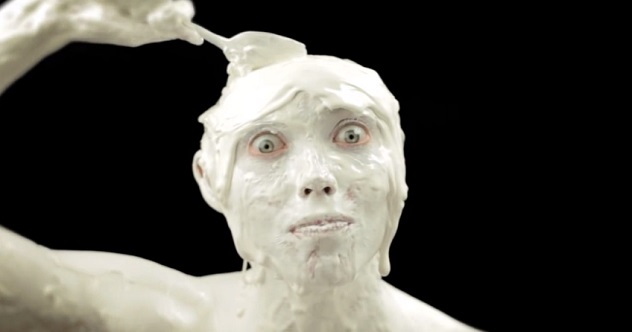
Released in 2012, this advertisement features a wide-eyed person covered in a thick white substance, calmly staring into the camera while scooping material from the top of their own head and eating it.
The narration describes Little Baby’s Ice Cream as though it were a sacred substance shared by members of an unusually cheerful dessert cult. The performer smiles, chews, and never breaks eye contact. The visuals resemble a surreal art film, except the art film has followed you home and is now standing beside your freezer.
Why it remains terrifying
The spot combines body horror with an aggressively soothing voice. Eating ice cream is familiar; eating yourself is generally considered a more advanced dining experience. That contradiction creates instant discomfort. The advertisement also demonstrates how a small brand can earn enormous attention by making something too strange to ignore. You may not crave the product afterward, but you will remember its name while nervously inspecting your pint of vanilla.
3. PlayStation 3: “Baby”
Sony’s 2006 PlayStation 3 campaign placed a lifelike baby doll in a sterile white room with the console. The doll sits motionless before opening its eyes, laughing, crying, and reacting to flashing images reflected in its glossy face. Eventually, the PS3 rises into the air beneath the slogan “Play Beyond.”
The commercial apparently wanted to communicate that the console represented a mysterious new form of entertainment. It also communicated that someone at Sony had access to a haunted nursery and was not afraid to use it.
Why it remains terrifying
Dolls already occupy a dangerous region between living and lifeless. This one crosses the border repeatedly. Its expressions change without becoming convincingly human, and its laughter shifts from innocent to deeply wrong. The spotless room provides no warmth or context, leaving viewers trapped with the doll and a machine that appears capable of controlling its emotions.
4. Burger King: “Wake Up With the King”
In 2004, Burger King reintroduced its royal mascot as a silent figure wearing an enormous plastic head and an immovable smile. One of the campaign’s most famous commercials shows a man awakening to discover the King lying beside him in bed. The mascot slowly presents a breakfast sandwich.
There is no explanation of how he entered the house, why he chose the bed, or whether the homeowner should consider changing the locks. The King simply smiles the smile of a man who has never been questioned by local authorities.
Why it remains terrifying
The oversized head has realistic proportions but no natural facial movement. That makes every appearance feel slightly hostile, even when the King is offering food. The campaign leaned into the mascot’s unsettling reputation, using his silent invasions and fixed expression as a source of absurd humor. The strategy worked: viewers talked about him constantly, though not always while experiencing an appetite.
5. Quiznos: The Spongmonkeys
Quiznos introduced the Spongmonkeys to television audiences in 2004. Created by animator Joel Veitch, the creatures were distorted, floating, rodent-like animals with human teeth, bulging eyes, and voices that sounded as though they had been recorded inside a broken kitchen appliance.
They sang enthusiastically about Quiznos subs while one played a tiny guitar. The lyrics were simple, repetitive, and surprisingly effective at occupying the brain for several business days.
Why it remains terrifying
The Spongmonkeys are not conventionally frightening. They are cheerful. Unfortunately, that cheerfulness makes them worse. Their frozen bodies, exposed teeth, and screeching voices suggest creatures attempting to imitate a commercial after learning about human advertising from an intercepted radio transmission.
The campaign polarized viewers, which helped make it memorable. Some people loved its chaotic internet humor. Others saw the creatures and immediately reconsidered whether toasted sandwiches were necessary for survival.
6. Duracell: The Puttermans
During the mid-1990s, Duracell promoted its batteries with the Puttermans, a suburban family designed to look like living toys. Actors wore elaborate prosthetics, exaggerated wigs, stiff costumes, and large battery terminals on their backs.
The commercials treated the family as a mechanical sitcom household. In one especially dark joke, a talkative relative receives an inferior battery, runs out of power, and falls face-first into her food while the family celebrates the resulting silence.
Why it remains terrifying
The Puttermans resemble humans after being reconstructed from a description provided over a poor telephone connection. Their artificial skin, rigid expressions, and jerky behavior trigger the same discomfort associated with wax figures and malfunctioning animatronics.
The campaign was undeniably memorable. Whether viewers remembered the battery’s longevity or simply feared encountering Herb Putterman in a dark hallway is a separate marketing question.
7. American Express: M. Night Shyamalan
American Express gave director M. Night Shyamalan a lengthy commercial that aired during the 2006 Academy Awards. The advertisement follows him through a restaurant filled with strange events: an apparently supernatural child, an unsettling waitress, unexplained behavior, and background details that suggest reality has developed a loose connection.
Shyamalan observes everything calmly, as though disturbing coincidences are simply part of ordering dinner in his neighborhood.
Why it remains terrifying
The commercial never fully explains what viewers are seeing. That uncertainty is the point. Rather than delivering a single scare, it builds an atmosphere in which every customer may be a ghost, every waiter may know the future, and the dessert menu may contain a final-act twist.
It is beautifully produced and perfectly suited to Shyamalan’s screen persona, but it also turns an ordinary restaurant into a place where requesting separate checks feels dangerously optimistic.
8. Dirt Devil: “The Exorcist”
This 2011 commercial begins like a serious horror film. A priest arrives at an old house during the night and is led upstairs, where a terrified young woman appears to be possessed. She screams, rises from her bed, and is pulled toward the ceiling by an unseen force.
The priest prepares to confront something demonic. Then the camera reveals the apartment above, where a woman is calmly using an extremely powerful Dirt Devil vacuum cleaner.
Why it remains terrifying
The advertisement earns its joke by committing fully to the horror setup. The lighting, acting, pacing, and production design create legitimate tension before the punchline arrives. Unlike many parody commercials, it does not wink at viewers too early.
The result is both creepy and clever. It may even convince you that the vacuum has impressive suction, although dragging a neighbor across the ceiling could complicate the warranty.
9. Lyndon B. Johnson: “Daisy”
Not every disturbing commercial sells a consumer product. The 1964 “Daisy” political advertisement begins with a little girl standing in a field, counting flower petals. Her innocent counting gives way to a military-style countdown as the camera moves closer to her eye. A nuclear explosion then fills the screen.
The spot was created for President Lyndon B. Johnson’s campaign and used Cold War anxiety to warn voters about the stakes of the election. It aired only once as a paid television commercial, but news coverage and public debate greatly expanded its reach.
Why it remains terrifying
“Daisy” contrasts childhood innocence with total destruction. There is no monster, distorted mascot, or supernatural trick. The fear comes from a real possibility that was already present in viewers’ minds during the Cold War.
The ad helped redefine political advertising by proving that a short television message could create fear through implication rather than a detailed argument. Decades later, its imagery remains more disturbing than many advertisements created with far larger budgets and considerably more computer-generated smoke.
10. Nationwide: “The Boy Who Couldn’t Grow Up”
During Super Bowl XLIX in 2015, Nationwide aired a commercial featuring a young boy describing experiences he would never have. He would never learn to ride a bicycle properly, travel with his best friend, get married, or grow older.
The reason arrives as a brutal reveal: he died in a preventable household accident. Images of an overflowing bathtub, an unsecured television, and dangerous household products reinforce the message.
Why it remains terrifying
Super Bowl audiences expect jokes, celebrities, puppies, and dramatic slow-motion cheese. Nationwide instead delivered a child narrating his own absence from the future. The abrupt tonal shift stunned viewers and generated immediate controversy.
The company explained that the campaign was intended to start a conversation about child safety. Whatever one thinks of the placement, the advertisement demonstrated the power and danger of emotional surprise. It was not creepy because of visual effects; it was creepy because it transformed ordinary household objects into evidence of how quickly a family’s life could change.
What Makes a Commercial Genuinely Creepy?
The most disturbing commercials usually rely on one or more of four techniques: the uncanny valley, broken expectations, sensory shock, and emotional contrast.
The uncanny valley appears when a person, doll, mascot, or animated figure looks almost human but not convincingly human. The PlayStation baby, Burger King mascot, and Puttermans all occupy this uncomfortable territory. Their eyes, skin, and expressions provide enough humanity to invite recognition but enough artificiality to activate suspicion.
Broken expectations are equally powerful. A peaceful road becomes a jump scare. A cheerful ice cream commercial becomes self-cannibalism. A Super Bowl celebration becomes a warning about childhood death. Viewers remember the moment because their minds must rapidly replace one interpretation with another.
Sound is another major ingredient. Screams, distorted laughter, uncomfortable silence, and repetitive singing can make harmless images feel threatening. Remove the sound from many creepy TV ads and they become merely strange. Turn the volume back on and suddenly the family dog has left the room.
The Viewer Experience: Why Creepy Commercials Stay With Us
The first viewing feels like an interruption
The most memorable experience often begins when a creepy advertisement appears without warning. You are not watching a horror movie. You may be eating cereal, folding laundry, waiting for a sitcom to return, or pretending not to fall asleep during a late-night movie. Your defenses are down because commercials are supposed to be predictable.
Then a plastic monarch appears beside a sleeping man, a white car vanishes behind the trees, or a doll begins laughing in an empty room. The advertisement does not simply present an image; it violates the emotional rules of the surrounding program. That interruption makes the experience feel more personal than a planned scare in a horror film.
The second viewing becomes a test of courage
Once viewers know what is coming, they often replay the commercial for friends. The experience changes from fear to anticipation. Everyone watches the calm opening of the K-fee advertisement while one person struggles not to smile. Another insists the volume should be increased for “authenticity,” which is how trust disappears from a friendship.
This social replay helps old commercials survive. A disturbing advertisement may run for only a short period, but viewers preserve it through conversation, video sharing, reaction clips, and nostalgic list articles. The scare becomes a ritual: first you endure it, then you introduce it to someone else.
Childhood memories make the ads seem larger
Creepy commercials can have an especially strong effect on children because young viewers may not understand where advertising ends and fiction begins. An adult can recognize that the Burger King mascot is a performer wearing a large head. A child may reasonably conclude that a silent breakfast monarch travels from home to home while families sleep.
Older commercials also gain an extra layer of eeriness from aging video technology. Faded colors, analog noise, stiff performances, practical effects, and unusual sound mixing can make an ordinary advertisement feel like recovered evidence. A commercial that looked merely cheap in 1994 may look paranormal when viewed on a modern high-resolution screen.
Humor and horror often arrive together
Many people laugh after watching a creepy commercial, but the laughter does not mean the fear failed. Humor provides relief after tension. It also helps viewers discuss something uncomfortable without admitting that a sandwich mascot briefly damaged their sense of safety.
The Spongmonkeys, Puttermans, and Dirt Devil exorcism work because they balance ridiculousness with discomfort. The viewer keeps moving between two reactions: “That is funny” and “Please remove it from my house.” This emotional uncertainty is often more memorable than straightforward terror.
The brand may be remembered better than the product
A creepy advertisement can achieve outstanding recognition while producing complicated buying intentions. Viewers may remember Little Baby’s Ice Cream for years without feeling hungry. They may instantly recognize the PlayStation baby while remaining unable to explain which console feature the doll represented.
That is the gamble behind unsettling advertising. Attention is not the same as affection, and brand awareness is not automatically a sale. Yet in an environment packed with forgettable commercials, being remembered at all can be valuable. The safest advertisement may disappear from memory before the program returns. The weird one may still be discussed decades later.
Ultimately, experiencing a truly creepy commercial is like finding a spider in a cereal box. It is unwanted, surprising, oddly fascinating, and guaranteed to become the first story you tell someone that morning.
Conclusion
The creepiest commercials ever shown on television succeeded because they treated discomfort as a creative tool. Some used horror intentionally, while others stumbled into nightmare territory through strange mascots, mechanical faces, or wildly misjudged cheerfulness.
From the K-fee jump scare to the quiet dread of “Daisy,” these advertisements prove that a commercial does not need a long running time to leave a lasting impression. It only needs the right image, the wrong laugh, and perhaps a giant plastic King waiting beside your pillow with breakfast.