Editorial note: This article discusses the Ku Klux Klan as a racist terrorist movement in American history. It is written for educational purposes and does not promote, excuse, or glamorize hate.
The Ku Klux Klan is one of those subjects that sounds like it belongs in a dusty history book locked in a basementbut unfortunately, history has a habit of leaving fingerprints on the present. The KKK was not a spooky costume club, not a misunderstood fraternity, and definitely not a group that deserves the soft-focus documentary treatment. It was, and remains in its modern fragments, a white supremacist hate movement built on intimidation, racial terror, political violence, and theatrical branding so over-the-top that even a Halloween store would say, “Maybe tone it down.”
Understanding the Ku Klux Klan matters because the group shaped American politics, civil rights struggles, law enforcement debates, hate-crime laws, and the national conversation about domestic extremism. Its history is not just about robes and burning crosses. It is about voter suppression, lynching, bombings, propaganda, public parades, political influence, and the long fight by Black Americans, Jewish Americans, Catholics, immigrants, civil rights workers, journalists, lawyers, teachers, and ordinary citizens who refused to be ruled by fear.
Below are 10 burning facts about the Ku Klux Klanburning not because they are cool, but because they expose how a hate movement used spectacle, secrecy, and violence to attack democracy itself.
1. The Ku Klux Klan Was Born After The Civil War
The first Ku Klux Klan emerged in Pulaski, Tennessee, in 1865, shortly after the Civil War ended. A group of former Confederate soldiers created what initially looked like a secret social club. The name “Ku Klux” is generally linked to the Greek word kyklos, meaning circle, while “Klan” gave it that theatrical, faux-medieval flavor that hate groups seem to love almost as much as misspelling things.
But the group quickly moved from secret society antics to organized racial terrorism. The Klan arose during Reconstruction, the period when the United States attempted to rebuild the South and extend citizenship, voting rights, and legal protections to formerly enslaved people. For white supremacists, that progress was treated as a crisis. The Klan’s mission became clear: restore white dominance by terrorizing Black citizens and their allies.
Its members targeted Black voters, elected officials, teachers, ministers, Republican organizers, and white Southerners who supported Reconstruction. Violence included beatings, whippings, arson, murder, and lynching. The goal was not random cruelty, although there was plenty of that. It was political terror designed to make democracy too dangerous for Black Americans to exercise.
2. The First Klan Was A Political Terror Organization
The KKK often hid behind costumes, secret titles, and ritual language, but its real function was painfully direct. It was a weapon against Reconstruction governments and Black political participation. Black men had gained voting rights through the Fifteenth Amendment, and many became voters, officeholders, jurors, and community leaders. The Klan responded with intimidation and violence.
In many Southern communities, the Klan worked like a shadow army for white supremacy. Members attacked people at night, masked themselves to avoid identification, and used fear to control elections and public life. This was not just “social tension,” a phrase that sometimes does a suspicious amount of laundry for ugly history. It was organized racial terror.
The Klan’s violence helped undermine Reconstruction and contributed to the restoration of white Democratic control across much of the South. That political outcome shaped decades of segregation, voter suppression, and Jim Crow laws. In other words, the Klan was not simply a hate group on the margins. At key moments, it functioned as an anti-democratic force with real influence.
3. Federal Law Was Used To Crush The First Klan
The federal government eventually responded with the Enforcement Acts of 1870 and 1871, including what became known as the Ku Klux Klan Act of 1871. President Ulysses S. Grant used these laws to prosecute Klan members and suspend habeas corpus in parts of South Carolina where Klan violence was especially severe.
This federal crackdown weakened the first Klan dramatically. Thousands were arrested, and many members fled, testified, or abandoned the organization when consequences finally arrived at the door. Apparently, secret bravery becomes less impressive when federal marshals know where you live.
Still, the collapse of the first Klan did not end white supremacist violence. Other paramilitary groups and mobs continued to enforce racial hierarchy through terror. The Klan’s early defeat shows two things at once: hate movements can be disrupted by serious legal action, and extremist ideas can survive even when a specific organization is broken apart.
4. The Klan Came Back In 1915 With Hollywood Help
The second Ku Klux Klan was revived in 1915, the same year the racist film The Birth of a Nation became a cultural sensation. The movie romanticized the Reconstruction-era Klan and portrayed white supremacist violence as heroic. It was historically dishonest, morally rotten, and technically influentialproof that a film can be important and terrible at the same time.
The revived Klan used modern marketing methods, public relations, membership drives, and spectacle. It presented itself as patriotic, moral, Christian, and “100 percent American,” while promoting racism, antisemitism, anti-Catholicism, anti-immigrant sentiment, and hostility toward anyone outside its narrow vision of white Protestant nationalism.
This second Klan was not limited to the South. It spread across the Midwest, West, and Northeast, finding members in cities, towns, churches, businesses, and politics. Its success showed that white supremacy was not just a Southern problem. It was a national problem wearing a hood and pretending to be civic virtue.
5. The 1920s Klan Was A Mass Movement
At its height in the 1920s, the second Ku Klux Klan claimed millions of members. Estimates vary, but historians commonly describe it as one of the largest extremist movements in American history. It held parades in major cities, sponsored picnics, published newspapers, sold robes, collected dues, and operated like a hateful franchise with better branding than ethics.
The 1920s Klan attracted many native-born white Protestants who feared immigration, urbanization, changing gender roles, religious diversity, and modern culture. Its targets included Black Americans, Catholics, Jews, immigrants, labor activists, and perceived moral outsiders. It supported Prohibition and wrapped its bigotry in language about law, order, family, and patriotism.
That is one of the most important facts about the Klan: it often tried to look respectable. It did not always appear as a mob in the woods. Sometimes it appeared as a parade downtown, a candidate endorsement, a church-adjacent social event, or a neighbor who insisted he was “just protecting tradition.” The lesson is uncomfortable but necessary: extremism often tries on respectable clothing before it reaches for a torch.
6. Burning Crosses Were Propaganda And Terror
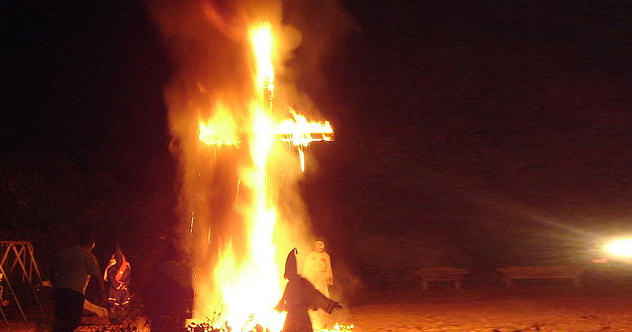
The burning cross is one of the most notorious symbols associated with the Ku Klux Klan, but it was not a major feature of the earliest Reconstruction-era Klan. It became widely associated with the second Klan in the early twentieth century, especially after popular culture helped transform it into a dramatic symbol.
To Klan members, cross burnings were often framed as ritual. To victims, they were threats. A burning cross outside a home, church, school, or community space sent a clear message: you are being watched, and violence may follow. Calling it a “ceremony” is like calling a shark attack a surprise swim lesson.
Cross burning became so closely tied to intimidation that it later appeared in major legal debates over threats, speech, and hate crimes. Its meaning depends on context, but in Klan history, it was repeatedly used to terrorize Black families, civil rights activists, religious minorities, and other targeted communities.
7. The Klan Used Costumes To Manufacture Fear
The white robes and pointed hoods of the KKK are among the most recognizable hate symbols in the United States. They served several purposes. First, they concealed identity, allowing members to commit violence while avoiding accountability. Second, they created a unified visual image. Third, they added supernatural theater to intimidation, especially in the Reconstruction era when night raids were designed to terrify.
The costumes also reveal something almost ridiculous about hate movements: they often need pageantry to feel powerful. The Klan created elaborate titles such as Grand Wizard, Exalted Cyclops, and other fantasy-novel leftovers. It built rituals, symbols, and ranks to make bigotry feel grand. Strip away the robes, and what remains is fear, resentment, and organized cruelty.
That does not make the Klan silly in its impact. Its violence was deadly. But understanding its use of costume and ritual helps explain how extremist groups manipulate emotion. They turn insecurity into identity, identity into performance, and performance into intimidation.
8. The Klan Had Real Political Power
The Ku Klux Klan was not always outside the gates of power. At different points, especially during the 1920s, Klan-backed candidates won offices at local, state, and even national levels. The organization influenced elections, policing, school boards, city governments, and public policy debates.
In some states, Klan membership became a political asset among certain voters. Indiana is one of the most infamous examples of Klan influence in the 1920s, where the movement became deeply entangled with state politics before scandal and criminal exposure helped bring it down.
The Klan’s political strategy was simple: turn prejudice into votes. It promoted fear of immigrants, Catholics, Jews, Black citizens, and social change. Then it offered itself as the defender of “real America,” a phrase that usually means someone is about to define millions of actual Americans out of the picture.
This fact matters because racism is not only personal hatred. It can become policy, policing, zoning, education, voting restrictions, and courtroom outcomes. The Klan’s history reminds us that democracy can be attacked not only by mobs, but also by organized movements seeking legitimacy.
9. The Klan Declined, But Its Ideas Did Not Disappear
The second Klan declined rapidly in the late 1920s and 1930s due to internal corruption, leadership scandals, public backlash, financial problems, and changing political conditions. One major blow came from the criminal conviction of Indiana Klan leader D.C. Stephenson, whose case exposed the brutality and hypocrisy behind the movement’s “moral” branding.
By the 1940s, the second Klan had largely collapsed as a mass organization. But white supremacist ideology did not vanish. During the civil rights era of the 1950s and 1960s, Klan groups reappeared in violent opposition to school desegregation, voting rights, and the broader movement for racial equality.
This third major wave of Klan activity was smaller than the 1920s movement, but it was deadly. Klan members and sympathizers were connected to bombings, murders, and attacks on civil rights workers. The 1963 bombing of the 16th Street Baptist Church in Birmingham, Alabama, killed four Black girls and became one of the most horrifying examples of racist terrorism in modern American history. In 1964, civil rights workers James Chaney, Andrew Goodman, and Michael Schwerner were murdered in Mississippi by conspirators connected to the White Knights of the Ku Klux Klan.
10. Today’s Klan Is Fragmented, But Hate Still Adapts
Modern Klan groups are far smaller and more fragmented than the mass movement of the 1920s. They often split, rename themselves, feud with one another, and compete with newer white supremacist and extremist movements. In the marketplace of hate, even bigots have branding problems.
However, decline does not mean disappearance. Klan symbolism, propaganda, and ideology continue to circulate online and offline. Some individuals still use Klan imagery to intimidate others. Other extremists avoid the old robes entirely and repackage similar ideas through coded language, memes, conspiracy theories, or “heritage” rhetoric.
The most important modern lesson is that hate movements adapt. When one symbol becomes socially toxic, extremists may find another. When one organization collapses, the ideology may migrate. That is why studying the Ku Klux Klan is not about memorizing villains from the past. It is about recognizing the patterns: scapegoating, conspiracy thinking, political intimidation, racial hierarchy, propaganda, and the attempt to make cruelty look like courage.
Why These Facts Still Matter
The history of the Ku Klux Klan is not comfortable, but comfort is not the point of history. The point is clarity. The Klan shows how quickly fear can be organized, how easily propaganda can dress itself as patriotism, and how violently people can react when equality threatens their privilege.
It also shows the importance of resistance. Black communities organized, testified, voted, taught, preached, sued, marched, wrote, documented, and survived. Journalists exposed Klan crimes. Lawyers pursued justice. Federal officials sometimes acted decisively, though often too late or too inconsistently. Teachers and museums continue to preserve the truth against attempts to blur it into “both sides” fog.
There is no honest way to study the Klan and come away thinking it was merely a strange chapter of American folklore. It was a terrorist movement. It attacked democracy. It harmed real people. And it left a legacy that still appears whenever hate tries to hide behind tradition, religion, nationalism, or free speech without responsibility.
Experiences Related To Learning About The Ku Klux Klan
For many Americans, the first real encounter with the Ku Klux Klan is not through a history textbook paragraph but through an experience: a museum exhibit, a family story, a documentary, a civil rights memorial, or even an uncomfortable classroom discussion where everyone suddenly becomes fascinated by their shoelaces. These moments matter because the Klan is not just an organization to define. It is a history people have inherited in different ways.
One common experience is visiting a civil rights museum and seeing ordinary objects connected to extraordinary courage: church pews, voter registration forms, photographs of marches, newspaper clippings, burned buildings, mug shots, and letters from people who knew they might be punished for demanding basic rights. In that setting, the Klan becomes less abstract. It is no longer just “men in robes.” It becomes the threat outside the church, the violence behind voter suppression, the reason a child needed protection walking into school.
Another experience comes from researching local history. Many people assume the Klan existed somewhere elseusually “the South,” “the past,” or “that one bad town over there.” Then they discover old parade photos, newspaper ads, membership rumors, or records showing Klan activity in their own county, sometimes in places that now market themselves with farmers markets and charming murals. That discovery can feel jarring. It should. Local history has a way of removing the protective glass from national history.
Teachers often describe the challenge of discussing the KKK with students. The robes and bizarre titles can make the group seem cartoonish at first, but the violence behind them quickly changes the mood. A good lesson does not sensationalize the costumes. It asks harder questions: Who benefited from intimidation? Who was silenced? Who resisted? What laws failed? What laws helped? How do symbols become threats? Those questions turn a disturbing topic into civic education.
Online experiences add another layer. Today, people may encounter Klan references through memes, coded numbers, extremist forums, or “just joking” comments. The internet allows hate to wear irony like cheap cologne. Recognizing the history behind those symbols helps people understand when something is not harmless humor but recruitment, intimidation, or normalization.
There are also family experiences. Some families pass down stories of surviving racial terror, leaving the South during the Great Migration, avoiding certain roads, protecting churches, or fighting for voting rights. Other families discover ancestors who belonged to racist organizations and must decide what honesty requires. Neither experience is easy, but both show why historical truth matters. Silence may feel polite, but it is rarely neutral.
The most useful experience related to studying the Ku Klux Klan is the moment when the subject stops being “old history” and becomes a warning about civic responsibility. Hate grows when people excuse it, laugh it off, profit from it, or decide it is someone else’s problem. It weakens when people document it, teach accurately, protect targeted communities, enforce the law, and refuse to let propaganda steal the language of patriotism.
Conclusion
The Ku Klux Klan’s story is not a campfire tale about creepy robes. It is a brutal chapter in the larger history of American racism, political violence, and resistance to equality. From its Reconstruction origins to its 1920s mass movement and civil rights era terrorism, the Klan repeatedly used fear as a political tool.
Yet the Klan’s history is also a record of opposition. Survivors spoke. Communities organized. Civil rights workers marched. Lawyers fought. Journalists investigated. Voters showed up. The Klan tried to make fear contagious, but courage proved pretty stubborn too.
Learning these 10 burning facts about the Ku Klux Klan helps readers recognize how hate movements operate: they create enemies, invent myths, use symbols, seek power, and pretend violence is virtue. The best response is not panic or amnesia. It is knowledge, honesty, and a commitment to protect equal rights before the smoke starts rising again.