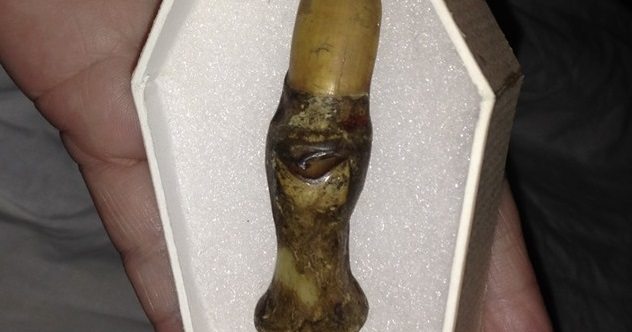
History is full of villains, outlaws, tyrants, pirates, assassins, and murderers who met dramatic ends. But for a select group of bad hombres, death was not the final chapter. Their bodies became evidence, warnings, museum specimens, political trophies, tourist attractions, and, in some cases, truly disturbing souvenirs. A head on a pike. A skull in a case. A pocketbook made from skin. A preserved brain. Humanity has never been short on imagination, especially when that imagination should probably be supervised by an adult.
This list is not just a parade of macabre curiosities. It is also a look at how societies have used human remains to send messages: obey the law, fear the state, remember the crime, study the criminal mind, or simply pay a dollar to see something shocking. Some of these relics are well documented. Others live in the foggy borderland between verified history and legend. Either way, they reveal a lot about punishment, celebrity, science, revenge, and our very awkward relationship with death.
Why Did People Keep Criminal Body Parts?
Before modern forensic science, photography, and DNA testing, body parts sometimes served as proof. A severed head could confirm that a pirate was dead. A preserved hand could help identify a wanted man. A skull or brain could be examined by doctors who believed, wrongly in many cases, that criminal behavior might be visible in anatomy. Public display also had a political purpose. If you saw a traitor’s head above a city gate, you got the message without needing a government newsletter.
Then there was the souvenir trade. Executions once drew enormous crowds. People bought rope fragments, death masks, pamphlets, and occasionally more intimate objects connected to the condemned. Today, many museums handle such materials more carefully, with attention to ethics, provenance, and the dignity of human remains. In the past, however, the rule often seemed to be: if it was horrifying and portable, someone would put it in a cabinet.
10 Bad Hombres Whose Body Parts Became Souvenirs
1. Blackbeard: The Pirate Head That Became a Warning Sign
Edward Teach, better known as Blackbeard, was the kind of pirate who understood branding before branding had a marketing department. With his fearsome beard, smoking fuses, and reputation for terror, he made himself into a floating nightmare along the Atlantic coast. In 1718, Lieutenant Robert Maynard and his men caught up with him near Ocracoke, North Carolina. After a brutal fight, Blackbeard was killed.
His head was cut off and carried as proof of death. According to tradition, it was later displayed on a pole near the mouth of the Hampton River in Virginia, at a place remembered as Blackbeard’s Point. The message was simple: piracy may come with rum, swagger, and dramatic hats, but retirement benefits are poor.
Legends later claimed that Blackbeard’s skull was turned into a drinking vessel, though that part is much harder to verify. The confirmed historical point is grim enough: his severed head became a public warning, transforming the pirate’s body into anti-piracy advertising.
2. Joaquín Murrieta: The Head in a Jar
Joaquín Murrieta occupies a complicated place in American frontier history. To some, he was a ruthless bandit. To others, he became a folk hero shaped by anti-Mexican violence in Gold Rush California. In 1853, California Rangers claimed they had killed Murrieta and one of his associates, Manuel García, known as Three-Fingered Jack.
To prove the kill and claim the reward, the Rangers preserved a head said to be Murrieta’s and a hand said to belong to Three-Fingered Jack in alcohol. These remains were displayed around California, and people paid to see them. Nothing says “frontier justice” quite like turning law enforcement evidence into a traveling sideshow.
The identity of the head has long been debated. Some later accounts claimed it was not Murrieta at all. The relic was reportedly destroyed in the 1906 San Francisco earthquake and fire, which means the mystery cannot be solved with modern testing. Whether the head was truly Murrieta’s or not, the episode shows how quickly violence, racial politics, and spectacle could fuse into a profitable exhibit.
3. Big Nose George: The Outlaw Who Became Shoes
George Parrott, better known as Big Nose George, was a Wyoming outlaw involved in robberies and the killing of lawmen. In 1881, after an attempted jailbreak enraged locals, he was lynched by a mob in Rawlins, Wyoming. What happened next is one of the strangest afterlives in Old West history.
Doctors claimed the body for medical study. His skull was cut apart. His brain was examined. Most infamously, pieces of his skin were used to make a pair of shoes. One of the men connected to the relics, Dr. John Osborne, later became governor of Wyoming, giving the story the surreal polish of civic respectability. “From outlaw hide to formal footwear” is not a career path most guidance counselors recommend.
Today, Big Nose George’s remains and related artifacts are associated with museum collections in Wyoming and Iowa. The shoes are among the most notorious examples of the Old West’s fascination with criminal bodies. They also prove that the phrase “walking all over a man” can become alarmingly literal.
4. Oliver Cromwell: The Head That Would Not Retire
Oliver Cromwell was not a bandit or serial killer, but he was absolutely a “bad hombre” to royalists. As Lord Protector of England, he played a central role in the political upheaval that led to the execution of King Charles I. When the monarchy was restored under Charles II, revenge arrived late but theatrically.
Cromwell had already been dead for years when his body was exhumed in 1661. He was posthumously executed, and his head was displayed on a pole above Westminster Hall. That is one way to lose an election after leaving office.
The head remained a political symbol, then a historical curiosity, passing through private hands before finally being reburied in 1960 at Sidney Sussex College, Cambridge. Cromwell’s skull had a longer public career than many living politicians. It went from warning sign to relic to debated artifact, showing how body parts can become battlegrounds for memory.
5. John Wilkes Booth: The Assassin’s Vertebrae
John Wilkes Booth assassinated President Abraham Lincoln at Ford’s Theatre in 1865 and fled into one of the most famous manhunts in American history. He was eventually tracked to a barn in Virginia and shot. During the autopsy, several cervical vertebrae and related tissue were removed.
Those bones became part of the collection of the Army Medical Museum, now the National Museum of Health and Medicine. Unlike some relics on this list, Booth’s vertebrae were not originally kept as carnival souvenirs. They were preserved as medical and historical evidence related to the gunshot wound that killed him.
Still, the public fascination around them is unmistakable. Booth’s bones became part of the material memory of Lincoln’s assassination. In a country still grieving and furious, even a small section of the assassin’s spine carried symbolic weight. It was evidence, yes, but also a kind of historical punctuation mark.
6. Charles Guiteau: The Brain of a Presidential Assassin
Charles J. Guiteau shot President James A. Garfield in 1881. Garfield died weeks later after suffering through medical treatment that modern readers can only describe as “please wash your hands, gentlemen.” Guiteau was tried, convicted, and hanged in 1882.
After execution, doctors autopsied his body, hoping to find physical evidence that might explain his mental state and violent act. His brain, spleen, skeleton, and other remains were preserved in medical collections. Portions of his brain have been associated with museum display, while other remains were stored for study.
The Guiteau case sits at the crossroads of crime, medicine, and the nineteenth-century obsession with locating morality inside the body. Doctors wanted the anatomy of evil. What they mostly found was a human brain, an enlarged spleen, and a reminder that bad ideas can wear ordinary tissue.
7. William Burke: The Murderer Turned Pocketbook
William Burke was one half of the infamous Burke and Hare murder case in Edinburgh. In 1828, Burke and William Hare killed victims and sold the bodies to anatomists, taking advantage of the high demand for cadavers in medical schools. Hare testified against Burke and escaped execution. Burke did not.
After Burke was hanged in 1829, his body was publicly dissected. His skeleton was preserved for anatomical teaching, and pieces of his skin reportedly became souvenirs, including a pocketbook. That pocketbook is associated with Surgeons’ Hall Museums in Edinburgh.
The punishment was deliberately symbolic. Burke had treated human bodies as merchandise, so the authorities and public treated his body as an object lesson. It was moral theater with a leather accessory. If irony had a smell, this story would need ventilation.
8. William Corder: The Killer Bound Into a Book
William Corder was convicted for the 1827 murder of Maria Marten in the famous Red Barn Murder case in England. The case became a media sensation, helped by scandal, mystery, courtroom drama, and the eerie story that Marten’s stepmother dreamed of the burial location.
After Corder was executed in 1828, his body was dissected. Some of his skin was used to bind an account of the murder and trial. The book was later displayed at Moyse’s Hall Museum in Bury St. Edmunds. In recent years, another book believed to be partly bound in Corder’s skin was rediscovered in museum storage and placed on display with the older volume.
This is one of the clearest examples of a criminal body becoming both punishment and publication. The man became the cover story in the most literal way possible. Publishing professionals may call that strong packaging, but everyone else is allowed to shudder.
9. Peter Kürten: The Vampire of Düsseldorf’s Head
Peter Kürten, known as the Vampire of Düsseldorf, was a German serial killer active in the early twentieth century. His crimes horrified the public, and after his conviction he was executed by guillotine in 1931. His head was later preserved and studied, reflecting the era’s interest in whether the brains and skulls of violent criminals could reveal physical signs of monstrosity.
Kürten’s mummified head eventually became part of the Ripley’s Believe It or Not! collection. It is one of the most unsettling examples of a criminal relic moving from forensic curiosity to oddity attraction.
The object is disturbing not only because of what it is, but because of what it represents: the belief that if we stare closely enough at a villain’s remains, we might understand evil. Sometimes, however, the glass case tells us more about the viewers than the viewed.
10. Henri Désiré Landru: Bluebeard’s Preserved Head
Henri Désiré Landru, nicknamed the Bluebeard of Gambais, was a French serial killer convicted of murdering multiple victims, most of them women he had targeted through lonely-hearts schemes. He was executed by guillotine in 1922.
A preserved head claimed to be Landru’s has been displayed at the Museum of Death in Hollywood. The relic fits into a long tradition of collecting criminal artifacts, from letters and trial documents to death masks and body parts. Landru’s case was already theatrical in life, filled with aliases, missing bodies, and a stove that became central to the prosecution’s story. In death, his head became another grim exhibit in the museum culture of true crime.
Landru’s preserved head also raises modern questions about consent, display, and the line between education and exploitation. A century ago, the public wanted monsters in jars. Today, we are more likely to ask who benefits from the jar.
What These Morbid Souvenirs Tell Us About History
These stories may sound like bizarre footnotes, but they reveal serious patterns. First, body parts were often used as proof. Before digital records, preserving a head or hand could settle a bounty claim or prove an enemy was dead. Second, remains were used as warnings. Blackbeard’s head and Cromwell’s skull were political billboards written in bone.
Third, criminal bodies became scientific objects. The brains and bones of Guiteau, Booth, Burke, and Kürten entered medical or pseudo-medical collections because doctors believed anatomy might explain violence. Some of this research was sincere, some was misguided, and some was wrapped in the discredited language of phrenology and “born criminal” theories.
Finally, these relics show the public appetite for dark tourism. People paid to see Murrieta’s alleged head. Crowds attended executions. Museums and private collectors preserved objects that blurred the line between history lesson and sideshow. The souvenir was never just a souvenir. It was a story people wanted to hold, own, display, or whisper about.
The Ethics of Displaying Criminal Body Parts
Modern museums face a difficult task when dealing with human remains. On one hand, these objects can teach us about law, medicine, violence, racism, punishment, and public memory. On the other hand, human remains are not ordinary artifacts. They belonged to people, even when those people committed terrible acts.
Good interpretation matters. A museum can display a relic in a way that explains history without turning suffering into cheap shock. Context changes everything. A preserved brain used to discuss nineteenth-century medical theories is different from a head displayed only for gasps. The best exhibits help visitors understand why the object was kept, what people believed at the time, and how those beliefs have changed.
These stories are fascinating because they are uncomfortable. They remind us that justice has often been theatrical, science has not always been ethical, and curiosity can become cruelty when it forgets the humanity of its subject.
Experience Section: Visiting the Dark Corners of History Without Losing Your Head
Reading about criminal body parts is one thing. Standing in front of an actual relic, or even a carefully documented replica, is something else entirely. The mood changes. The jokes get quieter. The glass case suddenly feels less like entertainment and more like a challenge: What exactly did you come here to see?
That is the strange experience at the heart of macabre history. Many people are drawn to these stories because they are unusual, shocking, and almost unbelievable. A pair of shoes made from an outlaw’s skin sounds like something invented around a campfire after too much whiskey. A book bound in a murderer’s skin feels like a Gothic novelist got control of the museum catalog. Yet these things existed because real societies made real choices about bodies, punishment, and memory.
For readers, travelers, and true-crime fans, the best way to approach this topic is with curiosity and restraint. Curiosity asks useful questions: Who kept this body part? Why? Was it evidence, punishment, science, propaganda, or profit? Restraint keeps the story from becoming a cheap thrill. These relics are not Halloween props. They are remains connected to victims, crimes, communities, and historical systems that often treated bodies very differently from the way we try to treat them today.
A museum visit connected to this kind of history can be surprisingly reflective. You may begin by expecting the bizarre and end by thinking about the death penalty, public executions, medical consent, racial violence, colonial power, or the growth of forensic science. Joaquín Murrieta’s alleged head, for example, is not just a Wild West oddity. It opens questions about anti-Mexican violence and how legends are built. Guiteau’s brain is not just a creepy specimen. It reflects a period when medicine searched the body for moral explanations that it could not truly provide.
There is also a lesson for modern true-crime culture. We still collect fragments of criminals, though usually in digital form: mugshots, documentaries, podcasts, courtroom clips, prison interviews, and endless theories. The old souvenirs were skulls and skin; the new souvenirs are screenshots and streaming queues. The technology changed. The appetite did not.
That does not mean we should avoid dark history. It means we should handle it better. The most valuable experience comes when the shock opens the door to understanding. Ask what the relic says about the people who preserved it. Ask whose story is missing. Ask whether the display honors history or merely sells horror. And if you ever find yourself thinking, “This would make a great souvenir,” please step away from the gift shop and drink some water.
Conclusion
The story of bad hombres whose body parts became souvenirs is really a story about the living. The dead did not put themselves in jars, bind themselves into books, or climb onto museum shelves. People did that. Governments, doctors, collectors, crowds, and curators all played roles in turning bodies into messages.
Some relics warned criminals. Some fed public revenge. Some promised scientific insight. Some became attractions for people who wanted to stand close to danger without actually being in danger. Together, they show that history has always had a macabre marketplace, and that the line between education and spectacle has never been as clean as we would like.
These ten cases are unsettling, but they are worth studying. They remind us that justice can become performance, curiosity can become exploitation, and even the worst villains deserve careful historical context. After all, the most chilling souvenir is not a skull, a hand, or a strip of skin. It is the realization that people once thought keeping them was perfectly normal.
Note: This article is based on historical museum records, archive-style references, and reputable history sources. Disputed relics and uncertain identities are described with caution rather than presented as unquestioned fact.