Some photographs introduce themselves politely. Others walk into the room wearing a feathered crown, rearrange the furniture, and refuse to leave your imagination. Jovana Rikalo’s Sun and Moon portrait concept belongs firmly in the second category.
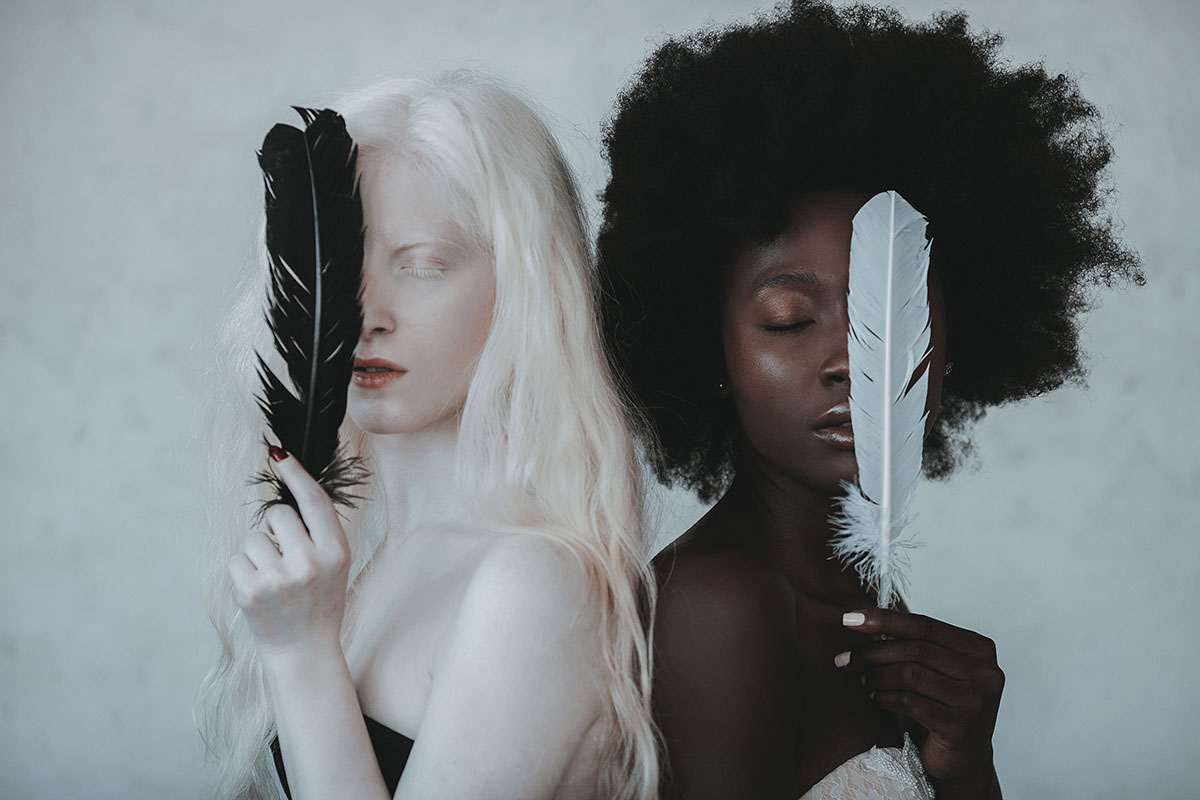
The fine-art photography series brings together two women whose appearances create an immediate visual contrast: a woman with albinism and a dark-skinned Black woman. Rikalo surrounds them with black-and-white styling, soft light, textured hair, delicate feathers, and poses that suggest two celestial forces meeting in the same frame.
The result is not merely a “light versus dark” portrait. It is a visual story about difference, balance, individuality, and connection. The photographs invite viewers to notice contrast first, then look beyond it. That second look is where the project becomes especially interesting.
The Story Behind Jovana Rikalo’s Sun and Moon Concept
Jovana Rikalo is a Serbian fine-art and portrait photographer known for creating dreamlike scenes that sit somewhere between fashion photography, fairy tales, and remembered dreams. Her portfolio regularly combines expressive models with natural settings, handmade props, elaborate clothing, and carefully controlled color palettes.
Rikalo has explained that people, nature, emotions, and events from everyday life often become raw material for her photographs. Instead of simply recording a model standing in front of a camera, she develops a world around the subject. A portrait becomes a scene, the scene becomes a story, and the story occasionally looks as though it has wandered out of an enchanted forest without checking the weather forecast.
The Sun and Moon concept is dated to 2020 in Rikalo’s portfolio presentation. She described it as an idea that had remained in her mind for a long time before she was finally able to create it. That extended development period makes sense when viewing the finished images. The styling does not feel random, and the contrast is not limited to complexion. Hair, clothing, feathers, makeup, background tones, hand placement, and facial expressions all contribute to the same visual language.
In the commonly circulated title, the phrase “albino woman” is used. However, many advocacy organizations recommend person-first language, such as “woman with albinism,” because it recognizes the individual before the condition. Some people with albinism personally embrace the word “albino,” but preferences vary. Respectful writing should therefore avoid treating one term as universally acceptable.
Why the Sun and Moon Metaphor Works
The sun and moon have been used as symbols for thousands of years. They may represent day and night, heat and coolness, activity and rest, visibility and mystery, or two different energies sharing the same sky. Rikalo’s concept borrows that familiar symbolism but expresses it through contemporary fine-art portraiture.
At first glance, viewers may assign the woman with albinism to the moon and the dark-skinned woman to the sun. The pale model’s white hair and luminous complexion resemble moonlight, while the Black model’s warm, deep skin tone and sculptural presence can suggest solar strength. Yet the photographs resist such a tidy division.
Both women can be read as either celestial body. The moon is not simply white, and the sun is not simply dark. Each produces light in the visual narrative, although the character of that light differs. This ambiguity prevents the project from becoming a basic comparison chart with better wardrobe styling.
Contrast Without Competition
One of the project’s strongest qualities is that the models are not presented as rivals. The images do not ask viewers to decide which woman is more beautiful. Instead, their poses create relationships: they stand close together, mirror each other, overlap, or appear to share the same emotional space.
This changes the meaning of contrast. Difference becomes something that can coexist rather than something that must be ranked. The eye moves between the models, noticing distinct features while also recognizing the harmony of the complete composition.
Black-and-White Details Strengthen the Theme
Feathers are among the most memorable props in the series. Black feathers appear beside pale skin, while white feathers appear beside dark skin. This reversal adds a clever visual echo. The props do not merely match each model; they cross the apparent boundary between them.
The styling also avoids busy colors that might compete with the central idea. A restrained palette allows skin, hair, eyes, and texture to carry the image. The photographs feel editorial, but they maintain the softness and emotional atmosphere associated with Rikalo’s broader body of work.
Albinism Is More Than a Visual Characteristic
Albinism is a group of inherited genetic conditions involving reduced or absent production of melanin, the pigment that contributes to the color of the skin, hair, and eyes. Different forms of albinism affect people in different ways, so there is no single appearance shared by everyone with the condition.
Although popular media often focuses almost entirely on pale hair and skin, albinism frequently affects vision. People may experience reduced visual sharpness, involuntary eye movements, sensitivity to light, or differences in eye development. Reduced melanin can also increase vulnerability to ultraviolet damage, making sun protection especially important.
These facts matter when discussing a visual project such as Sun and Moon. A model with albinism should not be treated as an unusual special effect created for someone else’s photograph. She is a person participating in the creation of an image, not a collection of rare physical features placed beside another model for maximum internet astonishment.
Representation Can Challenge Familiar Stereotypes
People with albinism have often been portrayed in popular culture as mysterious, supernatural, frightening, or otherworldly. Fine-art photography can challenge those stereotypes by presenting people with albinism as elegant, expressive, complex, and fully human.
Rikalo’s dreamlike style naturally contains fantasy, but the model’s beauty does not depend on being transformed into a creature or curiosity. Her gaze, posture, hair, and presence command attention. The fantasy belongs to the entire scene rather than being attached to her condition alone.
The Importance of Representing Dark-Skinned Black Women
The Black model’s presence carries its own cultural significance. Photography, advertising, cinema, and fashion have not always represented dark skin accurately or respectfully. For decades, many cameras, film-development systems, lighting conventions, and beauty campaigns were optimized around lighter complexions.
At the same time, Eurocentric beauty standards frequently favored lighter skin, narrower features, and looser hair textures. Dark-skinned women were often underrepresented, poorly lit, exoticized, or pushed into limiting stereotypes. Greater visibility has improved the situation, but simply placing a dark-skinned model in front of a camera does not automatically create meaningful representation.
In Sun and Moon, the Black model is not used as a shadow behind the lighter subject. Her complexion retains dimension, warmth, and detail. Her natural hair becomes a major compositional form, framing her face and balancing the pale model’s long white hair. She is presented as powerful, graceful, and central to the image.
That visual equality is essential. The series succeeds when both women are seen as complete subjects rather than as two ends of a skin-tone scale.
How the Photography Balances Two Very Different Skin Tones
Photographing people with significantly different complexions in the same frame requires careful lighting. A setup that protects highlights on very pale skin may leave dark skin underexposed. A brighter exposure that reveals shadow detail may remove texture from pale areas. Cameras are talented, but they are not mind readers wearing tiny berets.
The photographer must therefore shape light rather than simply increase or decrease brightness. Soft, directional illumination can preserve detail across a wider tonal range. Reflectors or controlled fill light may open shadows without making the scene look flat. Accurate exposure and color calibration also help retain natural undertones in both complexions.
Light Should Reveal, Not Standardize
Good portrait lighting does not attempt to make different skin tones look alike. Its purpose is to reveal texture, shape, color, and personality. Dark skin may reflect highlights beautifully, creating sculptural contours along the forehead, cheekbones, shoulders, and lips. Very light skin requires equal care so that subtle details remain visible rather than disappearing into featureless white.
Rikalo’s images appear soft and polished, but the subjects do not lose their individuality. The lighting supports the concept while allowing each face to remain distinct.
Post-Production Must Respect Real Skin
Editing is an important part of fine-art photography, particularly in a surreal series. Color grading, background cleanup, tonal adjustments, and selective contrast can help unify the finished work. The risk is that aggressive editing may flatten dark complexions, erase pale skin texture, change undertones, or make the models appear artificially plastic.
The strongest images retain variation. Skin has texture. Highlights have shape. Shadows contain information. A thoughtful editor enhances the visual story without replacing human faces with glossy digital furniture.
Beauty, Duality, and the Danger of Reducing People to Opposites
The project’s contrast makes it visually powerful, but it also invites an important question: Can a celebration of difference accidentally reduce people to symbols?
Calling one woman the sun and the other the moon can create poetic meaning. However, viewers should avoid assuming that complexion reveals personality. Dark skin does not automatically represent heat, strength, danger, or masculinity. Pale skin does not automatically represent coldness, fragility, innocence, or mystery. Those associations come from cultural storytelling, not from the women themselves.
The most generous reading of Rikalo’s work sees the celestial metaphor as a starting point rather than a final label. The women are visually different, but neither is confined to one symbolic role. Their relationship within the frame suggests exchange, reflection, and shared power.
This is also why their expressions matter. They are not smiling for approval or performing exaggerated opposites. Their calm gazes create dignity and control. The viewer may enter because of the contrast, but the models’ presence determines how long the viewer stays.
Why the Sun and Moon Portraits Became So Shareable
Online audiences respond quickly to images that can be understood in a second but explored for much longer. Sun and Moon has that useful combination. Its central concept is immediate: two dramatically different women presented as complementary celestial figures.
The portraits also perform well on visual platforms because they remain recognizable at a small size. The black-and-white feathers, contrasting hair, close framing, and direct gazes create a strong graphic structure. Even before a viewer reads the caption, the photograph announces that the contrast is intentional.
Yet virality can simplify artwork. Reposts frequently strip away the photographer’s explanation, the project date, model credits, or context about albinism. The image then circulates under sensational headlines that emphasize physical difference more than artistic collaboration.
A responsible viewer can admire the striking contrast while remembering that the portrait involved real people, creative planning, professional styling, communication, and consent. “Wow, look how different they are” is an understandable first reaction. It should not be the last one.
Experiences Inspired by the Sun and Moon Photography Concept
Experiencing Sun and Moon often happens in stages. The first stage is almost automatic. The eye notices the dramatic contrast in complexion and hair before processing the smaller details. That response is not necessarily shallow; human vision naturally searches for differences, edges, patterns, and symmetry. The meaningful part is what happens next.
The Experience of Taking a Second Look
On a second viewing, the photograph becomes less about two skin tones and more about relationships. A feather partially covers an eye. One model’s hair expands into the space behind the other. Their faces form a quiet rhythm. The initial contrast begins to feel less like a dividing line and more like a bridge connecting the composition.
This second look can reveal personal assumptions. Some viewers may instinctively associate the pale model with delicacy and the dark-skinned model with strength. Others may make the opposite interpretation. Recognizing those reactions is useful because it shows how quickly visual culture teaches us to build stories around appearance.
The Experience of Planning a Similar Creative Portrait
For a photographer inspired by the project, the most valuable lesson is not “find two people who look different.” The better lesson is to begin with a relationship or emotion. Contrast should serve the story rather than become the entire story.
A thoughtful planning process would include conversations with the models about the concept, wardrobe, symbolism, posing, and how the finished images will be described. This is especially important when the concept touches identity, race, disability, or a visible genetic condition. Creative direction works best as collaboration, not as a surprise costume party held in someone else’s honor.
Technical testing would also be essential. A photographer could place both models under the intended lighting and make sample exposures before introducing elaborate props. The histogram, highlight warnings, and calibrated monitor would help determine whether detail is being preserved across both complexions. Adjustments could then be made with light position, modifier size, reflectors, flags, or separate accent lights.
The Experience on Set
On set, communication would matter as much as camera settings. Rikalo has emphasized the importance of explaining a concept to models and respecting their natural body language. Rather than forcing a pose that looks elegant only in a sketchbook, a photographer can demonstrate the desired emotion, invite interpretation, and make small refinements.
When two models share a close composition, comfort becomes particularly important. Head placement, overlapping hair, hands near the face, and direct physical contact should all be discussed. The final portrait may appear effortless, but “effortless” usually has a production schedule and several people quietly moving feathers two inches to the left.
The Experience After Publication
Once a photograph is published online, the artist loses some control over its interpretation. Captions may disappear, credits may be cropped, and thoughtful symbolism may be replaced by a headline designed to win a wrestling match with the social-media algorithm.
Photographers can reduce this problem by providing accurate credits, meaningful captions, accessible image descriptions, and clear licensing information. They can also use person-first terminology unless a subject states another preference. These details may feel less glamorous than selecting a 105mm portrait lens, but they strongly influence how real people are represented when the work travels beyond its original audience.
The lasting experience of Sun and Moon is therefore not simply admiration. It is an invitation to look carefully. Beauty can be found in contrast, but contrast becomes most powerful when it does not erase individuality. Two people can share a visual concept without becoming interchangeable symbols. Like the celestial bodies in the title, they can occupy different spaces, produce different kinds of light, and still belong to the same larger composition.
Conclusion: Two Forms of Light in One Frame
Jovana Rikalo’s Sun and Moon concept demonstrates why fine-art portrait photography can be more than a record of someone’s appearance. Through carefully coordinated styling, lighting, posing, props, and post-production, the series transforms visible contrast into a story about balance and shared beauty.
The woman with albinism and the dark-skinned Black woman are immediately striking together, but the portraits become more rewarding when viewers move beyond comparison. Each subject has her own presence. Neither exists merely to make the other look lighter, darker, softer, or stronger.
The photographs also remind artists that representation carries responsibility. Inclusive portraiture requires accurate lighting, respectful language, communication with subjects, and awareness of the cultural meanings attached to skin color and visible differences.
Ultimately, Sun and Moon works because it treats contrast as a form of harmony. Day does not defeat night. The moon does not cancel the sun. They illuminate the world differentlyand the sky would be considerably less interesting without both.
Note: The requested title has been preserved exactly. Within the article, “woman with albinism” is used as respectful person-first language, recognizing that individual terminology preferences may vary.