Note: This article is for educational purposes only and should not be treated as personalized investment, tax, or financial advice.
Treasury bills have become the financial world’s favorite comfort food: plain, dependable, and unlikely to give anyone heartburn. When yields are attractive, T-bills can feel like a brilliant hiding place for cash. You lend money to the U.S. government for a few weeks or months, buy the bill at a discount, and receive the face value at maturity. No quarterly earnings drama. No CEO scandals. No chart that looks like it drank six espressos.
But there is a sneaky problem. The cost of market timing in T-bills is often invisible. You do not see it as a red number on a brokerage screen. It does not arrive in the mail wearing a little hat labeled “missed opportunity.” Instead, it shows up quietly as lower long-term returns, reinvestment risk, inflation drag, tax surprises, and the emotional habit of waiting for the “perfect” rate.
This is the opportunity cost of market timing in T-bills: the return, flexibility, or future growth you give up while trying to squeeze a few more basis points from short-term Treasury securities. And yes, sometimes those basis points matter. But sometimes the chase for an extra 0.10% turns into a financial version of driving across town to save three cents on gas.
What Are T-Bills, Really?
Treasury bills, or T-bills, are short-term U.S. government securities with maturities of one year or less. Common maturities include 4-week, 8-week, 13-week, 17-week, 26-week, and 52-week bills. Unlike Treasury notes and bonds, T-bills do not pay regular coupon interest. Instead, they are usually sold at a discount to face value and mature at par.
For example, an investor might pay $9,900 for a T-bill that matures at $10,000. The $100 difference is the investor’s return. It is beautifully simple, which is part of the appeal. T-bills are backed by the full faith and credit of the U.S. government, and they are widely considered among the safest short-term investments available.
Investors can buy T-bills directly through TreasuryDirect or through brokerage platforms. Most individual investors use noncompetitive bids, meaning they accept the auction-determined rate instead of specifying a desired yield. That keeps the process straightforward: you choose the maturity, place the order, and let the auction do its thing.
Why Investors Try to Time T-Bills
Market timing in T-bills usually does not look as dramatic as trying to call the bottom of the stock market. Nobody is shouting into a headset or drawing lightning bolts on a candlestick chart. Instead, it sounds reasonable:
- “I’ll wait for next week’s auction because rates may be higher.”
- “I’ll stay in 4-week bills until the Fed makes its next move.”
- “I don’t want to lock in a 6-month bill if short-term yields rise.”
- “I’ll keep rolling bills until the stock market looks safer.”
Those thoughts are not foolish. T-bill yields are influenced by Federal Reserve policy, inflation expectations, money-market conditions, Treasury supply, and investor demand. When rates are moving quickly, it is natural to wonder whether waiting could improve the outcome.
The trouble begins when a tactical cash decision becomes a lifestyle. A small delay becomes another delay. A temporary T-bill position becomes a permanent parking lot. The investor may feel safe, but safety is not the same as progress. Sometimes cash is a tool. Sometimes it becomes a very polite trap.
The Core Problem: Opportunity Cost
Opportunity cost is the value of the next-best alternative you give up when you make a decision. In the case of T-bills, the obvious return is the yield you earn. The hidden cost is what your money could have done elsewhere.
If you hold T-bills because you need the money for a home down payment in six months, the opportunity cost may be worth paying. Preserving principal matters more than chasing growth. But if you hold a large long-term portfolio in T-bills because you are waiting for the “right time” to invest, the opportunity cost can become enormous.
Historically, stocks have delivered higher long-term returns than Treasury bills, but with much higher volatility. T-bills can protect against short-term market swings, yet they rarely build serious long-term wealth after inflation. This is the uncomfortable trade-off: T-bills reduce one kind of risk while increasing another. You avoid market volatility, but you may accept shortfall riskthe risk that your portfolio does not grow enough to meet your goals.
Reinvestment Risk: The Rate You Love May Not Last
One of the biggest risks in T-bill timing is reinvestment risk. Because T-bills mature quickly, investors must repeatedly reinvest the proceeds. That is convenient when yields are rising. It is less delightful when yields fall.
Imagine buying a 4-week T-bill yielding around 3.6% while a 6-month bill yields around 3.8%. You choose the shorter bill because you believe rates will rise. Four weeks later, inflation cools, the Fed sounds less restrictive, and short-term yields drop. Now your money comes back, but the new T-bill auction offers a lower yield. Your plan to “stay flexible” has accidentally become a plan to earn less.
This is why investors often use a T-bill ladder. Instead of putting all cash into one maturity, they spread money across different maturities. A ladder does not eliminate reinvestment risk, but it softens the blow. Some bills mature soon, giving liquidity. Others lock in current yields a little longer. It is not glamorous, but neither is flossing, and both tend to prevent future pain.
Inflation Risk: The Real Return Reality Check
A T-bill yield may look attractive in nominal terms, but investors live in the real world, where groceries, gas, rent, insurance, and healthcare do not politely stop rising just because your cash feels safe.
Real return is the return after inflation. If a T-bill yields 3.8% and inflation is running near or above that level, your purchasing power may barely grow or may even shrink. The account balance rises, but the money buys less than expected. That is the financial equivalent of jogging on a treadmill while someone slowly moves the wall backward.
This does not make T-bills bad. It makes them specific. They are excellent for short-term capital preservation. They are less powerful as a long-term inflation-fighting engine. Investors who use T-bills for emergency funds, upcoming tax payments, tuition, or near-term purchases are using the right tool. Investors who use T-bills to avoid making any long-term allocation decision may be confusing comfort with strategy.
The Stock Market Opportunity Cost
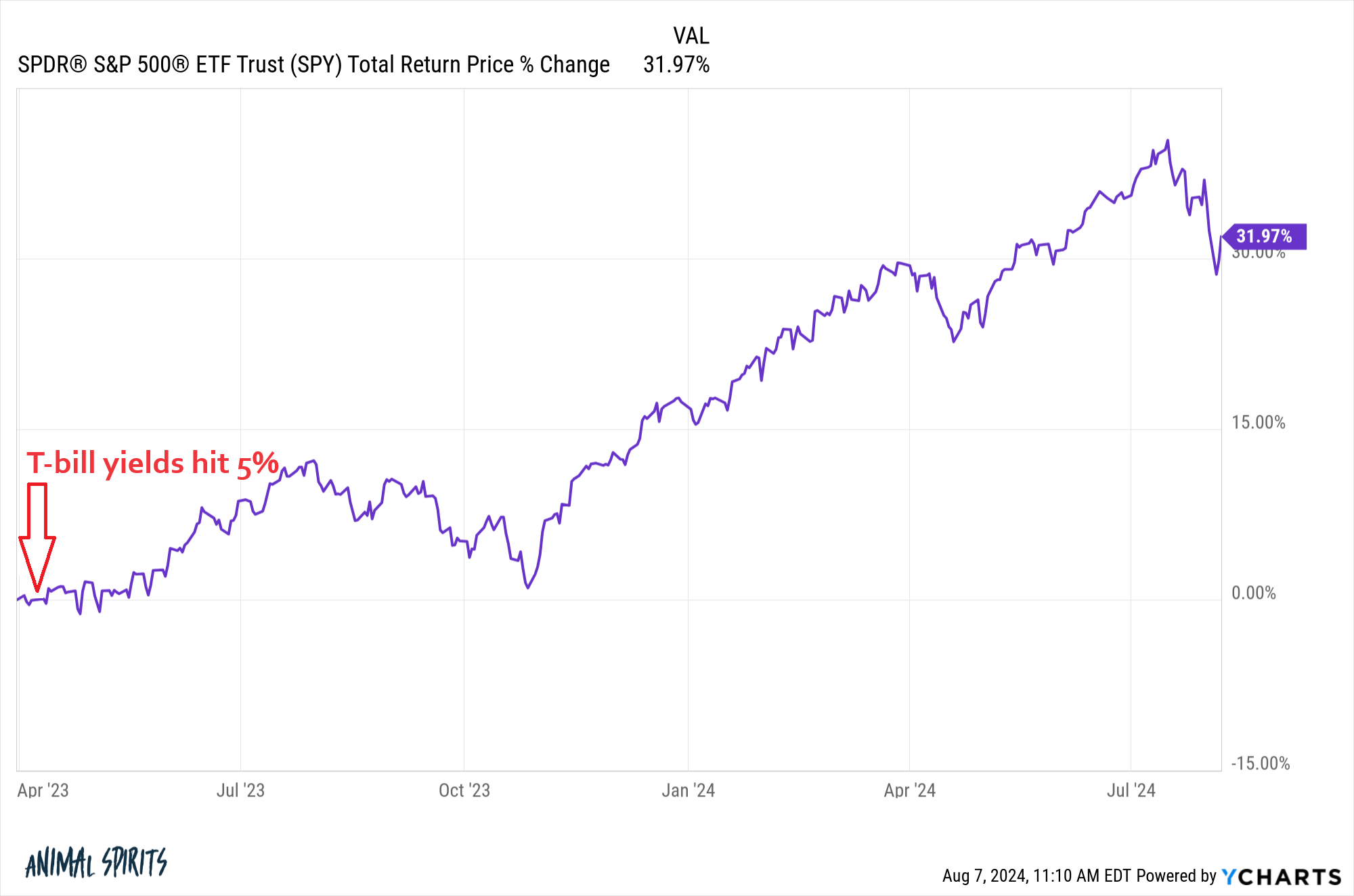
The most obvious opportunity cost of T-bill timing appears when investors hold too much cash while risk assets rise. Suppose an investor keeps $100,000 in 3-month T-bills earning about 3.7% annualized. Over three months, the gross return may be roughly $925 before taxes. That is not nothing. Nobody should sneer at $925. It can buy a lot of coffee, assuming coffee prices do not file for another promotion.
But if the investor was holding that cash while waiting to invest in a diversified stock portfolio, and the market rose 6% during the same period, the missed gain would be about $6,000. The T-bill return reduces the sting, but it does not erase the gap. The investor did not “lose money” in the brokerage account, but they lost ground relative to the plan they intended to follow.
Of course, the opposite can happen. Stocks can fall while T-bills quietly do their job. That is why this issue is not about declaring T-bills inferior. It is about matching the asset to the purpose. If the money is for a short-term goal, T-bills may be ideal. If the money is meant for retirement 20 years from now, using T-bills as a waiting room can become expensive.
Tax Considerations: The After-Tax Yield Matters
T-bill interest is generally subject to federal income tax, but it is typically exempt from state and local income taxes. That can make T-bills attractive for investors in high-tax states compared with fully taxable bank products or certificates of deposit.
Still, investors should focus on after-tax return, not headline yield. A 4% T-bill yield does not mean every investor keeps 4%. The after-tax result depends on federal tax bracket, state taxes, account type, and whether the investor is comparing T-bills with CDs, money market funds, municipal securities, or bond funds.
This is where market timing gets messy. Some investors chase the highest posted yield without adjusting for taxes, liquidity, reinvestment timing, or transaction spreads. A slightly higher yield may not be better if it comes with less flexibility, more tax complexity, or a maturity that does not match the cash need.
Liquidity Is Valuable, But It Is Not Free
T-bills are highly liquid, especially compared with many other fixed-income investments. Investors can often sell them before maturity in the secondary market. However, selling before maturity may involve price movement, bid-ask spreads, or platform-specific limitations.
Liquidity has value. If you may need the money soon, shorter T-bills can be sensible. But liquidity also has an opportunity cost. The more you demand immediate access, the less you may be able to lock in a yield for longer. This is why the “best” T-bill maturity is not always the one with the highest annualized yield. The best maturity is the one that matches the timing of your actual financial need.
A Better Framework Than Guessing the Next Auction
Instead of asking, “Will T-bill yields be higher next week?” investors can ask better questions:
1. What is this money for?
Money needed within a few weeks or months belongs in stable, liquid assets. T-bills may fit beautifully. Money intended for long-term growth should usually not sit indefinitely in short-term bills unless there is a deliberate risk-management reason.
2. What is the time horizon?
A 4-week bill may be perfect for cash needed next month. A 26-week bill may fit a known expense six months away. A retirement account with a 25-year horizon probably needs a broader investment plan than “roll bills until vibes improve.”
3. What is the next-best alternative?
Opportunity cost only makes sense when compared with another realistic option. The alternative might be a high-yield savings account, money market fund, CD, short-term bond fund, intermediate Treasury fund, or diversified stock-and-bond portfolio.
4. What is the after-tax, after-inflation return?
A nominal yield is only the opening sentence. The full story includes taxes and inflation. A T-bill can look great before tax and mediocre after inflation, depending on the environment.
5. What rule will trigger action?
If you are holding T-bills temporarily before investing elsewhere, define the trigger in advance. Is it a date? A target allocation? A dollar-cost averaging schedule? Without a rule, “temporary” can become a financial recliner: comfortable, sticky, and surprisingly hard to leave.
When Market Timing in T-Bills Can Make Sense
Not every timing decision is bad. There are cases where paying attention to T-bill maturities is smart:
- You have a known expense, such as taxes, tuition, or a home purchase.
- You want to preserve principal for a short-term goal.
- You are building an emergency fund and prefer Treasury-backed securities.
- You are managing cash flow for a business or household.
- You are creating a ladder to reduce reinvestment risk.
In these situations, timing is not speculation. It is cash management. The investor is not trying to outguess the bond market; they are matching assets to liabilities. That is a much healthier game.
When T-Bill Timing Becomes a Problem
T-bill timing becomes dangerous when it is driven by fear, perfectionism, or an endless desire to wait for clarity. Markets rarely provide clarity in advance. They usually hand it over later, with a receipt and a smirk.
Common warning signs include repeatedly delaying a long-term investment plan, holding far more cash than your goals require, obsessing over tiny yield differences, or using T-bills as an emotional shelter from normal market volatility. In these cases, the investor may believe they are being cautious, but they may actually be making a large market-timing bet: the bet that cash will outperform their intended portfolio long enough to justify the delay.
That bet can work for a while. It can also fail quietly. The most painful missed returns often happen after scary periods, when markets recover before investors feel ready. By the time the news looks safe, prices may already reflect the improvement.
The Practical Solution: Segment Your Cash
One useful approach is to divide money into buckets:
Short-term cash bucket
This includes emergency funds and spending needs within 12 months. T-bills, high-yield savings, and money market funds may all belong here.
Medium-term stability bucket
This includes money needed in one to five years. A ladder of T-bills, Treasury notes, CDs, or high-quality short-term bonds may help balance yield and stability.
Long-term growth bucket
This includes retirement and wealth-building money. Here, the opportunity cost of staying in T-bills too long can be significant. A diversified portfolio may be more appropriate, depending on risk tolerance and goals.
This bucket strategy reduces the pressure to make one heroic decision. You do not need to choose between “all T-bills” and “all stocks.” Real financial planning is rarely that dramatic. It is more like packing for a trip: socks, jacket, passport, snacks, and maybe one emergency granola bar you will find crushed in your bag three months later.
Experiences and Lessons from Real-World T-Bill Timing
Many investors discover the opportunity cost of T-bill timing only after the fact. At first, the decision feels responsible. You move money into short-term Treasury bills because yields are attractive, headlines are messy, and the stock market seems expensive. The first maturity arrives, and the strategy feels great. Interest appears. Principal is intact. Nothing exploded. Compared with market volatility, T-bills feel like a spa day with government backing.
Then the second phase begins. You start watching auction results more closely. A 13-week bill looks slightly better than a 4-week bill. A 26-week bill offers a bit more, but maybe the Fed will move. You wait. Then you roll. Then you wait again. Soon, your investment process has turned into a weekly ritual involving rate tables and mild suspicion toward anyone who says, “Just stick to the plan.”
The real lesson is that T-bills are excellent servants but awkward masters. They are wonderful for money with a job: a property tax bill, payroll reserve, tuition payment, home down payment, or emergency fund. The problem begins when money without a short-term job hides in T-bills because the investor cannot decide what to do next.
Consider an investor who planned to put $200,000 into a balanced long-term portfolio but paused because T-bills were yielding around 4%. The investor tells themselves they will move the money once the market dips or once rates stabilize. Six months pass. The T-bills earn a respectable return. But if the balanced portfolio rises meaningfully during that same period, the investor now faces a psychological double bind: buying in feels harder because prices are higher, and staying in T-bills feels safer because it has “worked” so far.
This is how opportunity cost compounds emotionally. The investor is not just behind mathematically; they are more hesitant than before. The missed gain becomes a reason to wait for a pullback. The pullback may not come. Or it may come, but with scary headlines that make investing feel even harder. The T-bill strategy becomes less about yield and more about avoiding regret.
Another common experience involves reinvestment. Investors who keep choosing the shortest bills for maximum flexibility may feel smart while rates are rising. But when yields fall, flexibility turns into exposure. Every maturity becomes a new negotiation with the market. A ladder could have locked in some income for longer, but the investor stayed short because they were trying to be clever. Unfortunately, the market does not award bonus points for cleverness. It mostly awards outcomes.
The best experiences with T-bills usually come from investors who set rules in advance. They decide how much cash they need, which maturities match their spending schedule, and when excess cash should move into a longer-term allocation. They do not ask T-bills to solve every financial problem. They let T-bills do what T-bills do best: preserve short-term capital, provide predictable maturity dates, and reduce cash drag compared with idle bank balances.
The takeaway is simple but not always easy: use T-bills intentionally. If the money has a short-term purpose, T-bills can be a strong choice. If the money is waiting for courage, clarity, or a magical market entry point, the opportunity cost may be larger than the yield you are collecting.
Conclusion: T-Bills Are a Tool, Not a Crystal Ball
The opportunity cost of market timing in T-bills is not that T-bills are bad. They are not. They are among the most useful tools in personal finance, especially for short-term safety and liquidity. The danger comes from asking them to do a job they were not designed to do.
T-bills can protect money you need soon. They can help organize cash flow. They can provide a competitive short-term yield with very low credit risk. But they cannot remove inflation risk, reinvestment risk, or the long-term cost of avoiding growth assets when growth is required.
The smartest approach is not to predict every rate move. It is to match your T-bill strategy to your goals. Use short bills for short needs. Consider ladders for cash that must remain safe but flexible. And for long-term money, be honest about whether you are managing risk or simply postponing a decision.
In the end, the most expensive T-bill mistake may not be earning too little interest. It may be letting a safe investment become an excuse for missing the bigger financial plan.