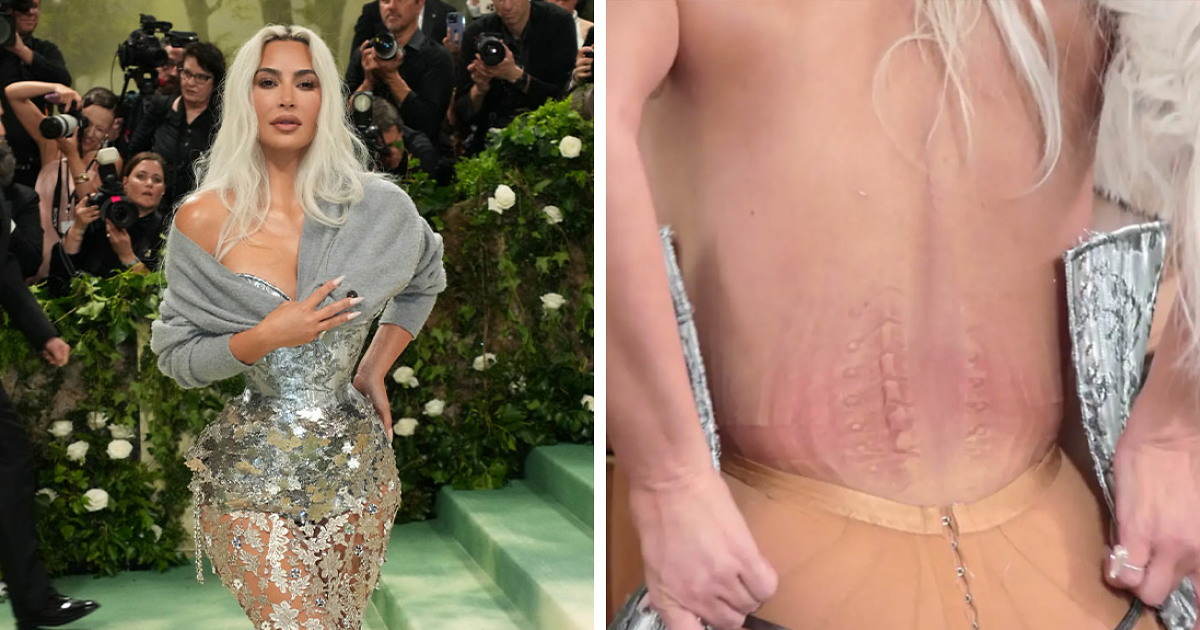
Kim Kardashian has never treated the Met Gala like a casual dinner reservation. For her, the first Monday in May is less “step onto a carpet” and more “enter a fashion Olympics where oxygen is apparently optional.” But her 2024 Met Gala look may have pushed that commitment further than usual. After wearing an ultra-tight Maison Margiela corset designed under John Galliano’s creative direction, Kardashian later revealed what her body looked like once the glamour was finally removedand the result turned the conversation from “How did she wear that?” to “Should anyone have to?”
The moment became a classic Kardashian headline: part couture spectacle, part internet debate, part behind-the-scenes reality TV reveal. On the red carpet, the outfit looked like a piece of fashion theater. Behind the scenes, it was a much less sparkly story involving discomfort, panic, breathing struggles, and visible marks left on her back. In other words, the dress did its job as a Met Gala conversation starter. It also accidentally became a PSA about the difference between high fashion and basic human comfort.
The Met Gala Corset That Had Everyone Squinting at Their Screens
At the 2024 Met Gala, Kim Kardashian arrived in a custom Maison Margiela look by John Galliano. The outfit featured a metallic, armor-like corset, a sheer floral chainmail-style skirt, and a soft gray cardigan draped over her shoulders. The official exhibition theme was “Sleeping Beauties: Reawakening Fashion,” while the dress code was “The Garden of Time.” Kardashian’s look leaned into the idea of a fragile, almost surreal figure moving through a fantasy gardenthough many viewers were less focused on the symbolism and more focused on whether she could breathe.
The corset was dramatically cinched, creating a sculptural silhouette that instantly became one of the most discussed celebrity fashion moments of the night. Social media did what social media does best: zoomed in, debated, worried, joked, criticized, defended, and somehow turned a single waistline into a national group project. Some praised the look as couture commitment. Others argued that it promoted unrealistic beauty standards. Many simply wondered how Kardashian made it up the stairs without requesting a medical-grade pause button.
What Kim Kardashian Revealed After the Corset Came Off
The real shock came later on The Kardashians, when viewers saw what happened after the cameras and flashbulbs faded. Kardashian admitted that the corset was not merely uncomfortable; it became overwhelming. She described feeling like she could not breathe properly and said she needed to get out of the outfit quickly. The reveal that got everyone talking was the condition of her back after the corset was removed: visible purple marks had been left where the garment pressed into her skin.
That detail changed the tone of the discussion. A corset can look sleek on a red carpet, but marks on the skin remind viewers that bodies are not mannequins, even when couture tries very hard to convince us otherwise. Kardashian has built a career on turning fashion into headline-making performance, and she did not frame the moment as a regret. In fact, she suggested the look was worth it because she felt the final result delivered the visual impact she wanted.
Still, the footage made it clear that this was not an ordinary dress with a slightly annoying zipper. It was a highly restrictive fashion piece requiring careful movement, help from a team, and serious tolerance for discomfort. The final image may have been polished, but the process behind it was far from effortless. Beauty, in this case, arrived with a backstage invoiceand the body paid part of it.
Why the Outfit Became More Than a Fashion Story
Celebrity fashion often lives in extremes. The Met Gala practically invites stars to wear outfits that are impractical, symbolic, dramatic, and occasionally impossible to sit in. But Kardashian’s corset stood out because it created a public conversation about the line between fashion fantasy and physical strain.
There is a long history of corsets in fashion, from Victorian silhouettes to modern runway reinventions. Designers use corsetry to create structure, shape, tension, and drama. On a runway or red carpet, a corset can tell a story about power, restriction, elegance, rebellion, or transformation. But when a garment visibly limits breathing or leaves strong marks, it also raises questions about what viewers are being asked to admire.
The controversy around Kardashian’s look was not just about one celebrity. It touched a bigger cultural nerve: how much discomfort is still expected from women in the name of beauty? Many people saw the outfit as art. Others saw it as an uncomfortable reminder that fashion often rewards bodies for appearing controlled, compressed, and reshaped. The internet may not agree on much, but it did agree that this corset was doing overtime.
Kim Kardashian’s Met Gala History Makes the Moment Bigger
Kardashian’s 2024 corset did not appear out of nowhere. Her Met Gala history is filled with memorable, high-effort looks. In 2019, she wore a Thierry Mugler “wet look” dress with a famously restrictive corset. In 2021, she appeared in a full black Balenciaga look that covered her entire face and body. In 2022, she sparked debate by wearing Marilyn Monroe’s historic dress. By 2024, audiences already expected her Met Gala arrival to be part fashion event, part cultural argument.
That expectation is part of Kardashian’s celebrity machinery. She understands how to create a visual that will travel. The 2024 corset was not simply clothing; it was content, branding, performance, and controversy stitched together. Every element was designed to be noticed, from the metallic corset to the casual-looking cardigan that made the extreme silhouette feel even stranger.
But the body reveal added a layer of vulnerability. Kardashian has often shown the effort behind her polished appearances, but this moment was unusually direct. Viewers saw the cost of the image, not just the image itself. It made the conversation more complicated than “love it” or “hate it.” It became a reminder that celebrity glamour is often edited, assisted, engineered, and occasionally endured.
The “Was It Worth It?” Question
One reason the story spread so widely is that Kardashian herself appeared to accept the discomfort as part of the fashion mission. That answer fascinated people because it revealed how differently celebrities may experience red carpet dressing compared with the average person. Most of us get annoyed when jeans feel tight after dinner. Kardashian wore a couture corset that required strategic breathing and still treated it as part of the job.
That does not mean the average reader should see the look as something to copy. There is a huge difference between wearing a carefully engineered couture piece for a short public appearance with a professional team nearby and using restrictive shapewear in everyday life. Doctors and health experts generally advise moderation with tight garments because extreme compression can affect breathing, movement, digestion, and comfort.
So, was it worth it? For Kardashian’s brand, probably. The look generated headlines, debate, and a memorable scene on her show. For the broader public, the better question might be: what do we actually value when we call a look successful? If success means creating a dramatic fashion moment, she achieved it. If success means comfort, mobility, and easy breathing, the corset lost that round by a landslide.
What the Internet Got Right About the Corset Debate
The online reaction was not just gossip. Many viewers were genuinely concerned, especially younger fans who see celebrity images every day and may compare themselves to impossible red carpet silhouettes. Kardashian’s look was custom-made, professionally fitted, temporary, and part of a theatrical event. It was not an everyday standard for bodies, style, or beauty.
That distinction matters. A celebrity’s Met Gala outfit is often closer to a costume than a lifestyle suggestion. The problem begins when a fantasy image gets mistaken for a realistic body goal. Kardashian’s corset did not reveal a natural shape people should try to achieve. It revealed what a highly constructed garment can do for a few hours under very specific conditions.
In that sense, the backlash had a useful side. It encouraged people to talk about fashion images more critically. A look can be visually stunning and physically questionable at the same time. A designer can create something technically impressive while viewers still ask whether the message is healthy. Two things can be true: the corset was a remarkable piece of craftsmanship, and it looked extremely uncomfortable.
Fashion Performance Versus Everyday Style
The Met Gala is not a mall, a school hallway, or an office elevator. It is a high-fashion fundraiser where guests often dress like living museum installations. That context matters. Kardashian’s outfit was meant to be dramatic, not practical. It belonged to the world of couture fantasy, where walking, sitting, breathing, and bathroom breaks sometimes appear to be treated as minor design obstacles.
Everyday style works differently. Good clothing should let a person move, breathe, sit, laugh, eat, and exist without needing a support crew. A great outfit should make someone feel confident, not trapped. The best style lesson from Kardashian’s corset may not be “suffer for fashion.” It may be “know the difference between a red carpet stunt and a real-life wardrobe choice.”
For regular people, the smarter inspiration is not the tightness of the corset but the intentionality of the styling. The metallic texture, contrast between hard and soft fabrics, old-world couture mood, and unexpected cardigan layering can inspire outfits without requiring anyone to lace themselves into misery. You can borrow the drama without borrowing the breathing problem. Fashion should have flair, not a hostage situation.
Experiences and Takeaways: What Kim Kardashian’s Corset Moment Teaches Us
Watching Kardashian reveal the aftermath of that Met Gala corset feels like peeking behind the curtain of celebrity glamour and discovering that the curtain is held up with pins, assistants, emergency patience, and possibly a silent prayer. The experience is relatable in a strange way because almost everyone has worn something uncomfortable for the sake of looking good. Maybe it was a pair of shoes that turned one city block into a survival course. Maybe it was a blazer that looked expensive but allowed no arm movement. Maybe it was formalwear that made breathing feel like a subscription service.
The difference is scale. Most people’s uncomfortable outfit stories end with changing into sweatpants at home and promising never again. Kardashian’s version becomes global entertainment. Still, the emotional lesson is familiar: when an outfit starts controlling your mood, movement, and body, the glamour begins to lose its sparkle.
One useful experience-related takeaway is that comfort should not be treated as the enemy of style. Many people assume a special event outfit has to pinch, squeeze, lift, flatten, or sculpt something to be “good enough.” But confidence usually looks better when the person wearing the outfit can actually enjoy the event. The best-dressed person in the room is rarely the one silently calculating how many minutes remain before they can escape their clothes.
Kardashian’s corset also reminds us that images do not tell the whole story. A photo can show a perfect silhouette but hide the effort, discomfort, lighting, tailoring, posing, and production behind it. That matters in a culture where people constantly compare their regular bodies to celebrity images created under extraordinary conditions. The body seen on the red carpet was not simply “Kim’s body.” It was Kim plus couture engineering, styling, posture, assistance, and a temporary garment designed to create illusion.
For anyone planning an outfit for prom, a wedding, a party, or a big photo moment, the practical advice is simple: test the outfit like you plan to live in it. Sit down. Walk around. Take a deep breath. Raise your arms. Try eating a snack. Check whether you can use the restroom without launching a three-person rescue mission. If the outfit fails those tests, it may be beautiful in theory but chaotic in real life.
There is also a body-image lesson here. A garment that changes the way a body looks does not make one body better than another. It only proves that clothing can create shapes. That is fashion’s magic trick, and like all magic tricks, it is less mysterious when you see the backstage setup. Kardashian’s reveal was valuable because it showed the cost of the illusion. It gave viewers permission to admire the artistry while rejecting the pressure to copy it.
In the end, the ultra-tight Met Gala corset did exactly what a Kardashian fashion moment often does: it dominated attention, sparked debate, and turned one outfit into a full cultural conversation. But the most useful conclusion is not that beauty requires pain. It is that style becomes far more interesting when we can discuss the image, the craft, the cost, and the message all at once. The corset may have been unforgettable, but breathing comfortably remains undefeated.
Conclusion
Kim Kardashian’s 2024 Met Gala corset was one of those rare celebrity fashion moments that looked like a sculpture, behaved like a trap, and generated enough opinions to power the internet for days. Her later reveal of the marks left on her body made the story feel less like a glamorous red carpet recap and more like a complicated conversation about beauty, performance, and pressure.
The look was undeniably memorable. It was also a reminder that celebrity fashion is often built for impact, not comfort. Kardashian may have decided the dramatic result was worth the discomfort, but viewers do not have to turn that into a personal rule. The smartest takeaway is to admire the couture, question the pressure, and remember that no outfit should make basic breathing feel like advanced math.