Movies can turn an ordinary staircase, private home, ancient monument, or quiet beach into something irresistible. One dramatic scene appears on the big screen, and suddenly thousands of travelers want to stand in exactly the same spot, strike exactly the same pose, and upload exac>screen tourism. It can be wonderful for local hotels, restaurants, tour guides, and souvenir sellers. A successful movie may introduce an overlooked destination to an international audience without the destination spending a fortune on advertising.
But Hollywood fame comes with a plot twist. Some filming locations are too fragile, too small, or too residential to absorb an endless stream of fans. Coral gets crushed, historic stone wears away, commuters encounter costumed dancers, and homeowners discover that “private property” apparently means “please recreate a 1980s movie scene on my porch.”
The word ruined is intentionally dramatic here. Not every location below was permanently destroyed, and several benefited economically from movie tourism. However, each suffered a documented loss of environmental health, privacy, cultural context, or everyday livability after appearing on screen.
How a Movie Location Becomes an Overtourism Hotspot
A movie does more than show viewers what a place looks like. Cinematography gives the location a personality. A Thai bay becomes untouched paradise. An archaeological site becomes the entrance to a supernatural temple. A neighborhood staircase becomes the stage for a villain’s transformation.
Viewers are not simply visiting geography. They are trying to step inside a story.
Social media intensifies that desire. In the past, a film fan might visit a location, take one photograph, and go home. Today, the exact coordinates can spread through Google Maps, TikTok, Instagram, travel blogs, and fan forums within hours. One visitor’s photograph becomes an advertisement for the next thousand visitors.
Trouble begins when the destination’s carrying capacity is smaller than the movie’s audience. A public staircase cannot operate like a theme park. A private driveway does not have a visitor center. An ancient sandstone facade cannot be replaced after too many hands, feet, animals, and vehicles wear it down.
1. Maya Bay, Thailand The Beach
Paradise Found, Photographed, and Nearly Loved to Death
Maya Bay is the most literal example of a famous movie location being damaged after Hollywood made it globally recognizable. The sheltered bay on Thailand’s Phi Phi Leh island appeared in The Beach, the 2000 adventure drama starring Leonardo DiCaprio.
In the film, the beach represents a secret tropical paradise hidden from conventional tourism. Unfortunately, millions of viewers received a slightly different message: “Here are directions to the secret tropical paradise.”
Visitor numbers surged. At the height of its popularity, thousands of people could arrive in a single day aboard a parade of speedboats. Anchors, propellers, snorkeling, swimming, pollution, and constant foot traffic placed enormous pressure on the bay’s coral reefs and marine habitat. The cinematic fantasy of an empty beach became a real-life scene involving packed sand, idling boats, and hundreds of people trying to crop one another out of photographs.
The movie was not the only cause of the damage. Expanding international tourism, inexpensive regional travel, warmer seas, and poor visitor management also played major roles. Nevertheless, The Beach gave Maya Bay the kind of worldwide recognition that conventional advertising departments dream about and conservationists occasionally have nightmares about.
Thai authorities closed Maya Bay in 2018 so the ecosystem could recover. What was initially discussed as a temporary closure lasted for more than three years. When visitors were allowed to return, the experience had changed significantly. New rules limited crowd sizes, restricted access by boat, and prohibited swimming in the bay. Visitors could still admire paradise, but they could no longer treat it like an aquatic amusement park.
Maya Bay demonstrates the central contradiction of movie-induced tourism: the film sold untouched nature so effectively that the resulting crowds helped erase the untouched quality people came to see.
Research basis: Reuters, TIME, National Geographic, Tourism Authority of Thailand.
2. Petra, Jordan Indiana Jones and the Last Crusade
The “Grail Temple” That Is Actually an Ancient Tomb
In the final act of 1989’s Indiana Jones and the Last Crusade, Indiana Jones rides through a narrow canyon and emerges before an extraordinary stone facade. Movie audiences know the building as the entrance to the temple containing the Holy Grail.
In reality, the facade is Al-Khazneh, commonly called the Treasury, at Petra in Jordan. It was carved by the Nabataeans roughly two thousand years ago and is generally understood to have been associated with royal burial traditionsnot a centuries-old knight offering beverage choices.
Petra was famous among archaeologists and adventurous travelers long before Indiana Jones arrived. The movie nevertheless introduced its rose-colored architecture to a much larger mainstream audience. Tourism increased, and the Treasury became one of the world’s most recognizable cinematic landmarks.
That visibility brought valuable revenue to Jordan and created jobs for nearby communities. It also concentrated enormous numbers of visitors around a vulnerable archaeological landscape. Petra’s sandstone structures face erosion from wind, water, salt, touching, climbing, dust, and heavy traffic. Crowds also place pressure on pathways, waste systems, working animals, emergency services, and conservation staff.
The problem is not simply that many people visit Petra. It is that many arrive with one image in mind. They race through the Siq, photograph the Treasury, and treat the rest of the ancient city like bonus material after the credits. This concentrates bodies, animals, souvenir stands, and commercial activity in the same photogenic spaces.
It would be inaccurate to blame all of Petra’s tourism pressure on one movie. Its designation as a UNESCO World Heritage Site, its selection as one of the New Seven Wonders, and Jordan’s tourism campaigns also increased its popularity. Still, The Last Crusade permanently changed how millions of people imagine Petra. A complex Nabataean capital became, in popular culture, “the Indiana Jones place.”
That may be excellent branding, but it is a rather small label for one of humanity’s most remarkable archaeological sites.
Research basis: Smithsonian Magazine, Business Insider, UNESCO heritage materials.
3. Skellig Michael, Ireland The Star Wars Sequels
When Luke Skywalker Moved Into a Fragile Monastic Site
Skellig Michael rises dramatically from the Atlantic Ocean off Ireland’s County Kerry. Long before it became Luke Skywalker’s island refuge, early Christian monks established a settlement there, building stone huts and terraces on terrain that looks challenging even before the rain starts moving sideways.
The UNESCO World Heritage Site appeared at the end of Star Wars: The Force Awakens and played a larger role in Star Wars: The Last Jedi. Its jagged cliffs, ancient stonework, isolation, and seabird colonies required almost no digital assistance to look otherworldly.
After the films, travel companies and tourism officials enthusiastically promoted the region’s connection to the galaxy far, far away. Visitor interest rose, while conservation groups questioned whether a fragile religious and ecological site should also function as a blockbuster movie destination.
Skellig Michael is especially sensitive because access is difficult. Visitors arrive by small boat, weather permitting, and climb hundreds of steep, uneven steps. The island supports important seabird populations and contains archaeological features that cannot accommodate unlimited foot traffic.
Irish authorities already regulate boat operators, landing seasons, visitor routes, and daily capacity. These controls mean Skellig Michael was not destroyed by Star Wars. In fact, strict management probably prevented its cinematic fame from producing a Maya Bay-style disaster.
Yet the movies changed the cultural identity surrounding the island. Many travelers now approach a sixth-century monastic landscape primarily as “Star Wars Island.” Local businesses benefit, but heritage managers must handle visitors who may know more about porgs than early medieval Christianity.
The damage here is therefore less about obvious physical destruction and more about risk, pressure, and cultural displacement. The island’s global fame grew faster than its physical capacity, leaving conservation rules to perform the difficult role of bouncer outside Luke Skywalker’s retirement home.
Research basis: UNESCO, Condé Nast Traveler, TIME, National Geographic, conservation reporting.
4. The Goonies House, Astoria, Oregon The Goonies
A Private Home Became an Unofficial Theme-Park Attraction
The white house in Astoria, Oregon, used as Mikey and Brand Walsh’s home in the 1985 adventure movie The Goonies is not a museum. It is not a studio-owned set. It is not staffed by tour guides wearing pirate hats.
It is a real house in a real residential neighborhood, a distinction that some visitors have historically treated as an optional technicality.
As The Goonies became a multigenerational cult favorite, fans traveled to Astoria to see filming locations. Many behaved respectfully and supported local businesses. Others blocked roads, parked illegally, left trash, allowed dogs onto neighboring lawns, walked up the private driveway, and treated residents as background extras in their personal remake.
During the movie’s 30th-anniversary period in 2015, local officials estimated that the house was attracting roughly 1,200 to 1,500 visitors on busy days. The owner eventually covered parts of the property and discouraged access because the volume had become overwhelming.
The property changed hands in 2022, when it was purchased by a devoted fan who was more welcoming toward visitors. That did not erase the conflict. Neighbors still had to cope with traffic and strangers circulating through a compact hillside community. The new owner’s enthusiasm and the neighborhood’s desire for peace created an awkward debate: Who gets to decide what happens around a famous house?
Legally and morally, buying a movie ticket does not include visitation rights to someone’s porch. Yet recognizable private homes often become tourism products without the residents’ consent. Travel websites publish directions, fans leave online reviews, and tour groups arrive even though the “attraction” has no bathrooms, parking lot, ticket system, or obligation to entertain anyone.
The Goonies helped Astoria’s economy and gave the city an enduring cultural identity. It also turned one family’s driveway into a boundary dispute that has lasted for decades. Goonies never say die, but neighbors occasionally wish they would say, “We took the picture from the public road and left quietly.”
Research basis: TIME, PEOPLE, local Oregon reporting and civic statements.
5. Burkittsville, Maryland The Blair Witch Project
The Town That Had to Explain the Witch Was Fictional
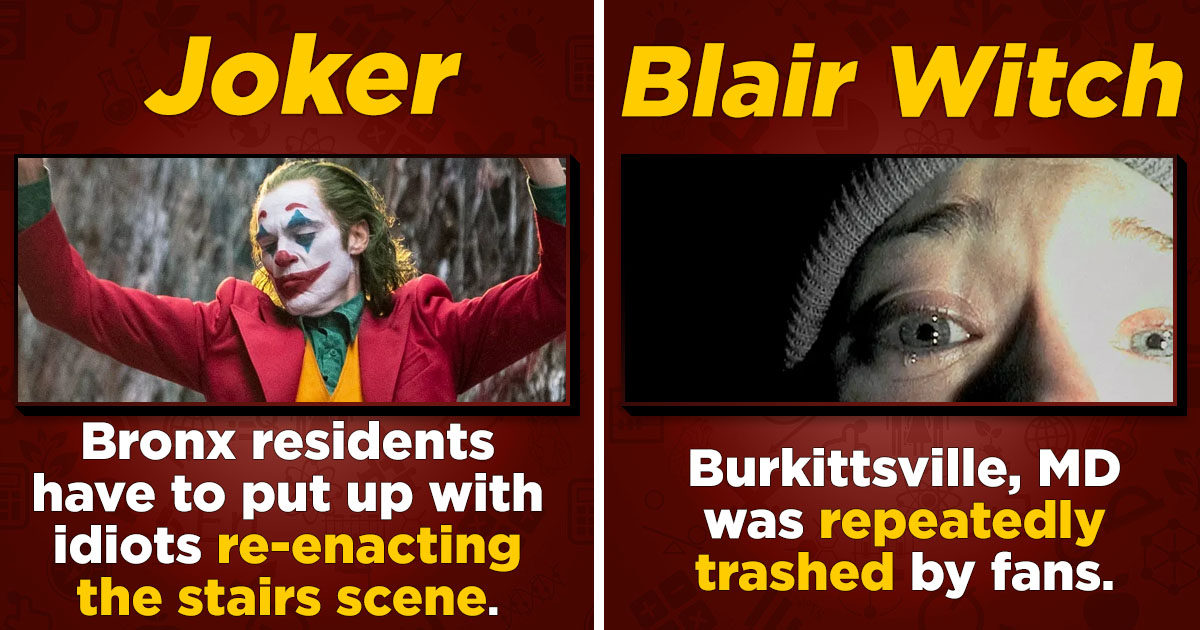
The Blair Witch Project became a sensation in 1999 partly because its marketing blurred the line between fiction and reality. The low-budget horror film presented its footage as material recovered after three student filmmakers disappeared while investigating a supernatural legend near Burkittsville, Maryland.
There was one small complication: Burkittsville was a real town.
The Blair Witch, the murdered children, and the movie’s mythology were fictional. However, curious viewers contacted local authorities, visited the community, searched nearby land, and occasionally behaved as though residents were concealing evidence of a paranormal conspiracy.
The town was a particularly poor match for sudden fame. Burkittsville is a tiny historic community with a population measured in the low hundreds. It did not have the infrastructure of a major tourist destination, and it certainly did not have a Department of Imaginary Witch Investigations.
Visitors reportedly trespassed, filmed residents without permission, damaged property, and left occult-themed graffiti. The town’s welcome signs became desirable souvenirs and were repeatedly stolen. Residents also faced the irritating task of explaining that most of the forest footage was shot elsewhere and that the movie was not a documentary, no matter how persuasive its website had seemed in 1999.
The film’s creators later expressed regret over using the name of an actual community. In later years, Burkittsville developed a more complicated relationship with its accidental fame. Some residents and local leaders began exploring ways to acknowledge the movie, welcome responsible fans, and direct attention toward the town’s genuine history, including its Civil War heritage.
That evolution provides a useful lesson. A place is not necessarily doomed once movie tourism arrives. With cooperation, boundaries, events, and accurate visitor information, unwanted fame can be reshaped into something more manageable.
Still, Burkittsville spent years dealing with strangers who arrived looking for a witch invented by filmmakers. That is a remarkably large community-relations problem for a movie reportedly produced for less than the cost of many modern luxury cars.
Research basis: Maryland civic records, Washington Post reporting, WIRED and local historical sources.
What These Famous Movie Locations Have in Common
These destinations are dramatically different, but their problems follow a recognizable pattern.
The Movie Creates a Simplified Identity
Petra becomes the Grail temple. Skellig Michael becomes Luke Skywalker’s island. Burkittsville becomes witch country. The cinematic association may attract visitors, but it can overshadow the location’s real history, culture, and community.
Visitors Gather in One Exact Spot
Movie tourism is unusually concentrated. Fans do not merely visit Astoria; they want one particular driveway. They do not simply explore Petra; they want a photograph directly in front of the Treasury. This creates intense pressure even when the wider destination has room for more travelers.
Social Media Turns Interest Into Repetition
Travelers copy images they have already seen. As thousands of people recreate the same scene, a location’s popularity becomes self-sustaining. The movie starts the cycle, but Instagram, TikTok, online maps, and travel rankings keep it spinning.
The Costs and Benefits Fall on Different People
Hotels and tour companies may earn money while homeowners absorb noise and traffic. A national tourism agency may celebrate increased arrivals while conservation workers manage erosion. Film tourism becomes controversial when the organizations receiving the revenue are not the same people cleaning up the consequences.
Travel Experience: What Visiting Movie-Famous Places Actually Feels Like
Visiting a famous filming location can be genuinely exciting. Even travelers who consider themselves too sophisticated for movie fandom may feel a jolt of recognition when a familiar landscape comes into view. The experience connects an imaginary world with physical space. A scene that once existed inside a screen suddenly has wind, texture, distance, and weather.
The surprise is that the real location rarely behaves like the movie.
A beach shown as deserted may require timed entry and a carefully managed stream of visitors. An ancient facade that filled the theater screen may be surrounded by guides, vendors, animals, photographers, and tour groups. A private house may look almost disappointingly normal because, inconveniently, everyday life continued after the director yelled “cut.”
The most uncomfortable experience occurs when visitors realize that they are helping create the very crowd they hoped to avoid. Everyone wants the clean photograph shown in the movie. Everyone also becomes an unwanted object in everybody else’s photograph. Soon, fifty people are waiting for one person to finish an elaborate pose, while another person is recording a dance video and a third is asking why the location does not look “authentic” anymore.
Responsible film tourism begins by accepting that a filming location owes visitors nothing. A private residence is not an attraction unless its owner has clearly made it one. A working staircase must remain usable by commuters. Archaeological ruins are not climbing equipment, and coral is not an underwater handrail.
Before visiting, travelers should check official access rules rather than relying on an old blog post or a geotagged photograph. Restrictions may change because of weather, restoration, seasonal wildlife, crowd levels, or neighborhood concerns. Where reservations or licensed guides are required, trying to sneak around the system is not adventurous. It is simply making conservation harder.
The experience improves when travelers widen their attention beyond the famous frame. In Petra, that means learning about Nabataean engineering and exploring more than the Treasury. Near Skellig Michael, it means understanding the monastic and maritime history of County Kerry. In Astoria and Burkittsville, it means supporting public attractions and local businesses instead of hovering around private property.
Travelers can also visit during quieter periods, use public transportation where possible, avoid drones and loud reenactments, carry out their trash, and ask permission before photographing residents. Most importantly, they should abandon the idea that reproducing a movie shot is the only worthwhile experience.
The best memory may come from noticing what the camera left out: the history behind the facade, the community beyond the driveway, or the fragile ecosystem surrounding the perfect beach. Movies can inspire a journey, but they should not provide permission to consume a place until nothing remains except the image that made it famous.