Nominal GDP sounds like something an economist might whisper lovingly to a spreadsheet, but the idea is refreshingly simple: it measures the value of all final goods and services produced in an economy using the prices of the period being measured. In plain American English, nominal GDP is GDP before anyone adjusts it for inflation.
That matters because the growth rate of nominal GDP tells you how fast the dollar value of an economy is expanding or shrinking. It captures both changes in real output and changes in prices. So when nominal GDP rises, the economy may be producing more stuff, charging higher prices, or doing a little bit of bothlike a coffee shop that sells more lattes and also quietly raises the price by 75 cents.
This guide explains how to calculate the growth rate of nominal GDP in 13 clear steps, with formulas, examples, common mistakes, and practical experience-based tips. Whether you are a student, investor, business owner, policy watcher, or someone trying to survive an economics class without developing a nervous twitch, this article will make the calculation feel manageable.
What Is Nominal GDP?
Nominal gross domestic product, often called current-dollar GDP or GDP at current prices, is the total market value of final goods and services produced within a country during a specific period, measured using that period’s actual prices.
The key phrase is “current prices.” If a country produces the same number of cars this year as last year, but car prices rise, nominal GDP can still increase. That is why nominal GDP is useful but must be interpreted carefully. It shows the size of the economy in money terms, not necessarily how much more people are actually producing or consuming.
Nominal GDP vs. Real GDP
Real GDP adjusts for inflation. It tries to answer the question: “Did the economy actually produce more goods and services?” Nominal GDP answers a slightly different question: “What is the total dollar value of what the economy produced?”
Think of it this way: nominal GDP is the restaurant bill; real GDP is how much food actually arrived at the table. If the bill is higher because you ordered more, that is real growth. If the bill is higher because the restaurant raised prices, that is inflation. If both happened, welcome to macroeconomics, where the soup comes with footnotes.
The Basic Formula for Nominal GDP Growth Rate
The standard formula is:
Nominal GDP Growth Rate = [(Current Period Nominal GDP − Previous Period Nominal GDP) ÷ Previous Period Nominal GDP] × 100
For example, if nominal GDP was $25 trillion last year and $26.5 trillion this year:
[($26.5 trillion − $25 trillion) ÷ $25 trillion] × 100 = 6%
So the nominal GDP growth rate is 6%.
How to Calculate the Growth Rate of Nominal GDP: 13 Steps
Step 1: Understand What You Are Measuring
Before grabbing your calculator like it owes you money, make sure you understand the goal. You are calculating the percentage change in nominal GDP between two periods. This could be year over year, quarter over quarter, or over a longer span.
The result tells you how much the economy’s current-dollar output changed. It does not automatically tell you whether citizens are better off, whether wages kept up, or whether the economy is healthier. It is one important signal, not the whole dashboard.
Step 2: Choose the Economy or Region
Decide whether you are calculating nominal GDP growth for the United States, a state, a country, a region, or the world. For the U.S., the Bureau of Economic Analysis is the primary official source. For international comparisons, economists often use sources such as the World Bank, International Monetary Fund, OECD, and Federal Reserve economic databases.
Do not mix data from different geographies. U.S. nominal GDP and global nominal GDP are not interchangeable, just as your grocery receipt and your neighbor’s mortgage statement are not the same document.
Step 3: Select the Time Period
Next, choose the two periods you want to compare. Common comparisons include:
- Year over year: 2025 compared with 2024
- Quarter over quarter: Q2 compared with Q1
- Same quarter year over year: Q2 2026 compared with Q2 2025
- Multi-year growth: 2030 compared with 2020
Be precise. “Recent growth” is too vague. “Nominal GDP growth from 2024 to 2025” is much better. Economists love precision almost as much as they love charts with tiny labels.
Step 4: Find Nominal GDP Data
Look for data labeled nominal GDP, current-dollar GDP, GDP at current prices, or GDP, current prices. These phrases usually mean the same basic thing: the figures have not been adjusted for inflation.
Avoid accidentally using real GDP data. Real GDP may be labeled as chained dollars, constant prices, or inflation-adjusted GDP. Those are useful numbers, but they are not the numbers you need for nominal GDP growth.
Step 5: Confirm the Units
GDP data may be shown in dollars, billions of dollars, trillions of dollars, local currency units, or current U.S. dollars. The formula works with any unit as long as both periods use the same unit.
For example, these are equivalent for calculation purposes:
- $25 trillion and $26.5 trillion
- $25,000 billion and $26,500 billion
The growth rate will still be 6%. The formula cares about the relationship between the two numbers, not whether the numbers are dressed in billions or trillions.
Step 6: Check Whether the Data Is Annualized
Quarterly GDP data can be tricky. In the United States, quarterly GDP is often reported at a seasonally adjusted annual rate. That means the quarterly figure has been adjusted to show what GDP would be if that quarter’s pace continued for a full year.
If you are comparing two annualized quarterly GDP levels, you can still calculate the percentage change between them. But do not confuse a simple quarter-to-quarter percentage change with an annualized growth rate. Those are cousins, not twins.
Step 7: Write Down the Previous Period Nominal GDP
The previous period is your starting point. In the formula, it goes in the denominator. For example, if you are calculating growth from 2024 to 2025, the 2024 nominal GDP is the previous period number.
Suppose nominal GDP in 2024 was $28.3 trillion. Write that down clearly. Your future self, the one staring at seven tabs and three spreadsheets, will thank you.
Step 8: Write Down the Current Period Nominal GDP
Now record the current period value. If nominal GDP in 2025 was $29.7 trillion, that is your current period number.
You now have:
- Previous period nominal GDP: $28.3 trillion
- Current period nominal GDP: $29.7 trillion
That is enough to calculate the growth rate.
Step 9: Subtract the Previous Period from the Current Period
Use this calculation:
Current Period Nominal GDP − Previous Period Nominal GDP
Using the example:
$29.7 trillion − $28.3 trillion = $1.4 trillion
This means nominal GDP increased by $1.4 trillion. That is the absolute change. It sounds large because it is large, but the growth rate will tell us how large it is relative to the starting economy.
Step 10: Divide the Difference by the Previous Period GDP
Now divide the absolute change by the previous period GDP:
$1.4 trillion ÷ $28.3 trillion = 0.04947
This decimal shows the proportional change. It is correct, but decimals can look like they escaped from a math worksheet, so the next step makes it easier to read.
Step 11: Multiply by 100
Convert the decimal into a percentage:
0.04947 × 100 = 4.947%
Rounded to one decimal place, nominal GDP grew by 4.9%. Rounded to two decimal places, it grew by 4.95%.
Always state your rounding method when precision matters. A classroom answer may not require much rounding detail, but a financial report should be clearer.
Step 12: Interpret the Result
A 4.9% nominal GDP growth rate means the economy’s current-dollar output increased by 4.9% from the previous period to the current period. But remember: this includes both real production growth and price changes.
If real GDP grew by 2.2% and prices rose by roughly 2.7%, nominal GDP growth around 4.9% would make sense. The exact relationship is multiplicative, not simply additive, but the quick mental shortcut is often useful:
Nominal GDP Growth ≈ Real GDP Growth + Inflation
For a more exact relationship:
1 + Nominal Growth = (1 + Real Growth) × (1 + GDP Deflator Growth)
This is why nominal GDP can grow quickly during inflationary periods even if real output is growing slowly.
Step 13: Document Your Source and Method
Finally, write down where your data came from, which periods you compared, whether the data was annual or quarterly, and whether the figures were seasonally adjusted or annualized. This step may feel boring, but it prevents chaos later.
A clean note might look like this:
Nominal GDP growth was calculated using current-dollar GDP for 2024 and 2025. Formula used: [(Current GDP − Previous GDP) ÷ Previous GDP] × 100. Figures were measured in trillions of current U.S. dollars.
Good documentation is like labeling leftovers in the fridge. You may think you will remember what it is. You will not.
Example: Calculating Nominal GDP Growth
Let’s walk through a simple example.
- Nominal GDP in Year 1: $20 trillion
- Nominal GDP in Year 2: $21.6 trillion
Apply the formula:
[($21.6 trillion − $20 trillion) ÷ $20 trillion] × 100
First, subtract:
$21.6 trillion − $20 trillion = $1.6 trillion
Then divide:
$1.6 trillion ÷ $20 trillion = 0.08
Then multiply by 100:
0.08 × 100 = 8%
The nominal GDP growth rate is 8%.
Quarterly Nominal GDP Growth Example
Suppose nominal GDP was $27.0 trillion in Q1 and $27.5 trillion in Q2.
[($27.5 trillion − $27.0 trillion) ÷ $27.0 trillion] × 100 = 1.85%
That means nominal GDP increased by 1.85% from Q1 to Q2. If you need an annualized rate, you can use this formula:
Annualized Growth Rate = [(Current GDP ÷ Previous GDP)4 − 1] × 100
Using the same numbers:
[($27.5 ÷ $27.0)4 − 1] × 100 ≈ 7.61%
This tells you what the annual growth rate would be if the quarterly pace continued for four quarters. Useful? Yes. Magical? No. Dangerous if misunderstood? Absolutely.
Why Nominal GDP Growth Matters
Nominal GDP growth is important because many real-world decisions are made in current dollars. Government tax revenue, corporate sales, debt burdens, budget planning, and income reports are often measured in nominal terms.
For example, if a country’s tax revenue rises by 7% while nominal GDP rises by 7%, tax revenue may simply be keeping pace with the size of the current-dollar economy. But if tax revenue rises much faster than nominal GDP, something else may be happening, such as policy changes, higher profits, stronger employment, or inflation-driven bracket effects.
Businesses also watch nominal GDP because their revenues are usually nominal. A company does not report “inflation-adjusted sales” on your receipt. It reports dollars. If the current-dollar economy is expanding, many companies may see higher nominal demand, even if real purchasing power is not improving as quickly.
Common Mistakes When Calculating Nominal GDP Growth
Using Real GDP Instead of Nominal GDP
This is the classic mistake. Real GDP is adjusted for inflation; nominal GDP is not. If your source says “chained dollars,” “constant dollars,” or “real GDP,” you are not calculating nominal GDP growth.
Mixing Currencies
Do not compare one year in local currency with another year in U.S. dollars. Exchange rates can distort the result. Use the same currency and same data source whenever possible.
Ignoring Revisions
GDP data is often revised as better information becomes available. An early estimate may change later. For serious analysis, note whether you are using advance, second, third, or revised GDP data.
Confusing Level and Growth Rate
Nominal GDP level is the total value, such as $29 trillion. Nominal GDP growth rate is the percentage change, such as 5%. One is a size; the other is a speed.
Forgetting Inflation
Nominal GDP growth can look impressive during high inflation. But if prices are doing most of the work, real living standards may not be improving much. Never let a big nominal number sweet-talk you without checking real GDP and inflation.
Nominal GDP, Inflation, and the GDP Deflator
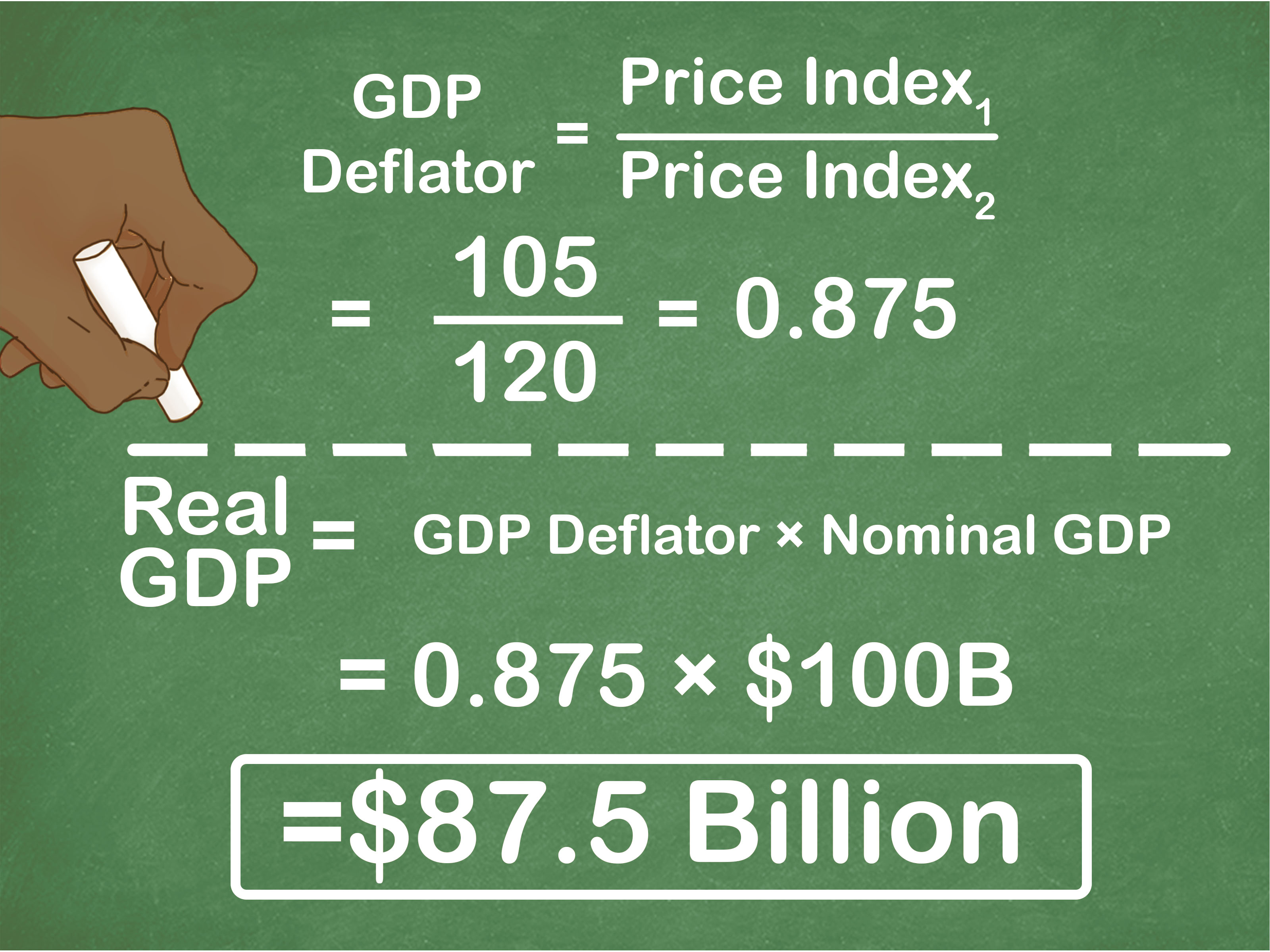
The GDP deflator is a broad price index used to convert nominal GDP into real GDP. It measures price changes for goods and services produced domestically, including exports, while excluding imports.
The basic relationship is:
GDP Deflator = (Nominal GDP ÷ Real GDP) × 100
If nominal GDP rises faster than real GDP, the GDP deflator usually rises too. That means part of nominal growth is coming from higher prices. This is why economists often compare nominal GDP growth, real GDP growth, and the GDP price index together.
How Nominal GDP Is Connected to the Expenditure Formula
GDP is often calculated using the expenditure approach:
GDP = C + I + G + (X − M)
Where:
- C = Consumer spending
- I = Business investment
- G = Government spending
- X = Exports
- M = Imports
Nominal GDP uses current prices for these components. If consumer spending rises because people buy more goods, nominal GDP may rise. If consumer spending rises because the same goods cost more, nominal GDP may also rise. Again, nominal GDP does not separate quantity from price by itself.
When Should You Use Nominal GDP Growth?
Use nominal GDP growth when you care about current-dollar economic size. It is especially helpful for analyzing tax bases, debt-to-GDP ratios, government revenue, corporate sales potential, and broad market demand.
For example, public debt is usually stated in nominal dollars. Comparing nominal debt to nominal GDP is logical because both are measured in current dollars. If nominal GDP grows quickly, a country’s debt-to-GDP ratio can improve even if the debt level itself rises.
However, if you want to know whether people are actually producing more goods and services, use real GDP growth. If you want to know whether average living standards are improving, look at real GDP per capita, wages, productivity, inflation, employment, and income distribution. GDP is powerful, but it is not a crystal ball wearing a tie.
Tips for Better Nominal GDP Analysis
Compare Nominal and Real GDP Together
Nominal GDP growth alone can mislead you. A country with 10% nominal GDP growth and 8% inflation is in a very different situation from a country with 10% nominal GDP growth and 2% inflation.
Use the Same Data Source
Different institutions may use different methodologies, exchange rates, or revision schedules. For clean comparisons, use one reliable source consistently.
Pay Attention to Frequency
Annual data is smoother. Quarterly data is more timely but noisier. Monthly GDP data exists for some countries, but it is less common and may be estimated differently.
Look at the Context
High nominal GDP growth may result from strong demand, inflation, population growth, currency depreciation, commodity booms, or statistical revisions. Numbers tell you what happened; context tells you why it matters.
Experience-Based Insights: What Calculating Nominal GDP Growth Teaches You
After working with nominal GDP growth calculations, one lesson becomes obvious: the math is easy, but the interpretation is where people trip over the furniture. The formula takes less than a minute. Understanding what the result means can take much longer.
For example, beginners often celebrate high nominal GDP growth as automatically good news. At first glance, that makes sense. Bigger number, bigger economy, happy headlines. But then you compare it with real GDP growth and inflation. Suddenly, the picture changes. If nominal GDP grew 9% but real GDP grew only 1%, most of the increase likely came from rising prices. That is not fake growth, but it is not the same as a productivity boom or a surge in living standards.
Another useful experience is learning to respect data labels. A table might say “GDP,” but that is not enough. Is it current-dollar GDP? Chained-dollar GDP? Seasonally adjusted? Annualized? In billions? In domestic currency? In current U.S. dollars? Economics data can be perfectly accurate and still easy to misuse. The problem is rarely the formula; the problem is feeding the formula the wrong numbers.
In practical analysis, nominal GDP growth is especially helpful when looking at debt, revenue, and market size. Suppose a government’s debt grows by 4% while nominal GDP grows by 6%. The debt level increased, but the economy’s current-dollar capacity grew faster. That can reduce pressure on the debt-to-GDP ratio. On the other hand, if debt grows 10% and nominal GDP grows 3%, the fiscal picture may become more concerning.
Business owners can also learn from nominal GDP growth. If nominal GDP is rising strongly, it may indicate that total spending in the economy is increasing. But businesses should still ask whether customers are buying more units or simply paying higher prices. A retailer may see revenue rise 7%, but if costs rose 9%, that “growth” may feel about as exciting as finding a coupon after checkout.
Students often benefit from building a small spreadsheet. Put the years in one column, nominal GDP in the next, the dollar change in the third, and the growth rate in the fourth. Once you calculate several years in a row, patterns appear. You can see recessions, recoveries, inflationary periods, and unusual jumps. The calculation becomes less abstract and more like reading an economic story written in numbers.
One final experience-based tip: never analyze nominal GDP growth in isolation. Pair it with real GDP growth, GDP deflator growth, population growth, employment, wages, and productivity. Nominal GDP is a headline number, but economies are messy, living systems. One statistic can open the door, but it should not be asked to carry the entire couch by itself.
Conclusion
Calculating the growth rate of nominal GDP is straightforward: subtract the previous period’s nominal GDP from the current period’s nominal GDP, divide by the previous period’s nominal GDP, and multiply by 100. The formula is simple, but the meaning deserves careful thought.
Nominal GDP growth measures the change in the current-dollar value of economic output. It includes both real production growth and price changes, which makes it useful for analyzing market size, tax revenue, debt ratios, and current-dollar economic activity. However, it should be compared with real GDP and inflation indicators to understand whether growth reflects more output, higher prices, or both.
If you remember one thing, remember this: nominal GDP tells you how much bigger the economy looks in today’s money. Real GDP tells you how much more the economy actually produced. Both matter. Use the right one, and your analysis will instantly become sharper, cleaner, and less likely to make economists spill their coffee.