For all its dragons, assassins, poisoned weddings, and people making catastrophically poor romantic decisions, Game of Thrones was apparently vulnerable to one surprisingly powerful weapon: a well-aimed joke from four animated children in Colorado.
In 2013, South Park transformed the battle between the Xbox One and PlayStation 4 into a three-episode parody of HBO’s fantasy phenomenon. The spoof targeted practically everything associated with Westeros: elaborate betrayals, endless promises that the exciting stuff was coming, shocking nudity, sudden deaths, George R.R. Martin’s writing pace, and the strangely serious way characters discussed treason while taking pleasant walks through beautiful gardens.
That last joke reportedly landed so accurately that the Game of Thrones production team adjusted how it staged certain conversations. No, HBO did not remove the dragons, replace the Iron Throne with a gaming console, or make everyone keep their clothes on. The change was smaller, smarter, and much funnier.
What Did South Park Actually Change About Game of Thrones?
The famous claim that Game of Thrones changed because South Park made fun of them refers to the show’s habit of placing politically important conversations in palace gardens.
During the early seasons of Game of Thrones, characters frequently delivered exposition while walking around the gardens of King’s Landing. Varys might exchange carefully selected information with Olenna Tyrell. Margaery might discuss royal strategy while admiring the flowers. Littlefinger could explain a conspiracy while strolling at exactly the speed required by a television camera operator.
The scenes were effective. Walking gave otherwise static conversations visual movement, while a garden provided privacy without forcing every secret discussion into another dark room. However, once viewers noticed the pattern, the gardens began to resemble an official Westerosi conference center.
Welcome to the Garden of Betrayal
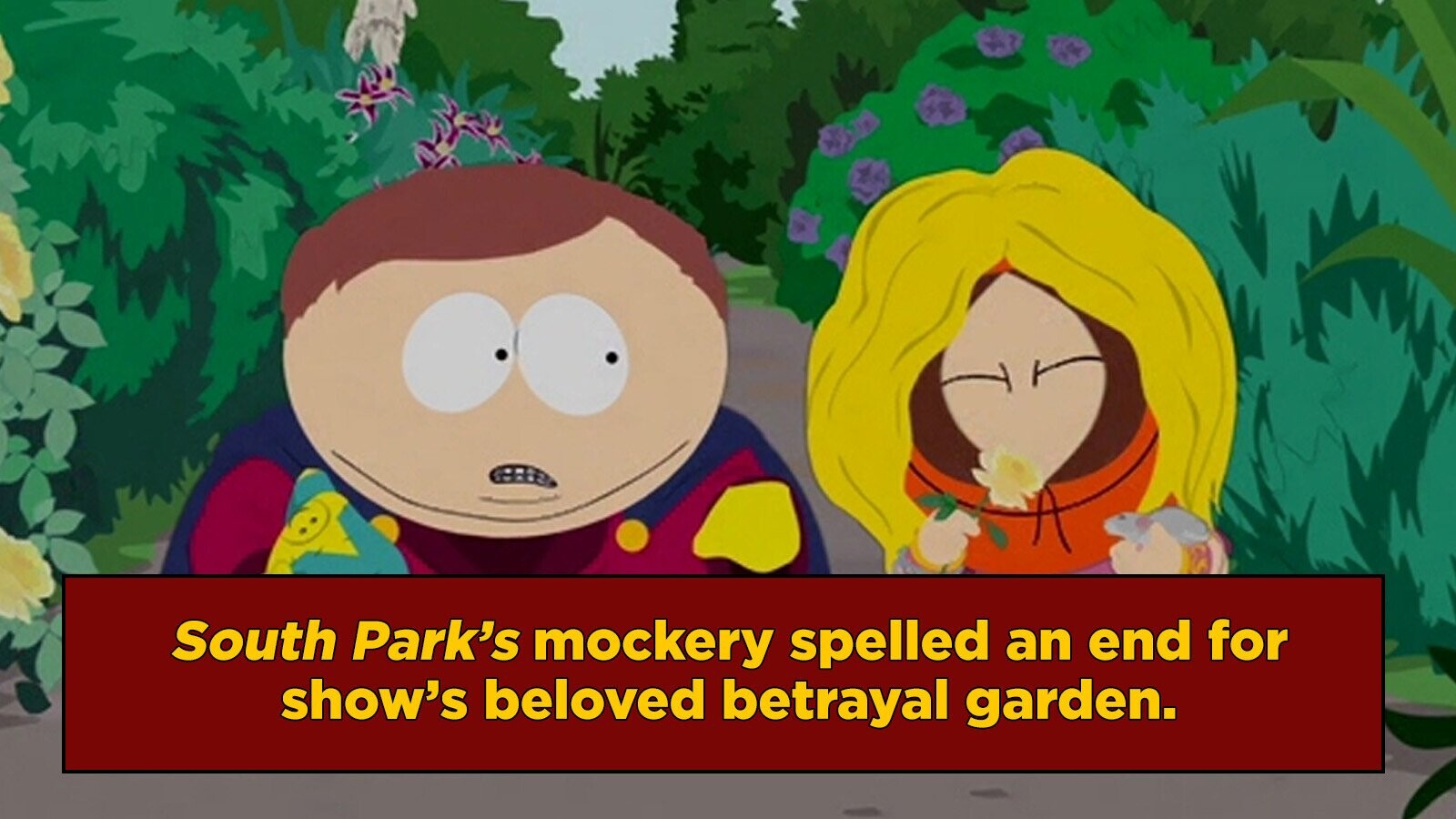
South Park turned this visual habit into a recurring gag. Cartman repeatedly led potential allies into what he treated as an enchanted political garden, where he whispered plans, offered reassurance, and prepared to betray nearly everyone involved.
There was only one problem: the “garden” was an ordinary neighborhood yard. Its irritated owner kept interrupting Cartman to complain that children were trespassing on his property and holding suspicious conversations about betrayal.
The joke worked because it did not merely reference Game of Thrones. It identified a genuine piece of the show’s filmmaking grammar. Once South Park pointed it out, every leisurely stroll through the Red Keep suddenly looked less like sophisticated medieval intrigue and more like a mandatory meeting organized by the Westeros landscaping department.
In commentary associated with the fourth season, showrunners David Benioff and D.B. Weiss reportedly acknowledged that the parody made them conscious of how often they used those walking-and-plotting scenes. They consequently reduced the frequency of that particular staging device.
The South Park Black Friday Trilogy Explained
The parody began with “Black Friday,” which aired on November 13, 2013. It continued with “A Song of Ass and Fire” and concluded with “Titties and Dragons” on December 4. Together, the episodes combined three subjects that had absolutely no business fitting together as perfectly as they did: Game of Thrones, Black Friday shopping, and the console war between Microsoft and Sony.
The children divide into rival Xbox One and PlayStation 4 factions. Their arguments over hardware become political alliances. Friends switch sides. Kenny becomes a fantasy princess. Cartman plots like a bargain-bin Littlefinger, while Randy joins mall security as shoppers gather outside like consumerist White Walkers.
According to official episode information, Trey Parker and Matt Stone had wanted to parody Game of Thrones and recognized that Black Friday’s ominous name and competitive chaos fit the fantasy series unusually well. The trilogy was therefore more than a collection of references. It rebuilt the political structure of Westeros around discounted electronics.
Why the Parody Felt Affectionate Rather Than Lazy
The best parody usually comes from people who understand what they are mocking. Parker and Stone clearly knew the rhythms of Game of Thrones: whispered alliances, shocking reversals, shifting loyalties, delayed supernatural threats, serious speeches, and the uncomfortable possibility that the person standing beside you might arrange your murder before dessert.
Critics observed that the trilogy was not a scene-for-scene imitation. Instead, it used the themes and storytelling machinery of Game of Thrones to frame an entirely different conflict. That approach allowed the comedy to work even for viewers who could not identify every Stark, Tyrell, Frey, or mysteriously bearded northern gentleman.
It also meant the jokes carried useful criticism. The parody admired the HBO series enough to understand why it was compelling, yet felt comfortable asking why the dragons were always “on the way,” why every alliance needed three betrayals, and why so much royal business took place beside decorative shrubbery.
Lady Olenna Delivered the Perfect Response
The funniest evidence of the shows’ cultural conversation arrived in “Oathkeeper,” the fourth episode of Game of Thrones Season 4, broadcast on April 27, 2014.
While walking with Margaery through the palace gardens, Lady Olenna complains, “If I have to take one more leisurely stroll through these gardens, I’ll fling myself from the cliffs.”
The line works within the story because Olenna is impatient, sharp-tongued, and thoroughly tired of King’s Landing. It also sounds like an unmistakable wink at the production’s dependence on garden conversationsand at the animated show that had publicly exposed the pattern.
The scene does not abandon the garden entirely. Olenna is still walking through it while criticizing the walk. That makes the moment even better. Game of Thrones did not respond defensively; it allowed one of its cleverest characters to participate in the joke. The episode is officially identified as Season 4, Episode 4 and was written by Bryan Cogman.
Why Garden Conversations Were So Common
It is easy to tease the garden scenes, but they existed for practical storytelling reasons. Game of Thrones had an enormous cast, multiple kingdoms, complicated family histories, and enough political information to make a royal accountant request early retirement.
Characters needed to explain plans without making every episode feel like an illustrated encyclopedia. A walk-and-talk scene solved several production problems at once. It created motion, displayed the expensive location, separated characters from the crowded royal court, and let the audience absorb exposition while watching something more interesting than two people sitting at a table.
The gardens also communicated status. These were controlled spaces occupied by nobles, courtiers, and influential advisers. A private conversation among roses suggested elegance and safety, even when the speakers were quietly planning someone’s downfall.
The problem was not that the technique was bad. The problem was repetition. Every storytelling shortcut becomes visible when used often enough. The first garden discussion feels graceful. The tenth makes viewers wonder whether the kingdom’s entire intelligence network is hidden inside a rosebush.
How Satire Can Function Like an Unofficial Focus Group
A comedy program can reveal habits that conventional criticism misses. Reviewers often focus on performances, plot developments, themes, and major production choices. Satire is more likely to notice the tiny recurring behaviors that audiences recognize subconsciously but have not yet put into words.
Repetition Becomes Obvious When It Is Exaggerated
South Park took the garden walks, repeated them rapidly, removed the prestige lighting, and placed them in an annoyed homeowner’s yard. The exaggeration exposed the formula immediately.
That does not mean television writers must obey every joke made about their work. If creators reacted to every online meme, dramatic television would soon consist of characters silently staring at a wall to avoid developing recognizable habits.
However, good writers can distinguish between empty ridicule and a useful observation. The garden parody highlighted a staging pattern without attacking the central story. Reducing that pattern did not damage the adaptation. It encouraged the directors and writers to find more varied ways of presenting political conversations.
The Best Response Was Not to Become Defensive
The Game of Thrones team could have ignored the parody or dismissed it as crude animation. Instead, the reported commentary suggests that the writers recognized the accuracy of the joke.
This is an underrated form of creative confidence. Admitting that a comedy show noticed one of your habits does not diminish the original work. It demonstrates that the creators were still examining how the series functioned, even after it had become one of television’s largest productions.
What Else Did South Park Mock?
The Long Wait for Dragons
One recurring complaint involved the slow arrival of the spectacular fantasy elements. Game of Thrones introduced dragons and White Walkers early, but its first seasons concentrated heavily on politics, families, and regional warfare.
That slow construction was one of the show’s strengths, but it was easy comedy material. The parody repeatedly suggested that the dragons were coming eventuallyjust not at any useful time. Years later, the HBO series delivered enormous supernatural battles, although many viewers still preferred the earlier episodes built around dialogue and political maneuvering.
Sex, Nudity, and George R.R. Martin
The trilogy also exaggerated the franchise’s sexual content and portrayed George R.R. Martin as unusually interested in male anatomy. Martin later responded good-naturedly, saying he was relieved that South Park had treated him relatively gently. He did, however, dispute the cartoon’s characterization of his personal preferences.
His reaction reinforced the affectionate nature of the parody. He did not treat it as an attack on his books. He simply wanted the historical record to show that the animated version of George R.R. Martin had made a rather significant factual error.
Death as Entertainment
The Black Friday crowds mirror the violent masses and armies of Westeros. Shoppers prepare to storm the mall for discounts as if they were invading a fortified castle. Mall employees become a version of the Night’s Watch, standing between civilization and an approaching horde armed with coupons.
The comparison is absurd, but it carries a sharp observation about consumer culture. People who would never fight for a medieval throne may still display alarming enthusiasm when a television is marked down by 80 percent.
Did South Park Really Change Game of Thrones?
Yesbut the size of the change should not be exaggerated.
South Park did not alter the main plot, eliminate a character, rewrite George R.R. Martin’s mythology, or determine who ultimately occupied the Iron Throne. The influence involved a recurring method of staging exposition. The showrunners reportedly became aware of the garden-walking pattern and used it less frequently.
That is still a meaningful example of one television series influencing another. Large productions are often presented as sealed kingdoms where creative decisions descend from an untouchable throne. In reality, writers and directors watch television, hear criticism, notice jokes, and occasionally realize that somebody outside the castle has made a fair point.
The story is especially memorable because the feedback did not come from a formal industry panel. It came from Cartman trespassing in a stranger’s yard while pretending to be a medieval strategist.
Experiencing the Joke as a Game of Thrones Viewer
Watching the South Park trilogy before revisiting Game of Thrones changes the viewing experience in a peculiar way. Scenes that once seemed completely natural acquire a second comic layer. The camera cuts to palace gardens, two important characters begin walking, and a small part of the viewer’s brain immediately expects an elderly homeowner to appear and order them off the property.
The effect demonstrates how parody can permanently alter visual perception. A viewer may have watched several garden conversations without consciously connecting them. After the parody, the shared structure becomes impossible to miss: two characters walk slowly, one offers apparently sincere advice, the other reveals a concern, and both carefully avoid saying anything that could not later be denied.
A rewatch also reveals why the original device was appealing. The scenes often contain excellent performances. Diana Rigg turns a pleasant stroll into a strategic interrogation with a change in expression. Natalie Dormer’s Margaery can smile warmly while evaluating several paths to power. Conleth Hill’s Varys makes every polite sentence sound as though a second, more dangerous sentence is hiding underneath it.
The comedy therefore does not ruin the scenes. It adds an extra level of appreciation. Viewers can recognize the repetitive staging while still enjoying the dialogue, performances, costumes, and political tension. In many cases, noticing the formula makes the actors’ work more impressive because they repeatedly create suspense within similar physical settings.
Another enjoyable experience comes from watching the two programs in chronological order. Begin with the early seasons of Game of Thrones, paying attention to the Red Keep’s outdoor conversations. Then watch the three South Park episodes. Finally, continue with “Oathkeeper” and listen for Olenna’s complaint about taking another leisurely garden stroll.
The sequence feels like a conversation between television shows. HBO establishes a visual convention. Comedy Central exaggerates it. HBO then acknowledges the criticism through a character whose personality makes the acknowledgment believable.
The Black Friday trilogy also rewards viewers who lived through the Xbox One and PlayStation 4 launch period. At the time, online arguments about the consoles could become remarkably intense. Friends debated hardware specifications, exclusive games, price differences, and corporate policies with the seriousness of rival noble houses negotiating military alliances.
By combining those arguments with Game of Thrones, South Park captured the emotional absurdity of consumer loyalty. The children believe they are participating in an epic historical conflict, yet their objective is simply to purchase matching entertainment systems. That feeling remains familiar whenever fans turn a product preference into a question of honor.
For new viewers, the trilogy works as a compact lesson in parody. It does not require the audience to hate Game of Thrones. In fact, knowing and enjoying the HBO series makes most of the jokes stronger. The experience resembles hearing a close friend imitate one of your habits perfectly: mildly embarrassing, immediately recognizable, and far too accurate to dismiss.
Most importantly, the story makes later garden scenes more entertaining rather than less. Whenever nobles begin another elegant discussion among the flowers, viewers can appreciate the political strategy while privately wondering whether the property owner has finally contacted the authorities.
Conclusion: Even Westeros Could Take a Joke
The claim that Game of Thrones changed because South Park made fun of them is based on a real but modest creative adjustment. The animated comedy identified the HBO drama’s reliance on walking political conversations in palace gardens. The Game of Thrones team reportedly recognized the observation, reduced the habit, and appeared to acknowledge it through Lady Olenna’s wonderfully impatient dialogue.
The episode is a reminder that satire can do more than entertain. It can identify patterns, expose overused techniques, and give creators an opportunity to see their work through an audience’s eyes. Sometimes criticism arrives in a thoughtful essay. Sometimes it arrives through an animated fourth grader discussing treason beside a suburban rosebush.
Either way, the wisest response is to listenpreferably while seated somewhere other than the garden.