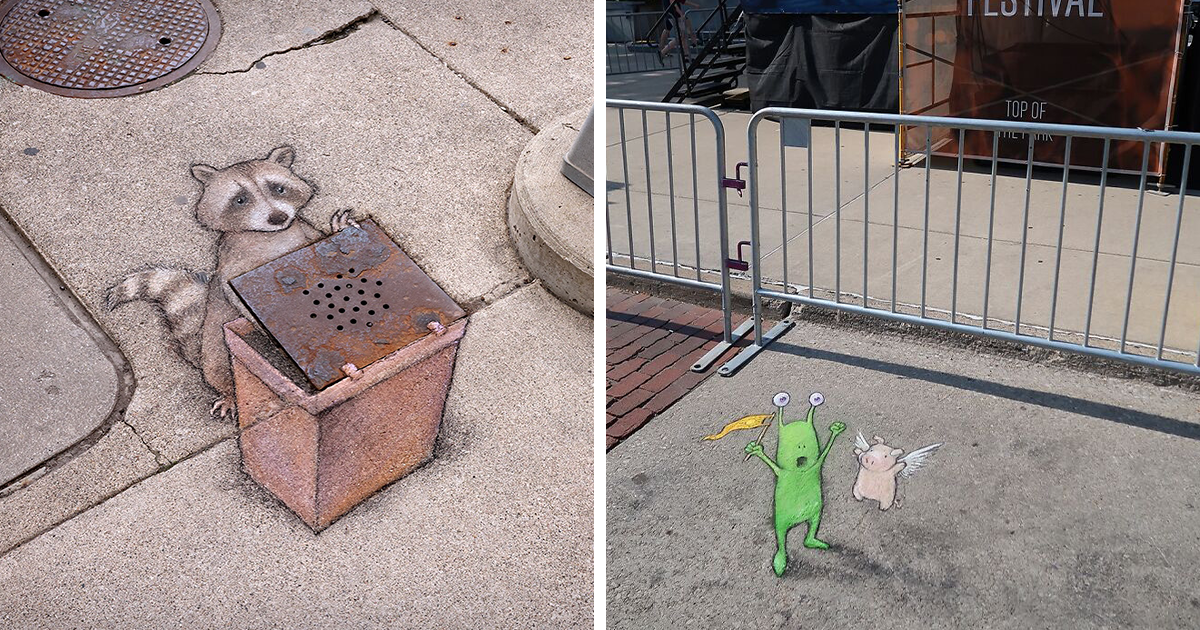
Most people see a cracked sidewalk and think, “Someone should fix that.” David Zinn sees the entrance to a mouse-sized apartment, a dragon’s hiding place, or the ideal stage for a green creature with spectacularly inconvenient eyeballs.
The Ann Arbor artist transforms pavement, bricks, tree roots, utility covers, weeds, stones, and forgotten corners into whimsical scenes using little more than sidewalk chalk, charcoal, and whatever objects happen to be nearby. His drawings are playful, technically clever, and temporary. A rain shower can erase an afternoon of work, which might sound tragic until you understand that impermanence is part of the point.
These 50 David Zinn chalk art moments show how ordinary streets can become miniature fantasy worlds when someone pays attention to the details everyone else steps over.
How David Zinn Found a Universe Beneath His Feet
Zinn has created original artwork around Ann Arbor, Michigan, since the late 1980s. Before sidewalk creatures became his best-known work, he spent more than two decades handling commercial projects that included posters, logos, educational cartoons, murals, theatrical illustrations, and even hand-painted garbage trucks. His chalk practice began in 2001, initially as a respectable-sounding excuse to leave his indoor workspace and enjoy good weather.
That excuse eventually became a career. Today, his temporary street drawings have appeared beyond Michigan in locations including California, Manhattan, Sweden, Taiwan, and the French Riviera. Yet Ann Arbor remains the natural habitat of most of his underfoot menagerie.
Cracks Are Not Flaws; They Are Plot Devices
Zinn rarely begins with a complete drawing planned on paper. Instead, he searches for a surface that suggests a story. A hole becomes a doorway. A strip of grass becomes a dragon’s spines. A hydrangea becomes an ice cream scoop. A dandelion can serve as a birthday candle, while a manhole cover may turn into a portal that municipal engineers somehow forgot to label.
His official biography jokingly describes this process as “ephemeral pareidolic anamorphosis.” In practical terms, he sees recognizable possibilities in random textures and then uses perspective to make a flat drawing appear connected to the three-dimensional environment. The final illusion is often designed for one viewing angle, so the surrounding architecture becomes part of the artwork rather than merely its background.
Meet Sluggo, Philomena, Nadine, and the Rest of the Neighborhood
Several characters return regularly. Sluggo is the bright green, stalk-eyed troublemaker whose anatomy makes hats unnecessarily complicated. Philomena is a calm flying pig who treats impossibility as a transportation option. Nadine is a small, adventurous mouse frequently found exploring holes, ledges, stars, and ideas that are considerably larger than she is.
They share the pavement with raccoons, rabbits, dragons, frogs, robots, squirrels, bears, mysterious aliens, and creatures that appear to have been rejected from biology class for excessive creativity. The recurring cast gives Zinn’s street art the continuity of an illustrated storybook, except the pages are scattered around town and occasionally removed by thunderstorms.
50 Magical Sidewalk Worlds Created by David Zinn
The following scenes are original descriptions of documented works. Together, they demonstrate how Zinn combines visual illusion, miniature storytelling, environmental details, and delightfully unnecessary puns.
Unexpected Residents: Scenes 1–10
- Henry’s patient high five: A raccoon appears inside a wooden corner, holding up one paw for a pedestrian who notices him.
- Geraldine’s scarf-sharing experiment: A tiny animal stretches an ambitious scarf around a sidewalk edge, proving optimism can also be knitted.
- Hannah’s emergency leaf stew: A mouse dressed like a pocket-sized wizard stirs autumn leaves in a chalk cauldron.
- Alice’s concrete speaking window: A raccoon leans from a miniature opening, prepared to deliver either a proclamation or an unsolicited monologue.
- Nadine’s shared log cabin: A weathered stump becomes a multilevel woodland home, complete with tiny residents peeking through its windows.
- Marcus and the rebellious antenna: A small robot lurks near a doorway while pretending his bent antenna is an intentional fashion decision.
- Rodney’s improvised holiday fireplace: A windowsill and an old sock provide one hopeful dog with everything necessary for seasonal optimism.
- Earl challenges winter: A canine face emerges from a wooden gap and sticks out its tongue at the cold.
- Roger, the lesser-known lake monster: A green serpent rises from a brick opening, delighted to receive any attention not reserved for Nessie.
- Maisie discovers aerodynamic advantages: A tiny mouse rockets through a narrow pavement opening as though late for an extremely small flight.
These early scenes demonstrate Zinn’s habit of turning gaps, beams, bricks, stumps, and corners into believable architecture for his characters.
Seasonal Mischief and Sidewalk Survival: Scenes 11–20
- Sluggo’s unusual new friendship: The green creature embraces a flowerpot, suggesting his social circle has expanded into horticulture.
- Ellery checks the compost: A raccoon investigates a metal bin with low expectations and the confidence of a professional scavenger.
- An older Sluggo cautionary tale: Sluggo and Philomena turn an ordinary street fixture into evidence of a previous misadventure.
- Clarence waits out the cold: A shivering possum stays close to a candle while hoping winter ends before his patience does.
- Max contributes to the potluck: A raccoon arrives ready to “bring the chips,” with the surrounding pavement supplying the visual punch line.
- Sluggo waits for eyemuffs: Winter clothing remains an engineering problem when your eyes are attached to long green stalks.
- Chuck courts a pollinator: A small creature offers a primrose to a bee with the formality of a nervous botanical diplomat.
- Nadine chooses the measured route: A mouse and turtle use a ruler as a slide across a set of concrete steps.
- Sluggo and Philomena remodel the mall: A retrospective shows the pair pulling, digging, and generally treating public pavement as an adventure course.
- Simon listens without becoming a prince: A relaxed green frog offers emotional support without promising any fairy-tale transformation.
Snow, discarded objects, street fixtures, and seasonal plants are not obstacles in these works. They are supporting actors with excellent comic timing.
Portals, Wishes, and Questionable Fashion: Scenes 21–30
- Claude becomes accidental nesting property: A bird settles on a green creature’s head, apparently without reviewing the landlord’s temperament.
- Sluggo investigates a street grill: A storm drain becomes a kitchen, garden, or subterranean entrance depending on how literally one interprets the vegetables.
- Sluggo bottles his emotions: The character appears inside a transparent container surrounded by flowers and butterflies, looking surprisingly comfortable.
- Nadine reaches for a wishing star: The adventurous mouse fishes for a glowing star from the edge of a concrete block.
- Hamish approves the post: A shaggy Highland cow emerges beside a metal pole, turning the word “post” into a visual joke.
- Vivian extends Easter indefinitely: A determined bunny-suited character refuses to change clothes until every runaway jellybean has been recovered.
- Ursula delivers the bear minimum: A bear cub peers through a stone opening so small that the entire scene feels wonderfully secret.
- Benny plans a gentler descent: A squirrel with a pink balloon appears ready to retire from dangerous tree-climbing techniques.
- Nadine witnesses the impossible arriving: A three-dimensional hole seems to release Philomena the flying pig directly through the pavement.
- Greebix prepares a sleepy invasion: A stone-headed alien stands among leaves in pajamas, making interplanetary conquest look overdue for bedtime.
Zinn’s anamorphic openings are especially effective because the real surface supplies convincing depth. The viewer knows the pavement is solid, yet the eye happily accepts a tunnel, window, bottle, or hidden room.
Pizza Revelations and Tiny Adventures: Scenes 31–40
- Sluggo champions bunny slippers: Glasses and fluffy footwear give the green creature the confidence of a reluctant lifestyle influencer.
- Clyde discovers cold pizza: A fox holds one abandoned slice and immediately reevaluates his place in the universe.
- Melinda rides the blue-tailed Binkus: A delighted passenger travels on a fantastic blue bird while making calmness look impossible.
- Sluggo demonstrates aquatic anatomy: A transparent container becomes a swimming scene, with his stalked eyes serving as unlikely flotation equipment.
- Leonard manages an uncooperative rock department: A grumpy stone waits for nearby rocks to organize themselves by size, color, or shape.
- Alvin and Celeste continue their standoff: A small dinosaur and a ladybug remain locked in an argument neither can remember starting.
- Randolph haunts careless gardeners: A tiny ghost carries a flower while warning the living about overwatered begonias.
- Sluggo flies with maximum eye exposure: His unusual aircraft allows both stalked eyes to enjoy the breeze simultaneously.
- Sluggo finds a hydration station: A utility opening becomes an elaborate source of refreshment for creatures living below street level.
- Spring makeover season begins: One green character decorates another with a flower, proving sidewalk creatures also endure seasonal beauty trends.
Food scraps, rocks, insects, weeds, and utility structures become narrative triggers. Zinn does not conceal the ordinary object; he lets the audience recognize it twicefirst as itself and then as part of the joke.
Dragons, Opera, and One Very Talkative Beetle: Scenes 41–50
- Mavis seeks a fetching companion: A little green dragon waits with the hopeful energy of someone who may have misunderstood the word “fetch.”
- Andy waits for his summer wings: A wingless dragon handles seasonal development delays with visible awkwardness.
- Heavy-Hat McGee practices good manners: A small green figure tips an enormous stone hat through strength that raises several unanswered questions.
- Helen has a visitor on her mind: An owl sits with a tiny green bird balanced directly on her head.
- Captain Tawnyshanks demands respect: A sword-carrying miniature warrior stands beside a larger dog who objects to anyone calling the captain adorable.
- Sylvia protects the forest one rock at a time: A determined woodland guardian establishes her first conservation zone around a single stone.
- Clyde interprets a pink splodge: A raccoon holds an ice cream cone whose colorful scoop appears to have been predicted by the pavement.
- Martin keeps his heated hat: A sidewalk gnome refuses to acknowledge spring until the calendar provides legally acceptable evidence.
- Anastasia performs rabbit opera: A joyful bunny sings from a pavement crack, temporarily converting the sidewalk into a very small concert hall.
- Gordon learns beetle language: A green creature discovers he can converse with colorful insects and seems understandably unsettled by the news.
The final group captures a defining feature of David Zinn’s sidewalk art: every creature appears to have a life beyond the picture. Viewers encounter the middle of a story and are trusted to imagine what happened before and what will occur after the next rain.
Why David Zinn’s Chalk Art Is More Than Simply Cute
The Drawings Reward Attention
A large mural announces itself from across a block. Zinn’s pieces frequently do the opposite. They hide at ankle height, peek from behind fixtures, or occupy a broken section of concrete that pedestrians normally ignore. Finding one requires looking away from the phone, slowing down, and examining the street as though it may be keeping secrets.
That modest scale changes the relationship between the artwork and its audience. The viewer does not merely observe a public spectacle. The viewer discovers something. Even after photographs circulate online, encountering a creature in its original location retains the feeling of finding a note intended for whoever happened to notice it.
Impermanence Removes the Pressure to Be Precious
Chalk drawings are vulnerable to rain, shoes, street sweepers, and enthusiastic dogs with poor gallery etiquette. Zinn accepts that disappearance as a feature rather than a failure. Temporary materials reduce the pressure to create a flawless monument. The work can be playful, responsive, and fully present without needing to survive for decades.
This philosophy also makes chalk unusually approachable. It is inexpensive, familiar, and easy to use. A child, professional illustrator, or hesitant adult can make a mark without purchasing specialized equipment or worrying that one imperfect line has ruined an expensive canvas.
Public Art Becomes a Form of Neighborliness
Zinn’s work is not sealed behind museum glass. It shares space with commuters, children, shoppers, delivery workers, and people walking home after difficult days. That accessibility allows a tiny mouse or confused dragon to interrupt an ordinary routine with a few seconds of surprise.
Over time, drawing outside has also connected Zinn with his community. Passersby watch the process, ask questions, recognize recurring characters, and sometimes bring children to see what he is creating. A temporary picture may vanish, but the social exchange around it can become part of a neighborhood’s shared memory.
The Experience of Finding a Magical Chalk World in Real Life
Imagine walking down a familiar street with no artistic expectations whatsoever. You are thinking about groceries, parking, work, or why one sock always disappears during laundry. Then something green appears beside a crack in the pavement. You stop, step backward, and discover Sluggo climbing from what suddenly looks like a bottomless hole.
The first pleasure comes from recognition. You understand how the illusion works: chalk supplies the character, while a real crack supplies the depth. A leaf becomes a sail. A weed becomes a tree. A shadow becomes a room. Nothing has been hidden from you, yet your perception has been gently rearranged. The ordinary street remains visible inside the fantasy.
Next comes the story. Zinn’s characters rarely stand around posing like respectable portrait subjects. They are busy. A mouse is making a wish. A raccoon is searching for lunch. A dragon is embarrassed about its wings. A rock has been promoted into middle management and already regrets accepting the position. The scene gives you enough information to understand the joke but leaves enough unsaid for your imagination to continue it.
The physical scale matters too. Because many drawings are small, you may need to crouch, lean, or move sideways to find the intended viewing angle. That movement makes the experience participatory. You are not simply looking at a finished object; you are solving a visual puzzle. From the wrong position, the artwork may seem stretched or disconnected. From the right one, a curb becomes a cliff and a shallow groove drops into another world.
There is also the quiet thrill of knowing the drawing will not remain. You may be among a limited number of people who see it before weather and footsteps erase it. That knowledge encourages attention. Instead of postponing enjoyment, you look carefully now. The artwork turns a passing moment into the only available exhibition date.
For families, the experience can change how children interpret their surroundings. Cracked concrete is no longer merely damaged concrete. It might be a cave, river, staircase, mouth, or interdimensional customs checkpoint. Adults receive a similar invitation, though we may require more convincing because we have spent years becoming suspicious of fun that does not generate a quarterly report.
Zinn’s approach can also inspire a simple creative exercise. Walk through a neighborhood without drawing anything at first. Search for shapes in stains, bricks, roots, shadows, and gaps. Ask what kind of creature could live there and what problem it might currently be facing. Perhaps a drain is a dragon elevator. Perhaps a broken tile is the last piece of a robot’s apartment. Once the environment supplies the beginning, the blank-canvas problem becomes much smaller.
The deepest experience, however, is not really about chalk technique. It is about permission. These miniature worlds suggest that creativity does not always need permanence, prestige, permission slips, or a dramatic artist statement. Sometimes it can exist because the sun is out, the pavement looks interesting, and a shy green monster clearly needs help climbing through it.
Conclusion: The Sidewalk Was Never Empty
David Zinn’s chalk drawings succeed because they do not fight the street. They collaborate with it. Cracks, bricks, weeds, stones, holes, and stains become essential pieces of the composition, allowing each location to suggest its own character and story.
Across these 50 magical sidewalk worlds, the materials remain simple while the ideas become wonderfully elaborate. A few sticks of chalk can produce a flying pig, an anxious robot, an operatic rabbit, or a mouse reaching for a star. More importantly, the drawings remind us that imagination is not limited by an imperfect surface. Sometimes the imperfection is exactly where the story begins.
Note: The artwork descriptions above are independently written paraphrases of documented David Zinn creations. His chalk drawings are temporary, so individual pieces may have faded or disappeared from their original locations.