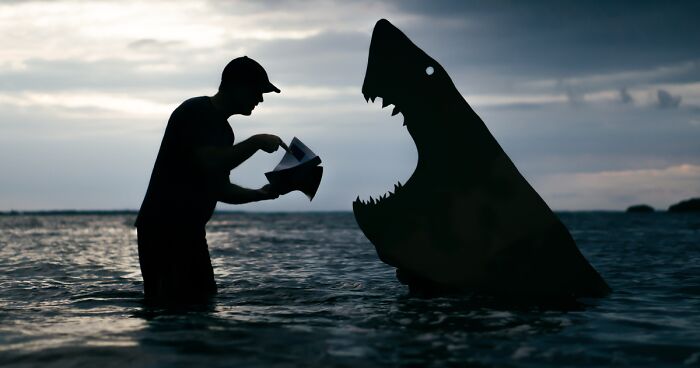
Some people chase sunsets with expensive cameras, matching linen outfits, and a suitcase full of “candid” poses that somehow require twelve retakes. Others, like artist and storyteller John Marshall, walk outside with cardboard, scissors, a sense of humor, and the bold belief that a flat piece of recycled packaging can become a dragon, a mermaid, a monster, a parade, a joke, or a tiny visual miracle. The result is the wonderfully strange world of cardboard cutouts at sunset: part photography, part handmade craft, part one-panel comic, and part “Wait, how did he make cardboard look that alive?”
The idea sounds almost too simple to work. Cut a shape from cardboard. Hold it up against the glowing sky. Pose with it. Take a photo. Done, right? Not exactly. The magic comes from the meeting point between planning and surprise. Sunset light erases messy edges, turns ordinary material into crisp silhouette art, and transforms a backyard, beach, lakeshore, or field into a stage. Suddenly, a cardboard dinosaur does not look like something rescued from the recycling bin. It looks like it has opinions, dramatic timing, and possibly a union contract.
This article explores why posing with cardboard cutouts at sunset creates such unforgettable images, how the technique works, what makes the results so charming, and what anyone can learn from this playful form of sunset photography. Whether you are a photographer, craft lover, social media creator, art student, or someone who simply believes sunsets deserve more cardboard goblins, there is a lot to love here.
Why Cardboard Cutouts At Sunset Work So Well
The secret begins with silhouette photography. When a subject is placed between the camera and a bright light source, the subject becomes dark while the background glows. Sunset is perfect for this because the sun sits low in the sky, creating warm color, long shadows, and dramatic contrast. Golden hour photography is famous for flattering portraits and dreamy landscapes, but for cardboard cutout art, it does something even better: it hides the evidence.
Cardboard is not glamorous. It bends. It wrinkles. It has corners that refuse to cooperate. It may have once been a cereal box, which is not usually the origin story of fine art. But when backlit by sunset, all those imperfections disappear. The camera sees the outline, not the tape. The viewer sees the character, not the corrugated trauma. That is why this handmade photography style feels both simple and brilliant.
In John Marshall’s “Sunset Selfies” style of work, the cutouts often become characters in tiny stories. A person might appear to walk a cardboard dragon. A fish might leap toward the sky. A monster might politely interrupt the evening. The joke lands because the image is readable instantly. The eye understands the silhouette first, then the brain notices the humor. It is visual storytelling without a long explanation, which is helpful because sunsets do not wait around while we write a five-paragraph backstory.
The Art Behind The Joke
It would be easy to dismiss cardboard sunset photography as a clever gimmick, but that would miss the craft behind it. A strong silhouette depends on shape language. Every cutout must be recognizable from its outline alone. That means the artist has to think like a cartoonist, designer, photographer, and stage director at the same time.
Shape Is The Main Character
In normal portrait photography, details matter: facial expression, clothing texture, eye contact, color, background blur. In silhouette photography, most of that disappears. What remains is shape. A dragon needs wings that read clearly. A bird needs a beak and posture. A giant needs scale. A joke needs a pose that tells the viewer exactly what is happening.
This is why cardboard cutouts at sunset often feel similar to classic paper silhouettes, shadow puppetry, and single-panel cartoons. They rely on instant recognition. A strong outline is the difference between “That is a charming whale” and “Is that a shoe arguing with a toaster?” Both could be art, technically, but only one is probably intentional.
The Human Pose Completes The Story
The cardboard is only half the performance. The person posing with it brings the scene to life. A small tilt of the head can turn a monster into a friend. A stretched arm can create the illusion of feeding, fighting, rescuing, or greeting a cardboard creature. A crouch can change scale. A jump can add motion. A still pose can make the whole image feel like a quiet fairy tale.
This is where the project becomes more than craft. It is performance photography. The artist is not simply displaying a prop; they are acting with it. The sunset becomes the theater light, the camera becomes the audience, and the cardboard becomes a surprisingly demanding co-star.
How Sunset Turns Simple Materials Into Magic
Sunset photography has a built-in emotional advantage. Warm skies make viewers feel nostalgic, calm, curious, or even a little dramatic. Add a silhouette and the image gains mystery. Add a handmade cardboard creature and suddenly the mystery is wearing googly-eyed confidence, even if the eyes are imaginary.
Golden hour and sunset create several advantages for this style of creative photography:
- High contrast: The bright sky helps dark shapes stand out clearly.
- Warm color: Orange, pink, purple, and gold backgrounds make simple silhouettes feel cinematic.
- Long shadows: Low-angle sunlight adds drama and depth to the scene.
- Soft atmosphere: The light feels less harsh than midday sun, giving the photo a polished mood.
- Natural simplicity: A clean sky removes distractions and keeps attention on the cutout story.
The best part is that this technique does not require a Hollywood budget. A phone camera, a tripod or stable surface, cardboard, scissors, tape, and patience can go a long way. The real investment is imagination. Also, possibly snacks, because sunset waits for no one but hunger arrives early.
Why The Results Feel So Shareable
Cardboard cutout sunset photos are built for the internet in the best possible way. They are quick to understand, visually bold, and emotionally friendly. In a crowded feed full of perfect meals, gym mirrors, and suspiciously clean desks, a silhouette of someone negotiating with a cardboard octopus feels refreshingly human.
There is also a strong “I could try that” factor. Viewers do not look at the image and think, “Ah yes, clearly this required a warehouse, a crane, and a fog machine operated by a man named Brent.” Instead, they think, “Wait, is that cardboard? Could I make one?” That accessibility is a major reason handmade visual projects connect with people. They invite participation.
The humor helps too. A sunset by itself can be beautiful, but a sunset with a cardboard dinosaur stealing the scene becomes memorable. The combination of beauty and silliness is powerful. It reminds viewers that art does not always have to stare into the distance wearing a black turtleneck. Sometimes art can be duct-taped to a stick and still make people smile.
Creative Lessons From Posing With Cardboard Cutouts
This project offers useful lessons for photographers, artists, and content creators who want to make original work without overcomplicating the process.
1. Constraints Can Make You More Creative
Using only cardboard, sunset light, and a human silhouette sounds limiting. In reality, the limitation becomes the engine. Because the materials are simple, the idea has to be strong. Because the image is mostly an outline, the pose has to be clear. Because sunset is brief, the artist has to commit quickly.
Creative constraints reduce decision fatigue. Instead of asking, “What can I make with everything in the world?” the question becomes, “What can I make with this cardboard before the sun disappears?” That is much easier. Also more urgent. The sun is basically a glowing project manager with no patience for procrastination.
2. Imperfection Can Be Part Of The Charm
Polished digital art can be stunning, but handmade work has a different kind of warmth. A cardboard cutout does not need to be flawless. In fact, its roughness is part of the appeal. Viewers can sense the hand behind the image. They know someone drew, cut, adjusted, posed, failed, laughed, tried again, and maybe dropped a cardboard sea monster into the grass.
That process gives the final image personality. It proves that creativity is not always about expensive tools. Sometimes it is about seeing a flat box and thinking, “You, my friend, are about to become a suspiciously elegant giraffe.”
3. A Simple Caption Can Deepen The Story
Many cardboard sunset images become stronger when paired with a caption. The photo creates the scene; the caption delivers the punchline. This is similar to the structure of a one-panel cartoon. The image must be strong enough to stand alone, but the words can add a twist, a voice, or a tiny narrative.
For example, a silhouette of a person standing beside a cardboard alien could be funny on its own. Add a caption like, “He asked for directions and left with my sandwich,” and the scene becomes a story. Captions work best when they are short, specific, and slightly unexpected. The goal is not to explain every detail. The goal is to open a little door in the viewer’s imagination.
How To Create Your Own Cardboard Cutout Sunset Photos
If you want to try this style, start small. You do not need to build a cardboard castle on day one. In fact, please do not build a cardboard castle on day one unless you have excellent tape and questionable priorities.
Choose A Clear Concept
Begin with one simple idea. A bird landing on your hand. A giant fish. A moon made from cardboard. A dog with dragon wings. A tiny robot asking for directions. The concept should be readable in silhouette. Avoid designs that depend on interior details, because those details will disappear when backlit.
Sketch The Shape First
Draw the outline on cardboard before cutting. Exaggerate important features. Make horns bigger, wings wider, claws clearer, hats taller, and gestures more dramatic. Silhouette art rewards bold shapes. Delicate details may look nice up close but vanish in the final photo like your motivation after opening a drawer full of tangled chargers.
Cut Safely And Keep It Lightweight
Use scissors or a craft knife carefully, and cut on a safe surface. If the cutout is large, attach it to a thin stick or handle so you can position it without your hand showing too much. Lightweight cardboard is easier to pose with, especially when the wind decides to participate as an unpaid creative director.
Arrive Before Sunset
Good sunset photography requires timing. Arrive early enough to test angles, check the background, and plan your pose. The most colorful light can change quickly, and the window for a clean silhouette may be shorter than expected. Practice the pose before the sky reaches its best color.
Expose For The Sky
To create a strong silhouette, the sky should be properly exposed while the subject becomes dark. On a phone, tap the bright part of the sky and lower exposure if needed. On a camera, use exposure compensation or manual settings to protect the highlights. The goal is a bold dark shape against a glowing background.
Review The Outline
After taking a test shot, check whether the shape is clear. If the cutout blends into your body, move it farther away. If your pose hides an important part, adjust. If the creature looks less like a majestic eagle and more like a confused spatula, congratulations: you have learned something valuable.
Why This Style Feels So Human
At its heart, posing with cardboard cutouts at sunset is not just about making funny pictures. It is about play. Adults often forget how useful play can be. We optimize, schedule, measure, compare, and refresh our screens until creativity starts to feel like another chore. Then a project like this comes along and reminds us that imagination can begin with trash-bound cardboard and a sky doing its evening routine.
The images work because they combine wonder with humility. The sunset brings grandeur. The cardboard brings comedy. The human pose brings vulnerability. Together, they create something approachable and memorable. You do not need to understand art theory to enjoy it. You just need to recognize the tiny spark that says, “That is ridiculous, and I love it.”
The Result: A Tiny Theater Made Of Light, Shadow, And Cardboard
So what happens when someone continues posing with cardboard cutouts at sunset? The result is a growing collection of handmade stories that feel funny, poetic, and surprisingly cinematic. A simple silhouette can suggest adventure. A rough cutout can become a creature. A familiar sunset can become a new world every evening.
This is the beauty of the project: it proves that creativity does not have to wait for perfect conditions. You do not need a studio. You do not need flawless equipment. You do not need permission from the Council of Serious Artists, which hopefully does not exist because their meetings sound exhausting. You need an idea, a material, a little time, and the willingness to look slightly silly while the sky turns gold.
And maybe that is why these photos resonate. They are not trying too hard to impress. They are trying to delight. In a world where so much content feels polished until it squeaks, cardboard cutout sunset photography feels handmade, funny, and alive. The result is not just a photo. It is a reminder that imagination still works best when it gets fresh air.
Personal Experience: What Posing With Cardboard Cutouts At Sunset Teaches You
Trying this kind of project in real life teaches you very quickly that cardboard has a personality. It may not speak, but it definitely has opinions. The first lesson is that your idea will look perfect in your head and slightly suspicious on the floor. A cardboard dragon, for example, may begin as a majestic beast and temporarily pass through a phase where it looks like a broken umbrella with emotional issues. That is normal. Keep cutting.
The second lesson is that sunset photography rewards preparation but also laughs at your plans. You can sketch the perfect scene, cut the perfect prop, and arrive early with all the confidence of a person who watched three tutorials. Then the wind arrives. Or a cloud covers the sun. Or the cutout refuses to line up with your body. Or your camera timer captures the exact moment you are blinking, bending, or looking like you are being attacked by your own craft project.
But that is also where the fun begins. The process forces you to experiment. You move the cutout higher. You crouch lower. You turn sideways. You realize the monster looks better if it appears to whisper in your ear instead of standing politely beside you. You discover that a tiny change in angle can make the difference between flat cardboard and believable character. The sunset becomes a collaborator, and like many collaborators, it is beautiful, dramatic, and constantly leaving early.
One of the most satisfying parts is seeing the first successful silhouette on the screen. Up close, the cutout may be rough. The tape may show. The edges may look like they were cut during a mild earthquake. But in the photo, against the glowing sky, it becomes clean and bold. The rough object becomes an icon. That moment feels like a magic trick, except the magician is cardboard and the assistant is panic.
Another experience that stands out is how quickly people respond to the images. Friends who might politely “like” a normal sunset photo will often stop and comment on a cardboard scene. They ask how it was made. They laugh at the pose. They suggest new characters. Suddenly the project becomes social. People want to participate because the barrier to entry feels low. Everyone has seen cardboard. Everyone has seen a sunset. Combining them makes creativity feel less intimidating.
The project also changes the way you look at ordinary materials. A shipping box is no longer just packaging. It might be a whale tail, a castle tower, a UFO, a giant sandwich, or a villain with excellent posture. This shift in attention is valuable. Creativity often begins when familiar objects become flexible again. Cardboard stops being cardboard and becomes possibility with corners.
Most importantly, posing with cardboard cutouts at sunset teaches patience without making patience boring. You wait for light. You adjust shapes. You repeat poses. You fail in small, funny ways. Then, for a few seconds, everything lines up: the sky glows, the silhouette sharpens, the cardboard character comes alive, and the photo says exactly what you hoped it would say. That little success is addictive.
In the end, the experience is not only about the final image. It is about stepping away from screens, making something with your hands, going outside, and letting a daily sunset become a creative appointment. It is playful, affordable, imperfect, and deeply rewarding. Plus, if the photo does not work, you can always recycle the evidence. That is more than most art forms offer.
Conclusion
“I Continue Posing With My Cardboard Cutouts At Sunset And Here Is The Result” is more than a quirky title. It describes a creative method that turns simple materials into memorable visual stories. By combining cardboard cutouts, silhouette photography, golden hour light, expressive posing, and a strong sense of humor, this style proves that art can be both accessible and unforgettable.
The charm comes from contrast: rough cardboard against a magnificent sky, silly ideas against cinematic light, handmade imperfection against polished composition. That contrast makes the images feel fresh. They are funny without being shallow, beautiful without being stiff, and creative without requiring a giant budget.
For photographers, the lesson is clear: strong ideas matter more than complicated gear. For artists, it is a reminder that limitations can unlock originality. For everyone else, it is an invitation to play. The next time the sun begins to set, look at that empty cardboard box in the corner. It may not look like much now, but give it scissors, shadow, and a little imagination, and it might just become the star of the evening.
Note: This article is written as an original, publish-ready piece based on real information about cardboard cutout sunset photography, silhouette art, golden hour photography, and handmade visual storytelling. Source links are intentionally not inserted in the article body.