There are two kinds of people at an airport gate. One arrives with a color-coded itinerary, a neck pillow, three backup chargers, and the emotional energy of a spreadsheet. The other shows up with a backpack, a mysterious bus ticket, and the confidence of someone who once ate soup from a coconut shell and called it “character building.” Holidify’s illustrated series about the differences between tourists and travelers taps directly into that funny, familiar split.
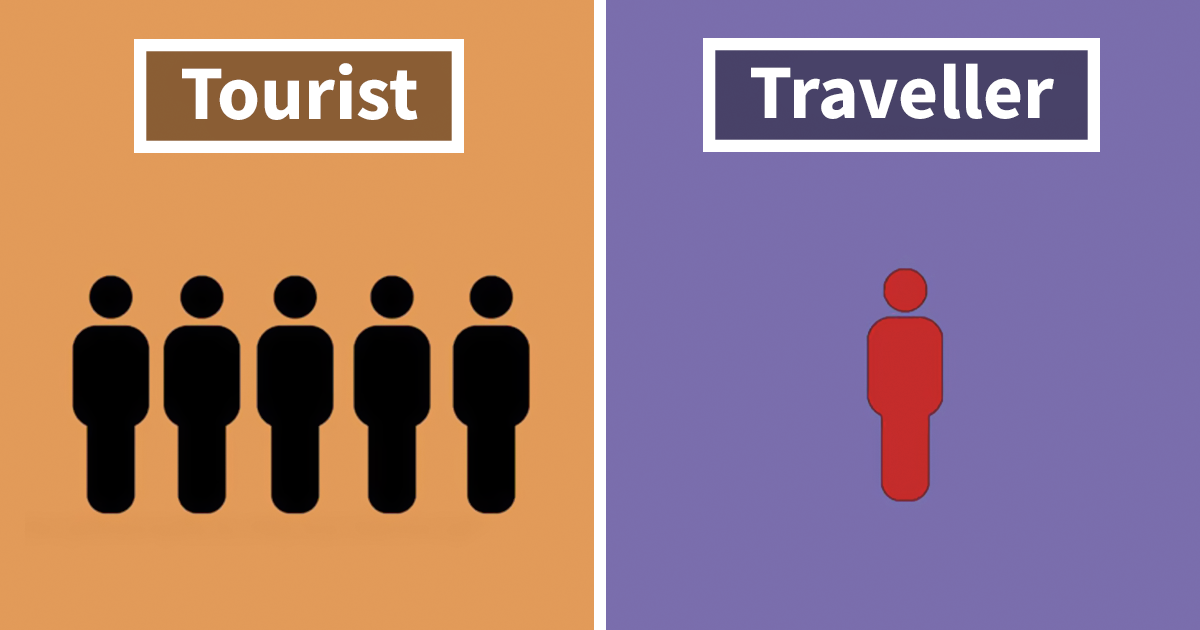
The concept is simple: twelve images compare how “tourists” and “travelers” experience the world. The tourist is often portrayed as comfort-loving, camera-ready, checklist-driven, and slightly allergic to uncertainty. The traveler, meanwhile, is drawn as curious, flexible, culturally engaged, and willing to trade perfect convenience for a memorable story. Of course, real life is messier. Plenty of tourists are thoughtful, and plenty of self-proclaimed travelers still secretly love hotel breakfast buffets. No judgment. Those tiny croissants are persuasive.
Still, the reason Holidify’s tourist vs traveler illustrations became shareable is that they use humor to ask a serious question: are we visiting places, or are we actually experiencing them?
Why the Tourist vs Traveler Debate Still Gets People Talking
The “tourist vs traveler” debate has been around for years because it pokes at travel identity. Nobody wants to be the person who lands in a destination, eats the same food they eat at home, takes fifteen identical photos, buys a magnet, and leaves with the deep cultural understanding of a luggage tag. Yet almost everyone has had at least one trip where convenience won the battle. Sometimes you are not searching for spiritual transformation; you are searching for a clean bathroom.
Holidify’s images work because they exaggerate both sides. Tourists are shown as people who prefer planned attractions, comfortable hotels, guided routes, and visible souvenirs. Travelers are framed as people who blend in, take local transport, explore hidden corners, and care more about stories than selfies. The joke is not that one group is good and the other is bad. The better reading is that travel has layers. Some people skim the surface. Others dig a little deeper.
What Holidify’s 12 Pics Are Really Saying
At first glance, the illustrations feel like light internet humor. But underneath the jokes, they highlight real travel behaviors that matter: cultural respect, environmental impact, local spending, flexibility, and curiosity. A tourist may ask, “What are the top ten things to see?” A traveler may ask, “What does daily life feel like here?” Both questions are valid, but the second one often leads to richer experiences.
1. Comfort Zone vs Curiosity Zone
One of the biggest themes is comfort. Tourists often stay close to what feels familiar: popular landmarks, international restaurants, hotel shuttles, and packaged activities. Travelers are portrayed as more willing to step into the unknown. That might mean trying a dish without fully understanding the menu, taking a slower train, learning basic local phrases, or walking down a side street where the best meal of the trip costs less than a bottle of airport water.
The lesson is not that comfort is wrong. Comfort can make travel safer, easier, and more accessible. The point is that the most unforgettable moments often begin where the itinerary gets a little wrinkled.
2. Checklist Travel vs Experience Travel
Tourists are often accused of collecting landmarks like achievements in a video game: Eiffel Tower unlocked, Colosseum unlocked, beach sunset unlocked, overpriced smoothie unlocked. Travelers, in contrast, tend to focus on atmosphere. They may visit fewer places but remember them more vividly.
This is where slow travel becomes important. Spending more time in fewer places can reduce stress and increase connection. It gives visitors time to notice morning routines, neighborhood rhythms, local markets, street sounds, and the tiny details that never make it onto a “must-see” list. A checklist gives you proof you went somewhere. An experience gives you a reason to remember it.
3. Souvenirs vs Stories
In the Holidify-style contrast, a tourist may come home with souvenirs; a traveler comes home with stories. Naturally, this is unfair to fridge magnets, which have been carrying the emotional weight of family vacations for decades. But the idea is useful. The best travel memories are rarely things. They are conversations, accidents, detours, meals, surprises, and moments of mild panic that later become hilarious.
Buying local crafts can be meaningful, especially when it supports artisans and small businesses. The key is intention. A mass-produced trinket bought in a rush is different from a handmade item purchased after learning who made it, how it is used, and why it matters.
Tourist Is Not an InsultAnd Traveler Is Not a Medal
One weakness of the tourist vs traveler debate is that it can become snobbish. Some people use the word “traveler” as if it comes with a cape and a soundtrack. Meanwhile, “tourist” gets treated like someone who claps when the plane lands. But tourism is not automatically shallow. Museums, guided tours, famous monuments, and organized trips exist for good reasons. They help people learn, navigate, and stay safe.
A first-time visitor to New York may want to see Times Square. A first-time visitor to Paris may want to see the Louvre. A first-time visitor to India may want to see the Taj Mahal. That does not make them less curious. Iconic places become iconic because they carry cultural, historical, architectural, or emotional power. The problem is not visiting famous places. The problem is visiting them without respect, context, or awareness.
Responsible Travel: The Real Upgrade
The smartest takeaway from Holidify’s images is not “be a traveler, not a tourist.” It is “be a better guest.” Responsible travel means thinking about how your choices affect the destination. That includes where your money goes, how you behave in public spaces, how you treat wildlife, how much waste you create, and whether your presence benefits or burdens the local community.
For example, choosing locally owned restaurants, shops, guesthouses, and guides can help tourism money stay in the community. Respecting local customs prevents visitors from turning someone else’s home into a theme park. Following outdoor ethics, such as staying on marked paths and packing out trash, helps protect natural places. Learning basic greetings shows humility. Nobody expects perfection, but effort travels well.
Travel Photography Without Becoming a Human Tripod
One classic tourist stereotype is the camera-first visitor. Holidify’s illustrations play with this idea: tourists document, travelers observe. In real life, photography can be wonderful. Photos preserve memories and help people share beauty. The issue is when the camera becomes a wall between the visitor and the place.
A good rule is to look first, photograph second. Ask permission before taking close-up photos of people. Avoid blocking paths, climbing restricted structures, or treating sacred spaces like personal photo studios. A picture should not cost a community its dignity or a historic site its safety. Also, nobody needs a twenty-minute sidewalk photoshoot while twelve people wait behind you. Even your best angle should have manners.
Local Food: The Fastest Way to Understand a Place
Food is one of the clearest differences between surface-level travel and deeper travel. Tourists may search for familiar meals; travelers often seek local flavors. But again, this is not about shame. If your stomach is staging a protest, eat the plain rice. Survival is also culture.
When possible, though, local food tells stories. A bowl of noodles, a regional spice mix, a family-run bakery, or a street snack can reveal history, migration, climate, agriculture, and community traditions. Eating locally also supports small vendors and makes travel more memorable. You may forget the hotel lobby, but you will remember the soup that made you briefly believe in destiny.
How to Travel More Like a Traveler Without Being Pretentious
You do not need to sell your suitcase, grow a philosophical beard, and wander into the mountains with one sock to become a better traveler. Small changes can make a big difference.
Plan, But Leave Space
A strong itinerary is helpful, especially for transportation, safety, and popular attractions. But leave unscheduled time. The empty parts of a trip often become the best parts. That is when you find a quiet café, a neighborhood market, a local festival, or a conversation that changes how you see the destination.
Learn Before You Land
Spend time understanding basic history, etiquette, dress norms, tipping customs, transportation rules, and local laws. This prevents awkward mistakes and helps you interpret what you see. A landmark becomes more meaningful when you know why it matters.
Use Local Transport When Practical
Public transportation can reveal the everyday life of a city. Buses, trains, ferries, and shared rides show how people move, commute, wait, talk, and navigate. It is not always the easiest option, but it often gives the most honest view of a place. It also usually costs less, which leaves more budget for important things, like snacks with names you cannot pronounce yet.
Respect the Place Even When No One Is Watching
Good travel behavior is not just for social media. Do not litter. Do not carve names into rocks, trees, or monuments. Do not take natural objects from protected areas. Do not feed wildlife. Keep noise reasonable. Follow posted signs. Dress appropriately in religious or traditional spaces. These are not boring rules; they are the basic price of being welcomed somewhere.
The Rise of Conscious Travel
Modern travelers are increasingly aware that travel has consequences. Overtourism, climate concerns, waste, housing pressure, wildlife exploitation, and cultural disrespect have all become major travel conversations. Destinations around the world are asking visitors to slow down, behave better, spend more thoughtfully, and understand that local communities are not background scenery.
This is where the Holidify series feels more relevant than ever. Its humor may be simple, but the bigger message fits today’s travel mood. People are still excited to explore, but more travelers want their trips to feel meaningful rather than extractive. They want to return home with memories, not just evidence.
Are You a Tourist or a Traveler?
The honest answer is probably both. You might be a tourist when you book a comfortable hotel, join a guided museum tour, or take a photo in front of a famous monument. You might be a traveler when you ask a local vendor about a dish, choose a family-run guesthouse, take a neighborhood walk with no agenda, or sit quietly in a public square and simply watch life happen.
Being both is not a failure. It is normal. Travel is not a personality contest. The goal is not to win the imaginary “most authentic human at the bus station” award. The goal is to move through the world with curiosity, humility, humor, and respect.
Why Holidify’s Illustrations Went Viral
Visual comparisons are easy to share because they simplify complicated ideas. Holidify’s tourist vs traveler images use familiar contrasts: comfort vs adventure, sightseeing vs immersion, souvenirs vs memories, hotels vs local stays, and guided routes vs spontaneous discovery. The illustrations are playful enough to make people laugh and pointed enough to make them argue in the comments, which is basically the internet’s favorite cardio.
The series also succeeds because everyone recognizes themselves in it. Even the most adventurous traveler has had a tourist moment. Even the most checklist-loving tourist has had a spontaneous experience that felt deeply personal. The images are not a final judgment. They are a mirror with a cartoon mustache drawn on it.
Experiences Related to the Tourist vs Traveler Mindset
The best way to understand the difference between tourists and travelers is to imagine two versions of the same trip. In the first version, someone arrives in a city with every hour planned. Breakfast at 8:00, museum at 9:30, landmark at 11:15, lunch at the restaurant with the most online reviews, shopping at 2:00, sunset photo at 5:45, collapse dramatically at 9:00. It is efficient. It is organized. It may even be fun. But it can feel like running errands in a beautiful place.
In the second version, the traveler still plans the essentials but leaves room for surprise. They know which neighborhood they want to explore, but not every doorway they will enter. They ask a café owner what seasonal dish to try. They notice an old cinema, a street mural, a tiny bookstore, a temple courtyard, or a public garden where grandparents are playing chess. They get slightly lost, but not dangerously lostthe charming kind of lost, not the “why is my phone at one percent?” kind.
One memorable travel experience often begins with choosing slowness. Imagine visiting a coastal town and skipping the crowded viewpoint for a morning walk through the fish market. At first, it may not look like a postcard. It smells like salt, diesel, seaweed, and breakfast being cooked somewhere nearby. Fishermen sort their catch. Vendors bargain. Cats behave like unpaid supervisors. A tourist might pass through quickly, searching for the famous beach. A traveler lingers long enough to understand that the market is not a side attraction; it is the town’s heartbeat.
Another example is taking local transportation. A taxi may be faster, but a train or bus can reveal the rhythm of a place. You see students going to class, workers carrying lunch, families heading to visit relatives, and street vendors stepping on and off with practiced balance. You learn that maps are useful, but people are better. Someone points you to the right stop. Someone laughs kindly when you mispronounce a station. Suddenly, the journey is not dead time between attractions. It is part of the trip.
Food creates the same shift. Eating only at familiar chains makes travel predictable, which is sometimes comforting but rarely unforgettable. Trying a local dish opens the door to conversation. You may learn that a recipe is served during festivals, that a spice came through old trade routes, or that a dessert is made differently from one family to another. Even when you do not love every flavor, you gain a story. And if you do love it, congratulations: you now have a lifelong craving that may be impossible to satisfy at home.
The traveler mindset also changes how you handle problems. A delayed train, rainy afternoon, closed museum, or wrong turn can ruin a rigid itinerary. But with curiosity, the same problem becomes a detour. Rain sends you into a tea shop. A closed museum leads to a neighborhood walk. A missed bus becomes a conversation with another traveler who recommends a better route. Flexibility is not just a personality trait; it is a travel skill.
Most importantly, traveling well means remembering that every destination is someone’s home. The streets, beaches, temples, markets, parks, and cafés are not props. They belong to people with routines, responsibilities, memories, and rules. When visitors understand that, they behave differently. They lower their voices. They ask before photographing. They support local businesses. They stop treating “authenticity” as something to consume and start treating it as something to respect.
That is the lasting value of Holidify’s tourist vs traveler series. It makes us laugh at the stereotypes, then gently pushes us to travel with more awareness. Whether you carry a backpack or a rolling suitcase, whether you love hostels or hotels, whether you collect magnets or handwritten memories, the real question is simple: did you leave the place better, or at least unharmed, because you were there?
Conclusion
Holidify’s “Differences Between Tourists and Travelers” illustrations may look like a fun set of travel memes, but their message goes deeper than backpacks and selfie sticks. They remind us that travel is not only about where we go; it is about how we show up. Tourists and travelers are not enemies. They are two sides of the same suitcase. One seeks comfort and highlights; the other seeks connection and discovery. The best modern explorer borrows from both.
Plan well, stay curious, respect local life, support communities, protect nature, and leave room for the unexpected. Do that, and it does not matter whether someone calls you a tourist or a traveler. You will be the kind of guest the world needs more ofand possibly the kind who finally learns how to pack without bringing seven “just in case” outfits.
Note: This original article is written for web publication and synthesizes real travel-industry ideas about responsible tourism, cultural respect, sustainable travel, visitor behavior, and Holidify’s widely shared tourist vs traveler illustration concept.