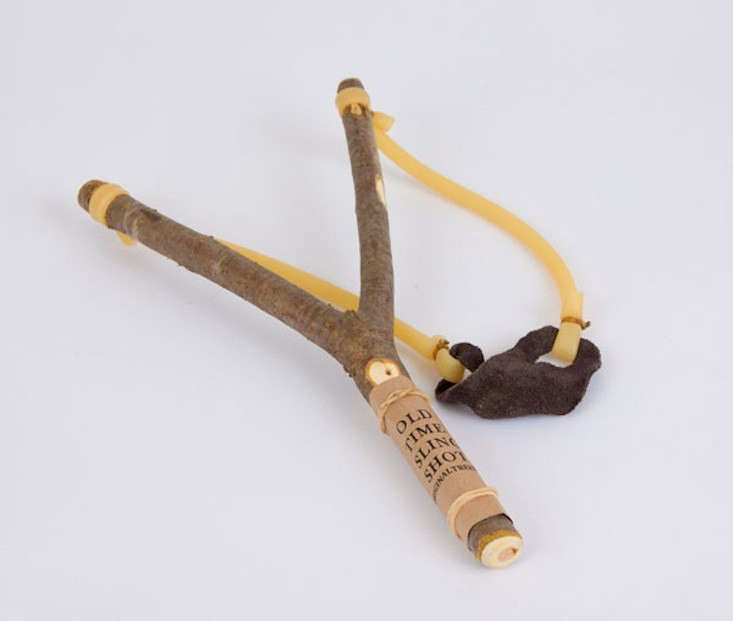
An old fashioned slingshot is one of those objects that appears almost too simple to have a history. A forked wooden frame, flexible bands, and a small pouch seem less like an invention than something a mischievous cartoon character would casually pull from a back pocket.
Yet the traditional slingshot tells a surprisingly rich story. It connects nineteenth-century rubber technology, American toy manufacturing, rural craftsmanship, popular culture, and changing ideas about childhood independence. It also carries a serious safety lesson: a device may look nostalgic without being harmless.
Today, vintage slingshots are remembered as childhood artifacts, collected as pieces of folk craftsmanship, photographed as rustic decorations, and studied as examples of minimalist design. Their appeal comes from a combination of honest materials, recognizable form, and the unmistakable feeling that somebody once made something useful from whatever happened to be nearby.
“`
What Is an Old Fashioned Slingshot?
The classic old fashioned slingshot has a Y-shaped frame, flexible elastic bands, and a small center pouch. Early examples were commonly associated with naturally forked branches, leather scraps, and rubber repurposed from household or automotive materials.
That familiar silhouette is important. A traditional slingshot does not require a label for most people to recognize it. Its two upward forks and central handle create an outline that has appeared in comics, movies, advertisements, and toy boxes for generations.
A Slingshot Is Not the Same as an Ancient Sling
The words are similar, but the objects belong to different technological eras. An ancient sling consists primarily of cords and a pouch. It relies on a swinging motion and has existed for thousands of years.
A slingshot stores energy in elastic material attached to a rigid frame. That means the recognizable wooden slingshot could not have appeared in its modern form until durable rubber became widely available. Calling an ancient sling a slingshot is therefore a little like calling a horse-drawn wagon an automobile because both have wheels. The family resemblance is real, but the engineering is different.
The Rubber-Age Origins of the Traditional Slingshot
The history of the modern slingshot begins with rubber. Natural latex had been used in the Americas long before industrial manufacturing, but untreated rubber presented major problems. It could become sticky in warm conditions and brittle in cold weather, which is not exactly the dependable personality one wants from an elastic material.
In 1839, Charles Goodyear discovered a process that treated rubber with sulfur and heat. Known as vulcanization, the process made rubber more stable across changing temperatures and opened the door to an enormous range of manufactured products.
The word “slingshot” appeared in American English by the middle of the nineteenth century. That timing makes sense: reliable elastic rubber was becoming available, and people quickly found inventive uses for it. Humanity rarely encounters a stretchy new material without immediately asking, “What happens if I pull this back?”
From Improvised Object to Recognized Design
Many early slingshots were homemade rather than factory-produced. Their frames reflected the irregular shape of the original branch, so no two looked exactly alike. Rubber strips and leather pieces could be replaced as they wore out, giving the object a practical, repairable character.
Commercial versions eventually appeared, introducing standardized frames and branded packaging. During the twentieth century, manufacturers replaced rough branch handles with shaped wood, molded plastic, and metal. Even so, the forked wooden slingshot remained the version most strongly associated with nostalgia.
How Wham-O Helped Bring Slingshots Into Toy Culture
American toy history gave the slingshot an unexpected business connection. Wham-O, the company later famous for products such as the Frisbee and Hula Hoop, was founded in 1948 by Richard Knerr and Arthur “Spud” Melin.
The company’s name reportedly came from the sound associated with one of its earliest products: a slingshot. Before Wham-O became a symbol of colorful postwar recreation, its roots were connected to a much simpler wooden-and-rubber design.
This transition reflects a larger shift in American childhood. Homemade playthings increasingly shared shelf space with professionally marketed toys. Packaging, advertising, plastics, and national retail distribution transformed play into a major consumer industry.
The old fashioned slingshot sat awkwardly between these worlds. It could be a folk-made object, a commercial toy, a sporting device, or a movie prop suggesting that the neighborhood troublemaker had just arrived. Few objects have managed to look so innocent and so suspicious at the same time.
Why the Wooden Slingshot Became an American Icon
The wooden slingshot became culturally powerful because it represented independence. It belonged to an era when childhood stories frequently involved vacant lots, creeks, tree houses, bicycles, pocketknives, and long afternoons conducted beyond the immediate range of adult commentary.
That does not mean every child owned one or that the past was as carefree as nostalgic storytelling suggests. Instead, the slingshot became a symbol of a particular idea of childhood: resourceful, unsupervised, curious, and occasionally one broken window away from a serious conversation.
The Comic-Book Shortcut for Mischief
In popular culture, artists could place a slingshot in a character’s pocket and communicate an entire personality. The character was inventive, rebellious, energetic, and probably not planning to spend the afternoon alphabetizing the family bookshelf.
This visual shorthand helped the object outlive its everyday popularity. Even people who have never handled a vintage slingshot recognize what it represents. It belongs to the same cultural toolbox as a patched pair of overalls, a tree-house sign, and a suspiciously innocent child standing beside a freshly cracked flowerpot.
The Design Appeal of an Old Fashioned Slingshot
Traditional slingshots remain visually appealing because their form is easy to understand. The frame follows the natural geometry of a forked branch. The handle fits the human hand, while the two arms create balance and symmetry.
Unlike highly decorated objects, a vintage slingshot often reveals exactly what it is made from. The wood shows knots, grain, tool marks, and age. Leather develops creases and a darker patina. Old rubber may fade or crack. These changes turn a mass of ordinary materials into a record of time.
Imperfection Is Part of the Character
Modern manufacturing generally aims for identical products. Folk craftsmanship does the opposite, even when that is not the intention. A naturally forked frame may lean slightly to one side. The handle may preserve a curve from the original branch. Tool marks may remain visible.
Collectors often value those irregularities because they suggest human involvement. The object looks made rather than generated by an anonymous machine. Its imperfections are not necessarily flaws; they are part of the evidence.
Minimalism Before Minimalism Became Fashionable
The old fashioned slingshot also appeals to modern designers because it uses relatively few components. Its visual logic is immediate. Nothing appears decorative unless the maker deliberately carved, painted, or polished the frame.
In that sense, the traditional slingshot resembles other enduring hand tools. Its beauty comes from the relationship between material and purpose rather than from added ornament. It is rustic minimalism without the expensive coffee-table book explaining that it is rustic minimalism.
Old Slingshots as Collectibles and Display Pieces
Vintage slingshots may be preserved as examples of childhood history, folk art, toy manufacturing, or regional craftsmanship. Factory markings, packaging, photographs, and family stories can make an otherwise ordinary object historically meaningful.
A plain wooden frame with no known background may still be attractive, but documentation adds context. Knowing who owned an object, approximately when it was made, and whether it was homemade or commercially produced helps separate a genuine artifact from a recently created rustic decoration.
What Age Does to the Materials
Wood, leather, and rubber age differently. Wood may dry, split, or darken. Leather can stiffen and lose natural oils. Rubber is especially vulnerable to oxygen, heat, light, and ozone. Old elastic material may look intact while having lost much of its strength.
For that reason, an antique slingshot is better understood as a display object than as functioning recreational equipment. Attempting to test aged bands can damage the artifact and create an unnecessary injury risk. Preservation is far more sensible than trying to discover whether Grandpa’s attic technology still has “one good launch left in it.”
Collectors generally benefit from stable indoor storage, moderate temperatures, limited direct sunlight, and careful handling. Keeping the original components together preserves historical integrity, even when those components are no longer usable.
Safety: Nostalgic Does Not Mean Harmless
An old fashioned slingshot may be remembered as a toy, but it is still a projectile device. It can damage property and cause serious injuries, particularly to the eyes and face. Rubber components may also fail unexpectedly, sending loose parts back toward the person holding the frame.
U.S. Consumer Product Safety Commission records have included slingshot recalls connected to severe facial and eye injuries. Modern safety standards for projectile toys consider factors such as impact force, accessible projectiles, small parts, and the possibility of using unintended objects.
Historical examples were created before many modern consumer-safety expectations existed. Their age makes them less predictable, not more charmingly dependable. Antique and decorative slingshots should therefore be stored securely, kept unloaded, and treated as display artifacts rather than casual playthings.
Local rules may also classify certain slingshot designs differently. Laws and regulations vary by jurisdiction, so assumptions based on childhood memories, movies, or a grandparent’s garage should not replace current local guidance.
Why Interest in Vintage Slingshots Has Returned
Interest in old-fashioned objects tends to rise whenever daily life becomes more digital. A wooden slingshot offers the opposite of an app: visible materials, no battery, no password, no software update, and absolutely no attempt to collect location data.
The traditional design now appears in rustic photography, historical displays, cabin-themed decorations, illustrations, and collections of vintage toys. Woodworkers and folk artists may also reinterpret the form as decorative craftsmanship, emphasizing carving and finish rather than function.
Nostalgia plays a major role. People are often drawn not to the object itself but to the world they associate with it: summer afternoons, grandparents’ workshops, handwritten labels, old hardware stores, and stories in which entertainment did not begin with selecting a subscription plan.
A Symbol of Repairable, Understandable Objects
The old fashioned slingshot also represents a category of object that ordinary people could understand by looking at it. Its parts were visible, its materials were familiar, and damaged components could historically be replaced rather than sending the entire product into an electronics-recycling mystery box.
That simplicity feels refreshing today. However, appreciating the design does not require ignoring its risks. The most responsible modern revival treats the traditional slingshot as an artifact of technology and culture, not as an invitation to repeat every questionable decision made during a 1950s summer vacation.
Frequently Asked Questions About Old Fashioned Slingshots
How old is the modern slingshot?
The recognizable elastic-powered slingshot emerged during the nineteenth century after vulcanized rubber became available. The term “slingshot” was recorded in American English by 1849.
Is a traditional slingshot an ancient invention?
No. Ancient slings are much older, but they use cords and a pouch rather than elastic bands attached to a rigid forked frame. The modern slingshot depends on rubber-age technology.
Why were early slingshots often made from wood?
Naturally forked branches offered a recognizable frame shape with minimal processing. Wood was widely available, easy to shape, and comfortable to hold, making it a common material for early homemade examples.
Are antique slingshots safe to use?
They should be treated as historical display objects. Old rubber, leather, wood, and attachment points may have weakened with age, while projectile devices can cause serious injuries even when they appear simple.
Why do people collect vintage slingshots?
Collectors may appreciate their folk craftsmanship, connection to toy history, natural wood forms, branded manufacturing history, cultural symbolism, or family provenance.
Experiences and Memories Connected to the Old Fashioned Slingshot
The most memorable encounter with an old fashioned slingshot often happens somewhere unexpected. It may be discovered in a workshop drawer beneath bent nails, chalk stubs, and a screwdriver that has apparently been waiting since 1963 for the correct screw. The wooden frame feels lighter than expected, and its polished handle reveals years of handling more clearly than any written label.
Such a discovery usually begins a story. A parent or grandparent remembers a neighborhood where children built forts from discarded boards and considered an empty cardboard box a complete entertainment system. The slingshot becomes less important as an object than as a key that unlocks details: the name of a childhood friend, the location of an old orchard, or the afternoon someone learned that windows were significantly less forgiving than they looked.
Another common experience occurs in a museum or historical collection. Behind glass, the slingshot looks almost comically modest beside complicated mechanical toys. It has no gears, painted characters, electronic sounds, or instruction booklet. Yet visitors frequently pause because they understand it immediately. Older visitors may recognize part of their childhood, while younger visitors see a strange ancestor of modern recreational equipment.
Examining the frame closely can become a lesson in materials. The curve of the handle may have been determined by the tree rather than the maker. Small knife or tool marks reveal where bark was removed. Darkened leather records exposure to oils and air. Brittle rubber shows that flexible materials are temporary, even when the wooden frame survives for decades.
For families, preserving such an object can create an opportunity to document ordinary history. Grand events usually receive photographs and official records, but everyday objects rarely do. Writing down the owner’s name, approximate date, and remembered story can transform an anonymous wooden fork into a meaningful family artifact.
Artists and photographers experience the traditional slingshot differently. Its Y-shaped outline creates instant visual balance, while aged wood works naturally with rustic backgrounds. The object suggests childhood adventure without requiring an elaborate scene. Place it beside an old lunchbox, a stack of comic books, or a faded baseball glove, and an entire fictional summer seems to appear around it.
Design enthusiasts may be most impressed by its economy. The form contains no hidden system. Every major element is visible, making it an unusually direct example of how people adapt natural shapes and manufactured materials. It demonstrates that memorable design does not always require complexity. Sometimes it begins with a branch that happened to grow in two directions.
The emotional experience is often a mixture of admiration and caution. The old fashioned slingshot represents creativity, independence, and hands-on problem-solving, but it also reminds us that earlier generations accepted risks differently. Remembering the past responsibly means keeping the craftsmanship and stories without pretending every old habit deserves a cheerful comeback.
Ultimately, the traditional slingshot survives because it holds more than one meaning. It is a rubber-age invention, a folk-made object, a toy-industry ancestor, a warning about projectile safety, and a powerful symbol of analog childhood. Its design may be simple, but its cultural baggage could fill a very large tree house.
Conclusion
The old fashioned slingshot occupies a curious place in American material culture. It emerged from nineteenth-century advances in rubber, became associated with homemade childhood entertainment, entered the commercial toy industry, and eventually evolved into a recognizable symbol of mischief and independence.
Its lasting appeal comes from its straightforward design and natural materials. A vintage wooden slingshot can preserve tool marks, family memories, manufacturing history, and the visible effects of age. At the same time, responsible appreciation requires recognizing that it is a projectile device rather than an innocent decorative toy.
Preserved as a historical artifact, the traditional slingshot offers a compact lesson in chemistry, craftsmanship, design, commerce, and childhood culture. Few objects say so much with only a forked frameand fewer still can make an adult remember a broken window before remembering what happened to the window.
Note: This article presents the old fashioned slingshot in historical, cultural, and collectible contexts. It does not provide instructions for constructing or operating a projectile device.