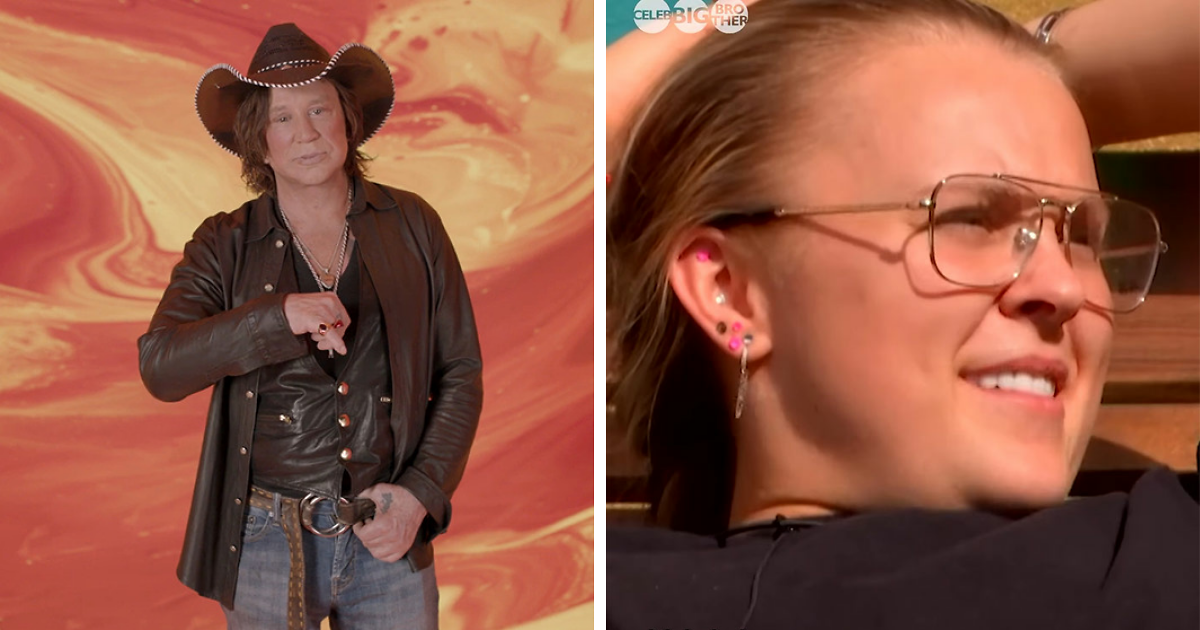
Reality TV loves drama, but viewers say Mickey Rourke’s comments toward JoJo Siwa crossed the line from messy television into something far uglier.
The Celebrity Big Brother Moment That Sparked Backlash
Mickey Rourke’s short run on Celebrity Big Brother UK became one of the most talked-about reality TV controversies of 2025 after he made comments about JoJo Siwa’s sexuality that viewers, housemates, and Siwa herself described as homophobic. The exchange quickly moved from a typical reality-show awkward moment to a full-blown public backlash, with fans calling out the actor’s language and questioning why such remarks were allowed to unfold on television.
The controversy began during a conversation in the Big Brother house when Rourke asked Siwa whether she was interested in boys or girls. Siwa, who was 21 during filming, replied that she liked girls and mentioned that her partner at the time was non-binary. Rourke then made a remark suggesting that if he stayed in the house long enough, Siwa would no longer be gay. Siwa pushed back immediately, saying she could guarantee that she would still be gay and still be in a happy relationship.
That might have been enough to make viewers wince, pause, and mutter, “Yikes,” at the screen. But the situation escalated. Rourke later said he intended to vote “the lesbian” out of the house, prompting Siwa to call the reasoning homophobic. He also used a slur that he claimed was meant as British slang for a cigarette, while gesturing in Siwa’s direction. The explanation did not exactly land like a graceful Olympic dismount.
Why Viewers Called Mickey Rourke’s Comments Homophobic
The problem was not simply that Rourke asked about Siwa’s sexuality. In the right context, questions about identity can be respectful, curious, and human. The issue was the tone, the follow-up comments, and the suggestion that someone’s sexuality could be changed by another person. That idea is not edgy banter. It is an old, harmful trope that LGBTQ people have been forced to hear for generations.
For many viewers, Rourke’s remark implied that Siwa’s attraction to women was temporary, negotiable, or something a man could “fix.” That kind of language carries baggage heavier than a Big Brother suitcase stuffed for a six-week stay. It echoes the false belief that queer identity is a phase or a challenge to be overcome, instead of a real part of a person’s life.
Siwa’s response was direct and calm. She did not need a lecture, a debate, or a panel discussion with dramatic lighting. She simply corrected him and stood her ground. That composure became one reason fans praised her after the episode aired. In a tense environment where cameras capture every blink, sigh, and snack choice, Siwa managed to defend herself without turning the moment into the kind of chaos reality TV often rewards.
Celebrity Big Brother Issued A Formal Warning
After the incident, Big Brother called Rourke into the Diary Room and issued a formal warning. Producers told him his language was offensive and unacceptable, and warned that further behavior of that nature could lead to his removal from the house. Rourke apologized on camera, saying he did not have dishonorable intentions and claiming he had been “talking smack.” He later apologized to Siwa directly, saying he had a short fuse and did not mean harm.
Siwa accepted the apology, but the public conversation did not stop there. Viewers debated whether an apology was enough, whether producers acted quickly enough, and whether reality TV has become too comfortable treating real discomfort as entertainment. In other words, the house got a formal warning, but the internet issued a group project.
The controversy also reignited questions about how reality shows handle offensive comments in real time. Celebrity Big Brother is built on constant surveillance, emotional pressure, and unpredictable personalities. That formula can produce unforgettable TV, but it also creates responsibility. When a contestant targets another person’s identity, producers cannot simply shrug and call it “content.”
Rourke Later Left The Celebrity Big Brother House
Rourke’s time in the house ended shortly afterward. He agreed to leave Celebrity Big Brother UK following what producers described as further inappropriate language and unacceptable behavior. Reports connected his exit to later incidents involving other housemates, including language described as threatening and aggressive. No physical altercation was reported, but the pattern of conduct was enough for producers to step in.
His departure changed the tone of the season. What began as a celebrity casting curiosity had become a case study in how quickly an old-school “bad boy” persona can sour when it meets modern audience expectations. Rourke has long been known for an unpredictable public image, but the Celebrity Big Brother backlash showed that viewers are far less willing to excuse offensive language as eccentricity, age, or Hollywood swagger.
Reality TV has always loved the phrase “he tells it like it is.” But audiences are increasingly asking a better question: tells what, exactly, and at whose expense?
JoJo Siwa’s Role In The Conversation
JoJo Siwa entered the public eye as a child performer on Dance Moms, then built a massive entertainment brand around bows, music, YouTube, and kid-friendly sparkle. Over the years, she has grown from a brightly dressed teen star into a young adult navigating fame, identity, music, relationships, and the internet’s favorite hobby: having opinions about strangers.
Siwa came out as part of the LGBTQ community in 2021 and has spoken publicly about identity in a way that many young fans found meaningful. During and after Celebrity Big Brother, she discussed her evolving understanding of sexuality, including identifying more with the word “queer” than with a fixed label. That evolution became another major storyline, especially after her close connection with fellow housemate Chris Hughes drew public attention.
But the Rourke controversy was not really about whether Siwa used one label or another. It was about respect. A person’s identity does not become open season because it is discussed on television. Being famous does not mean being available for every clumsy joke, invasive question, or “back in my day” monologue delivered with the subtlety of a dropped frying pan.
Why The “Gay” Comments Hit So Hard
Some viewers who defended Rourke argued that he was joking or that the comments were simply part of rough reality-show banter. But that defense misses the bigger point. Humor depends on context, power, and impact. A joke that reinforces a harmful stereotype is not automatically harmless because the person making it chuckles afterward.
The suggestion that a queer woman can be changed by a man is especially loaded. It is tied to a long history of dismissing lesbian, bisexual, pansexual, and queer women as confused, immature, attention-seeking, or merely waiting for the “right man.” Those ideas do not stay safely tucked inside bad jokes. They shape how people treat LGBTQ individuals in schools, workplaces, families, and relationships.
That is why the backlash was so immediate. Fans were not reacting to a single awkward sentence in isolation. They were reacting to a familiar pattern: a queer person being put on the spot, having their identity challenged, and then being expected to absorb the discomfort gracefully so everyone else can move on.
Reality TV, Accountability, And The Camera That Never Blinks
Celebrity Big Brother thrives on confinement. Put celebrities in a house, remove their usual PR buffers, add cameras, stir occasionally, and wait. The format can be hilarious, revealing, and occasionally profound. It can also expose prejudice, entitlement, and behavior that might normally be edited out of public life.
That is why accountability matters. A formal warning is not just a production rule; it is a message to the house and the audience. It says that entertainment has limits. It says that identity-based mockery is not just “drama.” It says that the person targeted deserves protection, not just a reaction shot.
Producers face a delicate balance. If they over-edit, audiences accuse them of hiding reality. If they underreact, audiences accuse them of exploiting harm. The best approach is transparency plus swift action: show enough for viewers to understand what happened, intervene clearly, and avoid turning someone’s pain into a ratings piñata.
The Public Reaction: Swift, Loud, And Very Online
Once clips and summaries of the exchange spread, social media users slammed Rourke’s comments and praised Siwa for standing up for herself. LGBTQ viewers in particular noted how familiar the moment felt. Many people shared versions of the same reaction: this is exactly what queer people deal with, only usually without a camera crew, a Diary Room, and a national audience watching the fallout.
The backlash also showed how celebrity culture has changed. In previous eras, a famous older actor might have been shielded by reputation, nostalgia, or the shrugging excuse of “that’s just how he is.” Today, audiences are more likely to ask why that should be anyone else’s problem. A long career does not come with a lifetime coupon for bad behavior.
That shift matters. Public criticism is not always perfect, and the internet can turn into a courtroom where everyone is both judge and person yelling from the parking lot. Still, in this case, the central message was clear: comments that demean or challenge someone’s sexuality are not harmless entertainment.
What The Controversy Says About LGBTQ Representation
JoJo Siwa’s presence on Celebrity Big Brother mattered because LGBTQ visibility on mainstream reality television still matters. Viewers see not only who gets cast, but how those people are treated when conflict happens. Representation is not just smiling in promotional photos. It is also whether a queer contestant is defended when another contestant crosses a line.
Siwa’s response gave audiences a specific example of self-advocacy. She did not disappear into embarrassment. She named the behavior. She accepted an apology without pretending the moment had been fine. And later, she spoke about how deeply the situation affected her, while still refusing to let it define her entire experience in the house.
That distinction is important. LGBTQ people are often expected to become symbols the second something bad happens. Siwa was allowed to be hurt, funny, forgiving, annoyed, resilient, and human all at once. That is the kind of representation television needs more of: not perfect victims or perfect heroes, just real people with boundaries.
Experience-Based Reflections: What This Moment Feels Like Beyond TV
For many people, the Mickey Rourke and JoJo Siwa controversy felt personal because it resembled uncomfortable moments that happen far away from television cameras. Someone makes a “joke” at a dinner table. A coworker asks an invasive question. A relative insists a person’s identity is just a phase. A stranger assumes they are being funny when they are actually being cruel. The setting changes, but the emotional math stays the same.
One common experience for LGBTQ people is the pressure to react perfectly in the moment. If they get angry, they may be called dramatic. If they laugh it off, people assume the comment was acceptable. If they calmly explain the problem, they may be accused of being too sensitive. It is a no-win game, and the rulebook appears to have been written by someone who has never apologized without adding “but.”
Siwa’s reaction showed how difficult that moment can be. She responded firmly, but she also had to keep living in the same house as the person who made the remarks. That is a key detail. In everyday life, people often cannot simply walk away from harmful comments. They may share a workplace, classroom, family group chat, or social circle with the person who crossed the line. The emotional labor does not end when the words are spoken. It continues in every awkward silence afterward.
Another experience connected to this topic is the strange burden of educating others while hurt. Many LGBTQ people have been asked to explain why a comment is offensive at the very moment they are processing the sting of it. That is like being handed a fire extinguisher while someone else is still tossing matches. Education can be valuable, but it should not always fall on the person targeted. Friends, coworkers, producers, and bystanders can step in too.
Chris Hughes standing up for Siwa mattered for that reason. Allyship is most useful when it happens in the room, not three days later in a carefully worded Instagram caption. A simple “that is not okay” can shift the pressure away from the person being targeted. It tells everyone present that respect is not optional and that silence will not be used as background music.
There is also a lesson here for anyone who has said the wrong thing and wants to do better. A real apology should be clear, specific, and free of escape hatches. “I am sorry I said that” is stronger than “I am sorry if you were offended.” The first takes responsibility. The second tries to toss the problem back into the other person’s lap like a very unwanted party favor.
Finally, this controversy reminds us that growth is possible, but consequences still matter. People can learn. People can change. People can become more thoughtful after being called out. But learning does not erase impact. Rourke’s apology may have been accepted by Siwa in the house, yet viewers were still allowed to criticize the behavior and discuss what it represented. Forgiveness and accountability are not enemies. They can sit at the same table, although preferably not in the Big Brother smoking area.
In the end, the most useful takeaway is simple: respect people’s identities, do not treat sexuality as a punchline, and remember that “just joking” is not a magic spell that turns harmful words into harmless ones. Reality TV may be designed for conflict, but basic dignity should not be the plot twist.
Conclusion
The backlash against Mickey Rourke’s comments toward JoJo Siwa on Celebrity Big Brother was not just another celebrity scandal passing through the internet’s revolving door. It became a larger conversation about homophobia, reality TV responsibility, LGBTQ representation, and the difference between provocative television and genuinely harmful behavior.
Siwa’s calm response, the support she received from fellow housemates, and the formal warning from producers all helped frame the incident as more than a viral clip. It was a reminder that words matter, especially when aimed at someone’s identity. Reality TV can be chaotic, funny, and dramatic without turning queer people into targets. The cameras may catch everything, but audiences are increasingly clear about what they are willing to excuse.
As celebrity culture continues to evolve, the old defense of “that is just how they are” is wearing thin. Viewers expect better from stars, producers, and networks. And honestly, that should not be controversial. Respect is not a luxury add-on. It is the basic subscription plan.