Note: This article is written in clean, body-only HTML for easy publishing. It is based on verified historical, architectural, and restoration information from reputable cultural, encyclopedic, and official heritage resources.
Notre-Dame Cathedral is one of those rare buildings that can make even the most confident traveler stop mid-sentence and stare upward like a tourist in a movie montage. Sitting on the Île de la Cité in the heart of Paris, Notre-Dame de Paris is more than a famous church. It is a Gothic masterpiece, a national symbol, a survivor of revolutions and fire, and a place where architecture, faith, literature, music, and human stubbornness all meet under one very dramatic roof.
For more than 860 years, Notre-Dame Cathedral has watched Paris grow around it. Kings, emperors, pilgrims, poets, revolutionaries, firefighters, stonemasons, and millions of visitors have passed through its story. The cathedral has been damaged, restored, reimagined, mourned, and celebrated. After the devastating fire of April 15, 2019, Notre-Dame reopened to the public in December 2024, proving once again that this Paris landmark has a remarkable talent for comebacks.
Here are 13 facts about Notre-Dame Cathedral that explain why this building still captures the world’s imaginationand why its gargoyles probably have better job security than most of us.
1. Notre-Dame Cathedral Stands on One of the Oldest Parts of Paris
Notre-Dame Cathedral is located on the Île de la Cité, a small island in the Seine River that has been central to the history of Paris since ancient times. Before the cathedral rose there, the site had already seen layers of religious and civic life. Historians connect the area with earlier churches and even remnants of the Gallo-Roman city of Lutetia.
This gives Notre-Dame a powerful sense of place. It is not simply a beautiful monument dropped onto a postcard-perfect island. It stands on a location where Paris has been reinventing itself for nearly two thousand years. That makes the cathedral feel less like a single building and more like a stone bookmark in the long, complicated novel of the city.
2. Construction Began in the 12th Century
The story of Notre-Dame Cathedral began around 1163, during the time of Bishop Maurice de Sully. His vision was ambitious: replace older religious buildings with a grand cathedral worthy of a growing medieval capital. In an age before cranes, power tools, and coffee-fueled project management software, this was not exactly a weekend DIY project.
Construction continued for generations. The main structure was largely completed by the 13th century, but like many great medieval buildings, Notre-Dame kept changing over time. Chapels, portals, windows, sculptures, and later restorations added new layers. The result is a building shaped by centuries of craftsmanship rather than one neat architectural deadline.
3. Notre-Dame Is a Masterpiece of French Gothic Architecture
Notre-Dame Cathedral is one of the finest examples of French Gothic architecture. Its ribbed vaults, pointed arches, flying buttresses, sculpted portals, and vast stained glass windows all reflect the medieval desire to build upwardtoward heaven, toward light, and perhaps toward giving future architecture students a lot to memorize.
The Gothic style was not merely decorative. It was engineering with spiritual ambition. Ribbed vaults helped distribute weight, pointed arches allowed for height and flexibility, and flying buttresses supported the walls from outside, making room for larger windows. That combination created a brighter, taller, more open interior than earlier Romanesque churches.
4. The Flying Buttresses Were Both Practical and Beautiful
Notre-Dame’s flying buttresses are among its most recognizable architectural features. These stone supports extend from the upper walls to outer piers, helping transfer the pressure of the vaulted roof outward and downward. In simple terms, they kept the walls from doing what tired people do after lunch: slumping.
Although flying buttresses were structural necessities, they also became part of the cathedral’s visual identity. They give Notre-Dame its skeletal elegance, almost like the building is wearing its engineering on the outside. This is one reason Gothic architecture feels so honest and dramatic at the same time.
5. The Rose Windows Are Medieval Showstoppers
Notre-Dame’s stained glass windows are among the treasures of Gothic art. The cathedral’s famous rose windows, especially the north and south roses, transform colored glass into storytelling, theology, and light. They were designed not only to decorate the building but also to create a sense of sacred atmosphere.
In the Middle Ages, stained glass served as a visual teaching tool. Many worshippers could not read, so biblical stories and religious symbols were communicated through images, color, and pattern. Today, even visitors who know nothing about medieval theology can still understand the basic message: “Please pause and look up. This took a while.”
6. The Western Facade Is a Lesson in Symbolism
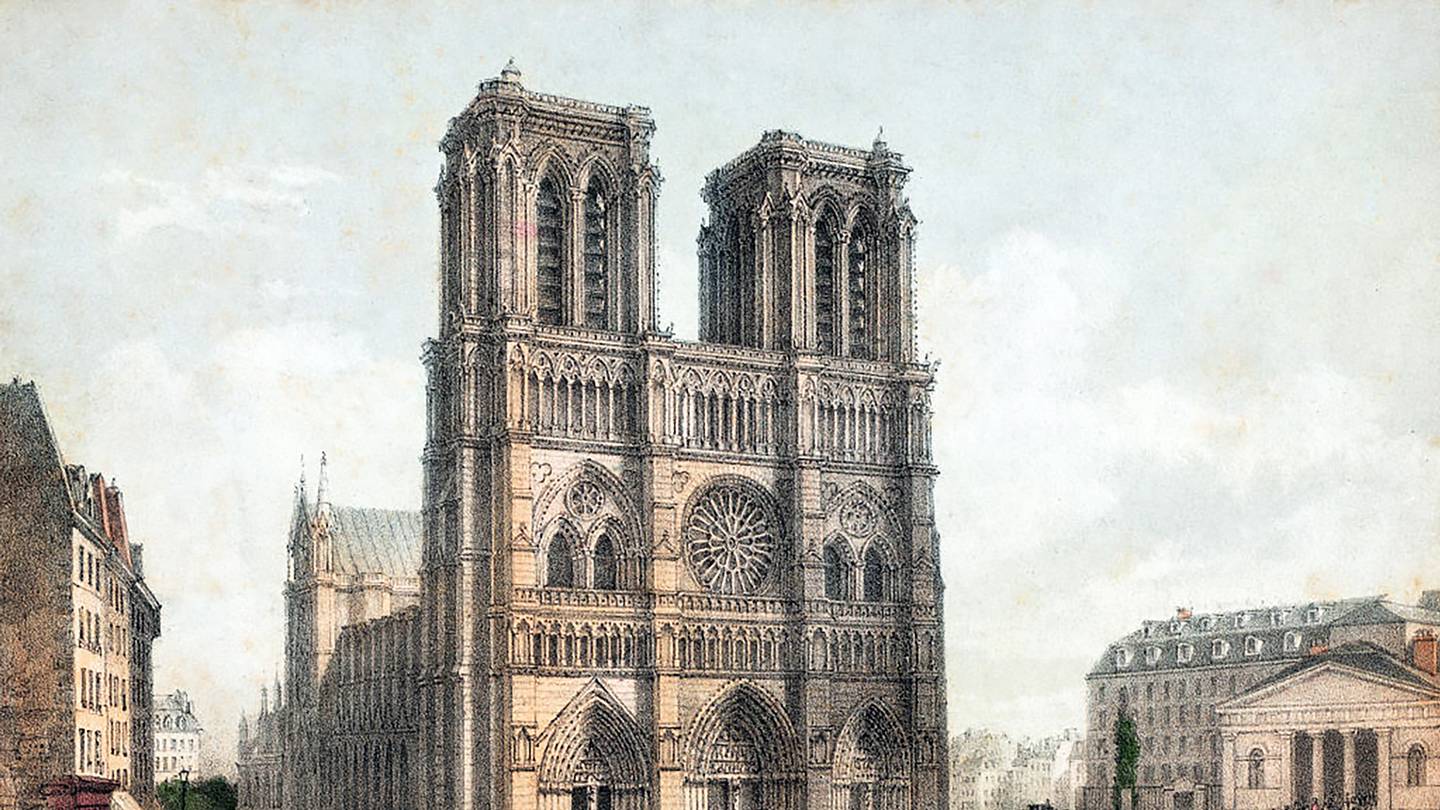
The west facade of Notre-Dame Cathedral is one of the most studied and photographed faces in architecture. Its three portals are filled with sculpted biblical figures, including scenes of the Last Judgment, the Virgin Mary, and Saint Anne. These portals helped teach Christian stories through stone at a time when images were a powerful public language.
Above the portals is the Gallery of Kings, a row of 28 statues representing the kings of Judea. During the French Revolution, these statues were mistakenly associated with French kings and were damaged or destroyed. The versions visible today are 19th-century replacements, while many original heads were rediscovered in the 20th century and preserved in a museum.
7. The Cathedral’s Bells Have Names and Personalities
Notre-Dame Cathedral is famous for its bells, and yes, they have names. The great bourdon bell Emmanuel, located in the south tower, is one of the most celebrated bells in Europe. Cast in the 17th century, Emmanuel weighs about 13 tons and rings for major religious feasts and historic occasions.
The cathedral’s bells are not just musical instruments. They mark time, announce worship, and participate in the public life of Paris. In 2013, new bells were installed to restore a more harmonious sound to the cathedral’s chime. If buildings could sing, Notre-Dame would have a deep, bronze voice and excellent acoustics.
8. Notre-Dame’s Roof Was Nicknamed “The Forest”
Before the 2019 fire, Notre-Dame’s medieval wooden roof structure was known as “the forest.” The nickname came from the enormous number of oak beams used in its construction, with many beams traditionally said to have come from individual trees. The roof structure dated largely from the 13th century and was one of the oldest of its kind in Paris.
This roof was hidden from most visitors, but it was a marvel of medieval carpentry. Its steep pitch, vast scale, and carefully joined timbers showed the sophistication of builders working without modern machinery. When the fire destroyed the roof, the loss was not only architectural but also deeply historical.
9. The Spire Was a 19th-Century Addition
Many people assume Notre-Dame’s famous spire was medieval, but the one destroyed in the 2019 fire was designed by Eugène Viollet-le-Duc during the major 19th-century restoration. The spire rose about 96 meters above the ground and became one of the cathedral’s most beloved silhouettes.
Viollet-le-Duc’s restoration did more than repair Notre-Dame. It shaped how modern audiences imagine the cathedral. His spire, sculptures, and design choices became part of the building’s identity. After the fire, France chose to rebuild the spire in its historic form, restoring the skyline that generations had known.
10. Victor Hugo Helped Save Notre-Dame
One of the most surprising facts about Notre-Dame Cathedral is that literature helped rescue it. By the early 19th century, the cathedral had suffered neglect, damage, and revolutionary vandalism. Then Victor Hugo published Notre-Dame de Paris in 1831, known in English as The Hunchback of Notre-Dame.
Hugo’s novel turned public attention back toward the cathedral and helped spark interest in preserving Gothic architecture. The book was not merely a tale of Quasimodo, Esmeralda, and Parisian drama turned up to theatrical levels. It was also a love letter to a threatened building. In a way, Notre-Dame became one of the novel’s main charactersand arguably the one with the strongest jawline.
11. Notre-Dame Survived the French Revolution
During the French Revolution, Notre-Dame suffered severe damage. Religious imagery was attacked, statues were broken, treasures were removed, and the cathedral was repurposed during a period of intense anti-clerical politics. It was even transformed into a “Temple of Reason,” which sounds like a bold rebrand but was not exactly kind to the artwork.
Despite this destruction, Notre-Dame endured. Its survival shows how historic buildings can pass through periods of neglect and violence before being rediscovered by later generations. The cathedral’s scars are part of its story, reminding visitors that monuments are not frozen in time. They live through history, and history is rarely polite.
12. The 2019 Fire Shocked the World
On April 15, 2019, a fire broke out at Notre-Dame Cathedral during a restoration campaign. The flames destroyed the spire and much of the wooden roof. Images of the burning cathedral spread across the world, and people watched in disbelief as one of the most recognizable buildings on Earth seemed at risk of collapse.
Firefighters saved the main structure, including the bell towers and many irreplaceable treasures. The stone vaulting helped prevent even worse interior destruction, although parts of the vault were damaged. The rescue effort became a defining moment in modern heritage preservation, proving that protecting history often depends on courage, planning, and a lot of very tired firefighters.
13. Notre-Dame Reopened After an Extraordinary Restoration
After five years of restoration, Notre-Dame Cathedral reopened in December 2024. The project brought together architects, engineers, carpenters, stonecutters, organ specialists, glass experts, metalworkers, and many other craftspeople. Their goal was not simply to make the cathedral usable again, but to restore its historic character while improving safety for the future.
The reopening marked a powerful moment for Paris and for cultural heritage worldwide. Notre-Dame returned not as a museum piece but as a living cathedral, welcoming worshippers, visitors, music, prayer, and quiet awe. The restoration reminded the world that heritage is not just about preserving old stones. It is about preserving memory, identity, beauty, and the human ability to rebuild after disaster.
Why Notre-Dame Cathedral Still Matters
Notre-Dame Cathedral matters because it brings together so many threads of human experience. It is architecture, but it is also faith. It is history, but it is also art. It is a Paris tourist attraction, but it is also a working place of worship. It belongs to France, yet people around the world felt its loss when it burned.
Its importance also comes from its contradictions. Notre-Dame is massive but delicate, ancient but constantly restored, religious but universally admired, damaged but resilient. It has been used for worship, ceremony, protest, literature, music, and national remembrance. Few buildings have carried so many meanings without collapsing under the weightthanks, flying buttresses.
Visitor Experience: What It Feels Like to Encounter Notre-Dame
Visiting Notre-Dame Cathedral is not only about checking off another famous Paris landmark. The experience begins before you even step inside. As you approach the Île de la Cité, the cathedral appears gradually, framed by bridges, riverbanks, and the movement of the city. Paris does not exactly hide its drama, and Notre-Dame knows how to make an entrance.
The first impression is usually the west facade. Visitors naturally slow down in the square, because the building demands a little attention. The towers rise with a kind of calm authority, while the portals invite closer inspection. The more you look, the more details appear: saints, angels, kings, demons, carved leaves, expressions, gestures, and tiny stone stories that reward patience.
Inside, the mood changes. The city noise softens, and the scale of the nave becomes immediately clear. Notre-Dame’s interior has a vertical rhythm that pulls the eye upward. Pillars, arches, galleries, stained glass, and vaults all work together to create a feeling of lift. Even if you are not religious, the space encourages quiet. It is the kind of quiet that does not feel empty; it feels full.
One of the best experiences is simply standing still and letting your eyes adjust. At first, the cathedral can seem dim compared with the bright Paris streets outside. Then the stained glass begins to glow. Colors become sharper. Stone details emerge. The rose windows feel less like decoration and more like architecture made of light. This is where Gothic design does its best magic trick: it turns weight into grace.
The visitor experience is also shaped by memory. For anyone who watched the 2019 fire, entering Notre-Dame after its reopening carries emotional weight. You may notice the restored surfaces, the cleaned stone, the revived sense of brightness. The cathedral feels historic, but not dusty. It feels old and renewed at the same time, like a beloved book repaired by someone who understood every page.
Outside again, it is worth walking around the cathedral rather than leaving after the main facade. The side views reveal the flying buttresses, the curve of the apse, and the sculptural complexity that makes Notre-Dame so fascinating. From certain angles, the building looks almost like a stone ship anchored in the Seine. From others, it resembles a forest of arches, towers, and shadows.
For a richer visit, slow down. Do not treat Notre-Dame as a quick photo stop between coffee and the next museum. Notice the bells, the windows, the portals, the restored roofline, the relationship between the cathedral and the river. Look for the ways old craftsmanship and modern restoration now sit together. The best way to experience Notre-Dame is not to rush through it, but to let it unfold.
And yes, take the photo. Everyone does. But after the photo, put the phone away for a minute. Notre-Dame Cathedral has survived wars, revolutions, pollution, literary fame, tourist crowds, and a catastrophic fire. It deserves at least a few moments of undistracted awe. Besides, the gargoyles are watching.
Conclusion
Notre-Dame Cathedral is more than one of the most famous buildings in Paris. It is a monument to imagination, endurance, and the long partnership between art and engineering. From its medieval foundations and Gothic innovations to its rose windows, bells, literary fame, revolutionary scars, and post-fire restoration, Notre-Dame de Paris remains one of the world’s most meaningful landmarks.
The 13 facts about Notre-Dame Cathedral reveal a building that has never been static. It has been built, damaged, restored, loved, misunderstood, rescued, and reborn. That is why Notre-Dame continues to matter. It does not simply preserve the past; it reminds us that the past can be carried forward with care, skill, and a little bit of stubborn hope.