Few cartoons have ever sounded like a prank call, looked like notebook doodles, annoyed half the adult population, and still ended up becoming a surprisingly durable piece of American pop culture. Yet that is exactly what Beavis & Butt-Head did. Mike Judge’s two couch-dwelling trouble magnets began as crudely animated slackers, but behind the snickering was a sharper machine than many viewers realized.
The show was not just about two teenagers laughing at music videos. It was a satire of television culture, consumer boredom, teenage aimlessness, media panic, and the wonderful human ability to say something deeply foolish with total confidence. In other words, it was America with nachos.
Below are 15 behind-the-scenes facts about Beavis & Butthead that reveal how a tiny animated short became an MTV phenomenon, a movie hit, a streaming revival, and a comedy brand that somehow survived longer than many “serious” cultural products. Huh-huh. Culture.
1. Beavis and Butt-Head Started as a Homemade Short
Before MTV, before the movie, and before parents started side-eyeing every kid who laughed too hard, Beavis and Butt-Head appeared in a short film called Frog Baseball. Mike Judge made the short in the early 1990s, long before he became known for Office Space, King of the Hill, Idiocracy, and Silicon Valley.
The original short was extremely simple: two dim teenagers, a television, boredom, and chaos. That formula sounds small, but it contained the DNA of the entire series. The characters did not need complicated goals. Their superpower was turning absolutely nothing into a disaster.
2. Mike Judge Came From a Science and Engineering Background
One of the funniest behind-the-scenes facts is that the creator of two of TV’s most gloriously unintellectual characters studied physics and worked in technical fields before becoming an animator. That contrast matters. Judge’s comedy often works because it observes systems from the inside: offices, suburbia, technology, school, media, and corporate nonsense.
With Beavis and Butt-Head, he took a scientist’s eye to stupidity. The result was not random noise. It was carefully observed dumbness, which is much harder to write than it looks. Anyone can make characters say silly things. Judge made them say silly things in a rhythm that felt weirdly true.
3. MTV Found Gold in the Grime
Frog Baseball eventually caught MTV’s attention through the animation scene and the network’s appetite for weird, youth-focused programming. At the time, MTV was not just a music video channel; it was experimenting with animation, sketch comedy, reality television, and anything that could make young viewers say, “What did I just watch?”
That made Beavis and Butt-Head a perfect fit. They were both a parody of MTV’s audience and, somehow, part of that audience. They watched videos. They judged them. They misunderstood everything. In a brilliant loop, MTV aired a show about people watching MTV.
4. Mike Judge Voiced Both Main Characters
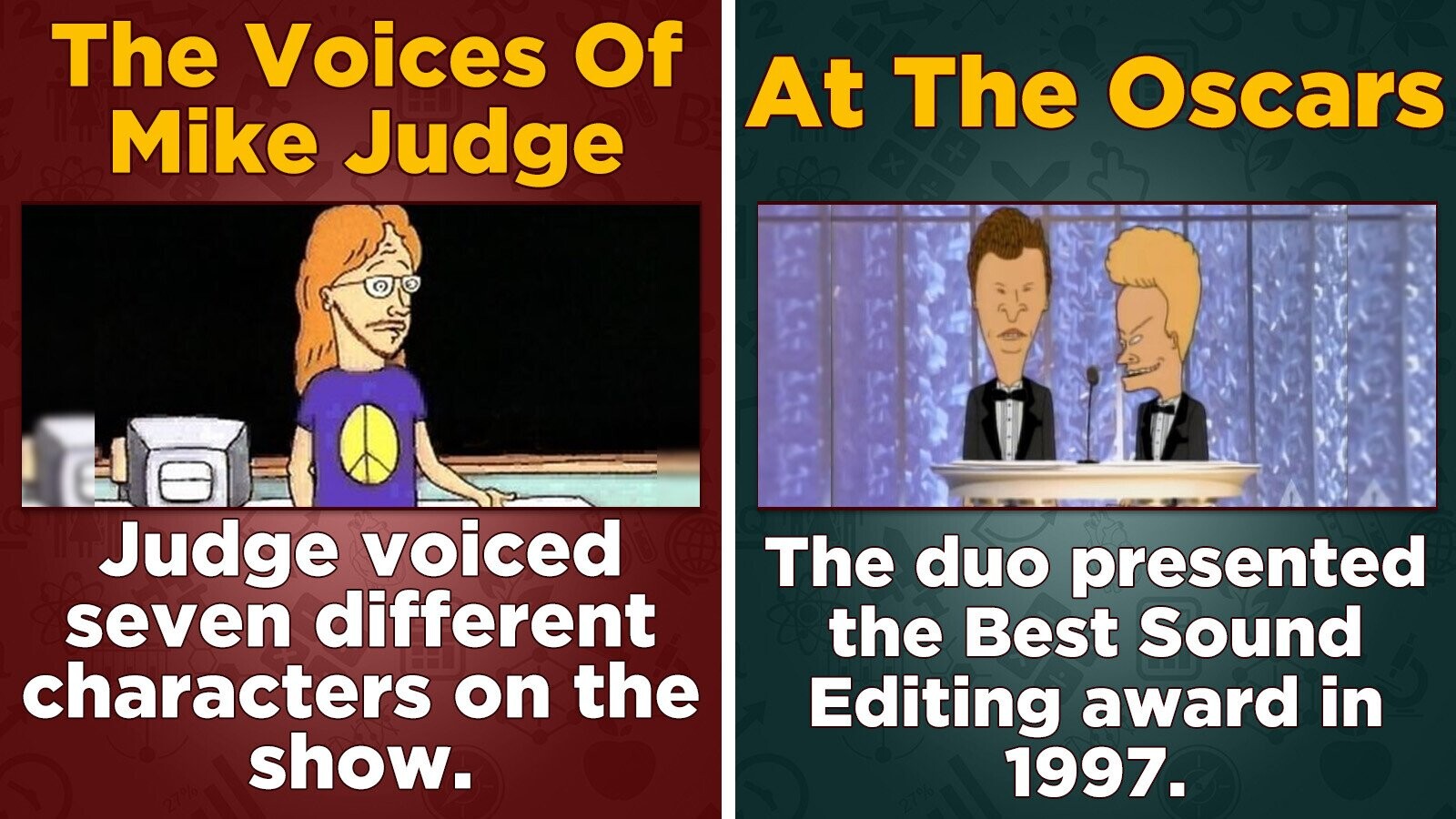
One of the most important Beavis & Butt-Head behind-the-scenes facts is also one of the easiest to overlook: Mike Judge voiced both Beavis and Butt-Head. Their voices are so distinct that it can feel like two separate actors are bouncing off each other. Instead, much of that bizarre chemistry came from Judge performing both halves of the idiotic conversation.
Beavis is frantic, scratchy, and combustible. Butt-Head is slower, smugger, and somehow confident despite having the intellectual horsepower of a broken vending machine. Together, they form a comedy engine: Beavis accelerates, Butt-Head drags, and the joke crashes into a wall.
5. The “Bad” Animation Style Was Part of the Joke
Beavis and Butt-Head never looked polished in the traditional Disney sense. That was the point. The awkward movement, ugly faces, stiff poses, and grimy suburban backgrounds made the world feel like it had been scribbled into existence during detention.
The rough look matched the characters’ personalities. If the show had been too slick, it might have lost its flavor. Beavis and Butt-Head needed to look like they belonged on a stained couch in a room where nobody had opened a window since 1993.
6. Music Video Commentary Became the Show’s Secret Weapon
The music video segments were not just filler. They were one of the smartest parts of the show. Beavis and Butt-Head would sit on the couch and react to real music videos with brutally simple opinions. Sometimes they loved a song for reasons that made no sense. Sometimes they destroyed a video with one dumb observation that was, annoyingly, accurate.
This format turned the duo into accidental music critics. They were not educated, refined, or even remotely prepared, but their reactions could make a band seem cooler, funnier, or more ridiculous. In the MTV era, that mattered. A Beavis and Butt-Head reaction was like a chaotic thumbs-up from the basement of pop culture.
7. The Show Helped Define MTV’s 1990s Identity
In the 1990s, MTV was shifting from wall-to-wall music videos into personality-driven programming. Beavis & Butt-Head became one of the channel’s signature shows because it captured the strange mood of the decade: bored teens, loud guitars, cable television, convenience stores, school cynicism, and a general suspicion that adults had no idea what was going on.
The series worked because it did not lecture. It simply presented two characters who absorbed media like junk food and then burped it back at the audience. That was the joke, and maybe the warning label too.
8. The Controversy Made the Show Even More Famous
No history of Beavis and Butt-Head is complete without mentioning the public backlash. The show became a target for critics who believed it encouraged bad behavior or represented the collapse of civilization, depending on how dramatic the newspaper column was feeling that week.
MTV responded to some concerns by editing certain references and moving the show to later time slots. Ironically, the controversy only made Beavis and Butt-Head more famous. For teenage viewers, being told not to watch something is basically a marketing campaign with parental signatures.
9. Daria Began as a Beavis and Butt-Head Character
Before she became the star of her own beloved MTV series, Daria Morgendorffer appeared on Beavis & Butt-Head. She was sharp, dry, unimpressed, and clearly operating at a different mental altitude than the boys. That contrast made her stand out immediately.
Daria’s later spin-off became one of MTV Animation’s biggest successes. It also showed that the Beavis and Butt-Head universe could produce more than one kind of satire. Where Beavis and Butt-Head mocked stupidity from the inside, Daria mocked the world through intelligence, sarcasm, and industrial-strength eye-rolling.
10. Burger World Became the Perfect Bad Job
Many classic episodes put the duo at Burger World, a fictional fast-food restaurant where they were somehow employed despite being a danger to customers, coworkers, and probably the fryer. Burger World worked because it gave the characters a tiny bit of responsibility, which they immediately mishandled.
The setting also connected the show to Mike Judge’s broader interest in workplace comedy. Years before Office Space became the anthem of cubicle misery, Beavis & Butt-Head was already joking about bad jobs, bored workers, clueless managers, and the spiritual emptiness of wearing a paper hat.
11. “The Great Cornholio” Became Bigger Than Expected
One of Beavis’s most famous alter egos is the Great Cornholio, a wild, babbling persona triggered when Beavis becomes overstimulated. The bit became one of the franchise’s most quoted and recognizable running jokes.
Why did it work? Because Cornholio gave Beavis a strange kind of power. Normally he was the more nervous half of the duo. As Cornholio, he became a tiny prophet of nonsense, demanding respect while making absolutely no reasonable point. It was ridiculous, but it had the energy of someone who had accidentally discovered public speaking.
12. The 1996 Movie Proved the Characters Could Carry a Feature Film
Beavis and Butt-Head Do America arrived in theaters in 1996 and became a real box-office success. That was not guaranteed. A lot of TV characters work in short bursts but collapse when stretched to feature length. Beavis and Butt-Head survived the jump because the movie gave them a bigger road-trip structure without making them smarter.
The film sent them across America, but emotionally they never left the couch. That was the genius. The world changed around them; they did not. The movie also attracted major voice talent, including Bruce Willis, Demi Moore, Robert Stack, and Cloris Leachman, helping the crude little MTV cartoon feel like a legitimate theatrical event.
13. Rob Zombie Contributed to the Movie’s Hallucination Sequence
One of the wildest visual moments in Beavis and Butt-Head Do America is the hallucination sequence connected to Rob Zombie’s artwork. The scene stands apart from the show’s usual rough suburban style, exploding into surreal, heavy-metal imagery.
That sequence showed how flexible the franchise could be. Most of the time, Beavis and Butt-Head lived in a world of couches, classrooms, parking lots, and fast food counters. But the movie briefly let the visuals go full nightmare carnival. It was still stupid, of coursebut artistically stupid, which is the fancy kind.
14. The 2011 Revival Updated the Couch
When the show returned in 2011, the media landscape had changed. MTV was no longer the same music-video universe it had been in the early 1990s. Reality TV, internet culture, and celebrity spectacle had taken over much of youth entertainment.
The revival leaned into that shift by having Beavis and Butt-Head comment not only on music videos but also on contemporary TV and pop culture. The idea still worked because the core joke remained intact: two idiots watching something and misunderstanding it with confidence.
15. The Paramount+ Era Brought Beavis and Butt-Head Into the Internet Age
The 2020s revival, titled Mike Judge’s Beavis and Butt-Head, moved the duo into a world of streaming, social media, YouTube, TikTok-style content, and modern online absurdity. This was a natural evolution. Beavis and Butt-Head were always media consumers. The only difference is that the couch now faces an infinite algorithm instead of a cable channel.
The revival also introduced versions of the characters as middle-aged men, a surprisingly effective concept. They are still dumb, still overconfident, and still trapped in their own tiny worldview. Aging them up does not make them wiser. It just gives them new ways to misunderstand modern life, which is painfully realistic.
Why Beavis & Butthead Still Works
The staying power of Beavis & Butthead comes from a contradiction. On the surface, the show is proudly stupid. Underneath, it is built with remarkable precision. The pacing, voice work, pauses, repeated phrases, and deadpan reactions are all tuned carefully. A single “heh-heh” can function like punctuation, commentary, or a tiny collapse of civilization.
The show also understands boredom. Many teen comedies chase adventure, romance, or big emotional lessons. Beavis and Butt-Head usually chase snacks, television, and bad ideas. That makes them strangely timeless. Every generation has its own version of kids sitting around with too much media and not enough supervision.
Another reason the series lasts is that the characters are not trying to be cool in the usual way. Butt-Head thinks he is cool, which makes him deeply uncool. Beavis is too chaotic to manage an image. Together, they create comedy from total lack of self-awareness. They are not influencers. They are anti-influencers. If they had a lifestyle brand, it would be sued by lunch.
Viewer Experience: Watching Beavis & Butthead Today
Watching Beavis & Butt-Head today is a strange experience because the show feels both ancient and current. The old episodes are full of 1990s textures: music videos, landlines, worn-out classrooms, malls, cable TV, and that unmistakable pre-smartphone boredom. Nobody is refreshing a feed. Nobody is building a personal brand. The boys simply sit there, stare at the screen, and let bad thoughts happen.
That simplicity can feel refreshing. Modern comedy often moves fast, stacks jokes on top of jokes, and worries about explaining itself. Beavis and Butt-Head do not explain anything. They barely understand anything. A scene can hang on a dumb pause, a confused look, or Butt-Head deciding that something is “cool” for the least impressive reason imaginable.
For viewers who grew up with the show, revisiting it can feel like opening a time capsule that smells faintly of nacho cheese and old carpet. The humor is crude, but the rhythm is oddly comforting. The characters are terrible students, worse employees, and unreliable citizens, but they are also weirdly innocent in their stupidity. They are not plotting grand evil. They are usually just bored, hungry, distracted, or trying to impress each other with information they do not have.
For new viewers, the best approach is to understand the show as satire, not instruction. Beavis and Butt-Head are funny because they are wrong about nearly everything. Their confidence is the joke. Their failure to learn is the joke. Their ability to turn a normal situation into a small civic emergency is also the joke. The series invites the audience to laugh at them, not become themalthough quoting them in a bad voice is apparently unavoidable and should be monitored by loved ones.
The revival episodes add another layer to the viewing experience. Seeing the duo react to internet-era content proves that the format was never limited to MTV videos. Beavis and Butt-Head are built to misunderstand media, and the modern internet is basically a luxury buffet of misunderstandable material. Influencers, viral clips, wellness trends, online tutorials, and algorithm-friendly weirdness all become fuel for the same old couch commentary.
The middle-aged versions are especially funny because they answer a question nobody urgently asked: what happens if Beavis and Butt-Head grow older without growing up? The answer is uncomfortable, hilarious, and a little too believable. They become the same people with more years behind them and not much wisdom in front of them. That joke lands because many comedies pretend age automatically creates maturity. Beavis and Butt-Head politely disagree, probably by laughing at the word “maturity.”
As a cultural experience, the franchise is best appreciated as controlled chaos. It looks messy, sounds ridiculous, and behaves badly, yet the creative intelligence behind it is obvious. Mike Judge understood that dumb characters can reveal smart things about society. They show how people consume media, repeat phrases, misunderstand authority, chase status, and mistake noise for knowledge. That may be why the series has survived so many eras. Technology changes. Platforms change. The couch changes. But human stupidity remains available in high definition.
Conclusion
Beavis & Butthead: 15 Behind-The-Scenes Facts shows that the franchise was never just a crude cartoon about two slackers. It was a sharp, weirdly durable satire built from homemade animation, unforgettable voice work, MTV’s experimental spirit, and Mike Judge’s talent for finding comedy in ordinary American emptiness.
From Frog Baseball to Beavis and Butt-Head Do America, from Daria’s spin-off to the Paramount+ revival, the story behind the show is almost as strange as the show itself. Beavis and Butt-Head may not have learned much, but somehow they taught television a lot about timing, branding, youth culture, and the power of laughing at the wrong moment.
Note: This article was written for web publication and synthesized from reputable entertainment, studio, interview, box-office, and pop-culture sources. No outbound source links or content reference tags are included in the article body.