Note: This article is written for web publication and synthesized from reputable entertainment reporting, film reference sources, interviews, reviews, and public career records about Brendan Fraser.
Introduction: The Human Cartoon Who Somehow Also Has a Soul
Some actors look like they were born for prestige dramas. Some look like they were engineered in a secret Hollywood laboratory to run from explosions, crack a joke, crash into furniture, apologize to the furniture, and still make the audience say, “Aw, I hope he’s okay.” Brendan Fraser belongs to the second groupand that is exactly why he became the perfect cartoon character.
The phrase “cartoon character” can sound like an insult, as if someone is too silly, too exaggerated, or too unserious. But in Fraser’s case, it is a compliment with a giant Acme stamp on it. His best performances combine rubbery physical comedy, wide-eyed sincerity, heroic timing, and a surprising emotional softness. He can swing on vines, battle mummies, stumble through modern life like a confused golden retriever, and still make the joke feel human. That rare blend is why Brendan Fraser’s movie career has always felt animated, even when no actual animation was involved.
From Encino Man to George of the Jungle, from The Mummy to Looney Tunes: Back in Action, Fraser built a screen identity that moved like slapstick but landed like heart. Later, in Doom Patrol and The Whale, he proved that the same qualities that made him funny could also make him deeply moving. His story is not just about becoming a cartoon character. It is about becoming the kind of cartoon character audiences trust: goofy, brave, bruised, kind, and impossible to forget.
Why Brendan Fraser Feels Animated Even in Live Action
His Body Language Speaks Before He Does
Great cartoon characters are readable from across the room. Bugs Bunny’s cool confidence, Daffy Duck’s nervous chaos, Goofy’s elastic awkwardnessthese characters tell you who they are before they finish a sentence. Brendan Fraser has that same visual clarity. In his early roles, he did not merely enter a scene; he bounced, lunged, tilted, blinked, stared, froze, and reacted with his entire body.
In Encino Man, Fraser plays Link, a caveman thawed into 1990s California. The role could have become a one-note joke, but Fraser turns Link into a full physical performance. He studies the world like every vending machine is a sacred artifact. He moves with prehistoric curiosity, not stupidity. That difference matters. A lesser performance would point at the modern world and grunt. Fraser makes Link seem like a visitor from another dimension who is both confused and delighted. In cartoon terms, he is the wide-eyed character who walks into a wall, then politely tries to understand the wall’s feelings.
This physical expressiveness became one of Fraser’s signatures. He understood that comedy often begins before the punchline. It starts in posture, timing, reaction, and rhythm. His face can go from heroic determination to complete panic in half a second. His shoulders can sell embarrassment. His eyes can turn a ridiculous scene into something oddly sincere. That is classic animated-character energy.
He Makes Slapstick Feel Friendly
Slapstick is tricky. Too little commitment and it looks fake. Too much and it becomes exhausting. Fraser’s gift is that he commits fully without seeming mean, smug, or desperate. When he crashes, tumbles, or reacts with cartoon-level shock, the audience laughs with him rather than at him.
George of the Jungle is the clearest example. Based on the animated television character, the film asks Fraser to become a live-action cartoon hero. He swings into trees, poses with impossible confidence, and treats the jungle with the innocent seriousness of a man who has never met embarrassment. The joke works because Fraser never winks too hard at the camera. He plays George as sincere, loyal, and completely convinced that his world makes sense. He is not mocking the cartoon. He is honoring it by becoming it.
That is a difficult acting balance. The performance is exaggerated, but it is not empty. George is funny because he believes in everything he does. Fraser understands a core rule of cartoon acting: the character should not know they are ridiculous. The audience knows. The trees definitely know. But George does not, and that innocence gives the comedy its charm.
The Brendan Fraser Formula: Elastic Comedy Plus Emotional Honesty
He Is Never Too Cool for the Joke
Many movie stars protect their image. They want to look sharp, powerful, mysterious, and preferably lit by three expensive lamps at all times. Brendan Fraser has never seemed afraid of looking silly. That willingness is central to his cartoon quality. He can be handsome without being vain, heroic without being stiff, and funny without acting above the material.
In Airheads, Fraser plays Chazz, a frustrated rock musician caught in a comedy of desperation. The movie is loud, absurd, and very much a product of its era, but Fraser fits because he can exaggerate frustration without losing likability. In Blast from the Past, he plays Adam Webber, a man raised underground who emerges into modern society with old-fashioned manners and total sincerity. Again, the performance depends on innocence. Adam could have been a walking gimmick. Instead, Fraser makes him sweet, awkward, and emotionally open.
That openness is the secret ingredient. Cartoon characters survive impossible situations because audiences understand their emotional logic. Fraser’s characters often have that same clarity. They may be confused, clumsy, or overmatched, but they are rarely cynical. They want love, friendship, adventure, family, or a chance to do the right thing. That makes even the broadest comedy feel grounded.
He Turns Vulnerability Into a Superpower
Fraser’s best characters are not invincible. Even Rick O’Connell in The Mummy, one of his most famous action roles, is not a stone-faced action machine. Rick is brave, yes, but he is also sarcastic, startled, sweaty, and frequently aware that ancient curses are extremely inconvenient. He fights monsters, but he reacts like a real person who has just discovered that the afterlife comes with teeth.
This is why The Mummy remains such a beloved adventure film. Fraser gives Rick the swagger of a classic hero and the comic timing of someone who knows the situation is completely bonkers. He can throw a punch, deliver a quip, and look mildly offended by supernatural nonsense. In animation terms, he is the hero whose courage is real but whose reactions are delightfully human.
That vulnerability later became even more important in Fraser’s dramatic work. In The Whale, he moved far away from jungle slapstick and action-adventure comedy, yet the emotional foundation remained familiar: openness, empathy, and a willingness to appear fragile on screen. The performance earned him major awards recognition, including the Academy Award for Best Actor, and reminded audiences that the qualities they loved in his comic roles were not separate from his dramatic talent. The cartoon heart had grown deeper, not disappeared.
Looney Tunes: Back in Action Made the Connection Obvious
Brendan Fraser Meets the Cartoon World Head-On
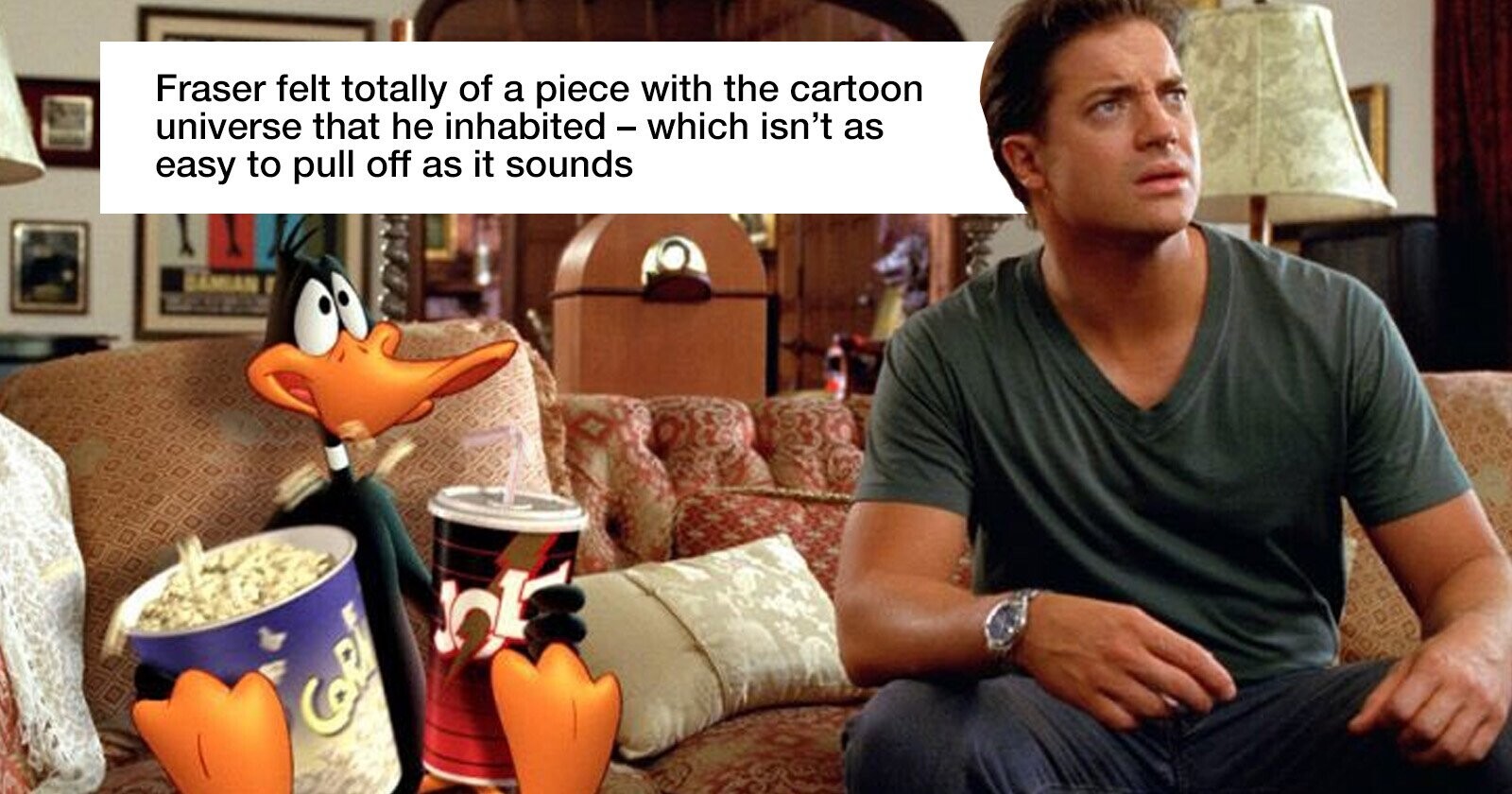
If there is one movie that turns the “Brendan Fraser as cartoon character” idea into actual text, it is Looney Tunes: Back in Action. Directed by Joe Dante, the 2003 live-action and animated comedy places Fraser directly beside Bugs Bunny, Daffy Duck, and other classic Looney Tunes characters. He plays D.J. Drake, a stuntman and security guard who gets pulled into a spy-adventure plot involving Hollywood, secret agents, and cartoon chaos. He also appears as a fictionalized version of himself, which is exactly the kind of meta joke Looney Tunes would order for breakfast.
The movie works best when Fraser acts as a bridge between the human and animated worlds. He does not treat Bugs and Daffy like special effects. He treats them like difficult co-workers with strong personalities and questionable workplace habits. That matters because live-action actors in animation hybrids must create believable relationships with characters who are not physically present in the normal way. Fraser’s reactions help sell the illusion. When Daffy is being dramatic, Fraser gives him the attention of a man trapped in a meeting that has gone off the rails. When danger arrives, he responds with the athletic panic of someone who knows he is in a cartoon but still has medical insurance concerns.
Fraser was especially suited to this world because his acting style already followed cartoon logic. His expressions are clean. His reactions are big but not random. His timing leaves space for visual gags. He can look heroic and foolish in the same shot. In other words, he does not compete with the Looney Tunes; he harmonizes with them.
The Taz Connection
Another fun detail: Fraser has been credited with voice work connected to the Tasmanian Devil in Looney Tunes: Back in Action. Whether running through live-action chaos or contributing to the wild soundscape of a cartoon universe, Fraser’s presence fits the Looney Tunes brand because he shares its essential rhythm. He understands speed, surprise, impact, and recovery. A cartoon character gets flattened and pops back up. Fraser’s screen persona has done that metaphorically for decades.
That resilience became part of his public image, too. After years of physical strain from demanding roles, personal setbacks, and a quieter period in Hollywood, Fraser’s return to major recognition felt less like a standard celebrity comeback and more like the third act of a beloved animated hero. The audience had missed him. When he returned, they did not merely applaud the performance; they applauded the person they felt they had grown up with.
Monkeybone, Doom Patrol, and the Strange Art of Being Human in Unreal Worlds
Monkeybone Put Fraser Inside a Cartoon Nightmare
Before Looney Tunes: Back in Action, Fraser starred in Monkeybone, Henry Selick’s strange 2001 dark fantasy comedy that blended live action, stop-motion animation, and surreal visual effects. Fraser plays Stu Miley, a cartoonist whose creation takes on a life of its own in a bizarre dreamlike underworld. The film was not a box-office success, but it has become an interesting part of Fraser’s “cartoon character” evolution.
Monkeybone places Fraser in a world where animation is not just decoration; it is psychology. The cartoon world represents imagination, fear, desire, and chaos. Fraser’s job is to remain emotionally understandable while surrounded by visual madness. That is not easy. In a film this strange, an actor can vanish under the design. Fraser does the opposite. He gives the audience a human anchor, even when the movie seems determined to turn reality into a fever dream with better production design than most fever dreams can afford.
This role shows a different side of his cartoon energy. It is not only bright and goofy; it can be weird, anxious, and surreal. Fraser can belong in a jungle comedy, a mummy adventure, a Looney Tunes chase, and a stop-motion nightmare because his acting style is flexible. He adapts to heightened worlds without making them feel fake.
Doom Patrol Turned Him Into a Literal Comic-Book Soul
Years later, Doom Patrol gave Fraser another unusual opportunity: playing Cliff Steele, also known as Robotman. The role combines live-action flashbacks, voice performance, and a physical robot body performed on set by another actor. Fraser’s voice carries much of Cliff’s personalityanger, regret, humor, confusion, and wounded humanity.
This is where the “perfect cartoon character” idea grows up. Robotman is visually exaggerated: a human brain inside a clunky mechanical body. That could easily become a joke machine. Instead, Fraser gives him emotional weight. His voice makes the metal feel bruised. His comic timing keeps the character entertaining, but his sadness keeps him real.
In animation and comic-book storytelling, the best characters are often extreme on the outside and painfully recognizable on the inside. Robotman fits that tradition perfectly. He looks impossible, but his feelings are ordinary: guilt, grief, frustration, longing, and the need to be loved despite damage. Fraser’s performance shows why he has always been so effective in heightened roles. He can make absurdity breathe.
Why Audiences Love Brendan Fraser’s Cartoon Energy
He Represents Innocence Without Being Naive as an Actor
Fraser’s characters often seem innocent, but Fraser’s acting is not simplistic. He knows how to play innocence as active curiosity rather than emptiness. That is why roles like Link, George, and Adam Webber still work. These characters are not dumb; they are unarmored. They experience the world directly. They do not hide behind irony. In a media culture that often rewards snark, that kind of sincerity feels surprisingly fresh.
This is also why audiences responded so warmly to his return to the spotlight. Fraser’s public persona has long been associated with kindness, humility, and emotional openness. Viewers who grew up with his movies did not just remember the jokes. They remembered how his characters made them feel: safe, amused, and oddly hopeful. That emotional memory is powerful SEO for the human brain. Search query: “actor who made childhood feel like Saturday morning.” Result: Brendan Fraser.
He Makes Exaggeration Feel Honest
The best cartoons exaggerate truth. They stretch reality until the feeling becomes easier to see. A character’s jaw drops to the floor because surprise really does feel that big. A character runs in midair before falling because panic really does delay logic for one glorious second. Fraser’s performances operate in that same emotional grammar.
When George crashes into a tree, it is not only a gag; it is a statement of character. He is brave, enthusiastic, and operating with limited navigation software. When Rick O’Connell reacts to supernatural horror with irritation and disbelief, the joke works because the feeling is true. When D.J. Drake shares space with Bugs Bunny, Fraser’s grounded reactions make the animated chaos feel more believable. His exaggeration does not replace honesty. It reveals it.
The Career Arc: From Living Cartoon to Beloved Comeback Hero
The Early Years Built the Shape
Fraser’s early career established the building blocks: physical comedy, innocence, athletic movement, and emotional warmth. Encino Man gave him the outsider’s curiosity. George of the Jungle gave him full-body slapstick. Blast from the Past refined his old-fashioned sweetness. The Mummy added heroic adventure and mainstream stardom. Together, these roles created an image of Fraser as a live-action animated hero: big reactions, big heart, big trouble, and usually a very bad day involving gravity.
Unlike some stars, Fraser did not become beloved by projecting untouchable coolness. He became beloved by being touchable, bashful, funny, and breakable. He made audiences feel protective of him even when he was playing the strongest person in the room. That is a rare star quality. It is also a common trait of great animated heroes: they are larger than life but emotionally close.
The Later Years Added Depth
As Fraser’s career moved into more mature roles, his cartoon-like qualities did not disappear. They became layered. Doom Patrol used his voice to explore pain through a comic-book body. The Whale used his emotional transparency in a serious dramatic context. His acclaimed return showed that audiences had not outgrown Fraser’s earlier charm; they had grown up with it.
That is why his story resonates beyond nostalgia. It is not simply, “Remember that fun actor from the ’90s?” It is, “Remember that actor who made absurdity feel kind? He can also break your heart.” The same sincerity that made George lovable made Charlie in The Whale devastating. The same timing that made Rick O’Connell funny made Robotman’s frustration sharp and human. Fraser’s career proves that cartoon energy and serious acting are not opposites. Sometimes, they come from the same brave place.
What Creators Can Learn From Brendan Fraser’s Cartoon Character Magic
1. Commit Completely
Fraser never seems halfway inside a role. If the scene requires him to swing, stumble, shout, whisper, panic, or stare at a cartoon duck as if the duck owes him money, he commits. That is a lesson for actors, writers, comedians, and content creators: audiences can forgive absurdity, but they rarely forgive hesitation. If the world is silly, believe in the silliness.
2. Keep the Heart Visible
The difference between annoying exaggeration and lovable exaggeration is emotional clarity. Fraser’s characters usually want something simple and human. They want to belong, protect someone, understand the world, or survive the latest supernatural inconvenience. Because the heart is visible, the comedy has weight.
3. Let the Character Be Uncool
Coolness can be a cage. Fraser’s best work often comes from his willingness to be uncool. He lets characters be embarrassed, confused, eager, and physically ridiculous. That freedom makes them memorable. A perfect cartoon character is not perfect because they never fall. They are perfect because they fall spectacularly and get back up with their dignity slightly bent but still functional.
Experience Notes: Why This Topic Still Connects With Viewers
Watching Brendan Fraser’s films today is a surprisingly warm experience because his performances do something many modern blockbusters forget to do: they invite the audience in. He does not perform as if he is standing behind glass. He performs as if he just tripped through the front door, brought snacks, and is very sorry about the vase. That accessibility is a huge reason the “Brendan Fraser cartoon character” idea remains so appealing.
For viewers who grew up with George of the Jungle or The Mummy, Fraser represents a specific kind of movie comfort. His films often feel adventurous without becoming cold, silly without becoming empty, and emotional without demanding that the audience sit through a lecture wearing formal shoes. There is a family-friendly warmth to much of his screen image, even when the movies themselves vary in tone. You can watch him battle ancient evil or talk to animated icons, and the central pleasure is the same: here is a performer who understands joy.
For writers and bloggers, Fraser’s career also offers a useful lesson in character design. A memorable character needs contrast. Fraser’s best roles are full of it. George is strong but innocent. Rick is brave but frequently alarmed. Adam is old-fashioned but emotionally intelligent. Robotman is mechanical on the outside but painfully human inside. These contrasts make the characters easy to describe, easy to remember, and easy to root for. That is exactly how great cartoon characters are built. They have simple silhouettes and complex feelings.
For performers, Fraser’s work is a reminder that physical comedy is not just falling down. It is storytelling through movement. A raised eyebrow can set up a joke. A delayed reaction can make a scene explode. A full-body pause can be funnier than a line of dialogue. Fraser’s performances show how the body can become part of the script. He does not simply say the joke; he becomes the punctuation mark at the end of it.
There is also something encouraging in the way audiences embraced Fraser’s later success. People did not celebrate him only because they remembered his old movies. They celebrated him because his return felt emotionally consistent with the characters he had played: bruised, decent, resilient, and still standing. In a world that often treats fame like a conveyor belt, Fraser’s story felt unusually human. The cartoon hero had taken real hits, but the heart was still there.
That may be the ultimate reason Brendan Fraser became the perfect cartoon character. Not because he is unreal, but because he makes heightened reality feel honest. He understands that comedy and pain often live close together. He knows that a hero can be ridiculous and still noble. He proves that sincerity is not a weakness, even when surrounded by mummies, monkeys, robots, or ducks with attitude problems. In the end, Brendan Fraser is not perfect because he is polished. He is perfect because he is animated by kindness, and that is the kind of character audiences never stop replaying.
Conclusion: Brendan Fraser Was Always Drawn in Bold Lines
Brendan Fraser became the perfect cartoon character because his screen presence combines the essential traits of great animation: clear movement, emotional honesty, comic rhythm, resilience, and an instantly recognizable heart. He can stretch a reaction without breaking the truth of a scene. He can play innocence without making it flat. He can survive absurd fictional worlds because he makes them feel emotionally real.
From Encino Man and George of the Jungle to Looney Tunes: Back in Action, Doom Patrol, and The Whale, Fraser’s career shows that “cartoonish” does not have to mean shallow. In his hands, it means expressive, generous, brave, and alive. He is the rare actor who can stand next to Bugs Bunny, fight an ancient mummy, voice a robot with a wounded soul, and still seem like the most human person in the room.