Finding the Qibla for prayer is one of those daily tasks that can feel beautifully simpleuntil you are in a hotel room, an airport corner, a new apartment, or a camping site with no mosque in sight and your phone compass begins spinning like it just discovered coffee. The Qibla is the direction Muslims face during salah, pointing toward the Kaaba in Makkah. It is a spiritual direction, but finding it also involves geography, navigation, and sometimes a little patience with technology.
The good news is that you do not need to be an astronomer, surveyor, or professional map whisperer to find the Qibla accurately. Today, Muslims can use reliable mobile apps, online Qibla finders, maps, compasses, local mosques, and even the sun to identify the prayer direction. Each method has strengths, limitations, and a few “please don’t hold your phone beside the refrigerator” warnings.
This guide explains five practical ways to find the Qibla for prayer, with clear examples, helpful tips, and real-life experience notes for travelers, students, families, new Muslims, and anyone who has ever turned in three directions before praying and thought, “Surely one of these is east.”
What Is the Qibla and Why Does It Matter?
The Qibla is the direction Muslims face when performing the five daily prayers. In Islamic practice, this direction points toward Al-Masjid al-Haram in Makkah, where the Kaaba is located. The Qur’an instructs believers to turn toward the Sacred Mosque, making the Qibla both a physical orientation and a powerful symbol of unity. Whether a Muslim is praying in New York, Los Angeles, London, Jakarta, Lagos, or a quiet living room somewhere between laundry day and dinner, the direction connects worshippers to a shared center.
One common misunderstanding is that Muslims everywhere simply face east. That is only true in some locations. The Qibla direction depends entirely on where you are on Earth. From much of North America, it is generally northeast by the commonly used great-circle calculation. From many parts of Europe, it is often southeast. From parts of South and Southeast Asia, it may be west or northwest. In other words, “face east” is not a universal ruleit is a shortcut that got lost and refused to ask for directions.
Because the Earth is round, Qibla direction is usually calculated using the shortest path along the globe, known as a great-circle route. This is why the direction may look surprising on a flat map. A line on a wall map can mislead the eye, while a globe or digital map calculation gives a more accurate bearing.
1. Use a Reliable Qibla Finder App or Website
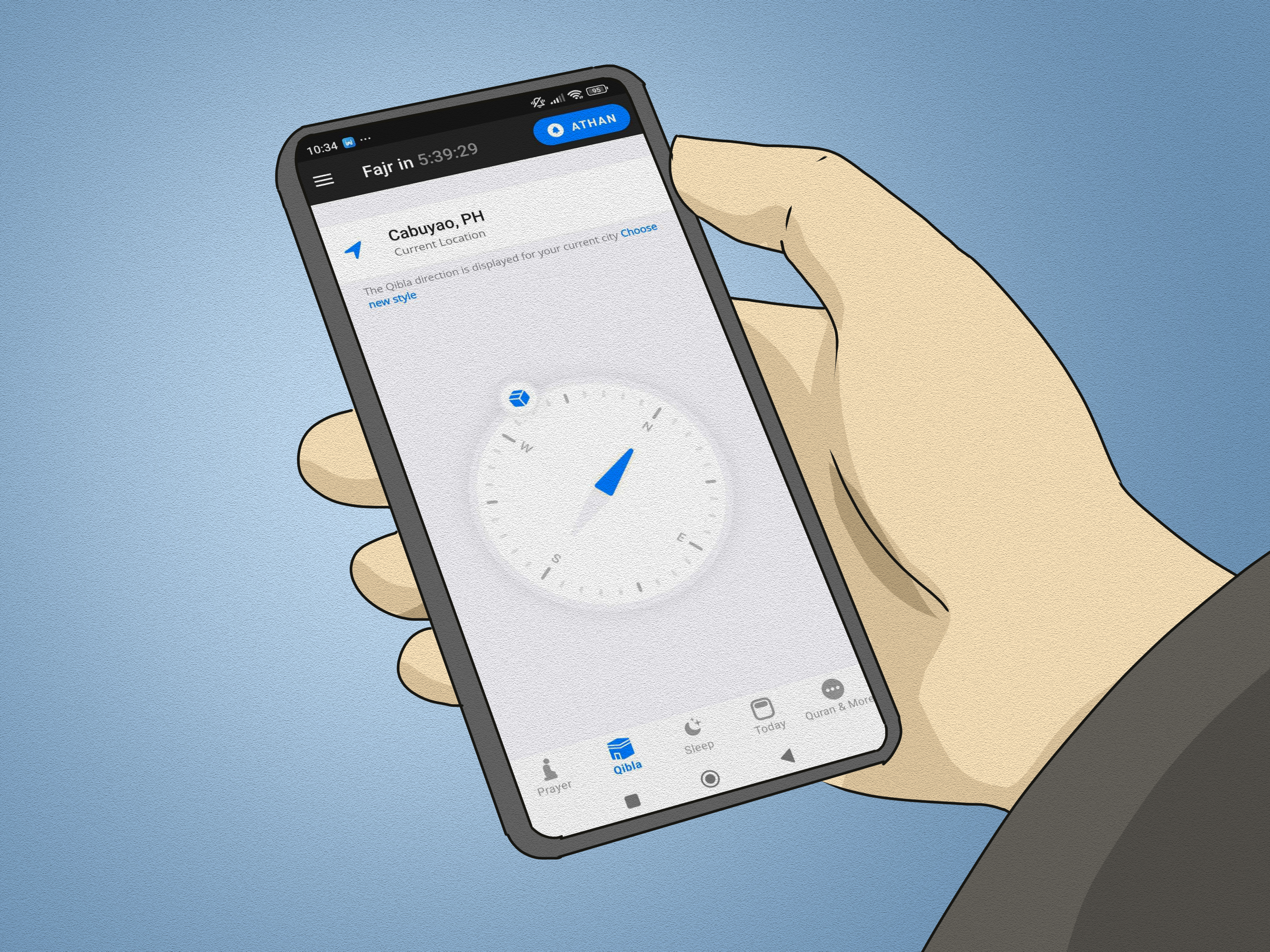
The fastest way to find the Qibla for prayer is to use a trusted Qibla finder app or browser-based tool. These tools usually combine GPS location, digital maps, and your phone’s compass sensor to point toward the Kaaba. Some apps also include prayer times, Islamic calendars, dua collections, Qur’an reading features, and reminders, but the core function is simple: identify where you are and show which way to face.
How to Use a Qibla App Correctly
Open the app, allow location access, and place your phone flat in your hand or on a stable surface. Many apps show an arrow, compass dial, or augmented reality view. Turn slowly until the Qibla marker lines up with the correct direction. If the app asks you to calibrate your compass, follow the instructionoften a gentle figure-eight movement with the phone.
For best results, move away from metal objects, magnetic phone cases, laptops, cars, elevators, speakers, and charging cables. A phone compass depends on a magnetometer, and magnetic interference can make it behave like a tiny confused weather vane. If your Qibla app suddenly points toward your microwave, the app may not be spiritually inspired; it may just be magnetically annoyed.
When This Method Works Best
Qibla apps are especially useful when traveling, moving into a new home, praying at work, staying in a hotel, visiting a hospital, or attending an outdoor event. They are quick, convenient, and usually accurate enough for daily prayer when used properly. However, they depend on your device sensors, GPS accuracy, and calibration, so it is wise to confirm the result with another method when possible.
2. Use an Online Map and Draw the Direction to the Kaaba
If your phone compass seems unreliable, a map-based method can be more stable. Open a digital map, locate your current position, then search for the Kaaba or Makkah. Some map tools allow you to measure distance or draw a line between two points. The direction of that line gives you a strong visual sense of the Qibla.
This method is excellent because it does not rely on the phone’s magnetic compass. Instead, it uses geographic positioning. It also helps you understand why the Qibla from your city may point in a direction that feels unexpected. For example, many people in North America are surprised that the Qibla is often northeast, because on a flat map Makkah may appear southeast. The great-circle route explains the difference.
Simple Map Method Step by Step
First, find your exact location on the map. Second, search for the Kaaba in Makkah. Third, use the map’s measuring or direction tool to create a line from your location to the Kaaba. Fourth, compare the line with nearby streets, building walls, windows, or landmarks. If the line cuts diagonally across your room, do not panic. Prayer rugs are portable for a reason.
In a city, this method becomes easier when you compare the Qibla line with street grids. For instance, if your street runs north-south and the Qibla line points slightly east of north, you know the prayer direction is angled across the room rather than perfectly parallel to the wall. This is often more practical than trying to interpret a spinning phone arrow indoors.
When This Method Works Best
Use a map when setting up a prayer space at home, checking the direction in an office, confirming a mosque’s prayer hall orientation, or planning a long-term prayer area. It is also helpful for people who prefer a visual explanation rather than a compass reading in degrees.
3. Use a Physical Compass With Magnetic Declination
A traditional compass is another effective way to find the Qibla, especially when you do not have internet access. However, there is one important detail: a compass points to magnetic north, not true north. The difference between magnetic north and true north is called magnetic declination, and it changes depending on your location and over time.
To use a compass accurately, you first need the Qibla bearing for your location. Many Qibla calculators provide a degree measurement, such as 58 degrees from true north. You then adjust for your local magnetic declination or use a compass that can be set to compensate for it. In some places, the difference is small. In others, it can be large enough to matter.
How to Use a Compass for Qibla
Place the compass on a flat surface away from metal objects. Let the needle settle. Rotate the compass housing until north is aligned properly. Then locate the Qibla bearing in degrees and face that direction. If you are using a simple Qibla compass with city codes or numbered zones, follow the manufacturer’s instructions carefully, because different models may use different reference systems.
For example, if a Qibla calculator gives your city’s direction as northeast, a compass can help you identify that angle in a room, park, campsite, or roadside rest area. It is especially useful when technology is unavailable, your phone battery is low, or your app keeps arguing with the furniture.
Important Compass Tips
Keep the compass away from keys, watches, phones, speakers, car doors, metal tables, and electrical equipment. Even a magnetic phone case can disturb readings. If you are indoors, take more than one reading from different spots. If the needle shifts dramatically from one corner of the room to another, the building may contain metal structures or wiring that interfere with the compass.
4. Follow the Direction Used by a Local Mosque or Muslim Community
One of the most practical ways to find the Qibla is to ask a local mosque, Islamic center, Muslim student association, or nearby Muslim community. Mosques usually have a mihrab, a niche or marked area in the prayer wall that indicates the Qibla direction. Even small prayer rooms often have signs, arrows, or carpet lines showing where worshippers should face.
This method is especially useful when you are new to an area. A local mosque’s prayer direction has often been checked by community leaders, builders, or knowledgeable members. If you live in an apartment complex, university dorm, office building, or neighborhood with other Muslims, someone may already know the correct direction from experience.
How to Apply This at Home
If you visit a nearby mosque, notice the orientation of the prayer rows. Then compare that direction with roads, landmarks, or your phone map. When you return home, you can recreate the same general angle. This does not mean every wall in your home will line up perfectly with the mosque, but it gives you a reliable reference point.
Many families mark the Qibla direction discreetly at home with a small sticker, a prayer rug placement, or a mental note such as “toward the window, slightly left of the bookshelf.” The bookshelf does not become sacred, of course, but it can be a surprisingly dependable landmarkunless someone redecorates.
When This Method Works Best
Ask the local community when you are unsure, when apps disagree, or when you are establishing a shared prayer area. It is also helpful for new Muslims who want confidence and reassurance. Prayer should bring focus, not a daily episode of “Compass Detective.”
5. Use the Sun, Shadows, and Natural Direction Clues
Before smartphones and online maps, Muslims used observation, astronomy, and navigation to determine the Qibla. The sun remains a useful backup for finding general directions. While this method may not give the precision of a GPS-based tool, it can help when no device is available.
In general, the sun rises in the east and sets in the west, though the exact points shift with the seasons. At solar noon, the sun is roughly toward the south in the Northern Hemisphere and roughly toward the north in the Southern Hemisphere. A simple shadow stick can help identify an east-west line: place a stick upright in the ground, mark the tip of its shadow, wait 15 to 30 minutes, mark the new shadow tip, and draw a line between the marks. The first mark is generally west, and the second is generally east.
Using Natural Clues With Caution
Natural direction clues are helpful, but they are approximate. Weather, season, latitude, and local geography all affect what you see. This method is best for emergencies, outdoor travel, camping, or situations where exact tools are unavailable. Once you regain access to a map, app, compass, or local mosque, confirm the direction.
There are also special times when the sun aligns with the direction of the Kaaba for certain locations, but this requires date, time, and geographic awareness. For everyday use, most people should treat the sun method as a backup rather than the primary tool.
When This Method Works Best
Use the sun and shadows when hiking, traveling in rural areas, camping, or praying outdoors without internet access. It may not be perfect, but it can provide a reasonable direction when other methods are unavailable. Islam recognizes human effort and practical ability; the goal is sincere worship, not turning prayer into a geometry exam with dramatic background music.
How Accurate Does the Qibla Need to Be?
For most daily situations, Muslims are expected to make a sincere and reasonable effort to face the Qibla. If you are in Makkah and can see the Kaaba, precision matters directly. If you are far away, the practical concern is facing the correct general direction based on the best information available. Scholars discuss details differently, but the everyday principle is clear: use reliable means, avoid carelessness, and do not let uncertainty become a barrier to prayer.
If you later discover that your Qibla direction was slightly off despite honest effort, do not panic. Many people have prayed in hotel rooms, airports, dormitories, hospitals, parks, and guest bedrooms with imperfect information. Use better information next time and continue. The purpose of finding the Qibla is to support prayer, not to create anxiety before it.
Common Mistakes When Finding the Qibla
Assuming the Qibla Is Always East
This is one of the biggest mistakes. The correct Qibla depends on your location. In some places it may be east, but in many places it is northeast, southeast, west, northwest, or another direction.
Trusting an Uncalibrated Phone Compass
A Qibla app is only as reliable as the phone sensors it uses. If your phone compass is not calibrated or is near magnetic interference, the reading can be wrong. Always recalibrate when the app behaves strangely.
Using a Flat Map Without Understanding Great-Circle Direction
Flat maps distort the Earth. The shortest path to Makkah may not look intuitive on a rectangular map. A globe-based or great-circle calculation is usually the better reference.
Standing Near Metal Objects
Metal furniture, elevators, cars, electronics, and magnetic accessories can disturb compass readings. Step away, take multiple readings, and compare results.
Ignoring Local Knowledge
If a nearby mosque or established Muslim community has already confirmed the Qibla direction, use that knowledge. There is no award for personally reinventing navigation every afternoon.
Best Method for Different Situations
If you are at home, use a map-based Qibla calculation and confirm it with a local mosque or reliable app. Once you know the direction, mark it subtly and keep it consistent. If you are traveling, use a trusted Qibla app, then double-check with a map if the compass seems unstable. If you are outdoors without internet, use a physical compass or sun-shadow method. If you are in a mosque, prayer room, airport chapel, or Islamic center, follow the marked Qibla direction unless there is a clear reason to question it.
The best approach is often combining two methods. For example, use a Qibla app plus a map, or a mosque reference plus a compass. When two reliable methods agree, you can pray with confidence. When they disagree, check for magnetic interference, recalibrate your phone, and use the method least affected by sensorsusually a map or local mosque reference.
Experiences Related to Finding the Qibla for Prayer
Real-life experience shows that finding the Qibla is usually easy at home but becomes more interesting when life starts moving. Travel is the classic example. A Muslim may arrive at a hotel after a long flight, open a Qibla app, and watch the arrow bounce between two walls as if the Kaaba is playing hide-and-seek behind the minibar. In that moment, the best solution is simple: step away from electronics, remove any magnetic phone case, recalibrate the compass, and check the direction again near a window or open space.
In apartments, people often discover that walls rarely cooperate with the exact Qibla angle. The correct direction may cut diagonally across the living room, between the sofa and the coffee table, or toward a corner that also hosts a suspicious pile of laundry. That is normal. A prayer rug does not need to align with the room’s design philosophy. Many families choose a consistent spot and use a small visual marker, such as the edge of a rug or a point near a window, to remember the direction.
Students and workers often rely on community knowledge. In universities, Muslim student groups may mark prayer spaces with arrows. In offices, one employee may quietly become the unofficial Qibla expert after checking a map once and saving everyone else from daily compass negotiations. This shared knowledge builds community and makes prayer easier for newcomers, visitors, and converts who may feel shy about asking.
Airports create another common experience. Some airports have prayer rooms with marked Qibla directions; others do not. When no sign is available, travelers can use a Qibla app or map while sitting away from large metal structures. If the direction is approximate because of movement, crowds, or limited space, the worshipper should do their best. The same applies on trains, buses, and airplanes, where perfect alignment may be difficult or impossible. Practical effort matters.
Outdoor prayer brings its own lessons. At parks, campsites, beaches, or hiking trails, a compass and sun awareness can be helpful. However, natural methods require humility. The sun does not rise in exactly the same place every day, and shadows shift. Experienced travelers often combine clues: the sun’s position, a map, a compass, and the general Qibla direction for the region. This layered approach reduces doubt.
New Muslims may initially worry about getting the direction wrong. That concern is understandable, but it should not become overwhelming. Learning the Qibla is part of learning the rhythm of salah. With time, it becomes familiar. The direction at home becomes second nature. The direction at work becomes easy. Travel still occasionally offers comedy, especially when three apps disagree by a few degrees, but confidence grows with practice.
The biggest experience-based lesson is this: use reliable tools, make a sincere effort, and avoid turning Qibla-finding into stress. The Qibla is meant to orient the body and heart toward worship. Technology helps, maps help, mosques help, and community helpsbut peace of mind matters too. Once the best available direction is known, stand, focus, and pray.
Conclusion
Finding the Qibla for prayer is easier today than ever before, but it still helps to understand the main methods. A reliable Qibla app is convenient, a digital map is excellent for confirmation, a compass works well with declination awareness, a local mosque provides community-tested guidance, and the sun can help when other tools are unavailable. Each method has a place, and the smartest approach is often to compare two of them.
The key is not perfectionism; it is sincere effort. Whether you are praying at home, in a hotel room, on a campus, at work, outdoors, or somewhere between connecting flights, you can find the Qibla with confidence. And if your phone compass starts spinning dramatically, do not take it personally. Move away from the metal table, recalibrate, check a map, and carry on.