The SpaceX launch of NASA TESS telescope livestream was one of those rare space events that felt both dramatic and delightfully practical. No astronauts waved from a capsule. No rover posed for a dusty selfie on Mars. Instead, a compact telescope named TESS rode a SpaceX Falcon 9 rocket into the evening sky from Florida, beginning a mission designed to find planets around other stars. In other words, humanity turned on a camera, lit a rocket, and said, “Let’s go look for worlds.” Not a bad evening.
NASA’s Transiting Exoplanet Survey Satellite, better known as TESS, launched on April 18, 2018, from Space Launch Complex 40 at Cape Canaveral Air Force Station. The Falcon 9 lifted off at 6:51 p.m. EDT, with NASA’s live coverage beginning shortly before launch. For viewers watching online, the livestream offered a front-row seat to a mission that blended modern commercial rocketry, NASA science, and the universal human habit of staring at the sky and wondering, “Is anybody else out there?”
Although the original livestream is now a historical event rather than a live broadcast, it remains important because it captured the start of a mission that continues to shape exoplanet science. TESS was built to survey bright, nearby stars and detect the tiny dips in starlight caused when planets pass in front of them. That method sounds simple until you remember that scientists are trying to notice a shadow from light-years away. It is like spotting a fruit fly crossing a flashlight beam from across a football stadium, except the flashlight is a star and the fruit fly may be a planet twice the size of Earth.
What Was the NASA TESS Telescope Launch?
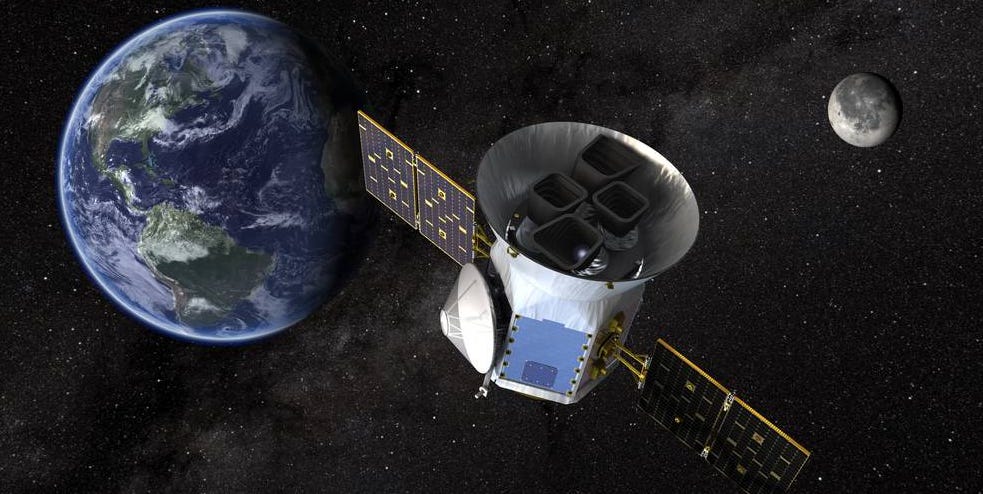
The TESS launch sent NASA’s planet-hunting satellite into space aboard a SpaceX Falcon 9 rocket. TESS stands for Transiting Exoplanet Survey Satellite, and its job is to search for exoplanets, which are planets outside our solar system. Unlike earlier missions that focused deeply on one region of the sky, TESS was designed as a wide-field surveyor. It looks across huge sections of the sky, monitoring the brightness of stars and searching for the rhythmic dimming that may reveal an orbiting planet.
The livestream mattered because it showed more than a rocket launch. It introduced the public to a new generation of astronomy. TESS was not just another telescope drifting above Earth. It was a scouting mission for future discoveries, helping astronomers identify promising planets that larger telescopes could study later. Some of those planets may be rocky. Some may orbit small, cool stars. Some may sit in or near the habitable zone, where temperatures could allow liquid water to exist on a planet’s surface.
That does not mean TESS was expected to find “Earth 2.0” before breakfast. Science is rarely that tidy, and the universe is not a vending machine. But the mission dramatically expanded the list of nearby worlds available for follow-up observations. For astronomers, that is gold. For the rest of us, it is an excuse to keep using the phrase “alien worlds” in polite conversation.
When and Where Did the SpaceX TESS Launch Happen?
The SpaceX Falcon 9 carrying NASA’s TESS spacecraft launched on April 18, 2018, at 6:51 p.m. EDT. The launch took place from Space Launch Complex 40 at Cape Canaveral Air Force Station in Florida. NASA and SpaceX had previously targeted April 16, but the launch was delayed for additional analysis, which is a very spaceflight way of saying, “Let’s double-check everything before we send a priceless telescope riding a controlled explosion.”
The launch window was brief, and the timing was precise. Viewers tuning into the livestream saw the Falcon 9 countdown, engine ignition, liftoff, stage separation, and the mission’s early ascent. SpaceX’s Falcon 9 first stage also successfully landed on the drone ship Of Course I Still Love You in the Atlantic Ocean. That landing added a second storyline to the livestream: not only was NASA sending a telescope to search for distant planets, but SpaceX was also recovering part of the rocket used to send it there.
For casual viewers, the event looked like a beautiful rocket launch. For spaceflight fans, it was a satisfying checklist of milestones. For scientists, it was the beginning of a mission years in the making. For anyone watching with snacks, it was proof that popcorn pairs surprisingly well with orbital mechanics.
How the TESS Livestream Worked
The NASA TESS livestream allowed viewers to watch the launch online through NASA TV and related coverage platforms. The broadcast began before liftoff, giving audiences background on the mission, the rocket, the countdown, and what would happen after launch. Space media outlets also embedded or carried the livestream, making it easy for people across the United States and around the world to watch from a laptop, phone, tablet, or office computer they definitely were not using during work hours.
Good launch livestreams do more than point a camera at a rocket. They explain the mission in plain language, show the countdown clock, provide views of the pad, and track major flight events. The TESS broadcast followed that familiar rhythm. Viewers could understand what Falcon 9 was doing, why the second-stage burn mattered, and how the spacecraft would eventually separate and begin its journey toward its science orbit.
One of the great things about NASA livestreams is that they turn complex missions into public moments. A spacecraft may be built by engineers, operated by experts, and analyzed by scientists, but the launch belongs to everyone who watches. The TESS livestream helped make exoplanet science feel immediate. Suddenly, the search for distant worlds was not hidden inside academic papers or telescope databases. It was riding a rocket on a clear Florida evening.
Why TESS Was a Big Deal for Exoplanet Science
Before TESS, NASA’s Kepler Space Telescope had already transformed our understanding of planets beyond the solar system. Kepler proved that exoplanets are common, diverse, and often wonderfully weird. It found hot Jupiters, super-Earths, mini-Neptunes, compact multi-planet systems, and worlds that forced scientists to rewrite their cosmic expectations. But Kepler focused on a relatively narrow patch of sky during its primary mission.
TESS took a different approach. It was designed to survey a much larger portion of the sky, focusing especially on bright, nearby stars. That matters because brighter stars are easier to study from Earth and with space telescopes. When TESS finds a possible planet around a bright star, astronomers can use follow-up observations to measure the planet’s mass, refine its orbit, and sometimes investigate its atmosphere.
The mission uses the transit method. When a planet passes in front of its star from our point of view, it blocks a tiny fraction of the star’s light. TESS measures those dips in brightness. If the dip repeats on a regular schedule, scientists may have found a planet candidate. The timing of the dip tells researchers about the planet’s orbit, while the amount of dimming provides clues about the planet’s size.
It is patient work. TESS does not “see” exoplanets like a tourist sees the Grand Canyon. It studies light curves, patterns, and subtle changes. The magic is in the data. A star dims, brightens, dims again, and somewhere in those numbers a planet announces itself with the quietest possible knock.
The Rocket: SpaceX Falcon 9
The launch vehicle for TESS was SpaceX’s Falcon 9, a two-stage rocket that had become central to NASA and commercial space missions. Falcon 9’s reusable first stage helped change expectations about launch economics and rocket operations. During the TESS mission, the first stage completed its job and returned for a drone ship landing, giving viewers one of the signature visuals of modern spaceflight.
For SEO readers looking for the quick summary, here it is: the SpaceX TESS launch combined a NASA science payload, a Falcon 9 rocket, a Cape Canaveral launch site, and an online livestream that let the public watch a planet-hunting telescope begin its mission. That combination is exactly why the event drew attention beyond the usual astronomy crowd. It had rockets, science, livestream accessibility, and the promise of discovering new worlds. That is a pretty strong content package, and nobody even had to invent a clickbait headline.
SpaceX’s role was launch delivery. NASA’s role was the science mission. MIT led the TESS mission, with major contributions from partners including MIT Lincoln Laboratory and NASA centers. Together, the mission represented a modern model of space exploration: public agencies, academic institutions, and commercial launch providers working together to move science forward.
What Happened After Liftoff?
After launch, TESS separated from the Falcon 9 upper stage and began a carefully planned journey toward its science orbit. The spacecraft deployed its solar arrays and started the process of reaching a highly elliptical orbit around Earth. This orbit allows TESS to conduct stable observations while efficiently sending data back to Earth.
TESS later began science operations and released its first-light image in September 2018. That first image showed a rich swath of the southern sky, including the Large and Small Magellanic Clouds and many bright stars. It was not a glamorous color postcard in the usual public-relations sense. It was better: a working scientific image that proved the telescope could monitor vast star fields and begin searching for transiting planets.
Since launch, TESS has identified thousands of planet candidates, and hundreds have been confirmed. The mission’s data continues to support new discoveries, including planets around nearby stars, multi-planet systems, and targets that can be studied by powerful observatories such as the James Webb Space Telescope and ground-based telescopes.
How TESS Finds Planets Around Other Stars
TESS looks for planets by measuring starlight with impressive consistency. Its four wide-field cameras monitor large strips of sky for weeks at a time. When a planet crosses in front of its host star, the star appears slightly dimmer. TESS records that dip. If the dimming happens again and again at predictable intervals, the signal may indicate a planet.
Think of it like watching a porch light from far away. If a moth passes in front of it once, you might ignore it. If something blocks the same tiny amount of light every three days, you start paying attention. Astronomers then use additional observations to rule out false positives, such as eclipsing binary stars or instrumental noise.
TESS is especially valuable because it targets many bright stars close enough for follow-up study. A planet candidate is only the beginning. Scientists want to know its radius, mass, density, orbit, temperature, and possible atmospheric properties. TESS provides the first clue, then other tools help solve the case. It is less like a single telescope discovering everything and more like a cosmic relay team.
Why the Livestream Still Matters Today
The original SpaceX launch of NASA TESS telescope livestream is still worth discussing because it marked the public beginning of one of NASA’s most productive exoplanet missions. Launch broadcasts are time capsules. They preserve the moment before the data, before the discoveries, before the mission becomes a line in a database. Watching the TESS launch now is like watching the opening scene of a story whose later chapters are still being written.
The livestream also shows how space communication has changed. A generation ago, many people learned about missions through newspapers or evening broadcasts. Today, a launch can be streamed live, clipped, replayed, shared, embedded, analyzed, and turned into educational content within minutes. That accessibility helps build public interest in science. When people can watch a mission begin, they are more likely to care about what it discovers later.
For students, the TESS launch livestream is a useful teaching tool. It connects physics, engineering, astronomy, data science, and media literacy. Teachers can use it to explain rocket stages, orbital mechanics, exoplanets, telescope design, and how public science missions communicate with audiences. For space fans, it remains a satisfying launch to revisit. For writers, it is a reminder that the best science stories often begin with a countdown.
How to Watch TESS Launch Coverage Now
Because the launch happened in 2018, viewers searching for a live feed today will not find an active TESS launch stream. Instead, they can look for archived NASA coverage, SpaceX launch replays, and educational videos explaining the mission. When searching, use phrases such as NASA TESS launch replay, SpaceX TESS Falcon 9 launch, TESS telescope livestream archive, or NASA Transiting Exoplanet Survey Satellite launch.
Archived coverage can still be valuable. You can pause during key mission moments, replay stage separation, compare commentary from different outlets, and understand how launch broadcasts explain complex events to general audiences. If you missed the original livestream, the replay still gives you the essential experience: the countdown, the ignition, the roar, the climb, the booster landing, and the beginning of a telescope’s search for planets beyond our solar system.
What TESS Means for the Search for Life
TESS does not directly detect life. It does not photograph alien oceans, read extraterrestrial license plates, or receive suspiciously catchy radio jingles from distant civilizations. Its contribution is more foundational. TESS finds planets that may deserve closer study. Some of those planets orbit stars bright enough for future telescopes to examine in detail.
The search for life requires many steps. First, scientists need to find planets. Then they need to determine their size, orbit, and mass. Next, they study atmospheres when possible. They look for chemical clues, temperature conditions, and signs that a planet might be rocky or gaseous. TESS helps fill the target list. It gives the astronomy community a better map of nearby planetary systems.
That is why the TESS launch livestream was more than a media event. It was the public start of a long scientific process. The rocket launch lasted minutes. The mission’s impact continues for years.
Experience Section: Watching the SpaceX Launch of NASA TESS Telescope Livestream
Watching the SpaceX launch of NASA TESS telescope livestream felt different from watching a routine satellite launch because the mission carried a sense of imagination. Some launches are about communications, weather monitoring, or national security. Those missions are important, but TESS had a poetic mission from the start: find planets around other stars. That phrase alone makes the room feel a little larger.
The best way to experience a launch livestream is to arrive early. The prelaunch commentary may not have the explosive drama of liftoff, but it gives the event context. For TESS, the explanation of the transit method was especially helpful. Once you understand that the spacecraft would search for tiny dips in starlight, the mission becomes more personal. You are no longer just watching a rocket carry hardware. You are watching a scientific instrument begin a long act of cosmic patience.
The countdown itself had the familiar tension of spaceflight. Even when everything is nominal, a launch countdown feels like a suspense movie written by engineers. The calm voices on the broadcast make it even better. Fuel loading, engine chill, internal power, strongback retract, final polls: each step sounds routine, but every viewer knows the rocket is about to perform an extremely difficult task. Then ignition arrives, and the screen fills with flame, steam, and motion.
For viewers at home, the liftoff was the emotional peak. Falcon 9 rose from the pad into the Florida sky, carrying a telescope that would soon begin scanning the heavens. The camera views showed the rocket climbing away from Earth, and the commentary helped track the major events. Main engine cutoff, stage separation, second-stage ignition, fairing separation, and booster landing all created small bursts of satisfaction. SpaceX launches have made booster landings feel almost normal, but they are still astonishing. A rocket stage returning to a drone ship in the ocean is not something civilization should get bored with.
The TESS livestream also worked because it balanced spectacle with science. The rocket provided the drama, but the telescope gave the launch meaning. As the spacecraft separated and began its independent mission, the broadcast shifted from “Will the launch succeed?” to “What will this mission discover?” That transition is the quiet magic of science livestreams. The big fiery moment ends, but the real story begins afterward.
For anyone watching the replay today, the experience is even richer because we know TESS became productive. The launch was not just a successful ascent. It was the opening move in a mission that has produced thousands of planet candidates and expanded the catalog of nearby worlds. Watching it now feels like seeing the first page of a book after already knowing the book turned out to be worth reading.
If you want to recreate the experience, watch the archived launch with good speakers, a large screen, and a little patience for the prelaunch explanation. Keep a notebook nearby and write down the mission milestones as they happen. Notice how much teamwork is involved: NASA, SpaceX, MIT, mission controllers, engineers, camera operators, commentators, and scientists all appear in the background of one smooth public broadcast. By the time TESS separates from the rocket, the livestream has done something rare. It has made orbital mechanics feel human.
Conclusion
The SpaceX launch of NASA TESS telescope livestream captured a major moment in modern astronomy: a reusable-era rocket carrying a planet-hunting NASA telescope into space. TESS launched from Cape Canaveral on April 18, 2018, aboard a Falcon 9, beginning a mission built to survey the sky for transiting exoplanets around nearby stars. The livestream gave the public a clear view of the countdown, liftoff, booster landing, spacecraft deployment, and the start of a mission that continues to influence exoplanet research.
For space enthusiasts, the launch was exciting. For scientists, it was the beginning of valuable data collection. For everyone else, it was a reminder that exploration no longer belongs only to those standing near the launchpad. With a livestream, a screen, and a little curiosity, anyone could watch a telescope leave Earth to search for other worlds. That is the kind of internet rabbit hole we can all support.