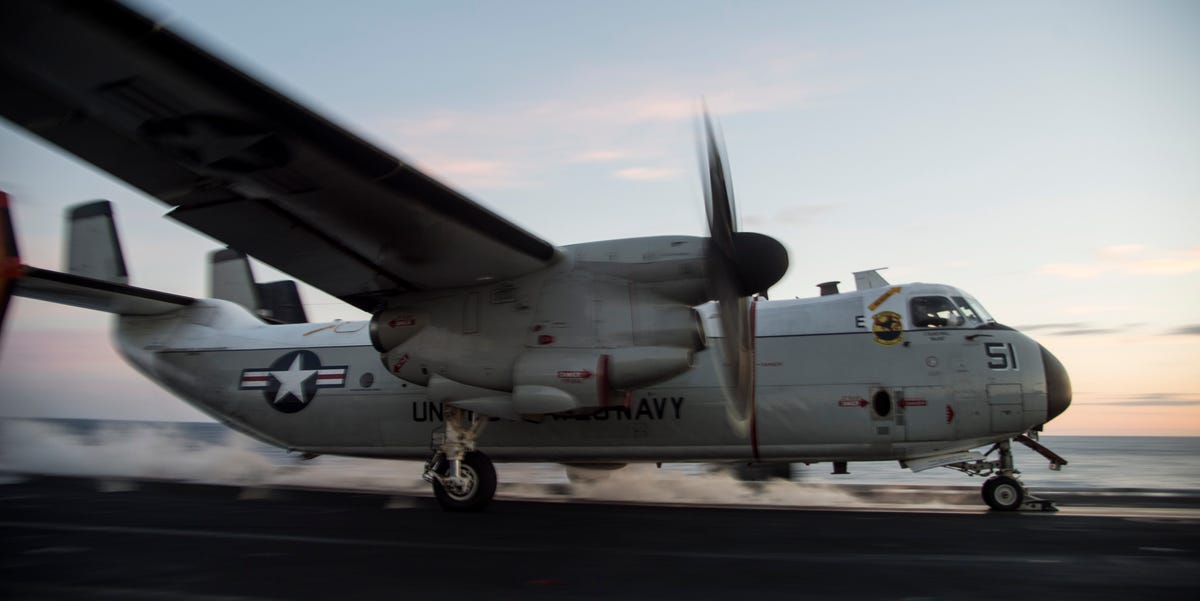
Three miles below the ocean’s surface, sunlight is a rumor, pressure is brutal, and even the most advanced machines have to work like surgeons wearing boxing gloves. Yet that is where the U.S. Navy went to recover a lost C-2A Greyhound aircraft from the Philippine Seaan operation that blended grief, engineering, patience, and deep-sea problem-solving at a scale few people ever see.
The recovery of the aircraft was not simply a dramatic technical achievement. It was a mission tied to accountability, safety, and respect for the sailors lost in the crash. When an aircraft goes down at sea, the ocean does not give up answers easily. Investigators need wreckage, flight data, structural evidence, and clues that can explain what happened. Families need closure. The fleet needs lessons. And somewhere between those needs sits a salvage team staring at 18,500 feet of water and saying, in very Navy fashion, “All right, let’s figure this out.”
This story is about more than a machine lifted from the abyss. It is about how modern naval recovery operations work, why the C-2A Greyhound mattered, what deep-ocean salvage requires, and how one difficult mission helped show the future of underwater recovery.
The C-2A Greyhound: The Navy’s Flying Delivery Truck
The C-2A Greyhound may not have the celebrity status of fighter jets or the cinematic swagger of aircraft carriers, but it played one of the most practical roles in naval aviation. Think of it as the Navy’s airborne delivery vanexcept the “driveway” was a moving aircraft carrier and the “parking spot” required landing on a flight deck in the middle of the ocean.
The C-2A specialized in carrier onboard delivery, often shortened to COD. Its job was to transport mail, cargo, parts, passengers, and urgent supplies between shore bases and aircraft carriers. In the world of carrier operations, a small part can keep a large aircraft grounded, a replacement component can restore mission readiness, and a single flight can make the difference between waiting and working.
Because of that mission, Greyhound crews operated in demanding environments. They flew long routes over open water, approached carriers in changing weather, and carried personnel who were often transferring to or from ships at sea. The aircraft was practical, sturdy, and beloved by many who depended on it. It was not glamorous, but neither is the refrigerator in your kitchenand you definitely notice when it stops doing its job.
What Happened in the Philippine Sea?
On November 22, 2017, a C-2A Greyhound assigned to Fleet Logistics Support Squadron 30 was flying toward the aircraft carrier USS Ronald Reagan in the Philippine Sea. The aircraft was carrying 11 crew members and passengers. During the flight, it crashed into the sea southeast of Okinawa.
Eight people were rescued by U.S. Navy helicopters and brought aboard USS Ronald Reagan for medical evaluation. Three sailors were lost: Lt. Steven Combs, Aviation Boatswain’s Mate Airman Matthew Chialastri, and Aviation Ordnanceman Airman Apprentice Bryan Grosso. Their loss remains the human center of the story, and every technical detail of the recovery sits beneath that larger truth.
Initial search and rescue efforts covered a vast area with support from U.S. and Japanese forces. The Navy later located the wreckage on the ocean floor at a depth of roughly 18,500 feet, more than three nautical miles below the surface. That depth made the planned salvage one of the most challenging aircraft recovery attempts in Navy history.
Why Recover an Aircraft From That Deep?
Recovering an aircraft from extreme depth is expensive, slow, and difficult. So why do it? The answer is simple: evidence. A crash investigation cannot rely only on memory, radar tracks, or assumptions. Investigators need physical proof.
Aircraft wreckage can reveal whether a component failed, whether structural damage occurred before impact, how systems behaved in the final moments, and what lessons should be sent back to the fleet. The flight recorder, often called the black box, may preserve valuable data. Even a broken part can speak volumes when engineers examine it carefully.
Deep-sea recovery also matters because naval aviation is a community built on repeated operations. If one aircraft suffers a failure, investigators must ask whether other aircraft could face the same risk. A recovered component might lead to new inspections, maintenance changes, design reviews, training updates, or emergency procedure improvements. In other words, what is learned from one tragedy may help protect future crews.
The Challenge of Three Miles of Water
At 18,500 feet below the ocean surface, the environment is almost cartoonishly hostileexcept nobody is laughing. The temperature is near freezing. The darkness is complete. Pressure is immense. Communication is delayed and limited. Currents can complicate positioning. Weather at the surface can interrupt work far below.
A salvage ship must hold position above the wreck site with extreme precision. That is not like parking a car. It is more like trying to hover a hotel over a dinner plate while waves shove the hotel around and the dinner plate sits three miles below in the dark.
Human divers cannot work at that depth. The operation requires specialized remotely operated vehicles, deep-ocean cables, sonar systems, lifting equipment, and crews trained to think in terms of both maritime engineering and aviation investigation. Every tool must survive the water pressure. Every connection must work the first time or be recoverable. Every movement must be deliberate because mistakes can cost time, equipment, and evidence.
How the Navy Found the Aircraft
Before anything could be recovered, the Navy had to find the aircraft. Search teams used specialized equipment, including a towed pinger locator designed to detect signals from underwater locator beacons. These beacons help searchers narrow down the position of a downed aircraft’s flight recorder or related equipment.
Once the wreckage area was located, a Navy-led mission aboard the research vessel RV Petrel mapped the debris field using side-scan sonar and a remotely operated vehicle. The survey found the aircraft in two main sections: the cockpit and the fuselage. Mapping mattered because a recovery team cannot simply drop a hook into the ocean and hope for the best. At three miles deep, “close enough” is not a plan; it is a very expensive way to lose more equipment.
Detailed mapping helps teams understand where major sections lie, how the wreckage is oriented, where lift points may be attached, and what environmental conditions could affect the operation. The better the map, the better the recovery plan.
The Role of SUPSALV and CURV 21
The Navy’s Supervisor of Salvage and Diving, commonly known as SUPSALV, leads some of the most technically demanding salvage missions in the U.S. military. For the C-2A recovery, SUPSALV worked from a contracted support vessel and used the deep-ocean remotely operated vehicle CURV 21.
CURV 21 is built for work humans cannot safely do. It can descend into extreme depths, transmit video, manipulate tools, attach rigging, and help recover objects from the seafloor. It is not a cute little underwater drone taking vacation footage of coral reefs. It is an industrial deep-sea robot designed to operate where the ocean is trying very hard to crush everything.
In May 2019, the Navy recovered the fuselage of the downed C-2A Greyhound. The operation supported the mishap investigation and showed how deep-ocean recovery had become a critical part of modern military safety work.
A Recovery Mission With Human Weight
It is easy to get fascinated by the engineering: the sonar, the ROV, the dynamic-positioning vessel, the cables, the lift. But the mission carried emotional weight. Three sailors were lost in the crash. Their shipmates survived. Their families waited for answers. The Navy had to investigate not only because aircraft are expensive, but because people matter.
Military recovery operations often sit at the intersection of technology and duty. The ocean may hide evidence, but the service still has an obligation to try. That obligation can be practical, investigative, symbolic, and deeply personal all at once.
The C-2A recovery also offered a reminder that naval service involves risk even outside combat. Logistics flights, training missions, maintenance operations, carrier landings, and routine transfers all depend on disciplined systems. When something fails, the response must be equally disciplined.
Lessons From the Deep
One major lesson from the C-2A recovery is that deep-ocean salvage is no longer a rare curiosity. It is becoming a necessary capability. Aircraft, helicopters, unmanned systems, sensors, and other military equipment operate across vast ocean areas. When something goes wrong, the ability to locate and recover assets from extreme depths can shape investigations, protect sensitive technology, and improve future safety.
Another lesson is that preparation matters before a crash ever happens. Underwater locator beacons, flight recorders, emergency procedures, rescue coordination, and salvage contracts all become important when time matters. A recovery operation begins long before the ship reaches the site. It begins with design standards, training, maintenance records, and a culture that expects evidence rather than guesses.
The mission also showed the value of partnerships. Navy teams, contracted vessels, private-sector marine specialists, remotely operated vehicle experts, aviation investigators, and fleet commanders all played roles. Deep-sea recovery is not a one-person heroic adventure. It is a giant group projectexcept the classroom is the Pacific Ocean and the deadline is set by weather, currents, and physics.
How Deep-Sea Recovery Protects Future Crews
When investigators recover wreckage, they are looking for patterns. Did a part fail? Did maintenance procedures miss something? Did the aircraft behave as expected under emergency conditions? Did crew training help survival? Were there design or inspection issues that should be addressed?
Answers to those questions can influence the entire fleet. A small discovery inside recovered wreckage may lead to alerts, inspections, revised manuals, or updated training scenarios. The goal is not to assign blame for the sake of blame. The goal is to prevent a similar accident from happening again.
That is why deep recovery has value beyond the individual aircraft. The wreckage becomes a classroom. The data becomes a safety tool. The tragedy becomes part of a larger effort to reduce future risk.
The Ocean as an Investigative Barrier
On land, investigators can secure a crash site, document debris, recover parts, and begin analysis relatively quickly. At sea, everything changes. The wreckage may sink before anyone can inspect it. Currents may spread debris. Saltwater begins working on metal, electronics, and materials immediately. Depth determines whether divers, standard ROVs, or highly specialized systems are needed.
In the C-2A case, the aircraft rested deeper than many conventional salvage systems could reach. That meant specialized equipment had to be brought in, planning had to be careful, and the operation had to wait for suitable conditions. The ocean does not care about schedules. It has been ignoring human calendars for several billion years and seems quite proud of it.
Why This Recovery Captured Public Attention
The phrase “three miles below the ocean’s surface” sounds almost unreal. Most people understand deep water in terms of swimming pools, lakes, or maybe the view from a beach. Three miles straight down is hard to imagine. It is deeper than many mountains are tall. It is a place where pressure, darkness, and distance turn ordinary tasks into major engineering problems.
That is why the recovery captured attention. It combined mystery, military aviation, robotics, ocean science, and human loss. It was a story about finding something that seemed almost unreachable. In an age where people get annoyed when Wi-Fi drops for nine seconds, the idea of operating machinery three miles under the sea feels both futuristic and humbling.
Experiences and Reflections: What This Story Teaches Us About Persistence
Stories like the recovery of the lost Navy aircraft from three miles below the ocean’s surface create a strange feeling. On one hand, the technology is astonishing. On the other, the reason for using it is solemn. That combination makes the story memorable. It is not just “look what the Navy can do.” It is “look how far people will go to understand what happened.”
One experience this topic brings to mind is the way difficult recoveries often require patience before action. In everyday life, people love quick solutions. We restart the router, refresh the page, tap the screen, and expect results. Deep-ocean salvage laughs politely at that attitude. You cannot rush a remotely operated vehicle down three miles of water. You cannot improvise a lift plan for wreckage that may be fragile, twisted, or buried. You have to map, measure, test, plan, and then act carefully.
That patience is a lesson worth carrying beyond naval operations. Many serious problems require slow, disciplined work before visible progress happens. Whether repairing a damaged system, investigating a failure, rebuilding trust, or solving a complex technical issue, the first step is often not dramatic. It is gathering facts. It is accepting uncertainty. It is resisting the urge to guess.
The recovery also highlights teamwork under pressure. Nobody succeeds in a mission like this by being a lone genius in sunglasses. The pilots, rescuers, ship crews, investigators, engineers, ROV operators, planners, and contractors each depend on one another. The operation works only if dozens of specialized jobs connect smoothly. That is a useful reminder in any high-stakes field: expertise matters, but coordination turns expertise into results.
Another powerful experience related to this topic is the emotional side of recovering lost equipment after a tragedy. To outsiders, wreckage can look like metal. To investigators, it is evidence. To families and shipmates, it can represent the last place where loved ones served. Treating that wreckage with respect matters. The mission becomes a bridge between technical necessity and human dignity.
There is also something inspiring about humans building machines to work where humans cannot go. CURV 21 and similar systems are extensions of human curiosity and responsibility. They carry cameras into darkness, arms into pressure, and tools into places that would crush a person instantly. They show that technology is most meaningful when it serves a serious purpose.
For readers, the larger takeaway is not simply that the Navy recovered an aircraft from an extreme depth. It is that hard answers are often hidden in hard places. Sometimes they sit under miles of water. Sometimes they sit inside data, records, conversations, or uncomfortable questions. The discipline is the same: locate the truth, recover what matters, study it honestly, and use the lesson to protect people in the future.
Conclusion
The recovery of the lost Navy C-2A Greyhound from more than three miles below the ocean’s surface stands as a remarkable example of modern deep-sea salvage. It required advanced technology, careful planning, skilled teams, and a commitment to finding answers after tragedy. The operation was not about spectacle. It was about investigation, accountability, and honoring those who were lost.
At 18,500 feet below the Philippine Sea, the Navy faced a place where darkness, pressure, and distance make every task harder. Yet the aircraft was found, mapped, and recovered with the help of specialized systems and determined people. That achievement matters because aviation safety depends on evidence, and evidence sometimes waits in the deepest parts of the ocean.
The story reminds us that recovery is not only about bringing something back. It is about learning from it. It is about turning loss into knowledge and knowledge into protection for the next crew that takes off over open water.