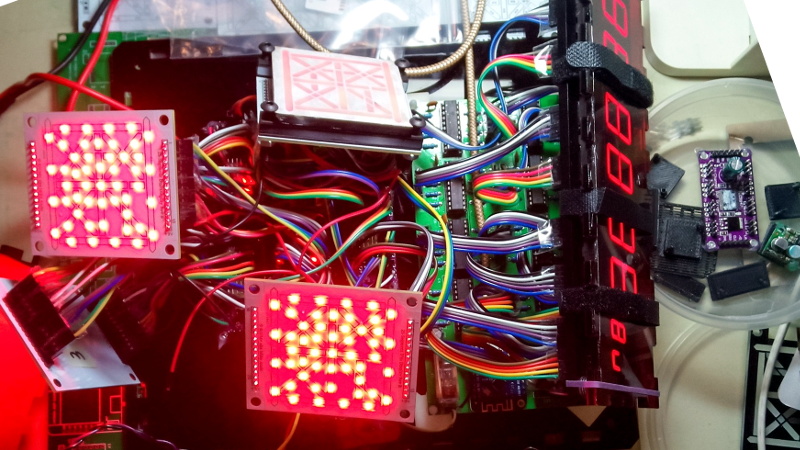
Most clocks have one job: tell you the time and stay politely out of the way. This one clearly never got that memo. The Myst-inspired custom clock built by maker Mike Ando, better known as RIUM+, does tell the time, yes, but it also does something far more delightful. It drags a beloved game universe out of the screen and bolts it onto the wall with acrylic, LEDs, circuitry, and the kind of precision that makes ordinary digital clocks look a little underdressed.
At first glance, the project sounds like a niche crossover designed in a Venn diagram where “retro adventure game fans,” “hardware tinkerers,” and “people who think a normal clock is emotionally insufficient” all overlap. But that is exactly why it works. This is not just a novelty timepiece. It is a practical clock, a tribute to Myst, a piece of interactive design, and a reminder that good worldbuilding does not stay locked inside fiction for long. Eventually, someone with a laser cutter, a soldering iron, and suspiciously strong opinions about fictional numbering systems brings it into the real world.
Why Myst Still Inspires Projects Like This
If you are wondering why anyone would go to the trouble of building a wall clock based on Myst, the short answer is: because Myst has never really left. Cyan’s original 1993 game was not just popular; it helped define what atmospheric, puzzle-driven PC gaming could be. For years it was the best-selling PC game of all time, and its combination of surreal architecture, environmental storytelling, and quiet mystery gave it a cultural staying power that many flashier games never achieved.
That lasting influence matters here. Myst was always a game obsessed with objects: books, levers, panels, gears, clocks, markers, and machines that looked like they had rules even before you knew what those rules were. The world felt handmade and deeply intentional. So when a modern builder creates a real object from that universe, it feels less like fan merchandise and more like uncovering an artifact that somehow slipped through the crack between fiction and reality.
Mike Ando has been in that lane for a while. Years before this clock made the rounds, his real-life Myst linking book drew attention because it turned one of the franchise’s most iconic fictional objects into a physical, functional build. That history matters because the clock does not feel like a random one-off. It feels like part of a larger maker tradition: taking the tactile language of Myst seriously enough to rebuild it with modern tools.
What Makes This Clock So Different
The headline feature is right there in the title: custom LED displays. But not the usual seven-segment, calculator-style digits that show up in a million alarm clocks. That would have been far too easy, and frankly, a little boring. Instead, Ando designed custom segmented displays to represent the D’ni number system associated with the Myst universe.
D’ni numerals are built around a base-25 system, which already tells you this clock was never going to be a casual weekend craft involving one screwdriver and a cheerful online tutorial. In D’ni notation, what humans think of as 25 is written as “10,” because the numbering system rolls over in base 25 rather than base 10. On public D’ni clocks, numbers cycle through a wrapped sequence designed for clock faces, which makes the visual language feel alien, elegant, and just complicated enough to make your coffee hesitate before it kicks in.
That is the genius of the project. It does not merely slap game-inspired graphics on top of standard hardware. It rebuilds the logic of the display around the fictional culture it references. In other words, this clock does not cosplay as D’ni time. It commits to the bit.
How the Custom LED Displays Were Built
This is where the project graduates from “cool idea” to “oh, this person absolutely knows what they are doing.” The custom display modules were made from laser-cut black acrylic, with the voids filled using a diffusion mixture of clear resin and very fine gypsum plaster. That detail sounds small, but it is the secret sauce. LED projects live or die on light quality. A shape can be technically illuminated and still look terrible if the diffusion is patchy, dotted, or uneven. Nobody wants a magical alien numeral that looks like a motel vacancy sign having an off day.
To smooth out the light, Ando used layered construction and added gaskets to reduce light bleed between adjacent cells. He even doubled up the diffusion layers to make the segments appear smoother. The result is a display that looks crisp and intentional, not cobbled together from spare parts and optimism. Behind those panels are custom circuit boards populated with tiny surface-mount LEDs, arranged to match the geometry of each symbol.
That attention to optical design is one reason the clock feels premium. In custom display work, the challenge is not just making light appear. The challenge is making it appear exactly where you want it, with clean edges, consistent brightness, and no ghostly spill into the neighboring segment. Makers working on large segmented displays often run into the same issue, which is why layered acrylic, spacing, and diffusion media are so common in serious LED builds. This clock simply applies those principles to something far stranger and more beautiful than a normal timer.
Why the Display Design Matters
Most consumer clocks are designed for convenience first and personality a distant second. This one flips that relationship without sacrificing function. The custom segments transform the act of reading time into a tiny puzzle, which is perfectly on brand for Myst. Yet it still remains usable because the structure is disciplined. The forms are bright, legible, and consistent. Once you understand the numbering system, the display stops feeling alien and starts feeling satisfying.
That is an underrated design achievement. Plenty of fan builds look impressive in photos but become awkward in daily life. This one seems built for actual living. It is a wall clock first, but one that politely insists you learn a fictional civilization’s counting habits along the way. Honestly, that is more educational than some semesters I could name.
Keeping Accurate Time, Not Just Atmospheric Time
It would have been enough for the clock to look good and display D’ni numerals. But it also had to be accurate, because a fancy wall sculpture that drifts into temporal nonsense is just modern art with a punctuality problem. To handle that, the project uses a WeMos D1 Mini and syncs over Wi-Fi with Network Time Protocol servers. That means the clock is not relying solely on a local oscillator and hoping for the best. It regularly checks in with internet time sources and corrects itself.
That choice is smart and practical. NTP is widely used because it is robust, common, and capable of very good accuracy when configured properly. For everyday human use, that level of synchronization is more than enough. In plain English: your Myst clock is not just dramatic, it is also on time, which is more than can be said for half the people in group chats.
The “self-setting, self-correcting, self-adjusting” aspect of the build is one reason it feels like a finished object instead of a bench experiment. A lot of DIY clocks require manual fiddling, occasional reprogramming, or the emotional resilience to accept that they will be wrong twice a year. This one aims to behave like a real household device. That matters because it bridges fandom and utility. It is not asking for display-cabinet respect. It wants wall space.
What “Myst Time” Actually Means
The phrase “Myst time” sounds poetic, but it has surprisingly specific lore behind it. The D’ni timekeeping system is not just decorative fluff. It has structure. D’ni numbers are base 25, and public clocks count through 25 pahrtahvotee, or bell-like hour divisions, in a cycle suited to everyday use. Meanwhile, a full D’ni day is longer than an Earth day, landing at roughly 30 hours and 14 minutes.
That distinction is important because it explains why the clock is so appealing to hardcore fans. It is not merely borrowing a font or symbol set from the games. It is engaging with the deeper internal logic of the world. Myst fans have always loved that Cyan treated its fictional cultures with anthropological seriousness. Languages, writing systems, architecture, rituals, machinery, and calendars were all designed to feel interconnected. A project like this honors that depth.
And yes, there is also something wonderfully nerdy about putting a fictional 25-based clock on your wall just to know whether it is the right time for Myst Online: Uru Live events. That is not overcommitting. That is called having a theme.
Why This Project Works Beyond the Fandom
Even if you have never played Myst, the clock still lands because it solves a classic maker challenge in a memorable way: how do you create a custom display that feels manufactured, not improvised? Off-the-shelf parts are efficient, but they can flatten originality. Custom builds are expressive, but they often become fragile, messy, or impossible to scale. This project threads the needle.
It uses accessible modern design tools, custom PCBs, laser-cut materials, and internet-connected control hardware to create something that feels bespoke without feeling flimsy. That is why the project resonates with hardware hackers as much as game fans. It demonstrates how far hobbyist fabrication has come. Years ago, something like this would have demanded industrial resources or a heroic tolerance for suffering. Today, a determined builder can design circuit boards in the browser, cut precise acrylic forms, tune light diffusion, and build a one-of-a-kind interface object that looks ready for a design museum gift shop in an alternate universe.
There is also a lesson here about storytelling in physical design. The best objects do not just function; they communicate. This clock tells a story about the person who built it, the fictional world that inspired it, and the design choices required to translate one into the other. It is engineering with subtext, which is far more interesting than engineering with a beige plastic enclosure and a shrug.
The Clock as Art, Tool, and Conversation Piece
What makes the clock so memorable is that it lives in three categories at once. It is a tool because it keeps accurate time. It is art because the custom symbols and layered light diffusion create a visual object worth staring at. And it is a conversation piece because nobody sees it and says, “Ah yes, a standard wall clock, emotionally neutral, moving on.”
Instead, it invites questions. What are those symbols? Why 25? How does it stay synchronized? Is this from a game? Could I make something like this for another fictional language or invented number system? Those are exactly the kinds of questions that great projects provoke. They do not just show off competence; they create curiosity.
In that sense, the Myst clock feels true to the spirit of the series itself. Myst was never about hand-holding. It was about intrigue. It placed strange devices in front of players and trusted them to care enough to learn. This clock does the same thing in miniature. It is a domestic artifact with puzzle energy.
Living With a Myst Clock: The Experience of Time Becoming a Little More Interesting
Imagine walking into a dim room late in the evening and seeing the numerals glowing on the wall. Not ordinary numerals, not the digital blocks your microwave has been flashing since the Bush administration, but elegant symbols with just enough unfamiliarity to make your brain slow down for half a second. That pause is part of the pleasure. The clock does not merely report time. It changes your experience of noticing it.
Most of us interact with time mechanically. We check it between tasks, glance at it before meetings, resent it on Monday mornings, and lose track of it whenever streaming platforms ask, in effect, “Are you still making good decisions?” A clock like this breaks that routine. It makes time feel tactile, designed, and maybe even a little ceremonial. Instead of receiving information instantly and forgetting it instantly, you engage with it. You decode it. You enjoy it. You remember that timekeeping was once an object of craft, not just a tiny number in the corner of a phone screen.
There is also a very specific kind of joy in owning an object that rewards repeat attention. At first, a Myst-themed clock is a novelty. Then it becomes a skill. After a while, reading D’ni-inspired numerals starts to feel natural, and that transition is weirdly satisfying. It is like learning the shortcuts in a favorite city or finally understanding the subway map everyone else pretended was obvious. The clock turns familiarity into a small accomplishment.
And then there is the atmosphere. Custom LED builds have a different emotional quality than mass-market electronics. Maybe it is the layered acrylic. Maybe it is the hand-tuned diffusion. Maybe it is just knowing that a real person had to obsess over light bleed, wiring routes, symbol geometry, and synchronization logic to make this thing exist. Whatever the reason, a handcrafted illuminated object has presence. It does not feel disposable. It feels inhabited by decisions.
That is especially fitting for Myst, a series built on the idea that objects are clues and machines are storytelling devices. A Myst clock on the wall quietly continues that tradition. It suggests there are systems beneath the surface. It makes the room feel a little more like a study, a workshop, or a place where someone might absolutely have a suspicious book collection and several unlabeled levers. In the best possible way, of course.
Even guests who do not know the franchise would probably feel it. They may not recognize the D’ni connection, but they will recognize intention. The clock looks like it belongs to a world. That is rare. Most household gadgets look like they were designed by committee and blessed by a focus group. This one has point of view. It is unapologetically specific, which is often what makes an object memorable.
In the end, that may be the most impressive thing about the project. It proves that themed design does not have to be kitschy, and fandom does not have to be loud to be deep. Sometimes it is enough to build one beautiful object that works exactly as promised and carries a whole universe inside it. A wall clock is a humble thing. But in the right hands, with the right LEDs, even a humble thing can open a little door.
Final Thoughts
Clock Uses Custom LED Displays To Keep Myst Time is the kind of project that reminds us why maker culture is still so compelling. It is technical without being sterile, nostalgic without being lazy, and playful without sacrificing engineering discipline. It takes the internal logic of Myst seriously, then translates that logic into a real, readable, accurate piece of hardware.
That combination is rare. Plenty of builds look cool. Plenty of clocks keep good time. Far fewer manage to be visually distinctive, lore-aware, technically polished, and genuinely useful all at once. This one does. It is a clock, a conversation starter, a design study in custom illumination, and a love letter to one of gaming’s most enduring worlds.
And perhaps that is the real magic here. Not that a fan made a clock inspired by Myst, but that the result feels like something Myst itself would approve of: mysterious, elegant, precise, and just strange enough to make you lean in closer.