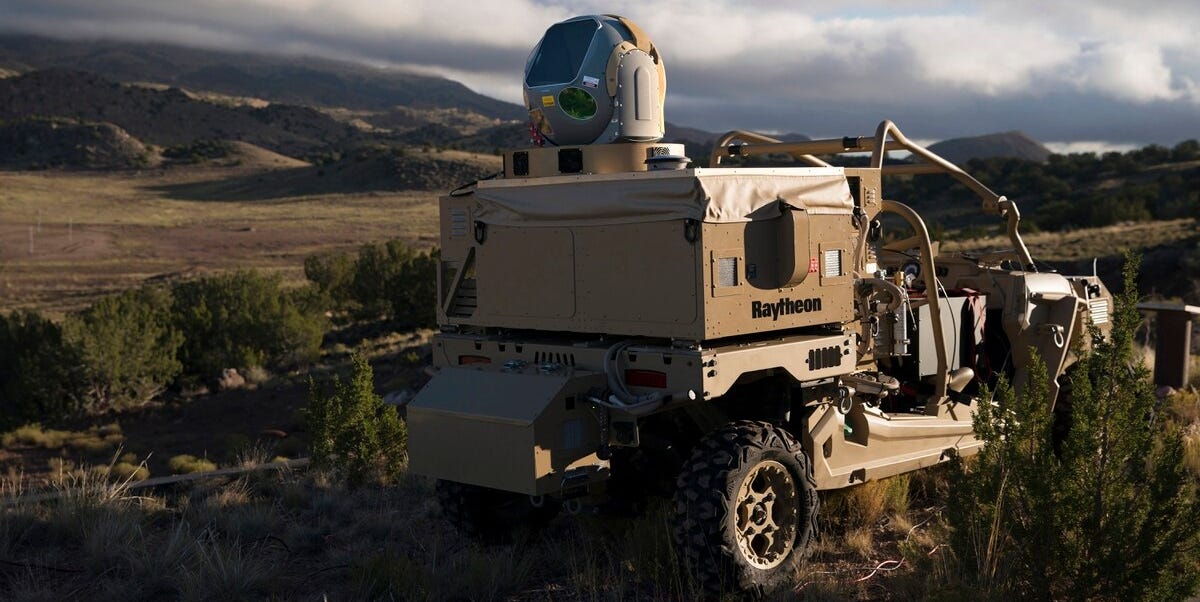
Once upon a time, air base defense meant fences, radar, patrols, missiles, and a stern-looking sign that basically said, “Please do not fly hostile objects here.” That world has not vanished, but it has gained a very futuristic new roommate: directed energy. The U.S. Air Force has been moving laser and microwave weapons from the “cool laboratory demo” category into overseas field assessments, where real operators, real logistics teams, and real base-defense crews can find out whether these systems are ready for the messy business of protecting troops abroad.
The headline sounds like something from a sci-fi paperback with a shiny chrome cover: the Air Force mobilizes its laser and microwave weapons abroad. But the reality is more practical than theatrical. These weapons are being evaluated mainly to counter small unmanned aircraft systems, or drones, which have become cheap, portable, increasingly autonomous, and annoyingly good at causing expensive problems. A $500 drone buzzing near a runway can disrupt operations. A weaponized drone can threaten aircraft, fuel storage, radar systems, and personnel. A swarm of drones can turn base defense into the world’s least enjoyable video game, except the stakes are real.
Why Directed Energy Is Suddenly a Big Deal
Directed energy weapons use concentrated electromagnetic energy rather than bullets, shells, or missiles. In plain English, that means they attack a target with energy instead of throwing metal at it. High-energy lasers can heat or burn through vulnerable parts of a drone. High-power microwaves can disrupt or damage electronic components, potentially knocking out multiple drones at once. Both approaches are attractive because they move at the speed of light, do not require a truckload of interceptor missiles, and can offer a much lower cost per shot than traditional air defense.
The timing is not random. Across recent conflicts, drones have moved from novelty gadgets to battlefield regulars. Small unmanned aircraft can scout, jam, drop explosives, guide artillery, or simply harass defenders until someone wastes a very expensive missile on a very cheap flying lawn mower. For overseas U.S. bases, especially in regions where militias, state-backed groups, or peer competitors can launch drones from long standoff ranges, this creates a serious defensive headache.
Traditional air defense systems are still essential. Nobody is suggesting that lasers should replace Patriot batteries, fighter patrols, electronic warfare, or kinetic interceptors. That would be like replacing an entire fire department with one very confident garden hose. The goal is layering. A directed-energy system may handle small drones, swarms, or low-cost aerial threats so that expensive missiles can be saved for bigger, faster, and more dangerous targets.
HELWS, PHASER, and THOR: The Names Sound Like Comic Book Characters for a Reason
The Air Force Research Laboratory’s overseas effort brought attention to several systems: Raytheon’s High Energy Laser Weapon System, commonly called HELWS; Raytheon’s PHASER high-power microwave system; and AFRL’s Tactical High-power Operational Responder, better known as THOR. The names are dramatic, yes, but each system represents a different answer to the same question: how do you stop hostile drones without emptying the missile magazine?
HELWS: The Laser Approach
HELWS is designed to detect, track, identify, and defeat small drones with a high-energy laser. In concept, the system focuses light energy onto a target until heat damages a critical component. Against small drones, that might mean compromising a motor, airframe, sensor, battery, or control surface. The appeal is precision. A laser can be pointed at a specific target, and if the beam stays focused long enough, the target fails.
The advantages are obvious: speed, accuracy, and a deep magazine limited mostly by available power and cooling. There is no need to reload a laser in the way a missile launcher must be reloaded. That said, lasers are not magic flashlights. Weather matters. Dust, fog, smoke, rain, turbulence, and atmospheric conditions can reduce effectiveness. The system also needs a clear line of sight and enough dwell time on the target. If the target hides behind terrain, flies through clutter, or arrives in large numbers at the same moment, the laser has to work harder.
PHASER: The Microwave Net
PHASER takes a different route. Instead of burning a drone with concentrated light, it uses high-power microwave energy to attack electronics. Think of it less as a sniper rifle and more as an invisible electronic fly swatter. A microwave system can affect multiple drones in a wider beam, which makes it especially interesting for swarm defense. When several drones arrive together, a one-target-at-a-time solution can get overwhelmed. A high-power microwave system is attractive because it may disrupt several targets in a single engagement.
That does not mean every microwave weapon automatically wipes out every drone in the sky. Range, target design, electronic hardening, beam control, and operational conditions all matter. Some drones may be more vulnerable than others. Some may have hardened electronics or flight modes that reduce susceptibility. Still, for the Air Force, the ability to counter groups of unmanned aircraft without firing a missile at each one is a major reason PHASER-like systems are being taken seriously.
THOR: Built for Swarms
THOR may have the most memorable name in the directed-energy family, and it is not shy about its mission. AFRL developed THOR as a counter-swarm electromagnetic weapon for air base defense. It is containerized, transportable, and designed to be moved by aircraft such as a C-130, then set up quickly in the field. The system uses high-power microwaves to create counter-electronic effects against drones, with the goal of disabling multiple targets rapidly.
That transportability matters. Overseas bases do not all look alike. Some are large, permanent installations with hardened infrastructure. Others are expeditionary, dusty, temporary, and held together by grit, logistics, and caffeine. A useful base-defense weapon must do more than work in a test range. It must survive shipping, heat, dust, maintenance cycles, operator turnover, command-and-control integration, and the simple fact that military equipment is often asked to perform in places where the weather seems personally offended by electronics.
Why Send These Systems Abroad?
Testing in New Mexico is valuable. Testing abroad is different. A weapon that performs beautifully on a controlled range still needs to prove that it can operate around real aircraft, real crews, real electromagnetic clutter, real base-defense procedures, and real threat conditions. That is why overseas field assessments are important: they measure military utility, reliability, sustainability, training requirements, maintenance needs, and integration with existing defenses.
In other words, the Air Force is not simply asking, “Can this thing zap a drone?” It is asking a much larger question: “Can normal operators use this system safely and effectively in the daily rhythm of a deployed base?” That includes training airmen quickly, connecting the weapon to sensors and command systems, avoiding interference with friendly operations, and deciding when a drone is suspicious enough to engage.
This last point is not small. Counter-drone defense is not just about the weapon. It is about detection, identification, decision-making, and rules of engagement. A laser or microwave system is only as useful as the network that tells it what to track and when to fire. If the base cannot distinguish a hostile drone from a friendly system, a bird, a balloon, or an innocent hobby aircraft in nearby airspace, the weapon becomes a very expensive source of anxiety.
The Drone Problem: Cheap Offense, Expensive Defense
The main strategic reason for directed energy is cost asymmetry. Attackers can buy or build cheap drones in large numbers. Defenders often respond with missiles, aircraft, or advanced interceptors that cost far more than the target. That is not a sustainable trade. If an adversary can send inexpensive drones and force defenders to spend hundreds of thousands or millions of dollars per shot, the attacker does not need to win every engagement. They only need to drain magazines, budgets, and attention.
Directed energy changes the math. A laser shot or microwave pulse may cost far less than a missile intercept once the system is deployed and powered. That does not make the weapon free; development, procurement, power generation, cooling, spares, training, and maintenance all cost real money. But the at-use cost can be dramatically lower, which makes directed energy a natural fit for repetitive threats such as small drones.
There is also the logistics argument. A missile launcher needs missiles. Guns need ammunition. Interceptors need storage, transport, replacement, and manufacturing capacity. Directed-energy systems need power and maintenance. That is still a logistics chain, but it is a different one. For overseas bases, reducing dependence on shipped munitions can be a major advantage, especially during high-tempo operations or in contested environments where resupply is difficult.
Lasers vs. Microwaves: Which One Wins?
The better question is not which one wins. The better question is which one fits the threat. Lasers are precise and useful against individual targets when the system has line of sight and enough dwell time. They can be excellent for engaging a drone without spreading effects across a wide area. Microwaves may be better when multiple drones arrive together, especially if the goal is to disrupt electronics across a group. One is a scalpel; the other is closer to an electronic broom.
Both have limitations. Lasers can struggle in bad weather or dirty air. Microwaves may have shorter effective ranges and must be carefully managed to avoid unintended effects on friendly electronics. Lasers need beam control and thermal management. Microwave systems need power, targeting, and safety boundaries. Neither system eliminates the need for radar, optical sensors, electronic warfare, kinetic interceptors, or human judgment.
The likely future is not a single wonder weapon. It is a layered defense architecture. A base might use radar and passive sensors to detect drones, electronic warfare to jam command links, lasers to defeat selected targets, microwaves to disrupt swarms, guns or interceptors for leakers, and command software to keep the whole orchestra from playing five different songs at once. It is less “Star Wars” and more “air defense spreadsheet with a death ray column.”
What Overseas Fielding Teaches the Air Force
Overseas deployment teaches lessons that a laboratory cannot. Operators may discover that a user interface is confusing under pressure. Maintainers may find that a component dislikes heat, dust, salt air, or constant vibration. Commanders may learn that the weapon needs better integration with existing sensors. Security teams may need new procedures for deciding when to engage a drone. Legal and safety teams may need clear rules for operating directed energy near friendly aircraft, civilian airspace, and allied forces.
These are not glamorous lessons, but they are the difference between a promising prototype and a useful military capability. The Air Force is particularly interested in reliability and sustainment. A system that works once during a demonstration is interesting. A system that works after months of deployment, repeated training cycles, maintenance hiccups, software updates, power interruptions, and operator turnover is much more valuable.
Another key lesson is whether directed energy can integrate with the base-defense ecosystem. A deployed air base already has radios, radar, air traffic control, security forces, intelligence feeds, and command centers. A new weapon cannot show up like a diva and demand its own spotlight. It has to plug into the system, share data, receive cues, and operate without disrupting the mission it is supposed to protect.
The Strategic Message Behind the Deployment
Moving laser and microwave weapons abroad sends a message beyond the technical test. It tells adversaries that the United States is serious about countering drones with cheaper, faster, and more scalable tools. It also tells allies that air base defense is evolving. In regions where drones and missiles are proliferating, bases are no longer safe simply because they are behind fences or far from the front line. The front line can now arrive in a backpack, a pickup truck, or a container launcher.
Directed energy also supports deterrence. If adversaries believe their drone salvos will be cheaply defeated, the appeal of launching them decreases. Deterrence is not only about threatening punishment. It is also about denying results. A base that can absorb or defeat drone attacks without burning through high-end interceptors is harder to coerce and harder to exhaust.
Still, expectations must stay realistic. Directed-energy systems will not make air bases invincible. They will not replace hardened shelters, dispersal, camouflage, deception, runway repair, active patrols, or traditional air defense. They are one layer in a much larger defensive puzzle. The most successful bases will combine passive defense, active defense, intelligence, mobility, redundancy, and rapid recovery. Lasers and microwaves are exciting, but concrete, sandbags, discipline, and spare parts remain undefeated classics.
Risks, Limits, and the Questions Nobody Should Ignore
Every emerging weapon creates new questions. Safety is one. Directed energy must be operated in ways that protect friendly personnel, aircraft, sensors, and civilian systems. Rules of engagement are another. When is a drone hostile? Who authorizes engagement? How do operators avoid collateral effects? How are engagements recorded and reviewed?
There are also acquisition questions. The Department of Defense has often struggled to move promising prototypes into stable programs of record. This is sometimes called the “valley of death,” the awkward gap between a successful demonstration and a system that is funded, procured, trained, maintained, and improved at scale. Directed energy has lived in that valley for decades. The current drone threat may finally give it a bridge out.
Industrial capacity matters, too. Building reliable high-energy lasers and high-power microwave systems requires specialized components, power systems, beam directors, thermal management, sensors, and software. If the military wants these systems widely deployed, it must support supply chains, training pipelines, testing ranges, and maintenance communities. A laser weapon is not just a laser; it is an ecosystem with a very bright business end.
Operational Experiences and Lessons From the Field
The most useful experience related to the Air Force’s laser and microwave weapons abroad is not the cinematic moment when a drone falls from the sky. It is the slower, less dramatic process of learning how such systems behave during real military routines. Imagine a deployed base at night. Aircraft are launching. Generators are humming. Security forces are watching perimeter cameras. Intelligence staff are tracking regional threats. Somewhere, a radar detects a small object moving in a way that does not match normal traffic. The question is no longer theoretical: is it a harmless object, a surveillance drone, or a weapon coming toward fuel storage?
In that environment, speed matters, but so does confidence. Operators need a clear picture before they engage. A laser system may be cued by radar and then use optical sensors to identify the target. A microwave system may be positioned to cover likely approach routes where a swarm could appear. The crew must know the weapon’s safety zones, its limitations, and its relationship to friendly air operations. Nobody wants to defeat a hostile drone by creating a new problem for the flight line.
Field experience also reveals the human side of advanced technology. A system may be brilliant on paper but frustrating if the interface is clunky. A deployed airman does not need a science fair project during an alarm; the airman needs clear controls, reliable feedback, and training that holds up at 2 a.m. when everyone is tired and the base loudspeaker is suddenly very interested in ruining the evening. AFRL’s emphasis on user-friendly controls and rapid setup reflects this reality. The best technology is not only powerful; it is usable.
Maintenance experience is equally important. Overseas locations can be brutal on equipment. Dust gets everywhere. Heat stresses electronics. Salt air corrodes. Power quality may vary. Transport can shake delicate components. A system that needs constant expert attention may be impressive but impractical. A system that can be maintained by trained military crews, repaired with available parts, and kept mission-capable through a long deployment has a far better chance of becoming part of everyday base defense.
Another lesson is that directed energy works best as part of a team. A laser cannot detect everything by itself. A microwave weapon still needs warning, cueing, and command integration. Electronic warfare may defeat some drones before they come close. Kinetic interceptors may still be needed for larger or hardened threats. The experience of using these systems abroad shows that the future is not one weapon replacing all others. It is a layered defense in which each tool handles the threat it is best suited to defeat.
Finally, field experience teaches humility. Drones evolve quickly. Adversaries adapt. A system that works well against today’s quadcopters may need upgrades for tomorrow’s autonomous, hardened, low-signature, or fiber-controlled drones. That does not make directed energy less valuable. It makes continuous testing, software updates, intelligence feedback, and operator experience more important. The Air Force’s overseas mobilization of laser and microwave weapons is not the final chapter. It is the beginning of a long learning curve, and in modern warfare, learning faster than the opponent is often the real superpower.
Conclusion
The Air Force’s mobilization of laser and microwave weapons abroad marks a turning point in the long story of directed energy. For decades, these systems sounded futuristic but stayed mostly experimental. Now the drone threat has created a practical mission that fits their strengths: defending bases from small, numerous, low-cost aerial threats without spending a fortune on every engagement.
HELWS, PHASER, THOR, and follow-on systems such as CHIMERA show that the Air Force is exploring both precision laser effects and wider-area microwave effects. The logic is clear. Lasers can offer accurate, low-cost engagements against individual targets. Microwaves can help address swarms and electronics-dependent threats. Together, they may give overseas bases a deeper, cheaper, and more flexible defensive layer.
But the promise comes with hard questions about weather, line of sight, safety, integration, maintenance, training, and acquisition. Directed energy is not a magic shield. It is a powerful tool that must earn its place beside traditional air defense, electronic warfare, passive protection, and smart base operations. If the Air Force can solve the practical problems, laser and microwave weapons may become as normal in future base defense as radar is today. The future may not look like a movie, but it may hum quietly in a container, wait for a drone swarm, and make the attacker’s cheap trick suddenly much less cheap.