Looking for a dice game that is easy to learn, cheap to set up, and just dramatic enough to make someone yell, “One more roll!” five seconds before disaster? Welcome to 10,000, also known in many homes as Farkle. It is a classic push-your-luck dice game where players roll six dice, collect points from scoring combinations, and decide whether to safely bank those points or risk everything for a bigger turn.
The beauty of the 10,000 dice game is that it feels simple after one round, but the strategy sneaks up on you. Do you stop at 650 points like a sensible citizen? Or do you roll the last die because you are apparently auditioning for a movie called The Fast and the Foolish? That decision-making tension is why this game has survived kitchen tables, family reunions, school game nights, camping trips, and rainy afternoons for generations.
This guide explains how to play 10,000, the standard dice game rules, scoring combinations, winning conditions, common house rules, examples, and practical tips for playing smarter without turning game night into a spreadsheet convention.
What Is the 10,000 Dice Game?
10,000 is a turn-based dice game for two or more players. Each player tries to be the first to reach 10,000 points, although some groups play to 5,000 for a shorter game or 20,000 when everyone is avoiding chores.
On your turn, you roll six dice. Certain dice and combinations are worth points. After each roll, you must set aside at least one scoring die or scoring combination. Then you choose: stop and bank your points, or roll the remaining dice to try to score more. If you roll and get no scoring dice, you “farkle,” meaning you lose all points earned during that turn.
The game is often called Farkle, Ten Thousand, 10,000 Dice, or Zilch, depending on the region and family tradition. The core idea is usually the same: roll, score, decide, and try not to regret your confidence.
What You Need to Play 10,000
You do not need a special board, app, or luxury dice tower shaped like a medieval castle, although nobody is judging if you have one. To play, gather the following:
- Six standard six-sided dice
- A score sheet or notebook
- A pen or pencil
- Two or more players
- A flat rolling surface, such as a table, tray, or box lid
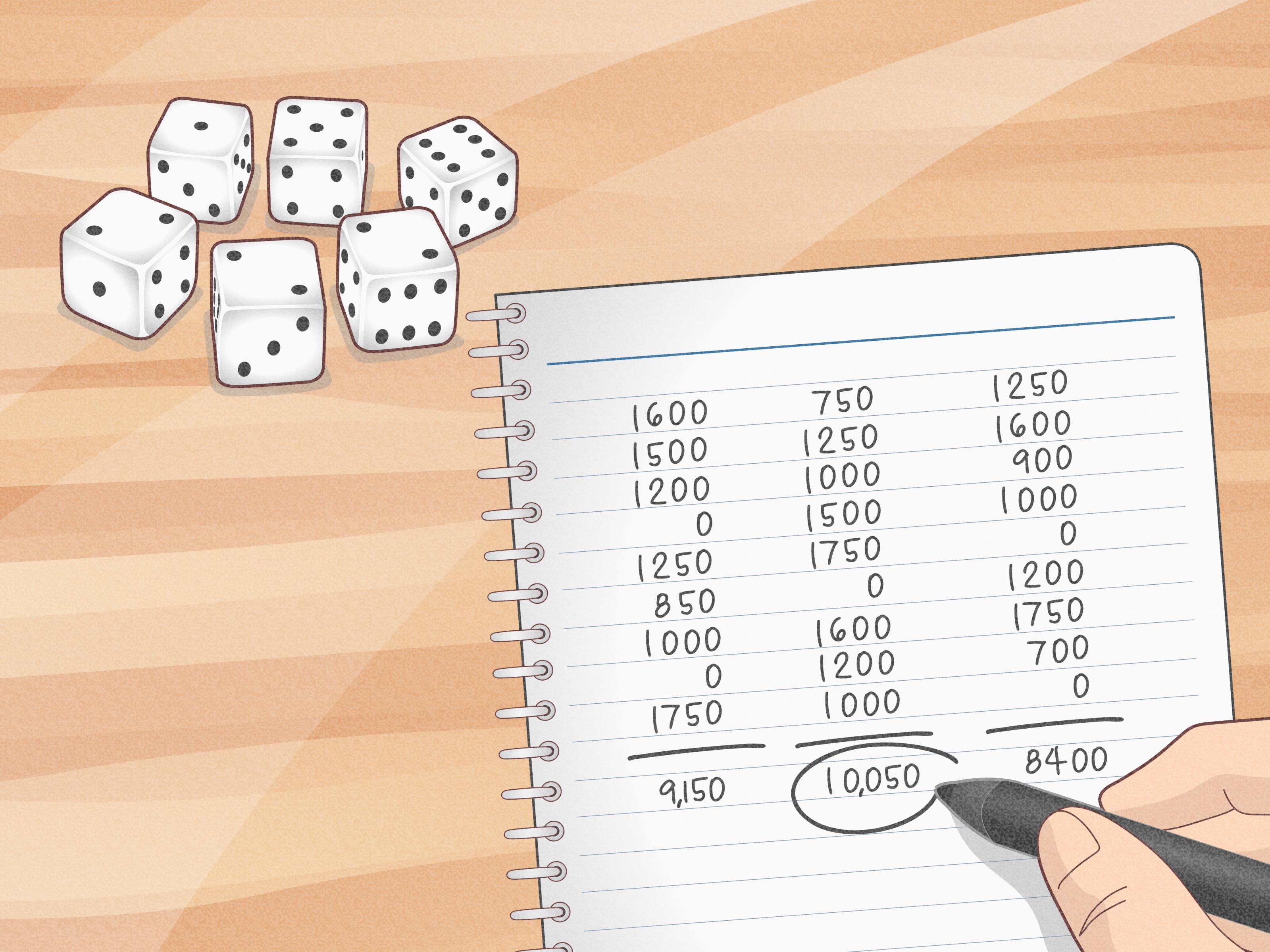
One player should act as scorekeeper. This person should be reasonably trustworthy and not the cousin who once “forgot” to subtract points in Monopoly. Scores are recorded after each player banks a turn.
Object of the Game
The goal of 10,000 is to be the player with the highest score once someone reaches or passes 10,000 points. In many versions, when a player reaches 10,000 or more, every other player gets one final turn to beat that score. After the final round, the highest total wins.
Some groups play that a player must land on exactly 10,000 points. That version is more difficult and can turn the endgame into a tiny math puzzle. For beginners, the “reach or pass 10,000” rule is easier and faster.
Basic 10,000 Dice Game Rules
1. Decide Who Goes First
Each player rolls one die. The highest roll goes first, and play continues clockwise. If there is a tie, tied players roll again. This is the only time a single die can create this much authority.
2. Roll All Six Dice
On your turn, roll all six dice. Look for scoring dice or scoring combinations. At minimum, you must set aside one scoring die if possible.
3. Set Aside Scoring Dice
After each roll, choose which scoring dice to keep. You do not always have to keep every scoring die, depending on the house rules. For example, if you roll a 1 and a 5, you may keep both for 150 points, or keep only the 1 for 100 points and roll the other dice again. This flexibility creates strategy.
4. Keep Rolling or Bank Your Points
After setting aside scoring dice, you may either:
- Stop rolling and bank your current turn score, adding it to your total score.
- Roll the remaining dice and try to earn more points.
If you stop, your points are safe. If you keep rolling and do not roll any scoring dice, you lose only the points from that turn, not your entire game score.
5. Farkle: When a Roll Scores Nothing
A farkle happens when none of the dice you roll can score. Your turn immediately ends, and you score zero for that turn. For example, if you roll 2, 3, 3, 4, 6, 6, that roll has no single 1s, no single 5s, and no three-of-a-kind, so it is a farkle.
Farkling is not a personal failure. It is just the dice gently reminding you that confidence is not a strategy.
6. Hot Dice: When All Six Dice Score
If all six dice are used in scoring combinations during your turn, you have hot dice. You may roll all six dice again and continue adding to your turn total. Some house rules require you to roll again when you get hot dice, while others allow you to bank immediately.
Example: You roll 1, 1, 1, 5, 5, 5. If your scoring chart counts three 1s and three 5s, all six dice score. You can roll all six dice again and keep building the same turn total. This is how huge turns happen. This is also how someone goes from 2,000 points to zero while everyone else makes sympathetic noises.
Standard 10,000 Scoring Chart
Scoring varies from table to table, but the chart below is one of the most common ways to score 10,000 or Farkle. Before starting, make sure all players agree on the exact scoring rules.
| Dice Combination | Common Score |
|---|---|
| Single 1 | 100 points |
| Single 5 | 50 points |
| Three 1s | 1,000 points |
| Three 2s | 200 points |
| Three 3s | 300 points |
| Three 4s | 400 points |
| Three 5s | 500 points |
| Three 6s | 600 points |
| Four of a kind | 1,000 points or double the three-of-a-kind value |
| Five of a kind | 2,000 points or double again |
| Six of a kind | 3,000 points or double again |
| Straight: 1-2-3-4-5-6 | 1,500 points |
| Three pairs | 1,500 points |
| Two triplets | 2,500 points |
Important Scoring Rule: Combinations Must Be Rolled Together
One of the most important 10,000 dice game rules is that combinations usually must happen in a single roll. You cannot build a three-of-a-kind across separate rolls.
For example, suppose you roll one 5 and set it aside for 50 points. Then you roll the remaining dice and get two more 5s. That does not become three 5s for 500 points. Instead, you have three single 5s worth 150 total points. The dice must show the combination at the same time to count as that combination.
Example Turn: How Scoring Works
Let’s walk through a sample turn so the rules feel less like a mysterious dice prophecy.
First Roll
You roll: 1, 3, 3, 3, 5, 6.
You can score the three 3s for 300 points, the single 1 for 100 points, and the single 5 for 50 points. If you keep all scoring dice, your turn total is 450 points, and one die remains.
Decision Time
You could stop and bank 450 points, assuming your house rules allow banking under 500. Or you could roll the last die. With one die, only a 1 or 5 scores. That means four of the six possible results lose your turn points. Risky? Absolutely. Tempting? Also absolutely.
Second Roll
You roll the last die and get a 1. Nice. Add 100 points, bringing your turn total to 550. Now all six dice have scored, so you have hot dice.
Hot Dice Choice
You may roll all six dice again and continue the turn, or bank 550 if your rules allow. If you roll again and farkle, you lose the 550. If you score, your turn could become much bigger. This is the heart of the game: brave, foolish, or brilliantly lucky? Sometimes those are the same person.
Opening Score Rule
Many groups require players to score at least 500 points in one turn before they can get “on the board.” Until a player reaches that opening score, they cannot bank smaller totals. Other common opening thresholds include 350, 400, 600, 750, or 1,000 points.
Once a player is on the board, they may usually bank any score on later turns. This rule makes the beginning of the game more exciting because players must take risks early. It also prevents the scoreboard from being filled with tiny 50-point turns that make the game feel like watching paint dry with dice.
Winning the Game
In the most beginner-friendly version, when a player reaches or passes 10,000 points, the final round begins. Every other player gets one last turn. If another player beats the leading score, they become the new leader. After everyone has had the same number of chances, the highest score wins.
Example: Maya reaches 10,350 points. Ben, Alex, and Jordan each get one final turn. Ben scores 700 and reaches 10,500. Alex farkles. Jordan scores 1,200 and reaches 10,800. Jordan wins because Jordan ends the final round with the highest total.
Common House Rules and Variations
Exact 10,000 Rule
In this version, players must land exactly on 10,000 points. If a player goes over, the turn may not count, or the points may be lost depending on your group’s rule. This makes the ending more strategic and slightly more chaotic.
Three Farkles Penalty
Some players use a penalty for three farkles in a row. A common penalty is minus 500 or minus 1,000 points. This rule adds suspense but can be rough for beginners, so use it only if your group enjoys a little emotional weather.
Piggybacking
In piggybacking, a player may start their turn by rolling the dice left from the previous player’s turn, sometimes with a bonus attached. This version can create big swings and is best for experienced players who already understand the base game.
Must Roll on Hot Dice
Some groups require a player to roll again after scoring with all six dice. Others let the player bank immediately. Decide before the game starts, because this rule can dramatically affect risk and scoring.
Strategy Tips for Playing 10,000
Bank More Often When You Are Ahead
If you already have the lead, you do not need to chase wild turns every time. Banking 400, 500, or 700 points can slowly push you toward 10,000 while forcing other players to take bigger risks.
Take More Risks When You Are Behind
If another player is close to winning, safe little turns may not be enough. This is when rolling with three or four dice remaining can make sense. You still want to avoid reckless decisions, but trailing players often need bigger turns to catch up.
Be Careful With One Die
Rolling one die is dangerous because only a 1 or 5 scores. That gives you a one-in-three chance to score and a two-in-three chance to farkle. If your turn total is already strong, banking may be smarter than gambling it all on one tiny cube.
Know the Value of Remaining Dice
Rolling five or six dice gives you more chances to score. Rolling one or two dice is much riskier. A good rule of thumb: the fewer dice you have left, the more carefully you should think before rolling again.
Agree on Rules Before Starting
Because 10,000 has many variations, the best strategy is not rolling technique. It is communication. Decide the scoring chart, opening score, hot dice rule, and winning condition before the first roll. This prevents midgame debates that begin with “Wait, in my family we always…” and end with someone Googling rules like a courtroom attorney.
Beginner-Friendly Version of 10,000
If you are teaching new players, use this simple version:
- Play with six dice.
- Single 1s are worth 100 points.
- Single 5s are worth 50 points.
- Three 1s are worth 1,000 points.
- Three 2s through three 6s are worth 100 times the number.
- A straight is worth 1,500 points.
- Three pairs are worth 1,500 points.
- Players need 500 points in one turn to get on the board.
- Hot dice may be rolled again, but players are not forced to roll.
- First player to reach or pass 10,000 triggers one final round.
This version keeps the game clear while still allowing exciting turns and big comebacks.
Common Mistakes to Avoid
Forgetting That Turn Points Are Not Safe Yet
Points are not safe until you bank them. If you have 900 points in a turn and decide to roll again, those 900 points are still at risk. Your total score on the score sheet is safe; your current turn score is not.
Combining Dice From Separate Rolls
Remember: three-of-a-kind and other combinations must generally be rolled together. Setting aside one 2, then later rolling two more 2s, does not create three 2s.
Playing With Unclear House Rules
Never assume everyone uses the same scoring chart. One group may score three 1s as 1,000, another may score them as 300. One group may count three pairs as 1,500, another may not count them at all. A quick rule check before playing saves confusion later.
Why 10,000 Is Such a Great Family Dice Game
10,000 is popular because it works for many ages and settings. Kids can practice addition and probability without feeling like they are doing homework. Adults get a light strategy game that does not require a two-hour rule explanation. Grandparents can destroy everyone with calm, surgical banking decisions. It is beautiful.
The game also teaches risk management. Every turn asks a simple question: “Is what I have enough, or should I push for more?” That question is easy to understand and surprisingly fun to argue about. Best of all, the game needs only six dice and something to write on, making it perfect for travel, parties, classrooms, and family nights.
Personal Experiences and Practical Playing Advice
One of the best things about learning how to play 10,000 is discovering that every table develops its own personality. Some groups are cautious and bank every respectable turn. Others play like every roll is sponsored by chaos. After enough games, you start to notice that the dice game itself is only half the entertainment. The other half is watching people negotiate with probability as if the dice can hear them.
When teaching new players, I have found that the first few turns should be slow and open. Let everyone see the dice, talk through the possible scoring choices, and explain what happens if the player keeps rolling. For example, if someone rolls 1, 5, 5, 2, 3, 6, show that they can keep the 1 for 100 points, the two 5s for 100 points, or all three scoring dice for 200 points. Then explain that rolling the remaining three dice is safer than rolling only one die, but still not guaranteed. Once players understand that rhythm, the game becomes much smoother.
A useful habit is to say your running turn total out loud. If you set aside three 4s for 400 points and then a single 1 for 100, say, “I’m at 500 this turn.” This helps the scorekeeper, reduces mistakes, and makes the decision more exciting for everyone watching. It also prevents the classic “Wait, how many points was that?” moment that appears whenever snacks, conversation, and dice all happen at the same table.
Another experience-based tip is to make the scoring sheet visible. A shared score sheet creates tension in a good way. When one player is sitting at 9,650 points, everyone knows the final round may be coming soon. That changes the mood immediately. Players who were banking safely may suddenly take bigger risks. Someone in last place may go on a heroic hot-dice run. Someone else may roll one die with 1,200 points at stake and learn a valuable lesson about humility.
For family games, the 500-point opening rule works well because it keeps the early game lively. Without it, beginners may bank tiny scores repeatedly, and the game can move slowly. With it, players must earn a meaningful first score before joining the scoreboard. However, with younger kids, you may want to skip the opening requirement or lower it to 300 points. The goal is fun, not turning game night into a dramatic survival trial.
For competitive groups, agreeing on the hot dice rule is essential. Allowing players to bank after hot dice makes the game more forgiving. Requiring players to roll again creates bigger swings and louder reactions. Both versions are fun, but they feel different. If your group enjoys wild comebacks, require the roll. If your group prefers strategy and control, allow banking.
The biggest lesson from playing 10,000 often is that the “best” move depends on context. Banking 450 points might be smart early in the game if you are building steadily. The same move might be too cautious if an opponent is already over 9,000. Rolling two dice might be worth it when you are behind, but unnecessary when you are leading. Good players pay attention not only to their dice, but also to the scoreboard.
Finally, remember that 10,000 is supposed to be fun. The dice will betray everyone eventually. Someone will farkle on six dice. Someone will turn 1,500 points into zero. Someone will insist they “had a feeling,” and that feeling will be incorrect. Laugh, reset, and pass the dice. That mix of luck, choice, and harmless table drama is exactly why the game remains so easy to love.
Conclusion
10,000 is one of the best dice games for players who want quick rules, real decisions, and plenty of suspense. The basic flow is simple: roll six dice, set aside scoring dice, choose whether to bank or continue, and try to reach 10,000 before your opponents. The scoring chart may vary by household, but the core game remains the same: push your luck wisely, know when to stop, and do not let one lucky roll convince you that you are invincible.
Whether you call it 10,000, Farkle, or your family’s “don’t roll that last die” game, it is a flexible, portable, and highly replayable classic. Start with the beginner-friendly rules, agree on scoring before the first roll, and let the dice do what dice do best: create joy, suspense, and occasional betrayal.
Note: Scoring rules for 10,000 can vary by family, region, and commercial Farkle set. Before playing, choose one scoring chart and house-rule list so every player follows the same version.