Art history has been painted in oils, carved in marble, assembled from steel, and occasionally argued about by people wearing extremely serious scarves. Yet one delightfully unconventional project proves that the entire subject can also begin with a piece of red onion, a sketchbook, and the sudden realization that dinner is staring back at you.
Berlin-based artist, illustrator, animator, and storyteller Allen Shaw noticed a face-like pattern in a freshly cut onion. Instead of dropping it into the pan, he placed the slice on a sketchbook and photographed it. Later, he turned that accidental face into a playful version of Edvard Munch’s The Scream. One recreation led to another until the same onion slice had traveled through centuries of famous art, borrowing the identities of Renaissance sitters, modern icons, solemn revolutionaries, and one impressively mustached Surrealist.
When an Onion Became an Art-History Time Machine
The basic idea is wonderfully simple. Shaw positioned the onion slice on a blank sketchbook page and drew the surrounding composition in black ink. The onion’s curved purple layers became hair, hats, foreheads, halos, shadows, and facial features. Its two pale internal shapes looked uncannily like eyes, although admittedly the kind of eyes one develops after reading museum labels for six hours.
This is a form of found-object art in which an ordinary item is removed from its expected setting and given a new visual role. The onion is still recognizably an onion, but it also becomes part of a portrait. That double identity creates the joke. Viewers recognize the famous composition, notice the vegetable, and then mentally bounce between the two.
The project also demonstrates how recognizable great artworks can be. Remove their colors, brushwork, and original materials, and many still survive through silhouette, posture, setting, or one memorable detail. A pitchfork can summon American Gothic. A counter beneath fluorescent light can suggest Nighthawks. Add a curled mustache, and Salvador Dalí practically introduces himself.
The 13 Famous Art Recreations, One Layer at a Time
1. The Scream Gets an Extra Reason to Cry
The series began with a vegetable-powered interpretation of Edvard Munch’s The Scream. The onion forms the distressed figure’s oversized head while Shaw recreates the bridge and the composition’s famous flowing lines around it. Munch produced several versions of the image between 1893 and 1910, using it to express emotional anguish within his broader Frieze of Life project. Shaw’s version retains that existential panic but adds a practical explanation: somebody nearby is chopping onions.
2. The Kiss Becomes Slightly More Aromatic
Gustav Klimt’s The Kiss is transformed by placing the onion where the woman’s face would normally appear. The embracing couple, ornate clothing, and close composition remain recognizable even in spare black lines. Klimt created the original in 1907–08 during his celebrated golden period, wrapping the lovers in richly patterned robes that visually unite their bodies. The onion version preserves the intimacy, although the kiss may now require industrial-strength breath mints.
3. American Gothic Meets American Grocery Shopping
Grant Wood’s American Gothic becomes even more deadpan when the onion replaces the woman’s head. The stern man, rigid pitchfork, pointed window, and stiff poses make the source instantly identifiable. Painted in 1930, the original depicts a farmer and his daughter standing before a house Wood saw in Eldon, Iowa. The painting became one of America’s most frequently parodied cultural images, so welcoming an onion into the family feels almost inevitable.
4. Girl with an Onion Earring
In the recreation of Johannes Vermeer’s Girl with a Pearl Earring, the onion’s purple arc fits neatly beneath the young woman’s head covering. Shaw keeps the turned pose, parted lips, dark background, and single dangling earring. The painting, created around 1665, is generally described as a tronie, or a study of an imagined character rather than a conventional commissioned portrait. Modern technical research has revealed details such as tiny eyelashes and evidence of a once-visible green curtain behind the figure.
5. Nighthawks, Now Serving Onion Rings
Edward Hopper’s late-night diner receives a lonely new customer in Shaw’s version of Nighthawks. The onion-headed figure sits apart while the familiar server and customers occupy the illuminated counter. Hopper completed the original in 1942, presenting four people in an all-night diner whose bright interior contrasts with the empty street outside. Its atmosphere of urban isolation remains powerful, but the onion adds a new mystery: Did this customer arrive alone, or did the burger come with fries?
6. Salvador Dalí and the Mustache That Refused to Behave
One drawing does not reproduce a single painting so much as recreate Salvador Dalí’s unmistakable public image. Shaw adds the artist’s sharply curled mustache beneath the onion’s enormous eyes. Dalí became famous not only for Surrealist paintings but also for treating his own appearance as a continuing performance. His mustache became such a powerful personal symbol that a few curved lines are enough to turn a salad ingredient into one of modern art’s most recognizable personalities.
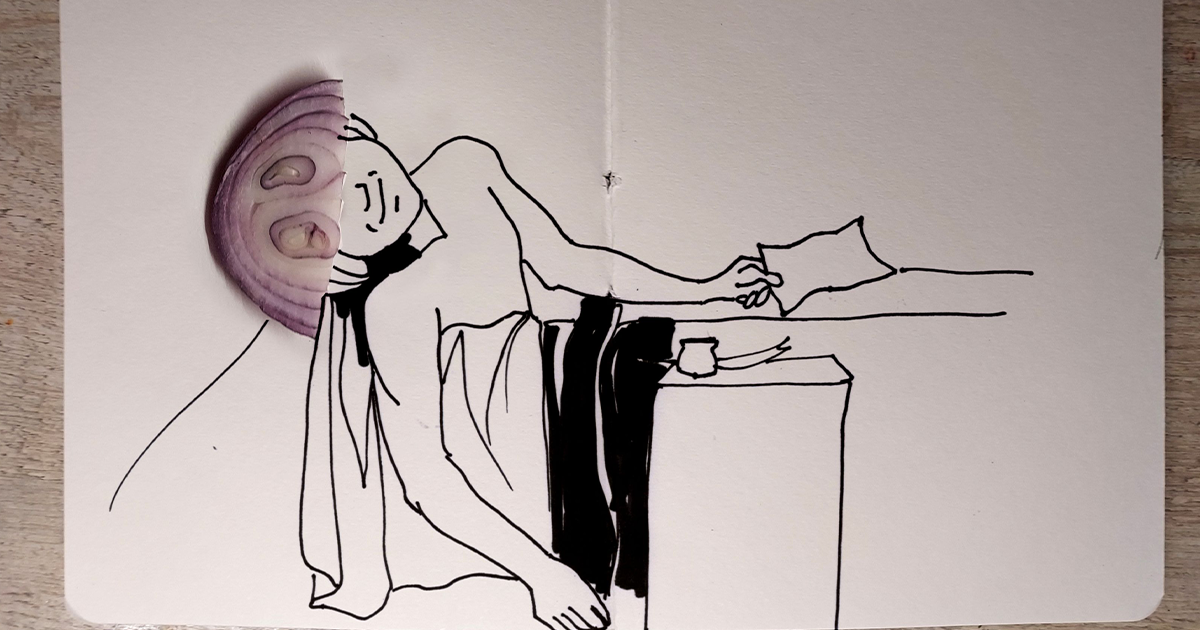
7. The Death of Marat Gets a Vegetable Plot Twist
Jacques-Louis David’s The Death of Marat is recreated with the onion resting on the collapsed revolutionary’s head. The bathtub, hanging arm, letter, and writing surface preserve the original painting’s solemn geometry. David painted the work in 1793 after the murder of Jean-Paul Marat, presenting the radical journalist as a political martyr. Shaw’s version remains visually dramatic, though “death by onion” sounds less like revolutionary history and more like an unusually aggressive cooking accident.
8. A Sunday on La Grande Jatte with an Onion Parasol
The onion becomes a fashionable parasol in a recreation of Georges Seurat’s A Sunday on La Grande Jatte1884. Shaw outlines the park, riverbank, trees, pets, and elegantly dressed visitors, then places the onion above the prominent woman in the foreground. Seurat developed the monumental original through numerous preparatory studies and carefully arranged tiny touches of color. The parody replaces thousands of painted marks with one raw ingredient, which is either artistic efficiency or the boldest shortcut in art-school history.
9. The Mona Lisa Finally Reveals Her Beauty Secret
Leonardo da Vinci’s Mona Lisa receives a dramatic purple hairstyle, with the onion positioned across the sitter’s forehead. Her folded hands, turned body, faint smile, architectural ledge, and distant landscape remain intact. Leonardo used subtle transitions between light and shadow, known as sfumato, to avoid hard outlines and create the portrait’s famously elusive expression. Shaw preserves the smile but supplies a possible explanation: Lisa may simply be trying to remain polite while somebody prepares lunch nearby.
10. Norman Rockwell Paints Himself as Produce
Norman Rockwell’s Triple Self Portrait is ideal for a joke about artistic identity. In the original, Rockwell sits before a mirror while painting a more flattering version of himself on canvas. Shaw places the onion inside the painted portrait, creating another layer of transformation. Produced in 1960 for The Saturday Evening Post, Rockwell’s work combines technical skill with self-deprecating humor. The onion fits naturally because the original painting was already playing games with appearance, observation, and vanity.
11. Lady with an Ermine and an Extraordinary Hairdo
Another Leonardo masterpiece, Lady with an Ermine, is reimagined with the onion forming a blunt, architectural hairstyle. The sitter still holds the alert animal while turning toward something beyond the frame. The woman is commonly identified as Cecilia Gallerani, and the ermine has been interpreted through associations with purity, courtly identity, and wordplay connected to her name. Technical investigation has also indicated that Leonardo revised the animal during the painting process. Apparently, even Renaissance geniuses occasionally looked at a composition and thought, “This needs more weasel.”
12. A Van Gogh-Inspired Self-Portrait
Shaw uses the onion as the upper half of Vincent van Gogh’s face, surrounding it with energetic, swirling lines that echo the painter’s expressive approach. Van Gogh painted himself repeatedly, particularly during his Paris years, partly because hiring models was expensive. Those portraits became opportunities to test complementary colors, short brushstrokes, and changing approaches to expression. In the onion interpretation, the vegetable’s natural rings conveniently provide the movement that Van Gogh normally created with paint.
13. The Arnolfini Portrait Gains One More Mystery
The final recreation takes on Jan van Eyck’s Arnolfini Portrait. Shaw includes the couple, chandelier, circular mirror, elaborate clothing, domestic interior, and tiny dog, while the onion becomes the woman’s head. Painted in 1434, the original is famous for its precise surfaces, complex symbolism, and highly effective use of layered oil paint. Scholars continue to debate aspects of the figures, ceremony, and objects. The onion solves none of those mysteries, but it gives the little dog something new to worry about.
Why the Onion Art Project Works So Well
The humor depends on recognition, but the project is more than a collection of visual puns. It compresses art history into a format that feels informal and welcoming. Someone who might avoid a dense textbook can still recognize The Scream, laugh at the onion, and become curious about Munch. Comedy opens the door; art history quietly walks in behind it.
The series also shows that iconic art is often built from memorable visual decisions. The tilted head in Vermeer’s painting, the pitchfork in American Gothic, the glowing diner in Nighthawks, and the tiny mirror in the Arnolfini Portrait function almost like visual signatures. Shaw does not need to reproduce every detail. He supplies just enough information for the viewer’s memory to complete the image.
Most importantly, the onion remains visible in every composition. Shaw does not disguise its texture or paint over its layers. The joke would become weaker if the vegetable disappeared completely. Successful found-object art allows the material to be two things at once: an ordinary object and an imaginative substitute.
How to Try an Everyday-Object Art Challenge
You do not need expensive materials to explore the same idea. Begin by examining objects with strong shapes or textures: leaves, coffee stains, paper clips, fruit peels, bottle caps, torn cardboard, or oddly folded socks. Rotate each object and photograph it from several angles. A banana peel might become a dancer, a leaf could become a Victorian collar, and a coffee ring is already halfway to becoming a planet.
Next, choose a familiar artwork with a clear composition. Print a small reference or study it on a screen, then identify the minimum number of lines needed for recognition. Avoid copying every detail. The challenge is to connect the real object to the drawing, not to produce a museum-perfect replica.
Lighting matters. Soft light makes the object’s shape and texture easier to read without creating distracting shadows. A plain sketchbook or sheet of heavy paper provides a clean background. Photograph the completed arrangement promptly, especially when using food, flowers, or other materials that wilt, leak, or begin developing artistic opinions of their own.
Finally, let the object guide the selection of the artwork. Shaw’s project succeeds because the onion already resembled a face. He did not force a square vegetable into a circular role. Constraints encourage better ideas by narrowing the available choices and making unexpected connections easier to notice.
The Experience of Seeing Creativity in Ordinary Things
Projects like this change the way everyday objects are perceived. After spending time looking for possible characters in an onion, it becomes difficult to return to a kitchen without noticing personalities everywhere. A bell pepper has an interior architecture worthy of a cathedral. A cracked eggshell resembles a landscape after an earthquake. A spoon can become a silver face, a canoe, a moon, or a tiny mirror for a very vain mouse.
The first lesson is that creative ideas rarely arrive in a formal, dignified manner. They often appear while cooking, cleaning, commuting, or avoiding a task that was supposedly urgent ten minutes ago. Shaw’s onion was not purchased as an art supply. It became useful because he paused long enough to notice its face-like pattern. That pause is a creative skill in itself.
The second lesson is that limitations can make a project stronger. Using the same onion slice 13 times creates continuity and gives viewers a game to play. They begin anticipating the next transformation: Will it become hair, a hat, a face, or part of the scenery? A completely open assignment can feel overwhelming, while one object and one sketchbook provide a clear set of rules.
There is also a satisfying contrast between the temporary object and the enduring artwork it references. Masterpieces such as the Mona Lisa and Girl with a Pearl Earring have survived for centuries under careful protection. The onion has a far less ambitious preservation plan. It will dry, soften, discolor, and eventually return to the kitchen or compost bin. Photography allows the temporary arrangement to survive without pretending that the physical material is permanent.
Another enjoyable part of the experience is discovering how little information the eye needs. A few black lines can awaken an entire painting from memory. This realization can make art history feel less like a catalog of dates and more like a collection of visual ideas. The viewer notices pose, balance, rhythm, negative space, costume, and gesture because color and painterly texture have been stripped away.
Recreating famous art with ordinary materials can also reduce the fear of making mistakes. Nobody expects an onion to outperform Leonardo. The humorous premise grants permission to experiment, draw imperfectly, and move on quickly. That freedom is valuable for beginners, children, professional illustrators, and anyone whose inner critic has appointed itself director of a major museum.
Finally, the project offers a reminder that parody and admiration can coexist. Shaw’s drawings tease the solemn reputation of famous artworks, but they also depend on close observation and affection. The compositions are recognizable because the artist studied what made them distinctive. The result does not diminish art history. It invites more people to join the conversation, preferably while keeping a safe distance from the cutting board.
Conclusion: Art History Has Layers
A single onion slice becomes 13 different characters because imagination is less concerned with what an object is than with what it might become. Allen Shaw’s playful series moves from the Northern Renaissance to Surrealism and modern American painting without requiring oil paint, gold leaf, or a private gallery. All it needs is a sketchbook, a marker, and a vegetable with excellent facial structure.
The project is funny, memorable, and surprisingly educational. It demonstrates how iconic compositions survive radical simplification, how found objects can generate narratives, and how humor can make art history accessible. It may also permanently change the experience of preparing dinner. Once you have seen an onion as Munch’s screaming figure, there is no going back. There are only more layers.