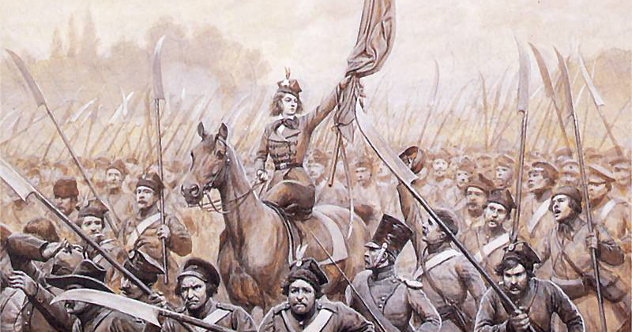
History books have a bad habit of putting women near the edge of the page: sewing a flag, cheering from a balcony, or being described as “the wife of” someone who gets much larger type. But when ordinary people pushed back against empires, enslavement, colonial rule, and political oppression, women were often nowhere near the sidelines. They recruited fighters, built supply networks, negotiated with enemies, organized communities, and, when necessary, picked up weapons.
These women who led rebellions came from different centuries, continents, and cultures. Some commanded armies. Some turned mountains, forests, and local knowledge into military advantages. Some led revolutionary movements that failed in the moment but changed how later generations understood freedom. Their stories are not identical, and neither are the causes they fought for. What connects them is leadership under pressurethe kind that does not wait for a perfect invitation, a polished podium, or a committee meeting with decent coffee.
This list celebrates ten extraordinary female rebellion leaders whose courage and strategy made them lasting symbols of resistance.
1. Boudica: The Celtic Queen Who Shook Roman Britain
Boudica, queen of the Iceni people in eastern Britain, led one of the most dramatic uprisings against the Roman Empire around A.D. 60 or 61. After the death of her husband, King Prasutagus, Roman officials moved to absorb Iceni territory and reportedly subjected Boudica and her family to brutal treatment. That was a spectacularly bad decision for anyone hoping to enjoy a quiet administrative career.
Boudica rallied the Iceni and allied groups, including the Trinovantes, against Roman rule. Her forces destroyed Camulodunum, now Colchester, and attacked Londinium, now London, before moving on to Verulamium. Roman accounts describe enormous destruction, although those accounts were written by the victors and should be read with appropriate historical caution. Boudica’s uprising was eventually defeated by the Roman governor Suetonius Paulinus, but her legacy endured. She became a powerful symbol of British resistance, national memory, and the refusal to accept humiliation as policy.
2. Trưng Trắc: A Queen Who Turned Grief Into Revolt
In A.D. 40, Trưng Trắc helped lead a rebellion against Han Chinese rule in what is now northern Vietnam. Traditional accounts connect the revolt to political oppression and to the killing of her husband, Thi Sách, by Han authorities. Whatever the precise mix of personal loss and public anger, Trưng Trắc transformed outrage into organized resistance.
She and her supporters seized control of a large part of the Red River Delta, and Vietnamese tradition credits the movement with reclaiming dozens of citadels. Trưng Trắc was proclaimed queen, an extraordinary achievement in a period when imperial power preferred its local subjects quiet, compliant, and very much not running their own governments. The Han dynasty sent General Ma Yuan to suppress the rebellion, which was defeated in A.D. 43. Yet Trưng Trắc remains one of Vietnam’s most revered historical figures and a lasting example of women in resistance movements.
3. Trưng Nhị: The Sister Who Helped Build a Nation’s Legend
Trưng Nhị was not a supporting character in her sister’s story. She was a co-leader in the Trưng sisters’ rebellion and an essential part of one of Southeast Asia’s most enduring independence legends. Together, the sisters became symbols of collective leadership, showing that political courage is not always a solo performance with one person hogging the spotlight.
The sisters’ revolt challenged Han authority at a time when local populations faced heavy political control, taxation, and cultural pressure. Their leadership inspired armies that included women commanders in Vietnamese historical memory. Even after the rebellion was defeated, the Trưng sisters became cultural touchstones for independence, sovereignty, and national pride. Their story has been celebrated for centuries in temples, festivals, literature, and public memorials. Trưng Nhị’s place beside Trưng Trắc matters because rebellions are rarely built by one lone hero; they are built through trust, shared purpose, and people who refuse to let one another stand alone.
4. Queen Nzinga: The Diplomat Who Also Knew How to Fight
Queen Nzinga of Ndongo and Matamba, in present-day Angola, was one of the most formidable African rulers of the seventeenth century. She governed during a brutal period of Portuguese expansion and transatlantic slave trading, when European colonial power was aggressively reshaping central Africa. Nzinga answered with diplomacy, military alliances, strategic relocation, and a talent for making powerful opponents realize they had underestimated the wrong person.
As a negotiator, she worked to protect the interests of Ndongo. As a ruler, she resisted Portuguese efforts to control territory and enslave local populations. After becoming ruler of Matamba, she strengthened the kingdom as a base of resistance, formed alliances when useful, and adapted tactics as conditions changed. Her long struggle was not a single uprising with a neat beginning and end; it was sustained anticolonial resistance over decades. Queen Nzinga’s leadership demonstrates that rebellion can be fought with a spear, a treaty, a fortified settlement, or all three before lunch.
5. Nanny of the Maroons: The Guerrilla Leader of Jamaica’s Blue Mountains
Nanny of the Maroons, often called Queen Nanny, led communities of self-emancipated people in eighteenth-century Jamaica. The Windward Maroonsmany of them formerly enslaved Africans and their descendantsbuilt independent settlements in the island’s rugged interior and resisted British colonial authorities during the First Maroon War.
Much of Nanny’s biography survives through oral tradition, while written colonial records are incomplete and often hostile. What is clear is that the Windward Maroons used terrain, camouflage, communication systems, and guerrilla tactics to resist a better-armed colonial force. Nanny Town, located in the Blue Mountains, became associated with this resistance. The British eventually negotiated treaties with Maroon communities, recognizing a measure of autonomy. Nanny’s legacy is immense: she is honored as Jamaica’s only female national hero, and her story reminds us that freedom movements often begin in places empires dismiss as remoteright up until those places become impossible to control.
6. Bartolina Sisa: The Aymara Commander at La Paz
Bartolina Sisa was an Aymara leader who helped organize one of the most significant Indigenous uprisings against Spanish colonial rule in the Andes. In 1781, alongside Túpac Katari and other Indigenous leaders, she played a major role in the siege of La Paz, then a colonial stronghold in the Viceroyalty of Peru.
Sisa was more than a symbol of resistance. She helped manage military camps, coordinate forces, and sustain the siege across the high-altitude landscape surrounding the city. The uprising drew strength from widespread anger over colonial exploitation, forced labor, taxation, and violence against Indigenous communities. Spanish authorities eventually broke the resistance, captured Sisa, and executed her in 1782. Her death was intended to intimidate others; instead, it helped make her an enduring emblem of Indigenous resistance. Today, Bartolina Sisa is honored across Bolivia and beyond as a revolutionary leader whose courage continues to inspire Indigenous women’s movements.
7. Micaela Bastidas: The Strategic Mind Behind a Major Andean Rebellion
Micaela Bastidas was a central leader of the Túpac Amaru II rebellion against Spanish rule in Peru. Too often introduced merely as the wife of José Gabriel Condorcanqui, known as Túpac Amaru II, Bastidas was a strategist, organizer, communicator, and military decision-maker in her own right. Calling her only a spouse would be like calling a ship’s navigator “someone who happened to be near the map.”
During the rebellion of 1780–1781, Bastidas helped oversee recruitment, intelligence, supplies, and communications across a difficult Andean landscape. Historical evidence shows that she urged faster action at key moments, recognizing that delay gave Spanish forces time to regroup. Her role reveals how revolutions depend on logistics as much as battlefield drama. Food must move, messages must arrive, alliances must hold, and somebody has to make decisions when everyone else is shouting. Bastidas was captured and executed by Spanish authorities in 1781, but her reputation as one of Latin America’s most important women revolutionaries has only grown stronger.
8. Rani Lakshmibai: The Warrior Queen of Jhansi
Rani Lakshmibai of Jhansi became one of the most famous leaders of the Indian Rebellion of 1857. After the British East India Company refused to recognize her adopted son as heir to the throne of Jhansi under its Doctrine of Lapse, the queen faced the possible annexation of her state. She did not respond by writing a politely disappointed letter and waiting for customer service to call back.
When rebellion spread across northern India, Lakshmibai emerged as a military and political leader. She defended Jhansi against British forces, organized resistance, and later joined other rebel leaders in central India. Accounts of her final days have been shaped by legend, but historians agree that she died in battle in 1858 while fighting British forces near Gwalior. Her death did not end her influence. Rani Lakshmibai became a national icon of courage, anticolonial resistance, and women’s leadership in wartime. Her story continues to resonate because it pairs fierce determination with a clear political demand: a people should not lose their future because an empire finds paperwork convenient.
9. Yaa Asantewaa: The Queen Mother Who Refused to Surrender the Golden Stool
Yaa Asantewaa, queen mother of Edweso in the Asante Empire, led resistance against British colonial rule in 1900 during the War of the Golden Stool. The conflict began after British officials demanded access to the Golden Stool, a sacred symbol of Asante authority and identity. To treat it as a trophy was not merely tone-deaf; it was a direct challenge to the political and spiritual foundation of the Asante people.
When some male leaders hesitated, Yaa Asantewaa famously called on the people to resist. She helped mobilize an army and became the leading figure in the campaign against British forces. The rebellion was eventually defeated, and Yaa Asantewaa was exiled to the Seychelles, where she remained until her death. Yet the uprising became a defining moment in Ghanaian history. Yaa Asantewaa’s leadership has been remembered not because she promised an easy victory, but because she recognized that some symbols are worth defending when they represent a community’s right to govern itself.
10. Blanca Canales: The Teacher Who Led the Jayuya Uprising
Blanca Canales was a Puerto Rican educator, nationalist, and leader of the Jayuya Uprising of 1950. A member of the Puerto Rican Nationalist Party, she became involved in a movement calling for Puerto Rican independence at a time of intense political tension and restrictions on nationalist expression.
During the uprising, Canales helped lead Nationalist forces in the mountain town of Jayuya. Rebels took control of key sites, raised the Puerto Rican flag, and declared Puerto Rico a free republic. The revolt was quickly suppressed by government forces, but Canales’s actions made her one of the most recognizable women in Puerto Rico’s independence movement. She was arrested and spent years in prison before receiving a pardon. Her story is a reminder that rebellions do not always begin with generals in elaborate uniforms. Sometimes they begin with a teacher, a community network, a hidden cache of supplies, and a belief that silence is no longer acceptable.
What These Women Who Led Rebellions Have in Common
These ten women lived in radically different worlds, but their rebellions share a few striking patterns. First, none of them led in a vacuum. Boudica relied on tribal alliances. The Trưng sisters drew strength from local communities. Nanny’s resistance depended on Maroon networks and knowledge of Jamaica’s mountains. Micaela Bastidas coordinated people, messages, and resources across the Andes. The point is simple: rebellion leadership is collective work, even when history later places one name on a monument.
Second, they understood that power is practical. Inspiring speeches matter, but so do routes, food stores, weapons, communications, hiding places, and trusted messengers. This is why women’s historical leadership has often been underestimated. Traditional histories sometimes glorify the person on horseback while ignoring the person who made sure the horse had a route, a rider, allies, and somewhere safe to sleep. The women on this list did both kinds of work. They inspired people and built systems.
Third, their stories show that defeat does not erase significance. Many of these rebellions were crushed by stronger imperial or colonial forces. Yet the leaders became more than military figures. They became symbols of cultural survival, national dignity, Indigenous rights, antislavery resistance, and political self-determination. A rebellion can fail militarily and still succeed in changing the future vocabulary of freedom.
Experiencing the Lessons of Women-Led Rebellions
Reading about these women can feel like walking through ten different doorways into the same difficult room: the room where people decide they have reached the limit of what they can endure. That experience is important because it changes the way rebellion is understood. From a distance, a revolt may look like a date, a battle, a statue, or a paragraph in a textbook. Up close, it is fear mixed with preparation. It is a family deciding whether to leave home. It is a messenger carrying information across dangerous territory. It is a leader trying to keep exhausted people focused when the enemy has more weapons, more money, and a much more irritating sense of entitlement.
The stories of Boudica, the Trưng sisters, Queen Nzinga, Nanny, Bartolina Sisa, Micaela Bastidas, Rani Lakshmibai, Yaa Asantewaa, and Blanca Canales offer a more human experience of political resistance. They reveal that leadership is not always loud. Sometimes it is a negotiation designed to buy time. Sometimes it is a warning that an army must move quickly. Sometimes it is building a community in the mountains and teaching people how to survive beyond the reach of plantation owners or colonial patrols.
There is also a useful lesson in how these women are remembered. Some are surrounded by legend, and some were documented mainly by enemies who had every reason to minimize, distort, or sensationalize their influence. That does not mean their stories should be dismissed. It means readers should approach them with both admiration and curiosity. Historical thinking is not about draining every story of its power. It is about asking better questions: Who recorded this event? Whose perspective was missing? What did leadership look like beyond the battlefield? Why did later generations keep retelling this story?
For students, writers, and anyone interested in world history, these women offer a practical kind of inspiration. They show that courage is rarely a magical trait that appears at sunrise with a soundtrack. It is often built through responsibility. A person sees a community threatened, understands the stakes, and chooses to act despite the danger. That choice can take the form of organizing, teaching, sheltering people, carrying messages, leading a raid, defending a city, or refusing to surrender a sacred symbol.
Most of all, these women remind us that freedom movements have never belonged to one gender, one nation, or one era. Women have always shaped rebellionssometimes visibly, sometimes behind the scenes, and sometimes so effectively that their enemies tried very hard to make the record forget them. Fortunately, history has a way of letting determined people return. Not as ghosts, exactly, but as names that refuse to stay buried.
Conclusion: Why These Female Rebellion Leaders Still Matter
The stories of these amazing women who led rebellions are not simple tales of victory. They are stories of resistance, political imagination, and leadership in moments when the safer choice would have been silence. From Boudica’s revolt against Rome to Blanca Canales’s stand in Jayuya, these women challenged systems that claimed to be permanent and proved that power is never as secure as it looks.
Remembering women revolutionaries does more than correct the historical record. It expands our understanding of what leadership looks like. It can wear a crown, carry a message, organize a mountain community, negotiate with an empire, or raise a flag in a town square. These ten women did not wait for history to make room for them. They made the room themselvesand history is still catching up.