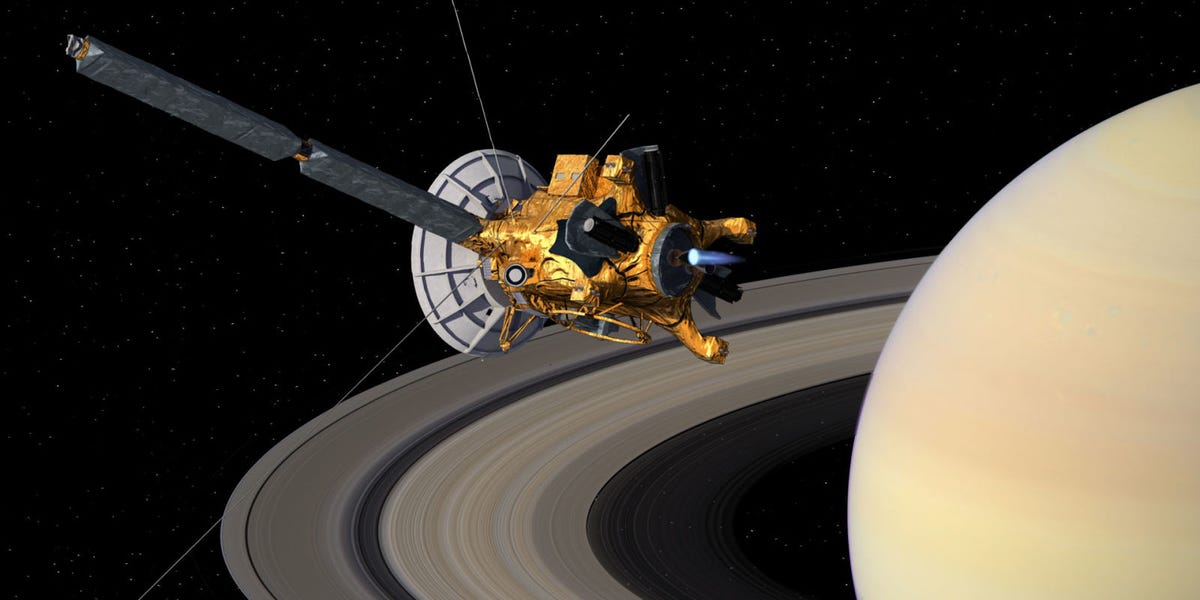
Saturn’s largest moon has never been interested in making introductions easy. Titan hides beneath a thick orange haze, keeps lakes of liquid hydrocarbons near its poles, and runs a weather system powered by methane instead of water. It is less “welcome to the neighborhood” and more “mysterious figure standing under a streetlamp in a science-fiction detective movie.” Fortunately, NASA’s Cassini spacecraft spent years learning how to look past the disguise.
In May 2017, during the final months of its mission, Cassini captured striking new views of bright, feathery methane clouds sweeping across Titan’s northern hemisphere. The images were visually beautiful, but their real value went beyond scenery. They gave planetary scientists another chance to examine Titan’s seasonal weather, track where clouds appeared, compare observations with climate models, and study the relationship between the moon’s atmosphere and its dark northern lakes and seas.
What Cassini Photographed Above Titan
Bright Cloud Bands in the Northern Sky
Cassini took the best-known images in this set on May 7, 2017. One enhanced view showed long, pale bands of methane clouds crossing Titan at northern latitudes. Dark regions near the top of the image were not shadows or missing pixels; they were hydrocarbon lakes and seas clustered around the north pole. The contrast made the scene look almost familiarclouds above lakesuntil one remembers that the liquid below was mainly methane and ethane, and the surface temperature was cold enough to make an Antarctic winter seem like patio weather.
The spacecraft obtained the view during a distant, non-targeted flyby. In one published frame, Cassini was about 316,000 miles, or 508,000 kilometers, from Titan. The orthographic projection was centered near 57 degrees north latitude and 48 degrees west longitude, with a scale of roughly 2 miles, or 3 kilometers, per pixel. A companion image provided a broader look at the northern summer cloud system and included isolated streaks extending toward lower latitudes.
Why the Images Do Not Look Like Ordinary Vacation Photos
Titan’s atmosphere is rich in nitrogen and contains methane, while its high-altitude organic haze blocks a clear visible-light view of the surface. Cassini therefore relied on carefully selected spectral filters and several remote-sensing instruments. Near-infrared wavelengths could take advantage of atmospheric “windows” where methane absorbed less light, allowing scientists to separate cloud features from the surface below.
Image processing also mattered. NASA released versions with different levels of enhancement because subtle cloud structures can disappear in a softer treatment. Enhancement does not mean scientists painted imaginary weather onto Titan. It means they adjusted contrast so genuine differences in recorded brightness became easier for human eyes to recognize. Space imagery often involves less “point and shoot” and more “point, measure, calibrate, process, argue politely in a meeting, and then publish.”
Titan’s Methane Weather: Earth-Like but Deeply Alien
A Hydrocarbon Cycle Instead of a Water Cycle
Titan is the only world beyond Earth known to have stable bodies of liquid on its surface and an active cycle in which material evaporates, forms clouds, falls as precipitation, and returns through channels and basins. On Earth, water performs that job. On Titan, methane is the star of the show, with ethane and other hydrocarbons joining the supporting cast.
Sunlight and atmospheric circulation move methane through Titan’s climate system. Methane can evaporate from lakes and damp surface reservoirs, condense into clouds, and fall as rain. Radar and infrared observations have revealed riverlike channels, polar seas, shorelines, equatorial dunes, and areas that darkened after rainfall. These features do not make Titan a frozen copy of Earth. They show that similar physical processes can sculpt landscapes using different materials under radically different conditions.
Seasons That Require Patience
Titan’s seasonal rhythm is slow because Saturn takes about 29.5 Earth years to orbit the Sun. Each season on Titan lasts roughly 7.5 Earth years. Cassini arrived in the Saturn system in 2004, observed the 2009 equinox, and continued watching as sunlight shifted toward the northern hemisphere. Northern summer solstice occurred on May 24, 2017, only weeks after the cloud-band images were taken.
Scientists expected cloud activity to migrate as the seasons changed. Earlier in the mission, clouds and rain had been observed in southern regions. Models predicted increasing northern cloud formation as summer approached, especially near the methane-rich polar seas. Yet the expected northern summer weather was often slower and less dramatic than forecast. Titan, apparently, had read the models and decided to arrive fashionably late.
Why the 2017 Titan Cloud Photos Mattered
They Tested Climate Models in Real Time
A climate model is useful only when it survives contact with observations. The 2017 images gave researchers specific cloud locations, shapes, brightness patterns, and seasonal timing to compare with simulations of atmospheric circulation. The cloud bands appeared across northern latitudes, while additional streaks occurred near the polar terrain and farther south. Tracking such features helped scientists estimate winds and examine how quickly Titan’s atmosphere responded to increasing sunlight.
The delayed arrival of widespread northern clouds suggested that Titan’s atmosphere possessed more seasonal inertia than some models assumed. In plain English, the atmosphere changed gears slowly. That raised questions about where methane was stored, how efficiently it moved between the surface and atmosphere, and whether subsurface reservoirs helped replenish the climate system. Methane is gradually destroyed by sunlight-driven chemistry, so its continued presence demands some source or resupply process.
They Connected the Sky to the Surface
The photos placed clouds in the same frame as Titan’s northern lakes and seas, making the atmosphere-surface relationship visually obvious. Cassini had already shown that most large bodies of surface liquid were concentrated near the poles, especially in the north. The moon’s equatorial regions, by contrast, were dominated by immense dune fields made from organic-rich particles rather than familiar beach sand.
Cloud observations helped researchers ask whether nearby seas supplied methane vapor, whether storms delivered enough rain to alter shorelines, and how liquids migrated over seasonal timescales. A single image could not answer all those questions, but repeated observations formed a meteorological record. Planetary science rarely gets one photograph that solves the mystery. It gets hundreds of clues, several competing explanations, and at least one feature nicknamed something delightful.
Cassini’s Long Relationship With Titan
The May 2017 cloud images were part of a much larger campaign. Cassini entered orbit around Saturn in 2004 and completed 127 close flybys of Titan during its 13 years in the system, along with many more distant observations. Titan was both a scientific destination and a navigation tool. Engineers used the moon’s gravity to reshape Cassini’s orbit, effectively obtaining major course changes without spending impossible amounts of fuel.
Cassini also carried the European Space Agency’s Huygens probe, which descended through Titan’s atmosphere and landed on the surface in January 2005. Together, the orbiter and lander transformed Titan from a blurry orange sphere into a complex world with weather, dunes, channels, lakes, seas, organic chemistry, and evidence for a subsurface ocean. Cassini’s radar eventually mapped about two-thirds of the surface, while cameras and spectrometers monitored atmospheric changes across nearly half a Saturnian year.
That long time span was crucial. A quick flyby can reveal geography, but climate demands patience. By returning again and again, Cassini watched cloud systems form and fade, haze layers shift, sunlight move between hemispheres, and rainfall alter portions of the landscape. The spacecraft became the first true weather satellite for an alien moonalthough its forecast department never had to deal with commuters complaining about drizzle.
What Scientists Couldand Could NotConclude
The bright features were consistent with methane clouds, and their distribution supported the idea of an active, seasonally changing atmosphere. Their feathery structure suggested dynamic winds rather than a static blanket of fog. Combined with earlier time-lapse sequences, the observations showed that Titan’s clouds could move, evolve, and dissipate over hours or days.
Still, photographs alone could not reveal the complete vertical structure, droplet sizes, rainfall rate, or exact methane source. Researchers combined imaging with infrared spectroscopy, radar, atmospheric measurements, laboratory chemistry, and numerical models. Even then, major puzzles remained: How is atmospheric methane replenished? How much methane is stored underground? Why are surface liquids distributed so unevenly? How closely are clouds tied to individual seas?
That uncertainty is not a weakness. It is the reason the images remain scientifically useful. Good observations do not merely confirm what researchers already believe; they expose where explanations are incomplete. Titan’s clouds were weather reports and model audits at the same time.
Why Titan Is More Than an Interesting Weather Station
Titan attracts scientific attention because it combines a dense nitrogen atmosphere, complex organic chemistry, surface liquids, weather, and a possible internal ocean. No other moon presents this exact package. Although Titan’s surface is far too cold for liquid water, its atmospheric chemistry may produce molecules relevant to research into prebiotic processesthe chemical steps that can precede biology.
This does not mean Cassini photographed alien organisms relaxing beside a methane sea. It means Titan offers a natural laboratory for studying how simple molecules become increasingly complex under planetary conditions. Organic particles form in the upper atmosphere, drift downward through the haze, accumulate on the surface, and may be redistributed by wind and methane rain. Clouds are therefore one visible part of a much larger chemical and geological system.
Studying that system also improves scientists’ understanding of planetary climates in general. Earth is not the only place with evaporation, condensation, precipitation, winds, dunes, rivers, and seasonal circulation. Titan demonstrates that recognizable climate behavior can emerge with a completely different working fluid and at temperatures almost unimaginably colder than those on Earth.
Experiencing Cassini’s Titan Cloud Images From Earth
Start With the Image Before Reading the Caption
A rewarding way to experience these photographs is to spend a minute looking before learning what each feature represents. At first, Titan appears soft and almost monochrome. Then the structure emerges. Bright arcs cross the globe. Dark northern patches interrupt the pale terrain. The edge of the moon fades into haze instead of ending with the crisp boundary seen on an airless body such as Earth’s Moon.
Try making your own first-pass interpretation. Which bright areas look like clouds? Which dark areas might be surface features? Where does the atmosphere appear thickest? This small exercise recreates, in a simplified way, the challenge faced by planetary scientists: the instrument records light, but interpretation requires context. After reading the official caption, return to the image. The dark polar shapes become seas, the pale streaks become methane weather, and the entire photograph changes from abstract texture into geography.
Compare Enhanced and Softly Processed Versions
The next useful experience is comparing the strongly enhanced image with the softer release. The enhanced frame makes the cloud bands jump out, while the gentler version gives a better sense of how subtle the raw contrasts were. Move your attention between the same locations in both images. Features that initially looked like processing artifacts often repeat with the same shape and position, showing that the enhancement is revealing recorded structure rather than inventing it.
This comparison is an excellent lesson in how space images are made. Cameras aboard spacecraft do not always produce a ready-to-frame color photograph. Scientists may combine filters, correct instrument effects, map a curved globe into a projection, and adjust brightness ranges. The experience encourages healthy skepticism without sliding into the internet’s favorite hobby of declaring every processed image “fake.” Processing is part of measurement, just as adjusting a microscope’s focus is part of seeing a cell.
Build a Miniature Titan Weather Investigation
For a classroom, astronomy club, or curious family, the photos can anchor a simple investigation. Gather Cassini images from different years and arrange them by Titan season and latitude. Record where clouds appear: south polar, equatorial, mid-latitude, or north polar. Note whether the images were taken in visible light, near-infrared wavelengths, or radar. Then compare the timeline with the 2009 equinox and the 2017 northern summer solstice.
The pattern will not be perfectly neat, which is precisely the point. Real atmospheres refuse to behave like textbook diagrams. Some expected clouds arrive late. Some storms erupt at surprising latitudes. Some observations are limited by viewing geometry or instrument sensitivity. Participants quickly discover that “no cloud detected” does not always mean “no cloud existed.” It may mean Cassini looked at the wrong time, used a less favorable filter, or viewed a region through thicker haze.
The most memorable part of the experience is recognizing the scale of the achievement. The scene was recorded around a moon orbiting Saturn, more than a billion kilometers from Earth, by a spacecraft launched in 1997. Commands took more than an hour to reach the Saturn system, data took more than an hour to return, and engineers could not simply reboot the mission with a quick visit from technical support.
Yet the final product lets anyone with a screen examine weather on another world. That is a remarkable transformation: photons became data, data became an image, and an image became a shared human experience of Titan’s sky.
Imagine Standing Beneath Titan’s Clouds
A grounded thought experiment can make the images even more vivid. Imagine standing on Titan’s icy surface in protective equipment. The gravity would be much weaker than Earth’s, and the atmosphere would feel remarkably dense. Daylight filtering through the hydrocarbon haze would be dim and orange-brown. Saturn might be hidden behind clouds and haze rather than hanging like a giant ornament in the sky.
A methane storm would not resemble a warm summer shower. The air and landscape would be brutally cold, the falling droplets would be hydrocarbons, and the rain could temporarily darken the ground or feed channels leading toward low-lying basins. Because Titan’s weather operates slowly in some respects, the scene might feel calm for long periods before a major storm reorganized the landscape.
No human has experienced that environment, so such visualization must remain tied to measurements rather than fantasy. Still, imagining the view helps translate Cassini’s distant pixels into a physical place. Titan is not merely a colored circle in an archive. It is a world with moving air, changing seasons, shifting clouds, wet shorelines, and weather forecasts that humanity is only beginning to understand.
Conclusion: A Final Weather Report From a Remarkable Explorer
Cassini’s new photos of Titan’s clouds captured more than attractive streaks in an alien atmosphere. They documented methane weather near northern summer, revealed cloud bands above hydrocarbon lakes and seas, challenged the timing predicted by climate models, and strengthened the comparison between Titan’s methane cycle and Earth’s water cycle. The images also demonstrated why long-lived missions matter: weather becomes climate only when someone keeps watching.
Cassini is gone, but its observations continue to generate discoveries and guide future exploration. Titan remains one of the solar system’s most compelling natural laboratoriesa place where familiar processes operate with unfamiliar ingredients. It has rain, rivers, dunes, lakes, seasons, and clouds, yet manages to make every item on that list wonderfully strange.
Note: The word “new” in the title reflects the historical 2017 image release. Cassini acquired the featured cloud-band views on May 7, 2017, and the mission ended with its controlled plunge into Saturn on September 15, 2017.