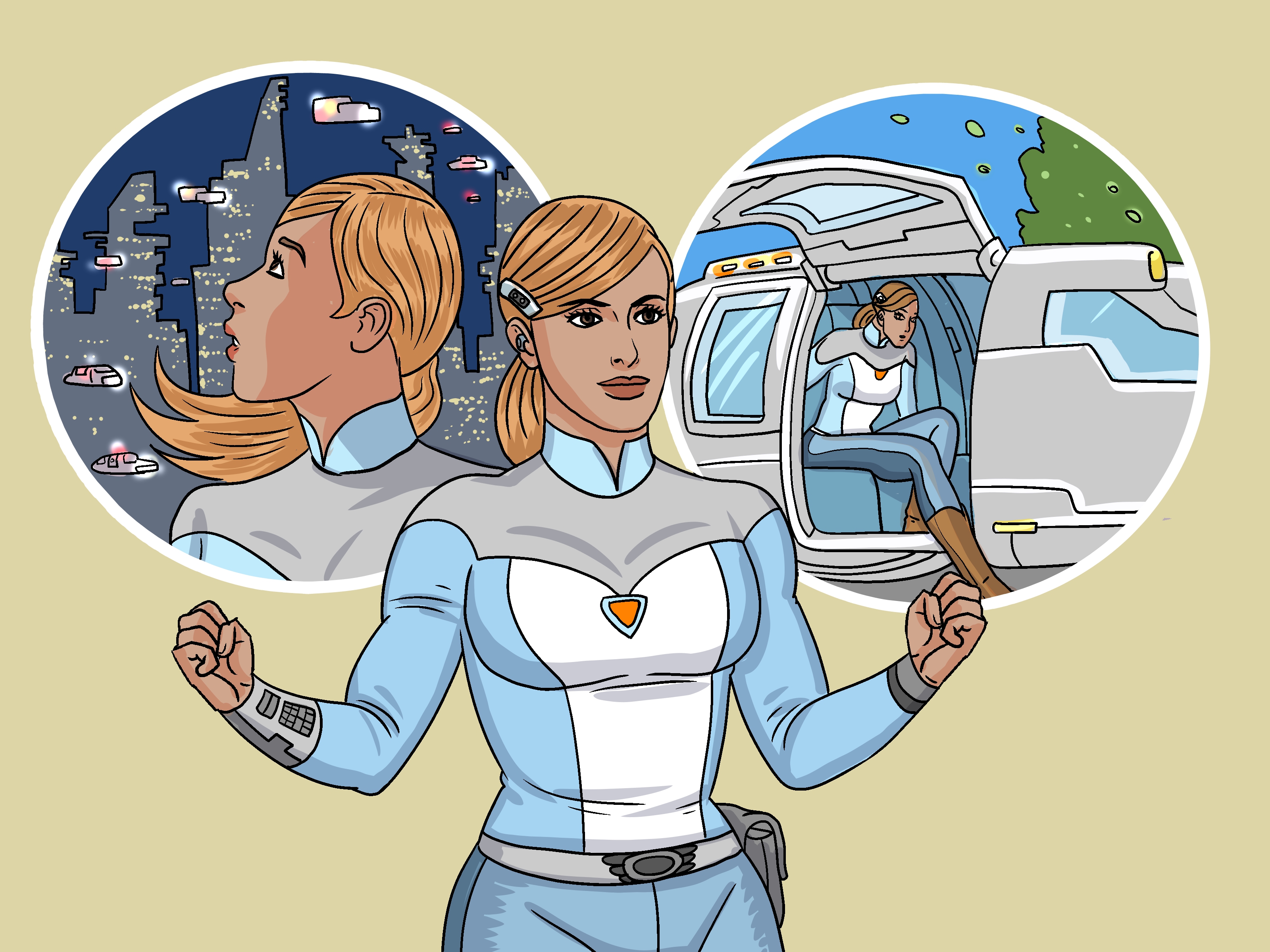
Creating a fictional universe sounds delightfully simple: invent a few kingdoms, add a moon with an alarming color, give somebody a sword, and declare Tuesday illegal. Unfortunately, readers are nosy. They want to know who grows the food, why the moon is purple, who enforces the Tuesday ban, and whether the sword requires a permit.
A convincing fictional universe is more than a collection of creative details. It is a connected system in which geography influences culture, history shapes politics, technology changes daily life, and every supernatural power comes with consequences. The world does not need to follow the rules of reality, but it must consistently follow its own rules. Professional writing resources similarly emphasize coherence, narrative purpose, and the intersection of setting, character, and plot.
Whether you are planning an epic fantasy series, a science-fiction novel, a superhero franchise, a role-playing campaign, or a suspiciously dramatic story about rival squirrel kingdoms, this guide will help you build a fictional universe that feels expansive without becoming an encyclopedia nobody asked to read.
1. Begin With the Story, Not the Planetary Tax Code
Before drawing twelve continents, ask a more useful question: What kind of story must this universe support?
A romantic fantasy needs social customs, relationship barriers, and emotionally meaningful locations. A space opera may require interplanetary travel, competing governments, military systems, and communication delays. A murder mystery set in a magical city needs laws, investigative methods, and clear limits on powers that could otherwise solve the crime before lunch.
Write a one-sentence universe premise:
In a civilization where memories can be bought and sold, a government archivist discovers that her childhood has been edited.
That sentence immediately suggests technology, economics, ethics, crime, class divisions, family conflict, and identity. It gives the world a reason to exist beyond looking impressive in a leather-bound notebook.
Keep returning to three questions:
- What does the protagonist want?
- What feature of the universe makes that desire difficult?
- What will the reader experience here that could not happen in an ordinary setting?
Worldbuilding is strongest when it creates pressure on characters rather than merely decorating the background. Story-first approaches also reduce the risk of spending six months designing currency for a country that appears in one sentence.
2. Choose the Scale of Your Fictional Universe
“Universe” does not always mean several galaxies and a family tree for every alien emperor. Your fictional universe might contain one apartment building, one haunted town, one planet, or thousands of star systems.
Start small when the story is intimate
A confined setting can feel enormous when it contains layered relationships, secrets, institutions, and history. A floating city may be all you need if every district has a distinct function and every citizen depends on the same failing engines.
Expand only when the plot demands it
Add neighboring nations when diplomacy matters. Create another planet when interplanetary differences affect the conflict. Develop ancient civilizations when their ruins, beliefs, or mistakes influence the present.
A practical method is to build in rings:
- The immediate ring: locations the protagonist visits.
- The influential ring: places that affect politics, trade, religion, or war.
- The distant ring: partially understood regions that create mystery and expansion opportunities.
This approach provides depth without requiring you to name every village on the western continent, including the village whose only economic activity is apparently standing near a decorative lake.
3. Establish the Core Laws of the World
Every fictional universe operates according to foundational rules. These may involve physics, magic, biology, technology, religion, or social organization.
Define what is possible
Can people travel faster than light? Can the dead return? Can machines become conscious? Can dragons speak, vote, and file noise complaints?
Define what is impossible
Limitations are usually more interesting than abilities. Perhaps resurrection works only within one hour of death. Perhaps teleportation cannot cross running water. Perhaps artificial intelligence is powerful but legally forbidden from owning its own hardware.
Define the cost
Power without cost drains tension from a story. Magic might consume memories. Space travel might require rare fuel. Immortality might stop physical aging while allowing psychological exhaustion. A useful cost can be physical, emotional, financial, political, environmental, or moral.
Create a short rules document containing:
- The origin of the system
- Who can access it
- Its limitations
- Its price
- How society has adapted to it
- What happens when someone breaks the rules
Consistency does not mean explaining everything. Mystery is healthy. Contradiction caused by authorial forgetfulness is less charming.
4. Build Geography That Creates Consequences
A map should do more than prevent characters from walking east in Chapter 3 and arriving from the northwest in Chapter 14.
Mountains influence borders, climate, defense, and cultural isolation. Rivers support transportation, agriculture, settlement, and trade. Deserts shape travel routes and resource conflicts. Islands may encourage maritime technology or political independence.
For Earth-like geography, water generally moves downhill through connected drainage systems, with smaller streams combining into larger rivers. Thinking in terms of elevation and watersheds can make invented maps feel more plausible.
Ask practical questions while mapping:
- Where does fresh water come from?
- Where can food be grown?
- Which resources are scarce?
- Where would cities naturally develop?
- Which routes connect major markets?
- What natural barriers separate communities?
- Which regions experience floods, droughts, storms, or volcanic activity?
For science-fiction worlds, consider the star, orbit, rotation, atmosphere, surface, and internal composition of the planet. NASA’s habitability resources describe planetary conditions as an interacting system rather than a simple matter of being the correct distance from a star.
You may deliberately break scientific expectations, but know what you are breaking. “A wizard adjusted the axial tilt” is a perfectly respectable explanation, provided the wizard’s decision has consequences and does not resemble an emergency repair made five minutes before publication.
5. Give the Universe a Layered History
History should leave fingerprints on the present. Old wars create disputed borders. Collapsed empires leave roads, ruins, borrowed vocabulary, and inconvenient statues. Religious reforms divide families. Past disasters influence architecture, law, and collective fear.
Create a timeline containing only events that continue to matter:
- An origin story or distant founding event
- A major migration, discovery, or expansion
- A political or religious transformation
- A war, revolution, epidemic, or environmental disaster
- A recent event that destabilizes the current order
Then create competing versions of those events. Governments simplify history. Families preserve private stories. Victors celebrate dates that defeated communities mourn. One culture’s legendary unifier may be another culture’s heavily armored home invader.
You do not need to answer every possible historical question before writing. Comprehensive worldbuilding questionnaires are most useful as prompts, not as entrance exams that must be completed before Chapter 1.
6. Create Cultures, Not Costume Collections
A culture is not a hat, one unusual food, and a national personality. Real communities contain regional differences, social classes, generations, professions, subcultures, reformers, traditionalists, and people who ignore all expectations because they are busy being difficult.
Build cultures from connected elements:
- Values and taboos
- Family and household structures
- Food, clothing, music, and art
- Religious or philosophical beliefs
- Education and childhood customs
- Attitudes toward age, gender, work, death, and authority
- Celebrations, mourning rituals, and public etiquette
- Internal disagreements
Consider how environment and history produced these practices. A community living beneath constant meteor showers may value underground architecture, precise calendars, communal shelters, and stories about the sky’s dangerous moods.
Avoid treating real cultures as shelves of exotic accessories. Research the history and meaning behind any inspiration, combine influences thoughtfully, and create meaningful variation within each fictional society. Responsible worldbuilding guidance emphasizes cultural complexity, memory, and the need to look beyond a creator’s default assumptions.
7. Design Governments, Economies, and Institutions
Someone produces food, controls transportation, settles disputes, teaches children, manages waste, and collects money. Even a kingdom ruled by an immortal phoenix needs administrative staff. Eternal flame maintenance does not schedule itself.
Ask who controls:
- Land and natural resources
- Military force
- Information and education
- Religious authority
- Trade and transportation
- Medicine and technology
- Citizenship and legal status
Then identify who benefits and who pays the price. A teleportation network may enrich central cities while destroying roadside towns. Cheap magical healing may weaken traditional healers but create dependency on a rare mineral. A universal translator may improve diplomacy while threatening local languages.
Political and economic systems become believable when they answer ordinary questions: How do people earn a living? How does food reach cities? What prevents rebellion? What happens during shortages? Economic forces can also generate plot by creating inequality, competition, migration, and institutional instability.
8. Develop Languages and Naming Patterns Carefully
You do not need to invent a complete language unless that is the part you enjoy. You do need names that seem to belong to related communities.
Create a simple naming guide:
- Common sounds and letter combinations
- Typical name length
- Family-name conventions
- Honorifics and titles
- Patterns for cities, rivers, ships, and organizations
- Words borrowed from neighboring cultures
Language can reveal geography, history, hierarchy, and worldview. Place names may preserve the vocabulary of earlier inhabitants, while official terms may reflect conquest or political reform. Language also evolves alongside the environment and culture of its speakers.
Keep names readable enough that audiences can distinguish them. Introducing Aelthar, Aelthir, Aelthor, and Aelthur in the same chapter is less like immersive linguistics and more like testing whether the reader has recently updated their prescription.
9. Build the World Through Character Experience
Readers rarely need an impartial lecture about a fictional universe. They need to experience it through someone who wants, fears, misunderstands, resents, or depends upon it.
A palace means something different to a monarch, a servant, a prisoner, and a revolutionary carrying an unnecessarily visible bag of explosives. The physical setting may be identical, but the emotional world changes with the viewpoint.
Reveal information through:
- Choices characters make under pressure
- Objects they use without explanation
- Rules they obey or quietly break
- Arguments about history or morality
- Contrasts between social groups
- Consequences when assumptions prove wrong
Strong characters make an invented world feel inhabited. Creative-writing guidance similarly recommends knowing more about characters than appears directly on the page and establishing unusual realities early enough for readers to understand what is normal within the story.
10. Avoid the Dreaded Information Dump
Worldbuilding is not automatically storytelling. A six-page explanation of the royal irrigation ministry may be fascinating to its fictional employees, but the reader would prefer a conflict.
Introduce information when it becomes relevant. Instead of explaining that magic is illegal, show a child hiding a glowing hand when a patrol approaches. Instead of listing funeral customs, let a character offend a grieving family by performing the wrong ritual.
Use the iceberg principle: develop enough beneath the surface to support the story, but show only what creates atmosphere, understanding, choice, or conflict.
Before including a detail, ask:
- Does it affect the scene?
- Does it reveal character?
- Does it create conflict or anticipation?
- Will the reader need it soon?
If the answer is no, save it in your world bible. It may become useful later, unlike the ceremonial spoon hierarchy you designed at 2:00 a.m.
11. Maintain a Searchable World Bible
A world bible is a reference document containing established facts about the fictional universe. It prevents continuity errors and becomes essential when writing a series.
Useful categories include:
- Characters and relationships
- Locations and travel times
- Historical timeline
- Magic or technology rules
- Governments and organizations
- Cultures and religions
- Terminology and pronunciation
- Unanswered questions
Record facts only after they become reasonably stable. Label uncertain ideas as possibilities rather than canon. Otherwise, an abandoned brainstorm about telepathic goats may quietly become official history and surprise you three books later.
12. Stress-Test the Fictional Universe
Once the basic system exists, try to break it.
Ask what happens when:
- A vital resource disappears
- A ruler dies unexpectedly
- A new technology becomes affordable
- A magical rule is exploited
- A suppressed group organizes
- A natural disaster interrupts trade
- Evidence challenges the dominant religion
- An outsider refuses to follow local customs
Follow the consequences through several layers. A drought does not merely create thirst. It raises food prices, increases migration, changes military strategy, encourages crime, challenges leaders, and may produce new religious movements.
This chain-reaction method transforms background information into plot. A fictional universe feels alive when one change causes several believable responses.
Practical Worldbuilding Experiences and Lessons
The following experiences are recurring patterns encountered during long-form fictional universe development. They show why a flexible process usually works better than attempting to complete an entire civilization before writing the first scene.
Experience 1: The beautiful map that produced no story
A common early project begins with an impressive map. The creator draws mountain ranges, sixteen provinces, ocean currents, and a small island whose main purpose appears to be looking mysterious. Weeks pass. The map improves, but no protagonist emerges.
The breakthrough often comes from asking what is changing. Perhaps the northern river has shifted, cutting a capital off from grain shipments. Suddenly, the map creates political pressure. Merchants seek another route, border towns grow wealthy, the crown raises taxes, and smugglers become local celebrities. Geography stops being decoration and becomes narrative machinery.
The lesson is simple: after creating any major worldbuilding element, identify at least one person who benefits from it and one person who suffers because of it.
Experience 2: The flawless magic system that ruined suspense
Another familiar experience involves designing powers before designing limits. Telepaths can read anyone. Healers can cure anything. Sorcerers can teleport anywhere. The first draft then develops an awkward question: why does any problem last longer than eleven seconds?
The solution is rarely to remove the power entirely. It is to attach meaningful restrictions. Telepathy may require emotional intimacy. Healing may transfer injuries to the practitioner. Teleportation may work only between prepared gates controlled by powerful institutions.
Once limitations appear, society changes around them. Privacy rituals develop. Healers become protected or exploited. Gate ownership determines trade and military power. A corrected rule can therefore improve the setting, plot, and character conflicts simultaneously.
Experience 3: Daily life made the universe believable
Writers often concentrate on wars, rulers, and ancient prophecies while overlooking breakfast. Yet ordinary routines can make an invented place feel real faster than another paragraph about royal ancestry.
Imagine a city built inside a migrating creature. Residents cannot use permanent addresses because neighborhoods move as the animal grows. Schools teach children how to recognize dangerous internal tremors. Religious ceremonies occur near the heartbeat. Street vendors sell food that must be cooked without open flames.
None of these details requires a historical lecture. They emerge naturally while characters travel, work, eat, argue, and solve problems. A helpful exercise is to follow one ordinary resident from waking until bedtime. Note how the universe affects clothing, hygiene, transportation, employment, meals, entertainment, relationships, and sleep.
Experience 4: Contradictions became opportunities
Continuity mistakes are inevitable in large projects. Perhaps an early chapter says magic cannot affect iron, while a later battle contains an enchanted iron gate. The immediate temptation is to panic, delete half the manuscript, and become a beekeeper.
Sometimes the contradiction can become a mystery. The gate may use a newly discovered alloy. The official rule may be false. A powerful institution may have hidden an exception. What began as an error can create intrigue, provided the revised explanation is established clearly and does not multiply contradictions elsewhere.
The practical lesson is to review inconsistencies before automatically removing them. Some are genuine mistakes. Others reveal unexplored possibilities within the fictional universe.
Experience 5: Writing early exposed what needed development
No planning method reveals every missing detail. Drafting scenes exposes practical questions that outlines overlook. How long does travel take? What do characters use as identification? Can a person refuse military service? What happens when magical machinery breaks during a rainstorm?
Rather than delaying the manuscript until the universe feels complete, alternate between creation and storytelling. Build enough to draft a scene, write the scene, record the new questions, and expand only the systems that matter.
This loop keeps worldbuilding connected to human stakes. It also provides permission to leave distant regions uncertain. People in real societies do not possess perfect information about their own world, so fictional characters should not sound like they swallowed the official encyclopedia.
Conclusion
Learning how to create a fictional universe is not about inventing the greatest possible number of facts. It is about building relationships between facts. Geography affects resources. Resources shape economies. Economies influence power. Power creates conflict. Conflict forces characters to make revealing choices.
Start with the story’s central promise, establish consistent rules, create cultures with internal variety, and reveal the world through character experience. Keep a world bible, test your systems under pressure, and allow the universe to grow alongside the manuscript.
The best fictional worlds feel larger than the pages containing them. Readers sense unexplored streets, disputed histories, private rituals, and distant places continuing beyond the visible story. You do not need to describe every corner. You need to make readers believe those corners existand possibly contain someone arguing about taxes.