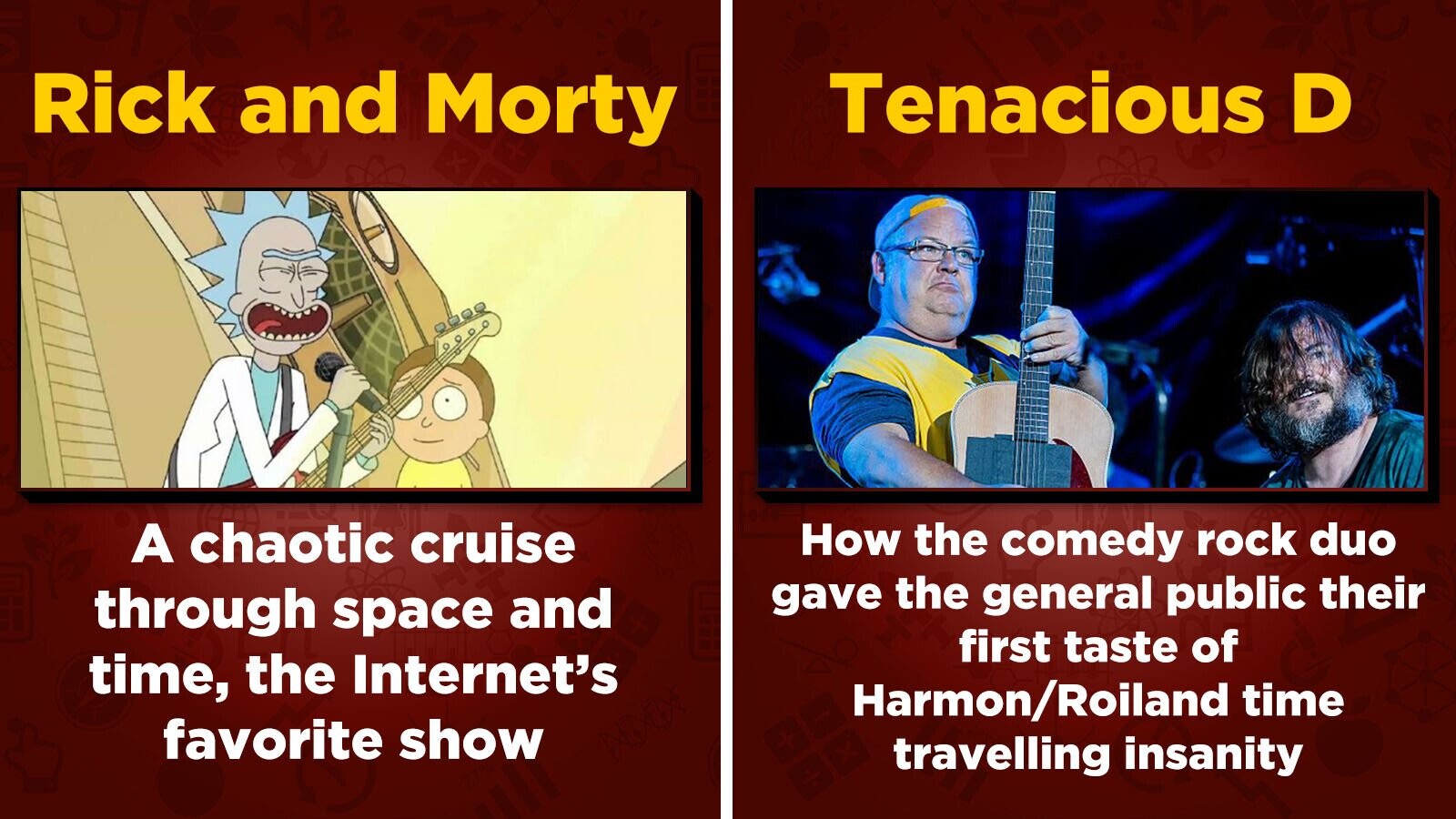
Some pop-culture origin stories arrive with a thunderclap. Others sneak in wearing a cape made of bargain-bin leather, holding a guitar pick, and shouting about destiny. Tenacious D: Time Fixers, the strange little iTunes-era short film starring Jack Black and Kyle Gass, belongs proudly in the second category. It was not a blockbuster. It was not a prestige pilot. It was not even a normal promotional video. It was a miniature time-travel comedy made to help sell The Pick of Destiny, and somehow it now sits on the weird family tree that leads toward Rick and Morty.
That does not mean Rick Sanchez crawled directly out of a Tenacious D van with nacho dust on his lab coat. The connection is more interesting than that. Time Fixers brought together people from the Channel 101 comedy world, including Dan Harmon and Justin Roiland, before their names became permanently linked to one of the most influential adult animated series of the 2010s. The short is a chaotic snapshot of a creative scene where absurd premises, low-budget fearlessness, and high-concept stupidity were treated like sacred art. In other words, it is exactly the kind of cultural fossil that deserves to be dusted off and admired.
What Was Tenacious D: Time Fixers?
Tenacious D: Time Fixers was a 2006 short film tied to the promotional campaign for Tenacious D’s album and movie The Pick of Destiny. At the time, iTunes was not just a music store; it was also a shiny digital mall where labels experimented with bonus videos, exclusive downloads, and preorder bait. This short was part of that strange, optimistic moment when the internet felt like a vending machine for comedy experiments.
The concept is delightfully ridiculous. Jack Black and Kyle Gass, playing their mythic Tenacious D personas, get pulled into a time-travel mission involving Abraham Lincoln, a villainous Time Goblin, and a message from Michael Keaton playing himself. Dan Harmon appears as a heckler, Justin Roiland plays Lincoln, and the whole thing feels like somebody fed a history textbook to a garage band and dared it to improvise a movie.
The short also reflects Tenacious D’s brand perfectly: classic-rock worship filtered through sketch comedy, fantasy quests, and the belief that acoustic guitars can solve problems usually handled by historians, law enforcement, or NASA. It was made to promote a movie about a magical guitar pick, so subtlety was never going to be invited to the party. Subtlety showed up anyway, saw the Time Goblin, and left quietly.
The Pick of Destiny Era: When Rock Comedy Went Mythological
To understand why Time Fixers exists, you need to understand the grandly silly universe around Tenacious D in The Pick of Destiny. The 2006 feature film imagined the origin of Tenacious D as a fantasy adventure: two musicians chasing the legendary pick that could make them the greatest band in the world. It had Jack Black, Kyle Gass, rock gods, Satanic mythology, and the confidence of a band that knew the joke was dumb but also knew the songs were genuinely good.
The film did not become a box-office monster. It opened during a crowded holiday season and earned far less than its reported budget. Yet commercial disappointment did not kill its cult appeal. For fans, The Pick of Destiny became a kind of sacred goofball text: a movie that treated power chords as prophecy and friendship as something best expressed through synchronized yelling.
Time Fixers belongs to that same promotional ecosystem. It is not just a trailer, not just a music video, and not quite a stand-alone episode. It is a marketing object wearing the fake mustache of a short film. That hybrid form matters because it gave comedy people room to play. The short could be weirder than a TV commercial and looser than a theatrical feature. It could exist because iTunes needed bonus content, Tenacious D needed attention, and Channel 101 people were excellent at making nonsense move fast.
Channel 101: The Comedy Laboratory Behind the Madness
The real secret ingredient is Channel 101, the Los Angeles short-film festival co-founded by Dan Harmon and Rob Schrab. Channel 101 functioned like an underground TV network where creators made short “pilots,” audiences voted, and the winners returned with new installments. It rewarded speed, originality, and the ability to make a room laugh before anyone had time to ask whether the premise was legally, morally, or structurally sane.
That environment shaped a generation of alternative comedy creators. It was part film school, part wrestling league, part public execution chamber for half-baked ideas. The audience had power. A show could survive if people loved it, or vanish if the room did not respond. For writers and performers, that feedback loop was brutal but useful. There was no hiding behind a development process. You either made the crowd laugh or you carried your failed pilot home like a wounded raccoon.
Dan Harmon’s later work often carries the DNA of that system. Community loved genre parodies and emotional structure. Rick and Morty loved sci-fi chaos and existential panic. Channel 101 taught creators to combine high-concept premises with immediate jokes, then push the premise until it either exploded or became brilliant. Sometimes both happened in the same minute.
Dan Harmon, Justin Roiland, and the Pre-Rick-and-Morty Connection
The reason Time Fixers is more than a Tenacious D curiosity is that it appears to be one of the earliest publicly released projects connecting Dan Harmon and Justin Roiland. Harmon wrote the short and appears in it. Roiland plays Abraham Lincoln. Years later, the two would co-create Rick and Morty, but before that they were part of the Channel 101 orbit, where Roiland had been making strange animated and live-action shorts.
The important word here is “connection,” not “blueprint.” Time Fixers did not contain Rick, Morty, portals, interdimensional cable, or a family named Smith. What it did contain was a shared comedic atmosphere: reckless pacing, absurd historical logic, cartoonish violence, and the willingness to treat a stupid idea with total commitment. That spirit would become familiar to anyone who later watched Rick turn himself into a pickle or drag Morty into a cosmic disaster because of one selfish decision.
Roiland’s own path to Rick and Morty ran through his crude Channel 101 short The Real Animated Adventures of Doc and Mharti, a warped parody of the Doc Brown and Marty McFly dynamic from Back to the Future. Harmon’s strength was structure, story engines, and turning chaos into something emotionally legible. When those instincts eventually collided at Adult Swim, Rick and Morty found its form: half sci-fi adventure, half family sitcom, half nervous breakdown. Yes, that is three halves. The show would approve.
Why the Short Feels Like a Rick and Morty Ancestor
Watch Time Fixers today and you can feel several future-friendly ingredients bubbling under the surface. First, there is time travel handled with the confidence of someone who has not read the safety manual. The mission is historically important, but the heroes approach it with the emotional maturity of two men choosing a gas-station burrito. That gap between cosmic stakes and foolish behavior is also a core pleasure of Rick and Morty.
Second, the short treats history as a toy box. Abraham Lincoln is not presented as a solemn statue. He is a character in a comedy machine, played by Roiland with the kind of manic oddness that would later become part of his voice-performance reputation. The joke is not simply “Lincoln is here.” The joke is that the logic of the scenario keeps folding in on itself until the characters are forced to accept an insane moral equation.
Third, there is the Channel 101 rhythm: introduce the premise quickly, escalate before the audience gets comfortable, and never apologize for the left turn. That rhythm is essential to internet comedy and adult animation. It respects the audience’s ability to keep up. It also assumes that boredom is the only true villain. The Time Goblin is bad, sure, but dead air is worse.
Michael Keaton, Abe Lincoln, and the Joy of Overqualified Cameos
One of the funniest things about Time Fixers is how casually it deploys recognizable talent. Michael Keaton shows up as himself, which immediately gives the short a strange authority. If Michael Keaton tells you time is broken, you listen. The man has been Batman, Beetlejuice, and enough intense professionals to make any nonsense sound urgent.
Tenacious D has always understood the power of overqualified cameos. Their world works because everyone behaves as if the mythology is real. When famous actors, comedians, and musicians enter that world without winking too hard, the ridiculousness becomes stronger. The joke is not that the production cannot afford seriousness. The joke is that it can summon seriousness and then make it wear a tiny wizard hat.
This same principle later became central to Rick and Morty. The show has featured guest voices and elaborate sci-fi concepts, but it usually grounds them in emotional or comedic commitment. The stranger the premise, the more important it is for someone inside the scene to act like the stakes matter. Time Fixers uses that trick in miniature.
iTunes Exclusives and the Weird Middle Age of Online Video
Another reason this short feels fascinating now is its platform history. In 2006, YouTube was young, streaming was not yet the default entertainment pipeline, and iTunes had real cultural weight as a place to buy music and video. A promotional short could be locked behind a preorder or split into free and paid pieces without seeming completely bizarre. It was the digital frontier, and everyone was wearing experimental pants.
That context matters for SEO-minded pop-culture history because Time Fixers represents a transitional form. It was not made for TikTok, not made for Netflix, and not made for Adult Swim proper. It was made for a digital storefront trying to make buying an album feel like entering a secret club. Today, that kind of exclusive bonus video would probably become a YouTube upload, a social campaign, or a streaming extra. Back then, it was an iTunes curiosity.
In hindsight, this made the short feel even more like a hidden artifact. Fans who missed the original promotion might only discover it later through reposts, DVD bonus features, or comedy-history rabbit holes. That delayed discovery is part of its charm. It feels less like content and more like contraband from a parallel internet.
The Difference Between Influence and Coincidence
It is tempting to say Time Fixers “created” Rick and Morty, but that would be too neat. Pop culture rarely works like a single domino chain. A better way to describe the relationship is that Time Fixers sits at a crossroads. It gathered Tenacious D, Channel 101, Dan Harmon, Justin Roiland, and absurd sci-fi comedy into one compact project. It did not build the highway, but it marked a signpost on the route.
The real line to Rick and Morty runs through Channel 101, Roiland’s early animation, Harmon’s story instincts, Adult Swim’s appetite for strange adult cartoons, and the broader rise of internet-trained comedy. Time Fixers matters because it shows some of those forces sharing the same room before the world knew what they would become.
That is why the short remains fun to discuss. It is not merely “look, famous people before they were more famous.” It is “look, here is a creative ecosystem in action.” Comedy scenes produce future hits through repetition, collaboration, failure, and side quests. Sometimes the side quest involves saving Abraham Lincoln by convincing him that his destiny is numismatic immortality. Art is mysterious.
What Makes the Short Still Worth Watching?
The best reason to watch Tenacious D: Time Fixers is not homework. It is funny in the loose, scrappy way that many mid-2000s comedy shorts were funny. It has the texture of friends making each other laugh, but with just enough production value to feel official. That balance gives it a strange energy: polished enough to include Michael Keaton, unhinged enough to feel like it was pitched in a parking lot.
For Tenacious D fans, it is another piece of the band’s mythology. For Rick and Morty fans, it is a prehistory object. For comedy nerds, it is a reminder that influential careers often grow out of odd collaborations that did not seem important at the time. And for everyone else, it is a short film where Jack Black and Kyle Gass travel through time for reasons that become less reasonable the more you think about them.
Experiences Related to The Bonkers Tenacious D iTunes Short Film That Led To Rick & Morty
Revisiting a project like Time Fixers is a very specific kind of viewing experience. It is not like watching a cleanly restored classic film or a carefully packaged anniversary special. It feels more like opening a drawer in an old desk and finding a concert ticket, a scratched DVD, and a note that says, “Remember when digital media was weird?” The short carries the mood of the mid-2000s internet, when comedy fans passed around links like secret handshakes and a strange video could become part of your personality for a week.
One of the best experiences connected to this topic is the pleasure of spotting creative fingerprints. If you know Tenacious D, you recognize the mock-epic tone immediately. Jack Black performs every small problem as if it might determine the fate of rock itself. Kyle Gass brings the grounded, dry counterweight, which somehow makes the madness louder. If you know Dan Harmon’s later work, you can sense his affection for genre machinery: time travel, mission logic, ironic destiny, and characters trapped inside a story shape bigger than their intelligence level. If you know Justin Roiland’s later voice work, his Lincoln performance becomes an amusing little time capsule.
Another experience is realizing how much comedy depends on communities. Time Fixers is not just a random promotional short; it feels like a product of people who knew each other, trusted each other’s weirdness, and were willing to look ridiculous together. That is harder to manufacture than expensive visual effects. A giant studio can buy a spaceship. It cannot always buy the feeling that everyone involved is trying to make the funniest possible version of a dumb idea before the pizza gets cold.
There is also a nostalgic media experience here. People who grew up around iTunes, DVD bonus discs, and early YouTube remember a time when entertainment felt scattered across formats. You might find one clip in a music store, another on a message board, another hidden on a second disc, and another through a friend who knew the exact search term. Discovery required mild detective work. That inconvenience made certain finds feel personal. Today, when platforms serve everything in endless rows, the scavenger-hunt feeling is rarer.
Finally, Time Fixers offers the satisfying experience of seeing how small creative choices echo forward. Nobody watching a Tenacious D iTunes promo in 2006 needed to predict Rick and Morty. That would have been absurd, and not even the helpful kind of absurd. But looking back, the short shows how comedy history often forms: not through one grand announcement, but through overlapping circles of performers, writers, musicians, and oddballs making each other laugh until something bigger emerges.
Conclusion: A Tiny Time Machine With a Huge Comedy Shadow
The Bonkers Tenacious D iTunes Short Film That Led To Rick & Morty is more than a catchy headline. It describes a real and wonderfully strange connection in modern comedy history. Tenacious D: Time Fixers was a promotional short, a Channel 101-flavored experiment, a Tenacious D side quest, and an early public overlap between Dan Harmon and Justin Roiland. It did not single-handedly create Rick and Morty, but it belongs in the same creative bloodstream.
Its lasting value comes from its glorious lack of caution. The short throws together time travel, rock mythology, historical comedy, celebrity cameo energy, and sketch-film pacing without pausing to ask whether any of this is normal. That fearlessness is exactly why it remains interesting. Great comedy often starts as a bad idea protected by talented people who refuse to blink first.
So yes, the short is bonkers. It is also a reminder that pop-culture landmarks sometimes begin as bonus content, preorder incentives, festival experiments, or jokes made by people who have no idea they are quietly building the future. Somewhere between Tenacious D’s acoustic heroism and Abraham Lincoln’s extremely inconvenient theater plans, you can hear the distant burp of adult animation history warming up.
Note: This article was written in original language and synthesized from verified entertainment-history sources without inserting source links into the publishable HTML, as requested.